

The surgery board is full, two patients are still in recovery, and the front desk has a stack of discharge calls nobody has returned. Your credentialed technician can place the catheter, run the blood count, and stay with the anesthetized dog. That same person is also the one owners ask for medication advice the moment they reach the phone. Vet tech responsibilities cover both jobs, and mixing them is how clinics lose the people they can least afford to replace.
Technicians and technologists in the United States carry a broad clinical load under a veterinarian's supervision. They aren't kennel staff with a different badge, and they aren't veterinarians. They execute trained nursing, laboratory, radiography, anesthesia, and client-education work. Diagnosis, prescribing, and surgery stay with the veterinarian unless a jurisdiction explicitly allows a narrow exception.
What follows is a duty map you can use on Monday: where the technician acts, where the veterinarian decides, which credentials to verify before you assign a task, and which coordination work can move to trained support staff without shifting clinical judgment.
Vet Tech Responsibilities Across the Clinic
A busy clinic can have patients waiting for diagnostics while phones ring and records need updating. A technician's clinical work supports the patient's care; coordination work supports the clinic's flow. Assigning both without clear boundaries can leave clinical tasks competing with calls and paperwork.
The U.S. Bureau of Labor Statistics lists duties that include collecting histories, observing condition and behavior, providing nursing care and emergency first aid, restraining patients, administering prescribed medications and vaccines, preparing patients and instruments for surgery, monitoring anesthesia, taking radiographs, and performing laboratory tests. These duties span several functions, from nursing and diagnostics to client education. A clinic can delegate tasks within those functions, but the veterinarian retains responsibility for diagnosis and treatment decisions.
Start with the supervision line, then assign the task. Technicians perform procedures and gather clinical information under the applicable direction and protocols. Veterinarians interpret findings and decide what care to provide.
| Duty area | Typical tasks | Supervision expectation |
|---|---|---|
| Nursing and patient care | Restraint, observation, emergency first aid, medication and vaccine administration | Under veterinarian direction and written protocols |
| Laboratory testing | Sample collection, urinalysis, blood counts, in-house analyzer work | Technician performs testing; veterinarian interprets results |
| Radiography | Patient positioning, exposure, repeat images, image handling | Performed under direction; veterinarian makes the diagnostic read |
| Anesthesia monitoring | Drug calculation, endotracheal intubation, operating monitors, anesthesia records | Continuous monitoring with veterinarian oversight |
| Surgical support | Patient and instrument preparation, sterile field, assisting the surgeon, recovery monitoring | Under surgeon direction |
| Client education | Home medication instructions, recovery and pet care teaching | Within approved discharge protocols; treatment decisions stay with the veterinarian |
| Records and coordination | Histories, treatment sheets, inventory, scheduling support | Varies by clinic policy and state rules |
Coordination work can move to trained support staff when the task does not require clinical judgment. For example, staff can schedule follow-ups or route calls using written instructions, while questions about symptoms, medication changes, or treatment decisions go to a veterinarian or qualified technician. That division frees clinical staff for patient care without turning administrative delegation into clinical decision-making.
Use the matrix as a working guide, not a legal ruling. State practice acts and clinic protocols set the actual limits, including which tasks require direct supervision. Review those boundaries before assigning duties, especially when a task involves interpreting results or advising a client.
Credentials and Titles That Define the Role
Two employees may both be called veterinary technicians, yet have different legal credentials and permitted duties. A résumé title alone does not establish what someone may do. The Purdue veterinary technician guide describes the education pathway: accredited veterinary technology programs prepare students for the profession, with associate and bachelor's programs typically taking two and four years, respectively.
Graduates commonly take the Veterinary Technician National Examination. Credential names and requirements vary by state. A state may use certified, registered, or licensed, and its veterinary board sets the rules for scope of practice and continuing education. Some states also restrict who may use the title. Verify the applicable state requirements rather than relying on a general description of VTNE rules.
What to check before the first shift
- Board verification: Confirm the employee's credential with the state veterinary board.
- Source documents: Review program completion records and VTNE results where applicable.
- Assistants: Check state rules and clinic protocols before assigning tasks to unlicensed assistants. Their permitted duties may be narrower than a credentialed technician's.
- Location: Confirm the rules that apply where the employee works and where the patient receives care, especially for remote or traveling staff.
Build the duty matrix around verified credentials, state rules, and written clinic protocols. Coordination work, such as phone handling and paperwork, can often be assigned separately, while clinical judgment remains with the veterinarian. A clinical assistant role is not interchangeable with a credentialed veterinary technician role, so define each position's boundaries before delegating.
Hands-On Nursing and Patient Care Duties
A useful way to see nursing work is to follow one ward morning, in the order the technician meets it.
Intake starts with what the owner reports, then weight, temperature, heart rate, and respiratory rate, plus a first look at pain. On rounds, the technician checks appetite, hydration, behavior, and breathing effort, and charts what changed since the last pass. Restraint is a clinical choice, not a default hold. A calm towel wrap may be enough. A muzzle may be safer. If the patient is escalating, the technician asks the veterinarian about sedation instead of forcing the hold.

Catheters, medications, and first aid
Inpatients often need a catheter and a fluid line placed and labeled so the next person can see the rate and the time. Medications go out against a written order, with a second check on drug, dose, route, and patient. Vaccines are prepared from the protocol, not from memory of “what we usually give.” Wound and bandage care, plus emergency first aid, sit in the same block: do the trained step, record it, and call when the patient doesn't match the expected course.
Ward rule: A change you can measure is a call, not a note for the next scheduled round.
A hospitalized cat whose respiratory rate has climbed across two checks is the test. The technician records the new rate, repeats the count, and calls the veterinarian. Waiting for the noon treatment sheet is how a quiet change becomes a crisis.
Where the morning changes
Exotic and large-animal patients change restraint, catheter sites, and how many people you need in the room. Who may place catheters or give injections still depends on state rules and your written policy. Build escalation triggers for each ward: which respiratory rates, temperatures, mentation changes, or bandage strikes require an immediate call, and who receives that call when the primary veterinarian is in surgery.
Diagnostics, Laboratory and Radiography Work
A technician's diagnostic value is reliable information, not a diagnosis. The handoff is the whole point. The technician collects, labels, runs, and flags. The veterinarian interprets and decides.
Samples and in-house testing
Blood, urine, fecal, and cytology samples fail without warning when the tube, the label, the timing, or the handling is wrong. In-house work such as urinalysis, blood counts, and chemistry only helps if someone owns daily quality checks and calibration logs. A result without that trail is a guess with a number on it.
Radiography follows the same split. The technician positions the patient, sets the exposure, repeats a view that can't be read, and handles image files so they stay with the right record. The veterinarian makes the diagnostic read.
AVMA policy on veterinary technology draws a hard boundary. Technicians provide nursing, diagnostic, anesthetic, and laboratory services under a veterinarian's direction and responsibility. They generally may not independently diagnose disease, prescribe treatment, or perform surgery unless a jurisdiction explicitly permits a limited exception. Specimen collection, laboratory testing, medication administration, imaging, dental prophylaxis, and perioperative nursing can be delegated. Interpretation cannot.
A blood smear makes the line obvious. If the technician sees clumping, the finding and the slide go to the veterinarian. Naming a cause in the chart is a diagnosis, and that isn't the technician's call.
A flagging list that matches the handoff
- Call now: Values or image problems your protocol marks as unstable, plus any result that doesn't match the patient in front of you.
- Review this shift: Abnormal but stable findings the veterinarian will read before discharge.
- Send-out or dedicated lab: Large hospitals and reference workflows change who draws, who runs, and who calls. Write that split down so it doesn't depend on who is working.
Keep written task protocols, supervision requirements, escalation triggers, and a competency record for each technician. Job title alone doesn't map the practice act.
Anesthesia Monitoring and Surgical Support
During a procedure, the technician assigned to anesthesia watches the patient, tracks changes, and alerts the veterinarian before a concern becomes an emergency. The veterinarian remains responsible for clinical decisions. Delegation works when the monitor role, escalation triggers, and supervision line are clear before induction.
AVMA competency standards for veterinary technology programs describe technician competencies that include calculating anesthetic-related doses, administering drugs as directed, placing endotracheal tubes, and operating monitors such as pulse oximeters, capnometers, ECGs, and blood-pressure equipment. They also cover recognizing a compromised patient, assisting with resuscitation, and completing an anesthesia record. The technician monitors heart rate, rhythm, and perfusion, and promptly reports concerning changes. The written anesthetic protocol must set monitoring frequency and staffing requirements. Neither may fall below its written minimum.
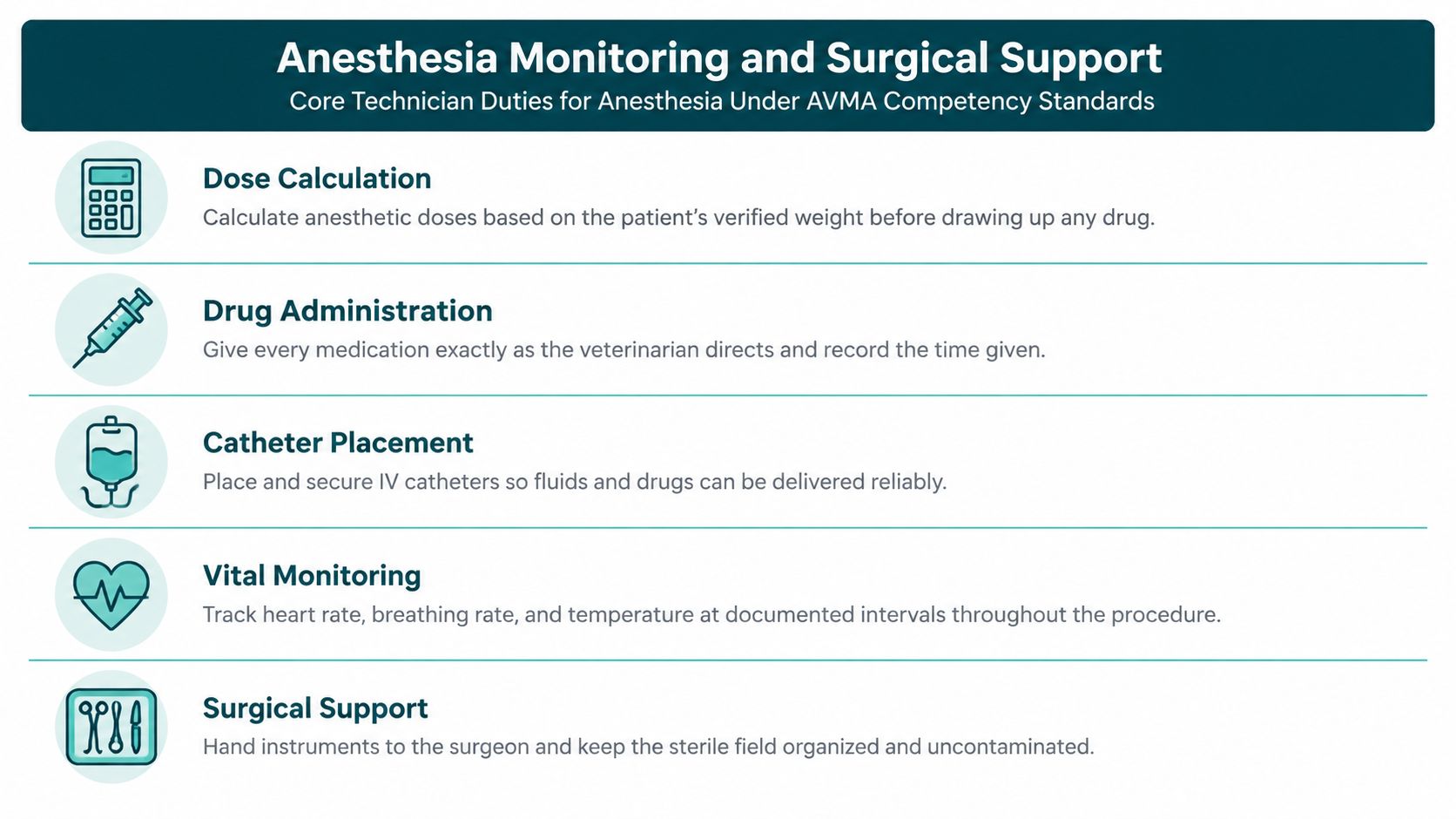
The record should capture preanesthetic status, medications and doses, vital signs, interventions, and recovery. Staff should document observations at the intervals set by the protocol and record changes or interventions as they occur. Familiarity with ECG, ETCO₂, blood pressure, SpO₂, temperature, ventilation, oxygenation, and anesthetic depth helps the assigned technician recognize deterioration and alert the veterinarian in time to respond.
| Monitor | What it tells the team | Early warning sign |
|---|---|---|
| ECG | Heart rate and rhythm | Rhythm change or heart rate drifting outside the planned range |
| Pulse oximetry (SpO₂) | Oxygen saturation | Falling readings or a poor pulse signal |
| Capnography (ETCO₂) | Ventilation and circulation | Sudden drop in end-tidal CO₂ or an abnormal waveform |
| Blood pressure | Perfusion | Falling pressure or signs of poor perfusion |
| Body temperature | Hypothermia risk | Steady downward trend during the procedure |
| Respiratory rate and effort | Ventilation adequacy | Irregular, shallow, or labored breathing |
Surgical support uses the same logic
The technician prepares the patient and sterile field, passes instruments, assists the surgeon, and monitors recovery. The surgeon directs the procedure; the technician reports changes and carries out delegated tasks within their training and clinic protocol. Sedation level alone does not justify reducing monitoring. If the protocol permits different monitoring arrangements for a specific case, it must state the minimum frequency and staffing in advance. Staff must not reduce either below that written minimum.
Assign one person to monitor each anesthetized patient. “Whoever is free” leaves responsibility unclear and makes missed checks more likely.
Before the case, use a checklist to confirm the patient's weight, dose calculations, tube size, monitor function, and named monitor. Dedicated monitoring is a defined assignment, not a task to fit around instrument handling. Phones, scheduling, and routine paperwork can go to coordination staff, but clinical observations and escalation stay with trained veterinary personnel under veterinarian supervision.
Client Communication and Education Duties
At discharge, an owner may ask whether to give another dose because a pet still seems uncomfortable. The technician can review the written schedule, ask what the owner has observed, and pass that information to the veterinarian. Changing the dose is a clinical decision, not a phone-service task.
Client education is part of patient care, but each conversation needs a clear boundary. Technicians can explain approved instructions and check the owner's understanding. The veterinarian diagnoses, prescribes, interprets results, and changes treatment plans.
| Conversation topic | Technician role | Veterinarian role |
|---|---|---|
| Home medication | Demonstrates dosing from the written schedule and checks owner understanding | Prescribes, sets the dose, and changes the plan |
| Recovery and pet care | Teaches wound care, feeding, and activity limits from discharge instructions | Sets the recovery plan and any restrictions |
| Pain management | Explains approved home pain-control steps and records owner observations | Diagnoses pain and selects analgesia |
| Diagnostic results | Explains what was collected and when results are expected | Interprets results and decides next steps |
| Estimates and treatment plans | Explains estimate components and scheduling | Approves the treatment plan |
| End-of-life support | Supports the owner, prepares the room, and explains aftercare logistics | Discusses prognosis and performs the procedure |
When the script should stop
A written script helps technicians give consistent explanations across similar cases. It should also state when to stop and transfer the conversation. Questions about changing medication, interpreting a result, or choosing treatment belong with the veterinarian. End-of-life decisions and emotionally difficult discussions may also call for the veterinarian to lead, while technicians can provide support and manage practical arrangements.
Phone coverage can pull technicians away from patient care. Practices can route appointment confirmations and message-taking to trained reception staff, including a medical office receptionist. Set a clear escalation rule: questions about dose, pain, symptoms, or results go to a credentialed clinical team member or the veterinarian. Staff who handle calls can collect the owner's concern and observations, but should not answer clinical questions beyond approved instructions.
Delegating Coordination Work Within Written Boundaries
A treatment sheet still needs accurate clinical review, but restocking, inventory, routine chart preparation, and kennel cleaning do not always require a credentialed technician. In a busy clinic, separating task ownership from clinical accountability helps technicians stay available for patient care. Controlled-substance records require particular care, and the clinic must follow applicable state rules.
The 2025 qualitative study of newly credentialed veterinary technicians examines how participants experience their work and transition into practice. It does not, by itself, establish which duties every clinic should delegate. The practical test is whether a task requires clinical judgment, what supervision it needs, and whether the assigned person has documented competence.
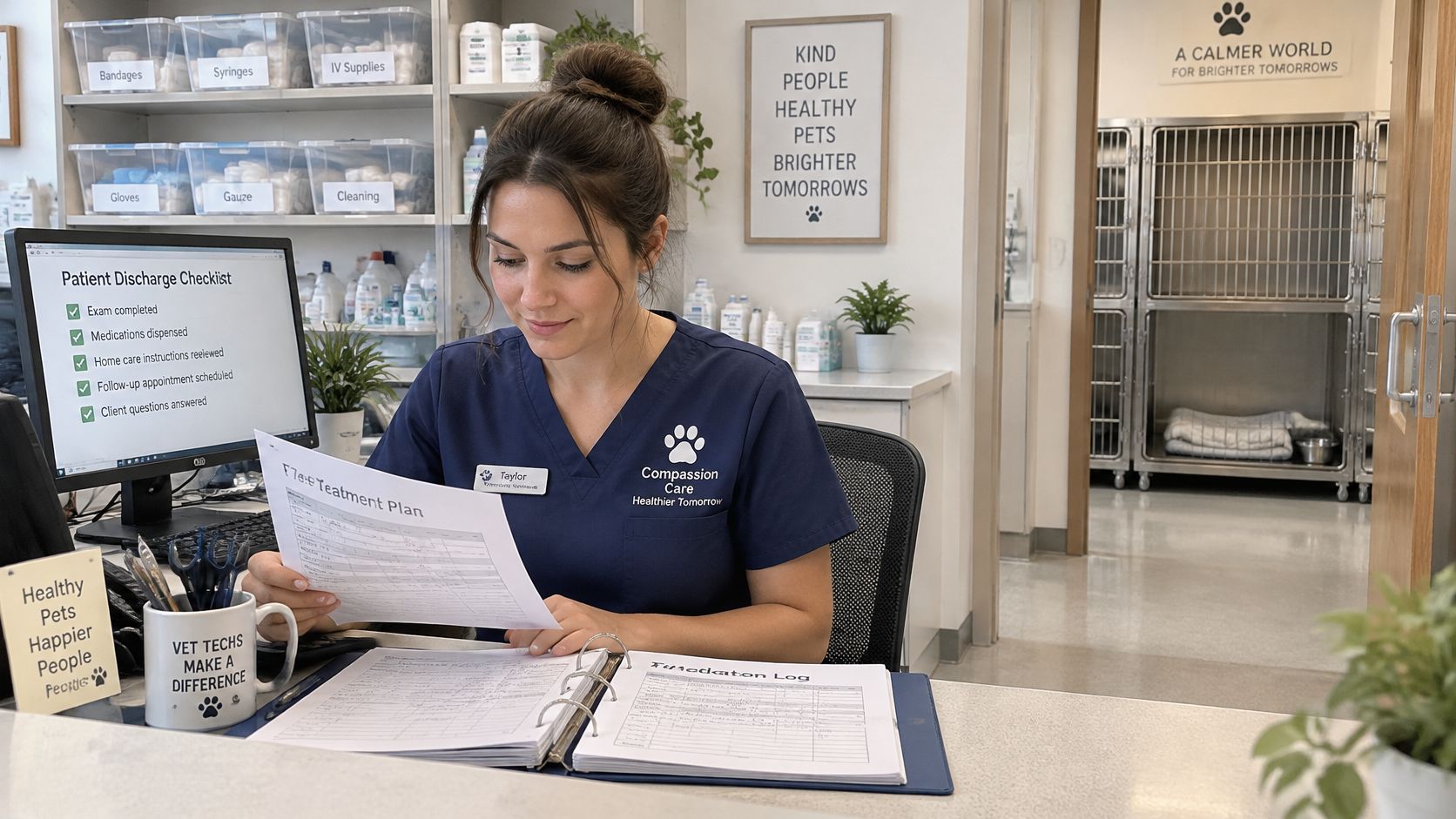
Coordination tasks can include appointment confirmations, reminders, message routing, and billing follow-up. Use written procedures to define what staff may complete and what must be escalated. The care coordination examples illustrate how routine follow-up can be organized separately from clinical decisions. In a veterinary clinic, the same division must fit state rules and clinic protocols.
Six steps before you move a task
- List procedures and coordination tasks, including duties that have informally become “someone's job.”
- Check the state practice act and veterinary board rules for each task. The AAVSB model scope-of-practice regulations describe delegation in relation to the veterinarian-client-patient relationship, the supervising veterinarian's direction and responsibility, and the person's competence. They offer a framework, not a replacement for state law.
- Classify each task as allowed within protocol, requiring direct supervision, or reserved for the veterinarian.
- Record each technician's sign-off by task and note any limits related to case complexity.
- Write clear escalation triggers and identify who must respond.
- Review the matrix quarterly and after an incident. Confirm it against current state requirements with the board or qualified counsel.
A small clinic may combine roles when staffing is limited, provided the person is trained and authorized for each assigned task. Set one rule: a person covering multiple roles may complete coordination work, but must pause and escalate whenever a task requires clinical judgment or exceeds their documented competence.
The Takeaway
A technician can monitor anesthesia, collect samples, provide nursing care, and deliver client instructions from approved discharge protocols. Diagnosis, prescribing, surgery, and treatment changes remain veterinarian decisions unless state rules allow a limited exception. Phones, scheduling, records support, and billing follow-up can go to trained staff, provided they leave clinical questions and decisions with the credentialed team.
State practice acts and written clinic protocols set the delegation boundary, not job titles. Map clinical and coordination tasks, check technician credentials with the state board, classify each duty, and document competence sign-off.
Moving routine calls and paperwork off the technician's queue can protect time for patient care. MedicalVirtual can provide a shortlist of pre-vetted bilingual candidates for front-desk and scheduling support, with duties kept on the non-clinical side of the matrix.
MedicalVirtual places bilingual virtual receptionists and coordinators who work clinic hours, confirm appointments, and route medical questions to credentialed staff. Visit MedicalVirtual to see how a shortlist is built for your practice.