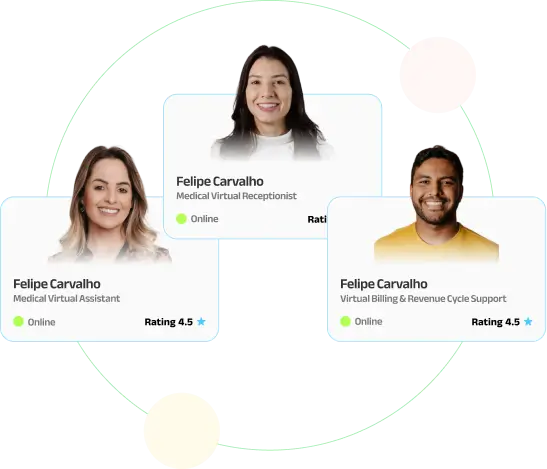
Hire a Virtual Assistant for Your Medical Practice
One dedicated MedicalVirtual assistant who takes the phones, scheduling, intake, insurance verification and the admin that piles up between patients, working your hours inside your EHR. Practices use this support to add capacity without adding a US salary, or to give an overstretched front desk its day back.
Jennifer is a Certified Medical Assistant who supports practices remotely across scheduling, intake, EHR documentation, insurance verification and patient communication, with telemedicine coordination experience on top.
EHR Documentation
95%
Scheduling and Intake
93%
Insurance Verification
91%
Front-desk staff in a medical practice spend most of their day on work that does not need to happen at the front desk: returning calls, chasing referrals, verifying coverage, working the fax queue. A dedicated virtual assistant takes that layer off your in-office team so they can stay with the patients in the room.
Phones answered live and appointments booked in your EHR
New patients registered, forms collected and insurance verified before the visit
Referrals, prior authorizations and records requests chased to completion
Inbox, faxes and portal messages triaged daily
HIPAA training before kick-off, refreshed annually, plus a signed BAA
Full-time from $1,900 a month, part-time from $1,200
Why hire a virtual assistant for your practice
Most practices do not need another specialist. They need one reliable person who takes the mixed bag of admin that currently falls to whoever is free: the phone, the fax queue, the referral that needs chasing, the new patient who has not sent their forms. A generalist virtual assistant absorbs that whole layer.
Full US hours overlap
Your assistant works your practice hours, a full 9 to 5 on your clock, so patients and payers reach a person.
Trained and checked
HIPAA training before kick-off, annual refreshers, background checks and a signed BAA.
US practice experience
Only people who have worked in a US practice on Athenahealth, eClinicalWorks, NextGen, Kareo or similar reach your shortlist.
One monthly rate
From $1,900 a month full-time, $1,200 part-time. No placement fee.
What a medical practice virtual assistant does
A generalist virtual assistant takes the whole layer of admin that does not need a body at the front desk. What they focus on each week is set by you; what follows is the typical scope.
Answer and triage inbound calls, return voicemails and portal messages
Book, confirm and reschedule appointments in your EHR or practice management system
Register new patients, collect forms and ID, and verify insurance before the visit
Send and chase referrals, prior authorizations and outside records requests
Work the fax queue, scan and file documents to the correct chart
Send appointment reminders and follow up on no-shows and cancellations
Prepare charts and pre-visit paperwork the day before
Handle recall lists, patient outreach and simple billing enquiries
Specialties
Virtual assistants support primary care, internal medicine, pediatrics, OB-GYN, dermatology, orthopaedics, physical therapy, behavioural health and most outpatient specialties. If it is a US outpatient practice with a front desk, the role transfers.
Skills and Qualifications
Practice assistants usually come from medical assistant, front-desk or practice administration backgrounds. What matters is having worked inside a US practice and its systems, not a degree.
Experience in Athenahealth, eClinicalWorks, NextGen, Kareo, Tebra or similar.
Working knowledge of insurance verification, referrals and prior authorization.
Professional English on the phone and in writing, with Spanish a common plus.
Organised, comfortable owning a task list and reporting on it.
Which EHR or practice management systems have you worked in day to day?
Candidates should name the system, describe scheduling, charting and messaging in it, and give an example of a workflow they ran end to end rather than a feature they have seen.
How do you prioritise when the phone, the fax queue and a referral deadline all land at once?
Look for a specific triage order: patient on the phone first, urgent clinical messages routed to the provider, then referrals and authorizations by deadline, then the queue. Vague answers about multitasking are a warning sign.
How do you handle protected health information in a remote role?
A strong answer covers minimum-necessary access, not discussing patients outside the practice, secure channels for PHI, and what they would do if they received records for the wrong patient.
What practices hand off first
Phones and scheduling
Inbound calls answered live during clinic hours, triaged, and booked or routed while the caller is on the line.
Patient intake
New patient forms, demographics, consents and insurance cards collected and entered before the visit.
Insurance verification
Eligibility and benefits checked ahead of every appointment and recorded in the chart so the desk can collect.
Referral coordination
Outbound referrals sent with the right records, tracked to a booked appointment, and inbound referrals scheduled quickly.
Inbox, fax and portal
The fax queue, portal messages and voicemails worked every day and routed to the right person or filed to the chart.
Patient communication
Reminders, no-show follow-up, recall outreach and post-visit instructions sent on your schedule and templates.
A remote team member dedicated to your practice who handles the administrative layer: phones, scheduling, intake, insurance verification, referrals, authorizations, records requests and the daily fax and message queue, working your hours inside your EHR. Explore MedicalVirtual assistants and the services available for your practice.
Around $1,900 a month full-time, or $1,200 to $1,500 part-time. There is no recruitment or placement fee, and the rate does not change with workload.
Yes. Our MedicalVirtual assistants work in Athenahealth, eClinicalWorks, NextGen, Kareo, Tebra, Practice Fusion and similar systems under access you grant and can revoke. You keep control of credentials and permissions.
If most of your admin is one task at volume, such as verification or prior authorization, a specialist role is usually the better fit and we will say so. If it is a mix of everything that lands on the front desk, a generalist is the right hire.
Latin America, working your practice hours on a full 9 to 5 on your clock. Many are bilingual in English and Spanish.
Every assistant completes HIPAA training before starting with a client and takes annual refresher training after that. Each passes a background check and signs a confidentiality agreement, and we execute a Business Associate Agreement with your practice.
Typically one to two weeks from your first call to their first day, including interviews. Most assistants are productive on their own within the first week because they have worked in a US practice before.
Yes. Many practices start with one assistant and add a second or move to a specialist role as the workload becomes clear. Everything is month to month.
Browse Similar Position
Virtual Medical Receptionist
Inbound and outbound patient calls, scheduling, confirmations and front-desk cover during your clinic hours.





 Verified