A MedicalVirtual assistant working as your virtual medical scribe documents the visit while it happens, so charts close before you leave the building instead of after dinner. Based in Latin America and working your time zone directly, a full 9 to 5 on your clock, with prior experience documenting for US practices and HIPAA training completed before kick-off.
Luis is a dedicated medical doctor from Honduras with a strong foundation in patient evaluation, diagnosis, and treatment planning. He has extensive experience in medical documentation and EMR management, gained through roles as a medical scribe and virtual medical assistant. Luis is known for.
A virtual medical scribe prepares visit documentation from clinician-directed information, working remotely in your EHR. The treating clinician reviews and signs the completed note.
Best suited to: Clinicians with documentation backlogs who need support preparing structured notes and organizing chart information.
Verified
Luis G.
Medical Scribe | 4+ years of experience
Luis is a dedicated medical doctor from Honduras with a strong foundation in patient evaluation, diagnosis, and treatment planning. He has extensive experience in medical documentation and EMR management, gained through roles as a medical scribe and virtual medical assistant. Luis is known for.
Danya is a dedicated medical professional with a strong foundation in both practical and theoretical aspects of healthcare. With a background in medical assistance, translation, and report editing, she has honed her skills in patient management and communication. Her experience spans clinical.
Jessika is a dedicated Medical Virtual Assistant and General Physician with a strong focus on enhancing healthcare efficiency through virtual solutions. With expertise in medical coding, patient care coordination, and clinical data management, she excels in supporting medical practices by.
Medical Scribe and Administrative Assistant | 8+ years of experience
Lucyana is a trilingual professional with over 6 years of experience in healthcare, technology, and education. She is a former dentist pursuing a medical degree, skilled in EMR/EHR management, medical scribing, and patient communication. She excels in cross-functional collaboration, AI training.
Claudia is a bilingual general practitioner with a robust medical background and experience in interpreting across various sectors. She is dedicated to providing comprehensive and quality care, emphasizing empathy, cultural respect, and confidentiality. Claudia is adept at managing emergencies.
Camila is an experienced virtual medical scribe who prepares accurate encounter documentation, updates charts in real time and helps providers close notes promptly without carrying administrative work into the evening.
Clinical Documentation
96%
Medical Terminology
94%
EMR Accuracy
92%
Ambient documentation tools have improved quickly and they suit some practices well. Where they struggle is everything around the note: chasing a missing result, queueing a referral, fixing the chart when the visit does not follow the template. A scribe handles the documentation and the loose ends, and can take on other admin work between patients.
Charts closed the same day, not at 9pm
Works live during the visit in your own EMR
Prior documentation experience with US practices
HIPAA training before kick-off, refreshed annually, plus a signed BAA
Handles the follow-up around the note, not just the note
Full-time from $1,900 a month, part-time from $1,200
Why hire a virtual medical scribe
Documentation time is the clearest driver of clinician burnout, and it is unbilled. A scribe gives that time back and often lets a provider add appointments to the day, which pays for the role several times over. The practical argument is simpler still: the note is finished when the patient leaves.
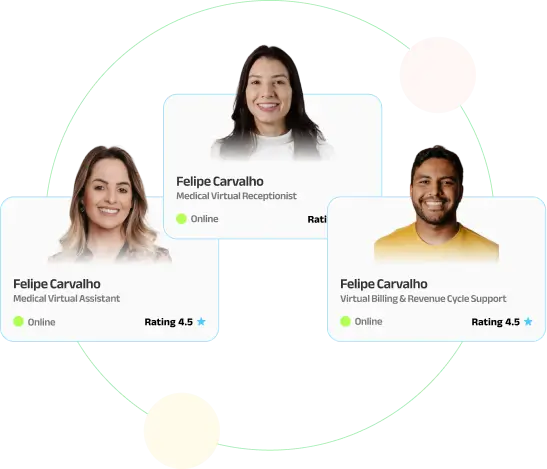
Felipe Carvalho
Medical Virtual Receptionist
Online Rating 4.5
Felipe Carvalho
Medical Virtual Receptionist
Online Rating 4.5
Felipe Carvalho
Virtual Billing & Revenue Cycle Support
Online Rating 4.5
Full US hours overlap
Your scribe works your time zone, a full 9 to 5 on your clock, so they are live in the room for every session.
Trained and checked
HIPAA training before kick-off, annual refreshers, background checks and a signed BAA.
US experience required
Only scribes who have documented for US practices reach your shortlist.
One monthly rate
From $1,900 a month full-time. No recruitment or placement fee.
What a virtual medical scribe does
Documentation is the work that follows clinicians home. A scribe joins the visit remotely, builds the note in real time, and hands you a chart to review rather than one to write from scratch.
Document the encounter in your EMR in real time during the visit
Build the HPI, review of systems, exam and assessment and plan for your review
Pull forward relevant history, medications, allergies and prior results
Queue orders, referrals and prescriptions for you to sign off
Draft after-visit summaries and patient instructions
Close charts the same day rather than leaving a backlog
Flag missing documentation that affects coding and reimbursement
Keep templates and smart phrases current as your workflow changes
Specialties
Medical Virtual Receptionists are healthcare professionals who support medical practitioners by managing patient communications, scheduling appointments, and handling administrative tasks. They are vital in ensuring that medical offices run efficiently and provide excellent patient care.
Skills and Qualifications
Medical Virtual Receptionists may have backgrounds in healthcare or administration. While a degree in healthcare is beneficial, it is not mandatory; experience in a medical setting is often sufficient.
Strong organizational and operational skills.
Proficient in professional English communication.
Familiarity with basic medical processes and terminology.
Which specialties and EMR systems have you documented in?
Ask for experience relevant to your specialty and workflow, including the types of encounters documented, common note formats and the EMRs used in prior US healthcare roles.
How do you maintain speed without sacrificing chart accuracy?
Strong scribes use structured templates, listen for clinically relevant details, flag uncertainties rather than guessing and complete a final review before sending notes to the provider.
How quickly can you complete notes after each encounter?
Agree on a measurable turnaround standard. For live or recorded encounters, candidates should explain how they keep documentation current while handling corrections and provider feedback.
How it works
Tell us the workload
A short call to map your visit volume, specialty, EMR and the clinic sessions you want covered.
We build a shortlist
A placement specialist matches scribes who have documented in your specialty and your software, then sends a shortlist worth reading.
Interview and choose
You meet the candidates and make the hire yourself. We handle the in-country contract, payroll and compliance.
Onboard and start
Your scribe starts with HIPAA training complete and a signed BAA in place, shadowing your first sessions before documenting live.
What practices hand off first
Real-time encounter notes
Document visits as they happen so providers can stay focused on the patient rather than the keyboard.
Chart preparation
Review the schedule, prior notes and available records so each chart is ready before the encounter.
SOAP note drafting
Organize histories, assessments and plans in the provider’s preferred format for review and sign-off.
Same-day chart closure
Complete and route notes promptly so documentation does not become an evening backlog.
EMR data entry
Update histories, medications, orders and follow-up instructions within approved workflows and provider oversight.
Documentation cleanup
Correct formatting, resolve flagged gaps and apply provider feedback without inventing clinical details.
Your practice needs clear answers about privacy, responsibility and insurance. MedicalVirtual maintains five business insurance policies alongside our HIPAA training, security procedures and Business Associate Agreements.
Documentation for your vendor review
Ask for our certificate of insurance and BAA before your assistant starts.
Certificate and policy limits available on request
Coverage is subject to policy terms, conditions, exclusions and applicable limits.
From task to handoff
A practical workflow for your virtual medical scribe
Start with a defined queue, an approved process and a named reviewer. These examples help you decide what to delegate and what a completed task should contain.
Workstream
Remote support
Expected handoff
Chart preparation
Review the permitted chart sections and organize the information your clinician requests.
A prepared encounter workspace with missing information flagged.
Visit documentation
Draft the history and other note sections from the clinician’s dictation or approved encounter workflow.
A draft note clearly awaiting clinician review.
Review and handoff
Flag unclear terms, reconcile requested corrections and route the draft to its authorizing clinician.
A review queue with outstanding questions recorded.
Where responsibility stays: A scribe does not diagnose, independently choose treatment, prescribe or sign the clinician’s note. Confirm consent and any recording rules before using audio or video.
Plan your budget
How much does remote medical staffing cost?
MedicalVirtual staffing starts at $10 per hour. The agreed rate depends on the role, experience and schedule. Direct hire and built-team engagements are quoted separately.
Hours budgeted per week
Weekly at $10/hour
Average month at $10/hour
20 hours
$200
About $867
40 hours
$400
About $1,733
Illustrative calculations, not package quotes: hourly rate × weekly hours × 52 ÷ 12. Actual invoices follow your agreed rate, billable hours and contract. Availability and minimum schedules are confirmed when quoted. Include any additional software seats or practice-side costs in your budget.
Your EHR note templates, specialty vocabulary and approved communication or dictation tools. Verify a candidate’s actual experience with your EHR rather than assuming familiarity with every platform.
Use individual accounts and permissions appropriate to the work. Your practice approves access, provides its procedures and names the person who handles exceptions.
How should you measure the work?
Track draft turnaround, clinician correction rate and unsigned-note backlog. Define what counts as a complete draft before measuring throughput.
Agree the definitions and review a sample of completed work during onboarding. Set targets from your own baseline; results depend on workload, staffing and practice processes.
Ready for the first working day
What should you prepare before hiring?
Define the workload. Share weekly volume, required hours, language needs, software and the tasks that stay with your team.
Assess the actual role. Interview shortlisted candidates and use de-identified examples to check the skills your workflow requires.
Set up approved access. Complete HIPAA training and the BAA before PHI access, then configure individual accounts and practice-approved communication channels.
Start with a supervised queue. Provide scripts, task checklists, an escalation contact and a review process before expanding responsibilities.
Matching and onboarding time depend on the specialty, candidate availability and your access setup. Agree a realistic start date after the role is scoped.
A trained documentation specialist who joins your visit remotely and writes the note in your EMR as the encounter happens. You review and sign rather than writing from scratch. They are not clinical staff and do not make clinical decisions. Explore MedicalVirtual assistants and the services available for your practice.
They suit different practices. Ambient tools transcribe well and cost less, but they stop at the note. A human scribe also queues orders and referrals, chases a missing result, and fixes the chart when a visit does not follow the template. Several practices run both, using the tool for straightforward visits and a scribe for complex ones.
Yes. Our scribes have documented in Athenahealth, eClinicalWorks, NextGen, Kareo and Tebra and others. You grant access under your own credentialing and access-control policies, exactly as you would for an in-office employee.
Around $1,900 a month for full-time, or $1,200 to $1,500 part-time if you only need cover for clinic days. There is no recruitment or placement fee.
Latin America, working your time zone directly on a full 9 to 5 on your clock. That matters more for scribing than for most roles, because the scribe has to be live in the room with you for every session rather than working from a recording overnight.
Every scribe completes HIPAA training before starting with a client and takes annual refresher training after that. Each passes a background check and signs a confidentiality agreement, and we execute a Business Associate Agreement with your practice.
Most practices allow a short calibration period while the scribe learns your templates, your phrasing and how you like an assessment structured. Because we only place scribes with prior US documentation experience, that is a matter of adjusting to you rather than learning the job.
Yes, and most do. Between patients a scribe can handle prior authorization follow-up, records requests, referral tracking or inbox triage, which is one reason a human scribe often earns its keep more easily than a documentation tool.
Browse Similar Position
Virtual Medical Receptionist
Inbound and outbound patient calls, scheduling, confirmations and front-desk cover during your clinic hours.

 Verified
 View Profile