A MedicalVirtual assistant dedicated to working your claims every day rather than whenever someone at the practice finds a spare hour. Charge entry, submission, denials and patient statements, handled by someone who has already billed US commercial and Medicare payers.
Andrea is a dedicated Virtual Medical Assistant with four years of experience in medical billing, customer service, and data entry. She has a strong background in insurance verification, appointment scheduling, and medical records management. Andrea is proficient in handling sensitive.
Virtual medical billing assistant: what the role covers
A virtual medical billing assistant supports the administrative revenue cycle, including claim preparation, payment posting, payer follow-up and accounts-receivable work under your billing policies.
Best suited to: Practices with unworked claims, aging receivables or billing staff who need a dedicated follow-up queue.
Verified
Andrea B.
Medical Billing Agent | 1+ years of experience
Andrea is a dedicated Virtual Medical Assistant with four years of experience in medical billing, customer service, and data entry. She has a strong background in insurance verification, appointment scheduling, and medical records management. Andrea is proficient in handling sensitive.
Medical Assistant and Coordinator | 5+ years of experience
Karina is a bilingual professional with extensive experience in medical assistance and coordination. She excels in patient scheduling, insurance verification, and medical billing. Her adaptability and attention to detail make her an asset in fast-paced environments, ensuring efficient workflows.
Fernanda is a dedicated professional with a strong background in the medical field, having worked as a medical interpreter, biller, and virtual assistant. She is passionate about teaching English, particularly to children, and is proficient in tools like Google Workspace and Excel. Her.
Manuel is a dedicated professional with extensive experience in the medical field and customer service. With a strong background as a virtual medical assistant, he has honed skills in billing, scheduling coordination, and referrals. His proficiency in both English and Spanish, coupled with his.
A biller on your team, not a percentage of collections
Verified
Valentina Cruz
7 years of US medical billing experience
Valentina supports the full medical billing cycle, including charge entry, clean-claim submission, payment posting, denial follow-up and accounts-receivable work across major US commercial and government payers.
Claims Submission
96%
Denial Follow-up
94%
AR Management
91%
Outsourced billing companies typically charge four to eight per cent of everything they collect, which gets expensive as your practice grows and gives you little say in how your claims are worked. A dedicated biller is a flat monthly cost that does not scale with your revenue, sits inside your systems, and answers to you.
Flat monthly cost rather than a percentage of everything you collect
Denials worked daily instead of whenever someone finds time
Prior experience with US commercial, Medicare and Medicaid payers
Works inside your own PM system, so you keep visibility of every claim
HIPAA training before kick-off, refreshed annually, plus a signed BAA
Full-time from $2,200 a month for billing and revenue cycle roles
Why hire a virtual medical biller
Unworked denials are the most expensive habit in a small practice, because a claim that is never appealed is revenue you have already earned and simply do not collect. A dedicated biller costs less per year than a local hire and considerably less than a percentage-of-collections arrangement once your volume grows.
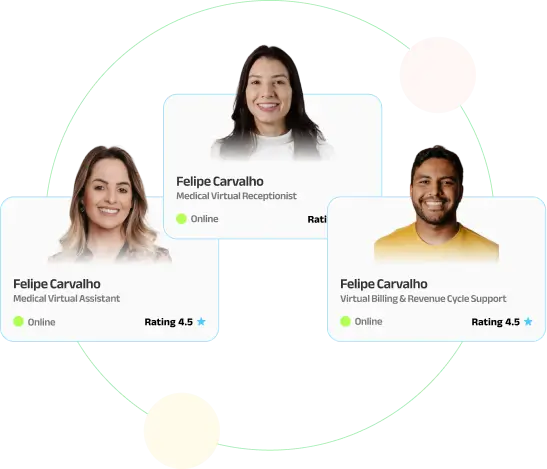
Felipe Carvalho
Medical Virtual Receptionist
Online Rating 4.5
Felipe Carvalho
Medical Virtual Receptionist
Online Rating 4.5
Felipe Carvalho
Virtual Billing & Revenue Cycle Support
Online Rating 4.5
No percentage of collections
A flat monthly rate that does not rise as your collections do.
Trained and checked
HIPAA training before kick-off, annual refreshers, background checks and a signed BAA.
US payer experience
Only billers who have worked US payers and denials reach your shortlist.
Daily, not sporadic
Denials and aged AR worked every day, not in monthly bursts.
What a virtual medical billing assistant does
Most practices do not have a billing problem so much as a capacity problem. Claims go out, denials come back, and nobody has a clear hour to work them, so AR quietly ages. A dedicated biller works the queue daily instead of in bursts.
Charge entry and claim scrubbing before submission
Submit clean claims to commercial, Medicare and Medicaid payers
Work denials and rejections daily, with appeals where the payer is wrong
Chase aged AR and escalate claims sitting past 30, 60 and 90 days
Post payments and reconcile ERAs and EOBs
Generate and follow up patient statements and balances
Handle payer phone calls and portal follow-up on your behalf
Flag coding and documentation gaps that are costing you reimbursement
Report on collections, denial reasons and AR ageing so you can see the trend
Specialties
Medical Virtual Receptionists are healthcare professionals who support medical practitioners by managing patient communications, scheduling appointments, and handling administrative tasks. They are vital in ensuring that medical offices run efficiently and provide excellent patient care.
Skills and Qualifications
Medical Virtual Receptionists may have backgrounds in healthcare or administration. While a degree in healthcare is beneficial, it is not mandatory; experience in a medical setting is often sufficient.
Strong organizational and operational skills.
Proficient in professional English communication.
Familiarity with basic medical processes and terminology.
Which payers, specialties and billing systems have you worked with?
Prior US billing experience should include relevant commercial or government payers, familiarity with your specialty’s common claim issues and hands-on work in a billing or practice-management platform.
How do you investigate and resolve a denied claim?
Look for a repeatable process: confirm the denial reason, review coding and documentation, check timely-filing rules, correct or appeal the claim and record every follow-up action.
Which billing performance metrics do you monitor?
Qualified candidates should be comfortable tracking clean-claim rate, denial rate, days in accounts receivable, aging balances, payment posting accuracy and payer follow-up queues.
How it works
Tell us the workload
A short call to map your payer mix, monthly claim volume, PM system and where AR is currently sitting.
We build a shortlist
A placement specialist matches billers who have worked your payers and your software, then sends a shortlist worth reading.
Interview and choose
You meet the candidates and make the hire yourself. We handle the in-country contract, payroll and compliance.
Onboard and start
Your biller starts with HIPAA training complete and a signed BAA in place, beginning with your oldest AR before taking on daily claims.
What practices hand off first
Clean-claim submission
Enter charges, verify claim data and submit accurate claims within payer filing deadlines.
Denial follow-up
Research denial reasons, correct claim issues and prepare reconsiderations or appeals with supporting records.
Accounts receivable
Work aging reports by payer and balance priority so unpaid claims do not sit untouched.
Payment posting
Post insurance and patient payments accurately and identify underpayments or unexplained adjustments.
Eligibility checks
Confirm active coverage and benefit requirements before services create avoidable billing problems.
Patient statements
Prepare clear statements, answer balance questions and route disputes under the practice’s policies.
Your practice needs clear answers about privacy, responsibility and insurance. MedicalVirtual maintains five business insurance policies alongside our HIPAA training, security procedures and Business Associate Agreements.
Documentation for your vendor review
Ask for our certificate of insurance and BAA before your assistant starts.
Certificate and policy limits available on request
Coverage is subject to policy terms, conditions, exclusions and applicable limits.
From task to handoff
A practical workflow for your virtual medical billing assistant
Start with a defined queue, an approved process and a named reviewer. These examples help you decide what to delegate and what a completed task should contain.
Workstream
Remote support
Expected handoff
Claim preparation
Check demographics, insurance information and supplied billing details for missing fields.
A clean work queue with documentation questions routed to the responsible team.
Payment and claim status
Post payments and adjustments as authorized; check clearinghouse and payer responses.
Updated balances and an auditable claim-status record.
Denial follow-up
Record denial reasons, gather requested documentation and track approved resubmissions or appeals.
An owner, next action and deadline for each unresolved claim.
Where responsibility stays: Coding decisions, write-offs and clinical appeal arguments need appropriately qualified review. A billing assistant cannot guarantee reimbursement or payer approval.
Plan your budget
How much does remote medical staffing cost?
MedicalVirtual staffing starts at $10 per hour. The agreed rate depends on the role, experience and schedule. Direct hire and built-team engagements are quoted separately.
Hours budgeted per week
Weekly at $10/hour
Average month at $10/hour
20 hours
$200
About $867
40 hours
$400
About $1,733
Illustrative calculations, not package quotes: hourly rate × weekly hours × 52 ÷ 12. Actual invoices follow your agreed rate, billable hours and contract. Availability and minimum schedules are confirmed when quoted. Include any additional software seats or practice-side costs in your budget.
Your practice-management system, clearinghouse, payer portals and approved payment-posting procedures. Match experience to your specialty and payer mix.
Use individual accounts and permissions appropriate to the work. Your practice approves access, provides its procedures and names the person who handles exceptions.
How should you measure the work?
Track unworked claims, follow-up age, denial reasons and accounts receivable by aging bucket. Separate recovered payments from claims still pending.
Agree the definitions and review a sample of completed work during onboarding. Set targets from your own baseline; results depend on workload, staffing and practice processes.
Ready for the first working day
What should you prepare before hiring?
Define the workload. Share weekly volume, required hours, language needs, software and the tasks that stay with your team.
Assess the actual role. Interview shortlisted candidates and use de-identified examples to check the skills your workflow requires.
Set up approved access. Complete HIPAA training and the BAA before PHI access, then configure individual accounts and practice-approved communication channels.
Start with a supervised queue. Provide scripts, task checklists, an escalation contact and a review process before expanding responsibilities.
Matching and onboarding time depend on the specialty, candidate availability and your access setup. Agree a realistic start date after the role is scoped.
A remote billing specialist who handles charge entry, claim submission, denial follow-up, payment posting and patient statements inside your own practice management system. They work as part of your team rather than as an external service. Explore MedicalVirtual assistants and the services available for your practice.
Billing companies usually charge four to eight per cent of collections, so the cost rises every time your practice grows, and you have limited say in how individual claims are worked. A dedicated biller is a flat monthly rate, works in your system, and reports to you. For most small and mid-size practices the flat rate wins once monthly collections pass roughly $40,000, though the right answer depends on your volume and payer mix.
Around $2,200 a month for a full-time biller. Billing sits above our average of $1,999 because payer knowledge and denial management are more specialised than front-desk work. There is no recruitment or placement fee and no percentage of collections.
Yes. Our billers have worked in Athenahealth, eClinicalWorks, NextGen, Kareo and Tebra and others, alongside the major payer portals. You grant access under your own credentialing policies, exactly as you would for an in-office employee.
Coding and billing overlap but are not the same job. Our billers handle claim submission, denials, AR and patient balances, and will flag documentation and coding gaps they see. If you need a certified coder assigning codes from documentation, tell us on the call and we will match for that specifically.
Latin America, working your time zone directly on a full 9 to 5 on your clock. That matters for billing because payer phone queues are only open during US business hours, so your biller can actually sit in them for the whole working day rather than leaving calls for tomorrow.
Every biller completes HIPAA training before starting with a client and takes annual refresher training after that. Each passes a background check and signs a confidentiality agreement, and we execute a Business Associate Agreement with your practice.
Billing takes longer to fill than front-desk roles because we match on payer mix and specialty rather than general experience. We will give you a realistic timeline on the first call rather than a number designed to close you.
Browse Similar Position
Prior Authorization Specialist
Submits, tracks and escalates authorizations for imaging, procedures and specialty drugs.

 Verified
 View Profile