A MedicalVirtual assistant who owns the new patient journey from first call to check-in: registration, forms, records requests, insurance details and reminder calls. Fewer incomplete charts at the door, and fewer empty slots from no-shows.
Medical Virtual Assistant |
Experienced medical professional
Elena is a dedicated and organized medical virtual assistant with nearly four years of experience in the healthcare industry. She excels in managing calendars, handling patient referrals, and ensuring meticulous documentation. Her proactive and empathetic approach ensures that patients feel.
A remote patient intake coordinator organizes the administrative information needed before a visit, including demographics, forms, referral records and appointment instructions.
Best suited to: Practices with incomplete new-patient files, high call volumes or repeated follow-up for missing paperwork.
Verified
Elena
Medical Virtual Assistant | Experienced medical professional
Elena is a dedicated and organized medical virtual assistant with nearly four years of experience in the healthcare industry. She excels in managing calendars, handling patient referrals, and ensuring meticulous documentation. Her proactive and empathetic approach ensures that patients feel.
Certified Virtual Medical Assistant | 9+ years of experience
Highly skilled Certified Medical Assistant with over 9 years of experience in remote healthcare operations. She specializes in complex prior authorizations and virtual care coordination, demonstrating expertise in managing digital workflows and telehealth environments. Jenny is bilingual in.
Virtual Medical Assistant | 28+ years of experience
Raimundo is a highly skilled Executive Administrative Assistant with extensive experience in customer service and virtual medical assistance. Proficient in managing scheduling, billing, and patient coordination, Raimundo has a strong background in using various tools such as QuickBooks, Outlook.
Customer Service Representative | 2+ years of experience
Juan is a proficient virtual administrative assistant with a strong background in customer service and medical interpreting. He excels in managing high-pressure environments, demonstrating exceptional organizational and leadership skills. With experience in developing EMR systems and proficiency.
Lennin is a dedicated professional with extensive experience in administrative tasks and customer service, particularly in the medical field. He has a proven track record in scheduling, managing patient information, and providing bilingual support. His proficiency in English and Spanish, along.
Josafat is a tech-savvy professional with a passion for technology and content creation. With a strong background in customer service and patient care, he excels in navigating complex processes and ensuring seamless communication between clients and service providers. His bilingual proficiency.
Mariana coordinates new-patient onboarding, registration forms, records requests, appointment preparation and reminder outreach so every patient arrives with the information the clinical team needs.
Patient Intake
96%
Records Coordination
93%
Appointment Scheduling
92%
You have already spent on marketing, referrals and phone time to get a new patient booked. If they arrive without records, without completed forms, or do not arrive at all, that spend is wasted and the slot cannot be resold on the day. Intake is where that gets protected.
Forms and records complete before the patient walks in
Reminder and confirmation calls that bring the no-show rate down
Cancellations backfilled from the waitlist the same day
Bilingual English and Spanish intake at no extra cost
HIPAA training before kick-off, refreshed annually, plus a signed BAA
Full-time from $1,900 a month, part-time from $1,200
Why hire a patient intake coordinator
Intake tends to be everybody's job and therefore nobody's. Reminder calls get made when the desk is quiet, which is exactly when it never is. Giving one person the whole sequence is usually the cheapest way a practice reduces no-shows, because it needs no new software and no change to how you schedule.
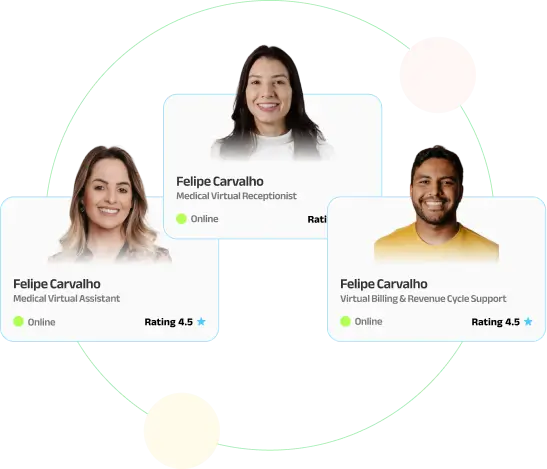
Felipe Carvalho
Medical Virtual Receptionist
Online Rating 4.5
Felipe Carvalho
Medical Virtual Receptionist
Online Rating 4.5
Felipe Carvalho
Virtual Billing & Revenue Cycle Support
Online Rating 4.5
Full US hours overlap
Reminder and confirmation calls land during your clinic day, on a full 9 to 5 on your clock.
Trained and checked
HIPAA training before kick-off, annual refreshers, background checks and a signed BAA.
US experience required
Only coordinators who have onboarded patients for US practices reach your shortlist.
One monthly rate
From $1,900 a month full-time, $1,200 part-time. No placement fee.
What a patient intake coordinator does
New patients are the most expensive appointments to win and the easiest to lose. Forms arrive half-finished, records never turn up, and nobody confirms the visit, so the slot goes empty. An intake coordinator owns that whole sequence instead of leaving it split across the desk.
Register new patients and build the chart before the first visit
Send, chase and check intake forms so they arrive complete
Request and track records from previous providers
Collect insurance details and pass them to verification
Confirm appointments and run reminder calls the day before
Work the waitlist to backfill cancellations the same day
Prepare the day sheet so clinicians see complete charts
Follow up patients who booked but never completed onboarding
Handle Spanish-speaking patients through intake without a language line
Specialties
Medical Virtual Receptionists are healthcare professionals who support medical practitioners by managing patient communications, scheduling appointments, and handling administrative tasks. They are vital in ensuring that medical offices run efficiently and provide excellent patient care.
Skills and Qualifications
Medical Virtual Receptionists may have backgrounds in healthcare or administration. While a degree in healthcare is beneficial, it is not mandatory; experience in a medical setting is often sufficient.
Strong organizational and operational skills.
Proficient in professional English communication.
Familiarity with basic medical processes and terminology.
How have you managed high-volume new-patient intake?
Look for experience collecting demographics, insurance details, forms, referrals and medical records while keeping patients informed and appointments moving on schedule.
What do you do when forms or records are incomplete?
A strong coordinator identifies missing items early, follows a consistent outreach schedule, documents each attempt and escalates issues that could delay or prevent the appointment.
How do you discuss sensitive information with patients?
Candidates should communicate calmly, verify identity, collect only the information required for their role and follow the practice’s privacy and escalation procedures at all times.
How it works
Tell us the workload
A short call to map your new patient volume, your intake forms and where patients currently drop out of the process.
We build a shortlist
A placement specialist matches coordinators who have onboarded patients in your specialty and your software, then sends a shortlist.
Interview and choose
You meet the candidates and make the hire yourself. We handle the in-country contract, payroll and compliance.
Onboard and start
Your coordinator starts with HIPAA training complete and a signed BAA in place, taking next week's new patients from day one.
What practices hand off first
New-patient registration
Collect demographics, contact information and required forms before the appointment.
Insurance intake
Capture insurance cards and subscriber details accurately so eligibility can be checked early.
Referral coordination
Track referrals, orders and supporting records that must arrive before the scheduled visit.
Forms follow-up
Contact patients about missing paperwork and document every outreach attempt.
Appointment preparation
Confirm that the chart contains the information staff need before the patient arrives.
Reminder outreach
Send reminders and preparation instructions that reduce avoidable no-shows and late cancellations.
Your practice needs clear answers about privacy, responsibility and insurance. MedicalVirtual maintains five business insurance policies alongside our HIPAA training, security procedures and Business Associate Agreements.
Documentation for your vendor review
Ask for our certificate of insurance and BAA before your assistant starts.
Certificate and policy limits available on request
Coverage is subject to policy terms, conditions, exclusions and applicable limits.
From task to handoff
A practical workflow for your patient intake coordinator
Start with a defined queue, an approved process and a named reviewer. These examples help you decide what to delegate and what a completed task should contain.
Workstream
Remote support
Expected handoff
New-patient setup
Capture contact and insurance details using your approved intake process.
A patient record with required fields checked.
Forms and records
Track completion of intake documents and request permitted referral or prior-care records.
A readiness checklist with missing items assigned.
Pre-visit handoff
Send approved logistics and route nonclinical questions to the right team.
A prepared file and clear escalation notes for staff.
Where responsibility stays: Intake support is administrative. Clinical assessment, treatment advice and consent discussions requiring a licensed professional remain with your clinical team.
Plan your budget
How much does remote medical staffing cost?
MedicalVirtual staffing starts at $10 per hour. The agreed rate depends on the role, experience and schedule. Direct hire and built-team engagements are quoted separately.
Hours budgeted per week
Weekly at $10/hour
Average month at $10/hour
20 hours
$200
About $867
40 hours
$400
About $1,733
Illustrative calculations, not package quotes: hourly rate × weekly hours × 52 ÷ 12. Actual invoices follow your agreed rate, billable hours and contract. Availability and minimum schedules are confirmed when quoted. Include any additional software seats or practice-side costs in your budget.
Your intake forms, EHR, scheduling software and secure messaging channel. Define identity checks and the minimum information needed for each visit type.
Use individual accounts and permissions appropriate to the work. Your practice approves access, provides its procedures and names the person who handles exceptions.
How should you measure the work?
Track completed intake before the visit, missing-form rate, follow-up attempts and time from inquiry to booked appointment.
Agree the definitions and review a sample of completed work during onboarding. Set targets from your own baseline; results depend on workload, staffing and practice processes.
Ready for the first working day
What should you prepare before hiring?
Define the workload. Share weekly volume, required hours, language needs, software and the tasks that stay with your team.
Assess the actual role. Interview shortlisted candidates and use de-identified examples to check the skills your workflow requires.
Set up approved access. Complete HIPAA training and the BAA before PHI access, then configure individual accounts and practice-approved communication channels.
Start with a supervised queue. Provide scripts, task checklists, an escalation contact and a review process before expanding responsibilities.
Matching and onboarding time depend on the specialty, candidate availability and your access setup. Agree a realistic start date after the role is scoped.
A receptionist covers the phones for the whole practice across every patient. An intake coordinator focuses on the new patient sequence and the confirmation and reminder work that protects your schedule. Smaller practices often combine the two roles; busier ones separate them so neither gets dropped.
Reminder calls the day before, confirmations, and following up patients who booked but never completed onboarding. None of it is complicated, which is exactly why it slips when the front desk is busy. Having one person do it consistently is what moves the number.
Around $1,900 a month full-time, or $1,200 to $1,500 part-time. Intake sits at the lower end of our range because it is less specialised than billing or prior authorization. There is no recruitment or placement fee.
Most are fully bilingual, which matters more for intake than almost any other role because this is a patient's first contact with your practice and it involves forms, medical history and insurance details.
Yes. Our coordinators have worked in Athenahealth, eClinicalWorks, NextGen, Kareo and Tebra and others, alongside common patient portal and form tools. You grant access under your own credentialing policies.
Every coordinator completes HIPAA training before starting with a client and takes annual refresher training after that. Each passes a background check and signs a confidentiality agreement, and we execute a Business Associate Agreement with your practice.
Intake is one of the faster roles to fill because we hold a standing bench. We will give you a realistic timeline on the first call rather than a number designed to close you.
Browse Similar Position
Virtual Medical Receptionist
Inbound and outbound patient calls, scheduling, confirmations and front-desk cover during your clinic hours.

 Verified
 View Profile