

A patient calls at 8:12 a.m. to book an appointment, another patient is waiting at check-in, and a provider needs a message routed before the next visit. If the receptionist's only documented responsibility is “answer the phone,” the practice has already underdefined the job. The result is usually inconsistent scheduling, incomplete intake, avoidable transfers, and a queue that becomes hardest to manage during the busiest part of the day.
Medical office receptionists are patient-access coordinators, not just greeters or switchboard operators. They connect patients with appointments, clinicians, records, insurance workflows, and follow-up tasks. The strongest teams measure their work through access and accuracy signals, including answer speed, abandoned calls, scheduling errors, message-routing quality, and unresolved queues.
This guide explains the actual duties of medical office receptionists, how the daily workflow fits together, which metrics matter, how specialty changes the role, what skills to hire for, and where remote or hybrid coverage requires stronger controls.
What Medical Office Receptionists Actually Do
The U.S. Bureau of Labor Statistics generally places medical office receptionists within the broader occupational category of medical secretaries and administrative assistants, SOC 43-6013. That workforce held approximately 979,000 jobs in 2025, and the occupation is distinct from other secretarial roles because it requires knowledge of medical terminology, medical records, coding, and hospital, clinic, or laboratory procedures. The BLS occupational profile for medical secretaries and administrative assistants also describes work that extends beyond greeting patients.
A receptionist may transcribe dictation, prepare physician reports, take basic medical histories, arrange hospital admissions, process insurance payments, and coordinate information between patients, clinicians, and payers. BLS data listed for the occupation projects growth from roughly 979,000 jobs to 1,026,100, or about 4.8%, with approximately 47,100 openings or employment opportunities associated with the occupation. That scale shows why front-office medical administration deserves a defined operating model rather than a generic clerical job description.
The operational scope of the role
The Department of Labor's O*NET task profile includes answering and routing calls, greeting visitors, scheduling and confirming consultations or diagnostic appointments, completing insurance or claim forms, transmitting records, maintaining files, routing laboratory results, and interviewing patients for intake or insurance information. It also includes scheduling laboratory work or X-rays, recording charts and correspondence in computer systems, handling billing or collection records, and providing emergency instructions to callers when appropriate.
Those tasks place the receptionist at the intersection of four workflows:
- Patient access: Booking, confirming, rescheduling, recalling, and waitlist management.
- Information routing: Recording messages, sending records, routing results, and directing requests to the right queue.
- Documentation support: Updating demographics, maintaining files, and entering information into the practice-management system or EMR.
- Revenue-cycle support: Collecting insurance information, processing payments, and maintaining billing or collection records.
The medical virtual assistant role overview is useful when translating these responsibilities into distinct administrative positions, such as reception, patient intake, insurance verification, or billing support.
| Functional Area | Representative Tasks | Performance Signal |
|---|---|---|
| Patient access | Answer calls, schedule visits, confirm appointments, manage recalls | Fewer abandoned requests and scheduling errors |
| Intake and registration | Verify identity, update demographics, collect required information | Complete and accurate registration |
| Records and messages | Route records, laboratory information, and patient messages | Correct destination and documented handoff |
| Insurance and payments | Collect payer details, process payments, support claim forms | Fewer missing details and avoidable rework |
| Office coordination | Maintain files, communicate delays, support check-in and check-out | Smoother patient flow and fewer unresolved tasks |
Practical rule: Write the job description around decisions, handoffs, and outputs. “Answers the phone” is a task. “Routes each request to the correct administrative or clinical queue” is an operating responsibility.
Treating the position as a check-the-box front-desk role leaves important work unowned. A receptionist who books the wrong appointment type can create clinical schedule problems. A receptionist who records an incomplete message can force a patient to call again. A receptionist who fails to capture insurance information can move a preventable problem from scheduling to check-in or billing.
The Daily Workflow From First Call to End of Day
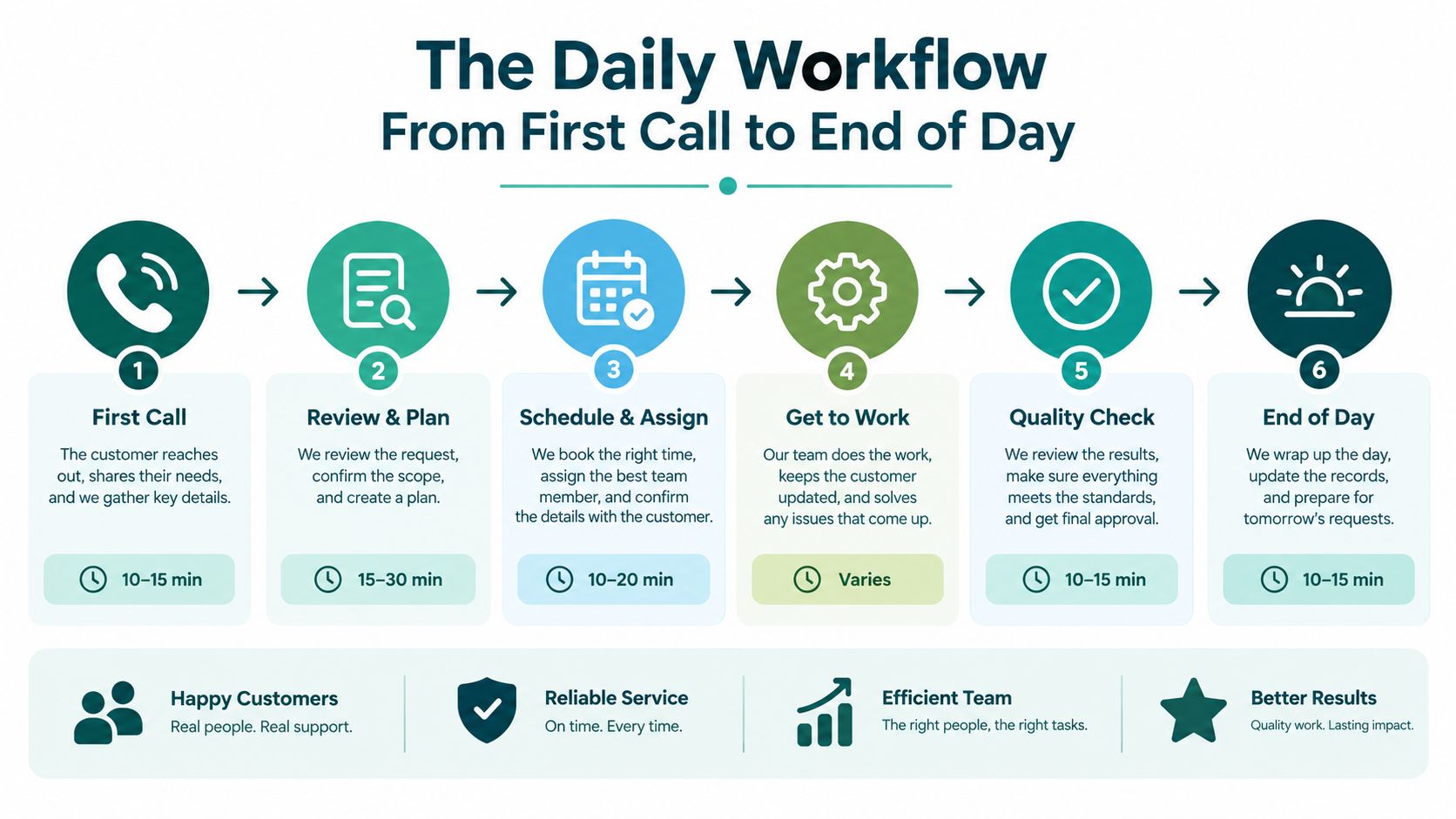
A medical office receptionist's day is a continuous sequence, not a collection of unrelated duties. The first call can create work that continues through scheduling, pre-visit preparation, check-in, provider communication, check-out, and end-of-day reconciliation.
Start with controlled call intake
The receptionist first identifies the patient, confirms the purpose of the contact, and determines whether the request belongs in scheduling, records, billing, a portal workflow, or a clinical message queue. This isn't a diagnosis step. It's an administrative navigation step governed by the practice's approved questions and escalation rules.
A useful intake record captures the reason for contact, preferred clinician, visit type, referral or insurance status when relevant, and any information needed for a licensed team member to review the message. Practices that need to refine how calls move between teams can use guidance on best practices for call routing, then adapt the approach to their phone system and clinical protocols.
Move from booking to pre-visit preparation
Scheduling requires more than finding an open slot. The receptionist matches the request to the correct appointment type, clinician, duration, location, and payer or referral requirements. Confirmation work then checks that the patient understands the appointment details and has completed the forms, records, or preparation instructions required by the practice.
Primary care may require a reason-for-visit category and updated insurance information. Dental practices may need procedure-specific scheduling. Therapy clinics may need the correct provider, service type, and communication preferences. A generic calendar process creates errors because the appointment slot doesn't contain enough context to support the visit.
Manage the visit and close the loop
At check-in, the receptionist verifies identity, confirms registration details, records arrival, and communicates delays through the practice's process. During the visit, the front desk may route messages, respond to calls, coordinate records, or adjust the schedule when a provider runs late. At check-out, the receptionist confirms follow-up instructions as directed by the clinical team, schedules the next administrative appointment, and handles authorized payment or billing steps.
The end of the day is where small practices often lose chart completeness and revenue-cycle momentum. Open encounters, unreturned messages, unsigned forms, missed payments, unprocessed records requests, and unfilled cancellation slots should be visible before the team leaves. A short reconciliation checklist is more reliable than relying on memory.
- Queue review: Identify unanswered calls, unresolved messages, and callbacks.
- Schedule review: Confirm cancellations, reschedules, waitlist opportunities, and next-day gaps.
- Documentation review: Check that registration updates, forms, and handoffs are recorded.
- Payment review: Reconcile authorized collections and flag missing billing information.
- Handoff review: Assign anything requiring clinical or managerial action to a named person.
Lunch-hour call surges and late-afternoon rescheduling shouldn't be treated as surprises. They should shape coverage plans and handoff expectations.
Scheduling and Patient Access as a Measurable System
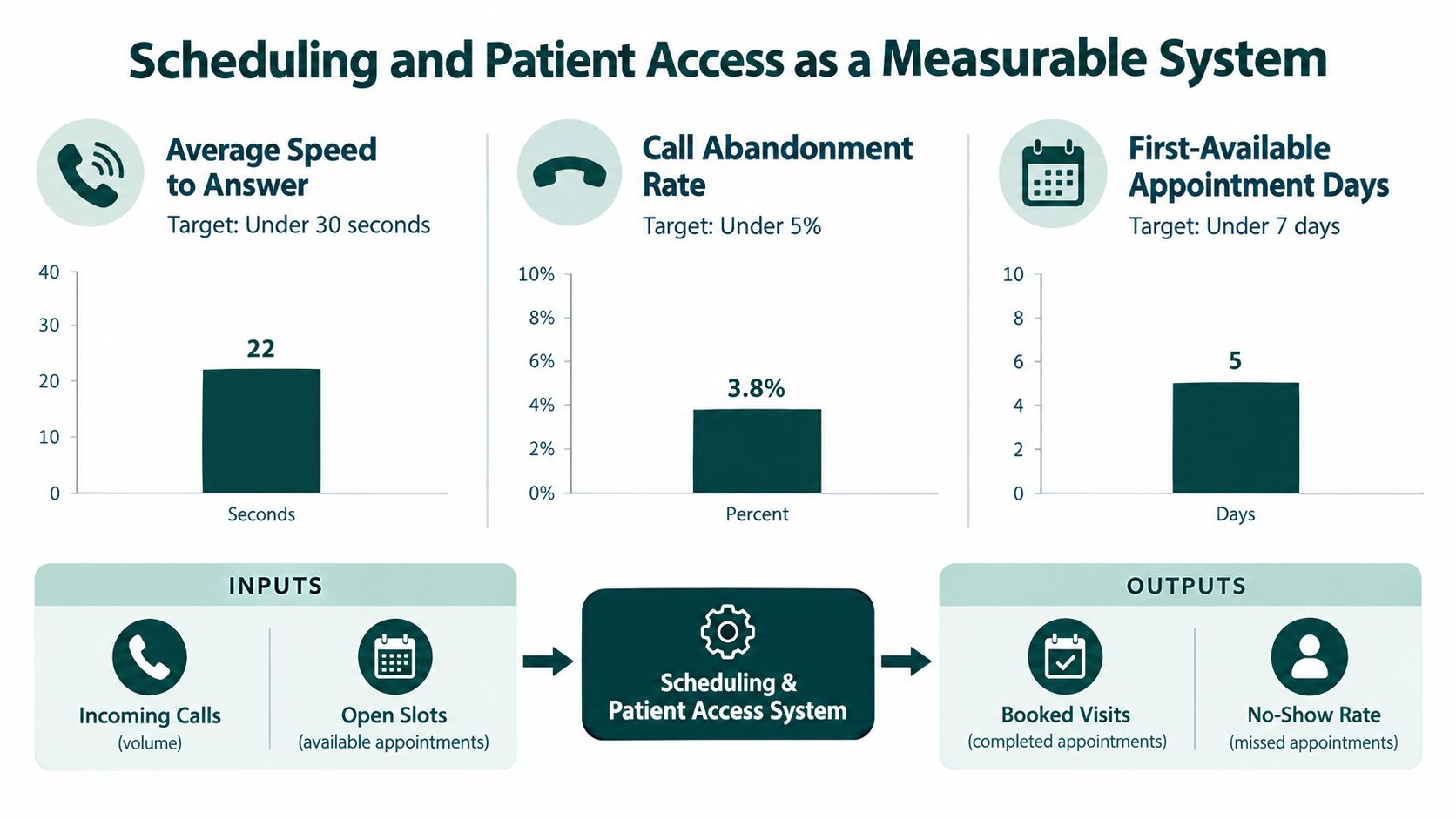
A practice can have polite receptionists and still provide poor access. The more useful question is whether patients can reach the right function, receive an accurate appointment, and get a timely response without repeating the same request.
A cross-case study of six high-performing Veterans Health Administration primary-care sites examined facilities with a time to the third-next-available appointment of six days or less, compared with a national average of 10 days, despite at least 5% enrollment growth. The study of telephone access and primary-care operations examined dedicated telephone capabilities for appointment scheduling, daytime nurse triage, telephone operating services, and pharmacy calls. Its operational lesson is clear: separating call purposes can work better than forcing every request into one general queue.
Use queue signals instead of daily averages
Daily call totals hide the periods that determine patient experience. A practice should examine calls offered, answer speed, abandonment, transfer rate, first-contact resolution, scheduling conversion, message error rate, and callback time by hour and weekday. Staffing against the busiest 15- or 30-minute intervals, rather than the daily average, gives managers a more realistic view of coverage needs.
The cause-and-effect pattern is predictable. Queue growth increases waiting and abandonment. Abandoned calls produce delayed scheduling or repeat calls. Repeat calls consume more receptionist capacity, which can increase congestion again. A dedicated receptionist during U.S. practice hours can interrupt that cycle by handling routine calls, bookings, confirmations, recalls, waitlists, and defined message escalation.
Measure the work that patients experience: An answer isn't a successful interaction if the appointment type is wrong, the message goes to the wrong queue, or the patient has to call again.
Digital scheduling doesn't remove the need for access coordination. One survey reported that 81% of surveyed U.S. patients wanted to schedule from home or a mobile device, while 55% of providers believed patients were unsure how to use self-scheduling and 37% identified patient education on digital tools as a major challenge. Those figures appear in coverage of patient and provider views on healthcare access. A separate survey of scheduling organizations found that most had adopted some form of self-scheduling, while the majority booked fewer than one-third of appointments through those tools.
Self-service works for straightforward requests. It struggles with new patients who aren't sure which visit type they need, referrals, payer restrictions, language needs, accessibility concerns, and symptoms that require protocol-based escalation. A receptionist becomes the human safety net around automation, not a redundant phone operator. Managers building a broader process can use an appointment setting playbook for 2026 as a planning reference, then define local metrics and escalation rules.
How the Role Changes by Medical Specialty
A receptionist trained for primary care won't automatically be ready for dental, behavioral health, veterinary, or optometry workflows. The communication skills transfer, but the scheduling logic, records, payer questions, and escalation patterns change materially.
Specialty-specific priorities
Primary care and internal medicine depend on controlled intake and accurate routing. The receptionist may need to distinguish a routine physical, follow-up, medication-related message, preventive visit, or symptom concern without diagnosing. Approved scripts should collect standardized information and route clinical questions to nurses or providers. The primary care and internal medicine staffing overview can help managers separate patient access work from clinical ownership.
Dental and orthodontic practices often place greater emphasis on procedure-specific scheduling, insurance verification, treatment-plan coordination, and missed-appointment recovery. A receptionist who books a procedure into an unsuitable slot can disrupt both chair utilization and the patient's expectations. Interview exercises should test how candidates confirm the service needed without promising coverage or clinical outcomes.
Mental health and therapy clinics require careful handling of privacy, provider matching, recurring appointments, cancellations, and communication tone. Patients may be especially sensitive to delays or unclear messages. The receptionist should know when to follow a crisis or urgent-contact protocol, but shouldn't interpret symptoms or make independent clinical decisions.
Veterinary practices combine client communication with species-aware intake. The receptionist may need to capture the animal's species, reason for visit, urgency indicators defined by the clinic, and owner contact details. A general medical scheduling script can fail because it doesn't ask the information the veterinarian needs.
Optometry, med-spa, and physical therapy settings may involve provider-specific services, equipment or procedure timing, referral requirements, recurring visits, and retail or elective-service questions. These practices still need careful boundaries around clinical questions, especially when patients ask whether a symptom or treatment is appropriate.
| Specialty | Top Receptionist Priorities | Common Failure Mode | Useful Interview Question |
|---|---|---|---|
| Primary care | Reason-for-visit intake, routing, preventive and follow-up scheduling | Treating symptom questions as ordinary booking | “How would you document and escalate a patient message you cannot answer?” |
| Dental and orthodontic | Procedure matching, insurance information, chair scheduling | Booking the wrong service or duration | “What would you confirm before scheduling a new treatment visit?” |
| Mental health and therapy | Provider matching, recurring visits, privacy-sensitive communication | Casual handling of sensitive messages or cancellations | “How would you respond when a patient asks for clinical guidance?” |
| Veterinary | Species-aware intake, urgency routing, owner communication | Using a human-clinic script that misses relevant details | “Which details would you collect before routing an urgent animal-care call?” |
| Optometry and med-spa | Service matching, provider calendars, referral or preparation details | Promising eligibility, results, or treatment suitability | “How do you explain administrative next steps without giving clinical advice?” |
A generic rubric that tests only phone manners will miss these differences. Specialty training should include sample calls, appointment-type exercises, message categorization, and realistic handoff drills.
Core Skills That Predict First-Year Success
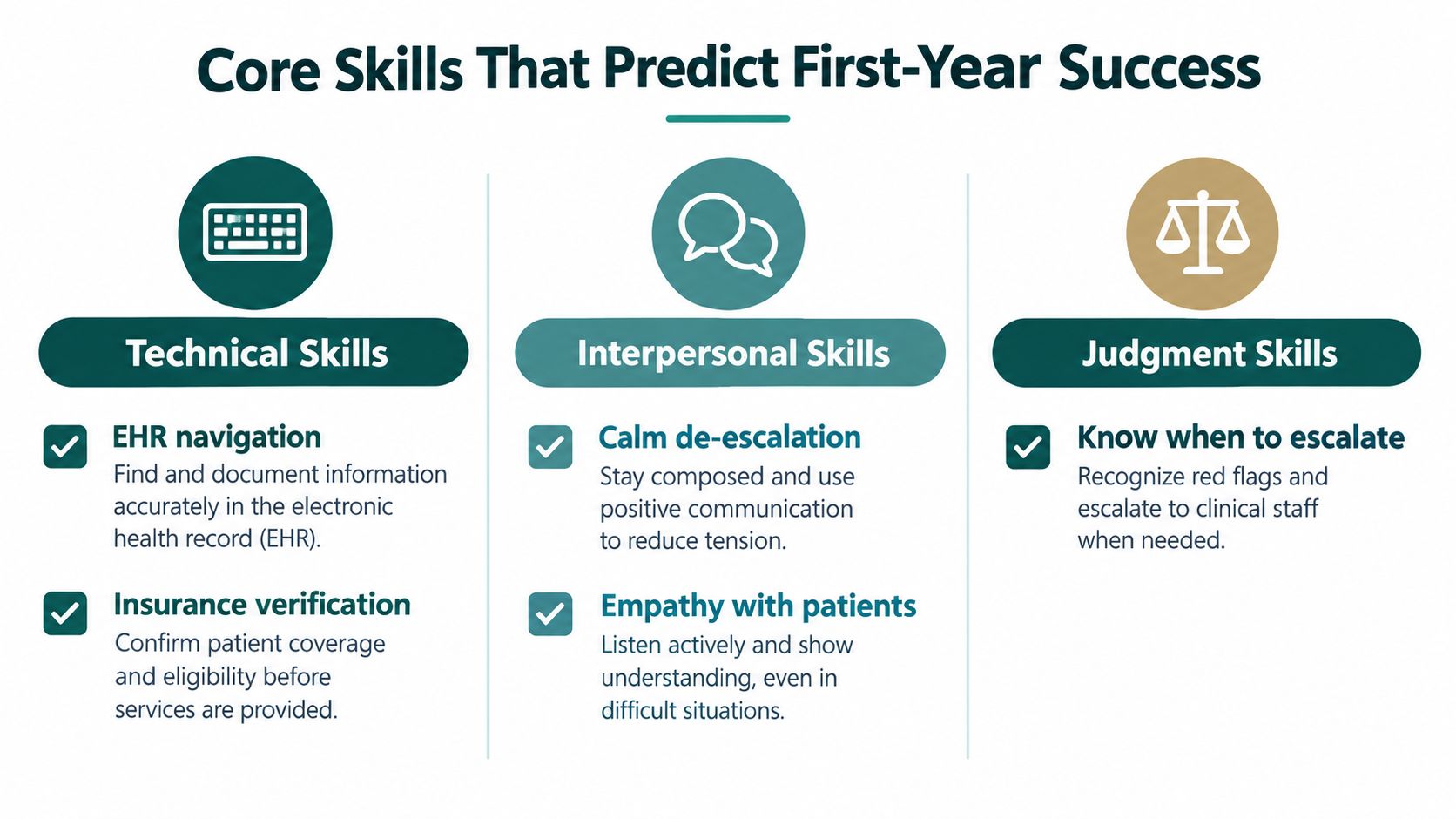
The strongest medical office receptionists combine technical fluency with judgment. A candidate may be friendly and organized yet still create problems if they can't identify the correct appointment type, document a message clearly, or stop before answering a clinical question outside their role.
Technical skills that support accurate work
EMR and practice-management navigation can be taught, but candidates should demonstrate comfort learning structured systems. The practical test isn't whether someone knows a particular platform. It's whether they can locate the right chart, verify identity, enter information in the correct field, select the correct message category, and avoid copying sensitive information into an inappropriate channel.
Payer-aware scheduling and basic insurance verification also matter. Receptionists don't need to make coverage promises, but they should know which information to collect, when a referral or authorization question requires another team, and how to document an unresolved issue. Written communication should be concise enough for a nurse, provider, or billing specialist to act without calling the patient again.
Judgment and communication under pressure
The harder skills to coach are escalation discipline, calm tone, scope awareness, and consistent documentation. A receptionist may face an angry patient, a delayed provider, a full schedule, and an uncertain message at the same time. The correct response isn't to improvise a medical answer or make an unsupported promise. It's to use the approved script, capture the required facts, and hand the issue to the designated person.
A practical hiring scorecard can use five categories:
- System navigation: Completes a sample registration or scheduling task accurately.
- Access judgment: Chooses the correct administrative queue for several call scenarios.
- Communication: Explains next steps clearly in writing and by phone.
- De-escalation: Maintains a respectful tone while setting realistic boundaries.
- Privacy awareness: Verifies identity, limits disclosure, and protects screens and messages.
Don't evaluate candidates by saying they are “HIPAA certified.” HHS doesn't recognize an official HIPAA certification. Instead, assess whether the person has received relevant training, understands the practice's procedures, can protect patient information, and knows when to ask for help. The broader medical administrative skills overview can help managers turn those requirements into an onboarding plan.
Training should start with scripts and supervised practice, then move to sampled-call review. Measure protocol adherence, documentation completeness, correct escalation, and privacy controls. Speed matters, but fast inaccurate work creates rework that the rest of the practice must absorb.
Remote and Hybrid Receptionist Coverage
Remote coverage works best when the practice treats location as a staffing choice, not as a substitute for workflow design. Call handling, appointment booking, confirmations, recalls, waitlist work, records requests, and some insurance verification can transfer cleanly when the remote receptionist has defined access and clear ownership.
The difficult work involves ambiguity. Symptom-related calls, medication questions, abnormal insurance findings, unclear appointment requests, and messages that could be interpreted as urgent require structured categories and named clinical escalation paths. A remote receptionist shouldn't diagnose, interpret test results, change medications, or determine clinical urgency outside approved rules.

The compliance and contract layer
A remote receptionist who creates, receives, maintains, or transmits electronic protected health information on behalf of a practice is generally a HIPAA business associate. Before access is granted, the practice must obtain satisfactory written assurances that the business associate will safeguard the information. HHS explains the required elements in its Business Associate Agreement guidance, including permitted uses, safeguards, subcontractors, and security-incident reporting.
A confidentiality agreement alone isn't a replacement for a HIPAA-compliant BAA. The agreement and internal procedures should define permitted tasks, access levels, escalation thresholds, documentation expectations, and who owns clinical review. Practices should also verify the controls used by cloud systems, phone platforms, messaging tools, and any subcontractors handling protected information.
HHS states that cloud services and mobile devices can be used to access electronic protected health information when appropriate physical, administrative, and technical safeguards are in place and relevant service providers have BAAs when they handle ePHI. The HHS business associate FAQ supports that distinction. Remote work isn't automatically prohibited, but it isn't automatically safe either.
Design the operating controls
A practical remote or hybrid model should document:
- Allowed systems: List the phone, scheduling, EMR, billing, records, and messaging tools the worker may use.
- Access boundaries: Grant role-based permissions and remove access that isn't needed for the job.
- Workspace standards: Require a private workspace, protected screens, controlled printing, and secure device practices.
- Audit trails: Review selected calls, messages, appointment changes, and access logs.
- Downtime procedures: Define what happens when the EMR, phone system, or internet connection is unavailable.
- Escalation ownership: Name the nurse, provider, manager, or billing lead responsible for each exception category.
On-site coverage still makes sense when the job includes physical documents, cash handling, walk-in volume, or tasks that depend on immediate room coordination. Hybrid coverage can fit practices where a local employee manages check-in and physical needs while remote staff handle calls, scheduling, reminders, records, or insurance work. The right model follows the workflow and control requirements, not a blanket assumption that remote staffing is always cheaper or always better.
The Takeaway
Medical office receptionists should be managed as patient-access coordinators whose work affects scheduling, records, communication, and basic revenue-cycle processes. The strongest practices define specialty-specific duties, measure queue and scheduling performance, and train staff to separate administrative navigation from clinical judgment.
In the first 30 days, document the call and message queues, measure performance by the busiest time intervals, and create scripts for common appointment and escalation scenarios. Then audit a sample of interactions for identity verification, appointment accuracy, documentation completeness, privacy, and correct handoff. Remote coverage can work when the practice has clear role boundaries, appropriate BAAs, controlled access, and metrics that show whether patients are reaching the right service.
MedicalVirtual offers U.S. medical practices pre-vetted LATAM healthcare talent for virtual receptionist, patient coordination, insurance verification, billing support, and related administrative roles, with coverage aligned to practice hours. If you're evaluating remote front-desk staffing, visit MedicalVirtual to review role options and discuss a practical coverage model.