

A clinical assistant is a supervised healthcare worker who combines patient-facing clinical support with administrative operations under a physician's direction. In the United States, the federal occupational title commonly used for this role is “medical assistant,” but the tasks an individual can perform depend on state law, employer policy, training, and supervision.
If you're considering a hire, the question isn't just what the job title means. It's which parts of your patient and administrative workflow need an owner, whether those tasks require someone onsite, and how you'll keep clinical decisions with qualified providers. A well-scoped assistant can connect intake, documentation, scheduling, and follow-up instead of leaving each task stranded in a different queue. A poorly scoped role can create confusion about who is allowed to do what.
The distinction matters especially when you're weighing an in-office medical assistant against remote support. Some work requires hands-on patient care; other work, such as scheduling or referral coordination, can often be handled remotely with the right access controls and escalation rules. The practical decisions are how to define the role, separate clinical from administrative duties, choose the right title and setting, fit the assistant into specialty workflows, manage AI-assisted documentation, and measure whether the hire is easing a real bottleneck.
Defining the Clinical Assistant Role
A clinical assistant supports the patient visit and the practice's operations under clinician direction. In the U.S., the federal O*NET profile for medical assistants describes a blended occupation, not a receptionist role and not an independently practicing clinician. That distinction should shape the job description from the start: the assistant can prepare information, carry out assigned tasks, and keep work moving, while the provider retains clinical judgment.
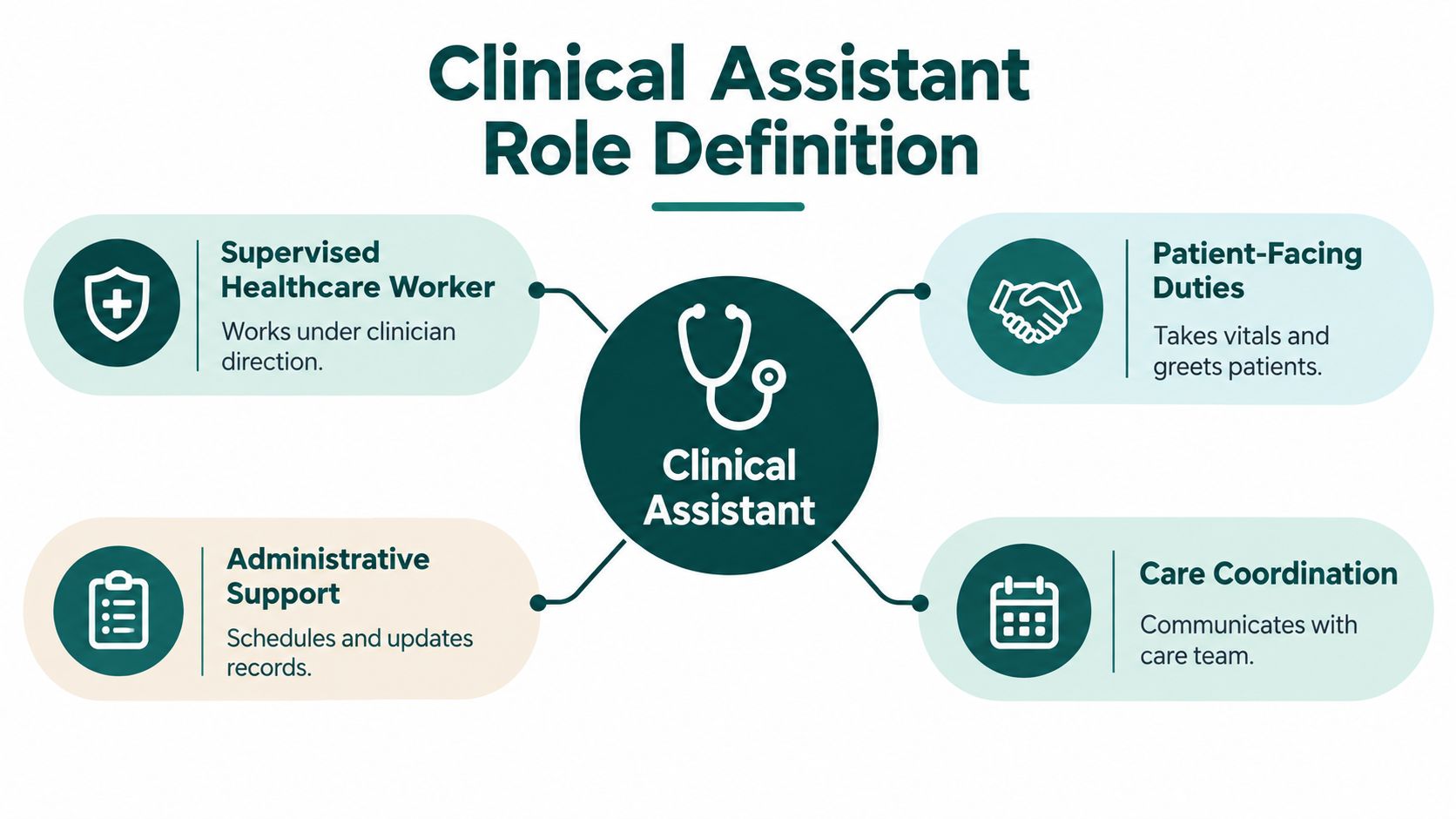
One role, several connected workflows
The work may begin at the front desk, continue through rooming and documentation, and end with instructions or follow-up coordination. That breadth is the role's operational value: a single trained person can help pass accurate information between the patient, the clinical team, and administrative staff. Practices exploring how remote support fits into that broader structure may also find this overview of a virtual assistant for healthcare clinics useful.
But “clinical assistant” isn't a universal license or a guarantee of a uniform task list. State rules, the practice's policies, the assistant's training, the specialty, and the level of supervision all affect what work is appropriate. A task that's allowed in one setting may need a different process or an onsite clinician in another.
Keep clinical judgment with the provider
An assistant may gather a medical history, record information, prepare a room, or route a patient's message according to an established protocol. That doesn't authorize the assistant to diagnose a condition, independently interpret findings, decide on treatment, or give medical advice. When a patient reports a new or worsening symptom, the assistant's job is to follow the practice's escalation process, not make a clinical call.
Write the scope down. Define the tasks the assistant owns, the work that needs provider review, and the situations that require immediate escalation. That clarity protects patients and gives the assistant a usable operating guide.
Core Responsibilities Across Clinical and Administrative Work
The Bureau of Labor Statistics' medical assistant profile describes duties on both sides of the practice: administrative work such as scheduling, records, billing, and coding, and clinical support such as taking histories and vital signs, preparing patients, and assisting physicians. The blend is useful, but it's also where job descriptions go wrong. Listing every possible duty without saying who performs it, where, and under whose direction leaves the scope open to interpretation.
Assign work by setting and authority
A remote assistant can often take ownership of non-invasive workflows that rely on accurate communication and system access. Those may include appointment scheduling, records requests, insurance verification, documentation support, authorization tracking, and message routing. A remote employee shouldn't be assigned hands-on procedures or asked to make clinical decisions because a task is waiting in the queue.
| Task family | In-office assistant | Remote assistant | Requires licensed clinician |
|---|---|---|---|
| Patient intake and history | Collect information as directed | Gather intake information through approved workflows | Interpret clinical meaning or decide next steps |
| Rooming and vital signs | Prepare the room and record vitals when permitted | Not a substitute for in-person rooming | Assess findings and make clinical decisions |
| Specimens and procedures | Assist onsite when trained and permitted | Not appropriate for remote performance | Direct or perform work when required by scope and policy |
| Records and documentation | Update records and support documentation | Provide documentation support and manage records workflows | Review and authenticate clinical documentation |
| Scheduling and follow-up | Schedule, confirm, and coordinate | Schedule, send approved communications, and route replies | Handle clinical questions and treatment decisions |
| Insurance and authorizations | Gather forms and track requests | Verify coverage, submit paperwork, and monitor status | Determine medical necessity and approve clinical content |
This matrix is a starting point, not a replacement for state-specific review. If the practice can't clearly assign an activity to a trained person with the right supervision, keep it out of the job description until the policy is clarified.
Put the boundaries into daily procedures
For each recurring task, identify who starts it, what information they can access, what counts as an exception, and who receives an escalation. For example, a remote coordinator might gather records for a referral and flag a missing test result. The clinician still decides whether the available information is adequate for care.
Practical rule: Delegate the process, not the clinical judgment. A written workflow should make it obvious where the assistant's responsibility ends.
How Clinical Assistant Differs From MA, CMA, and MAA
These labels can overlap in everyday conversation, but they don't necessarily describe the same work or credentials. Medical assistant (MA) is the broad U.S. occupational title for a role that may combine clinical support and administrative duties. Certified Medical Assistant (CMA) generally signals that an individual holds a particular certification, but a credential doesn't automatically establish that every task is permitted in every state or practice. Verify the credential and assess the candidate's current skills rather than relying on the initials alone.
Medical Administrative Assistant (MAA) usually describes an administrative-focused position. In practice, an MAA may handle scheduling, records, billing support, or patient communication without taking on rooming or other hands-on clinical duties. That can be a better fit than a blended clinical role when your actual backlog is at the front desk or in the revenue cycle.
| Title | Credential required | Clinical tasks | Administrative tasks | Best fit |
|---|---|---|---|---|
| MA | Requirements vary by role and jurisdiction | May support permitted, supervised clinical workflows | May schedule, maintain records, and support billing | Practices needing a blended role |
| CMA | Certification is indicated by the title; verify the specific credential | Depends on applicable rules, training, and supervision | May also handle administrative workflows | Practices seeking a candidate with documented certification |
| MAA | Don't assume a clinical credential from the title | Typically not the focus of the role | Scheduling, records, billing support, and communication | Administrative backlogs without hands-on duties |
Don't treat a credential as a substitute for a task-level scope review. Ask candidates what systems and workflows they've handled, confirm any credential directly, and check whether the planned duties fit your state's requirements and internal policies.
The distinction between documentation support and clinical care also matters when a practice compares assistants with scribes. This guide to medical assistants versus medical scribes can help clarify which role should own encounter documentation and which should support the broader visit workflow.
How the Role Functions Inside Real Practices
The same job title can describe different work in different specialties. The right design starts with the workflow that's slowing the team down, then assigns tasks according to setting, training, and supervision. A role built for primary care won't automatically fit a therapy group or a multi-site specialty practice.
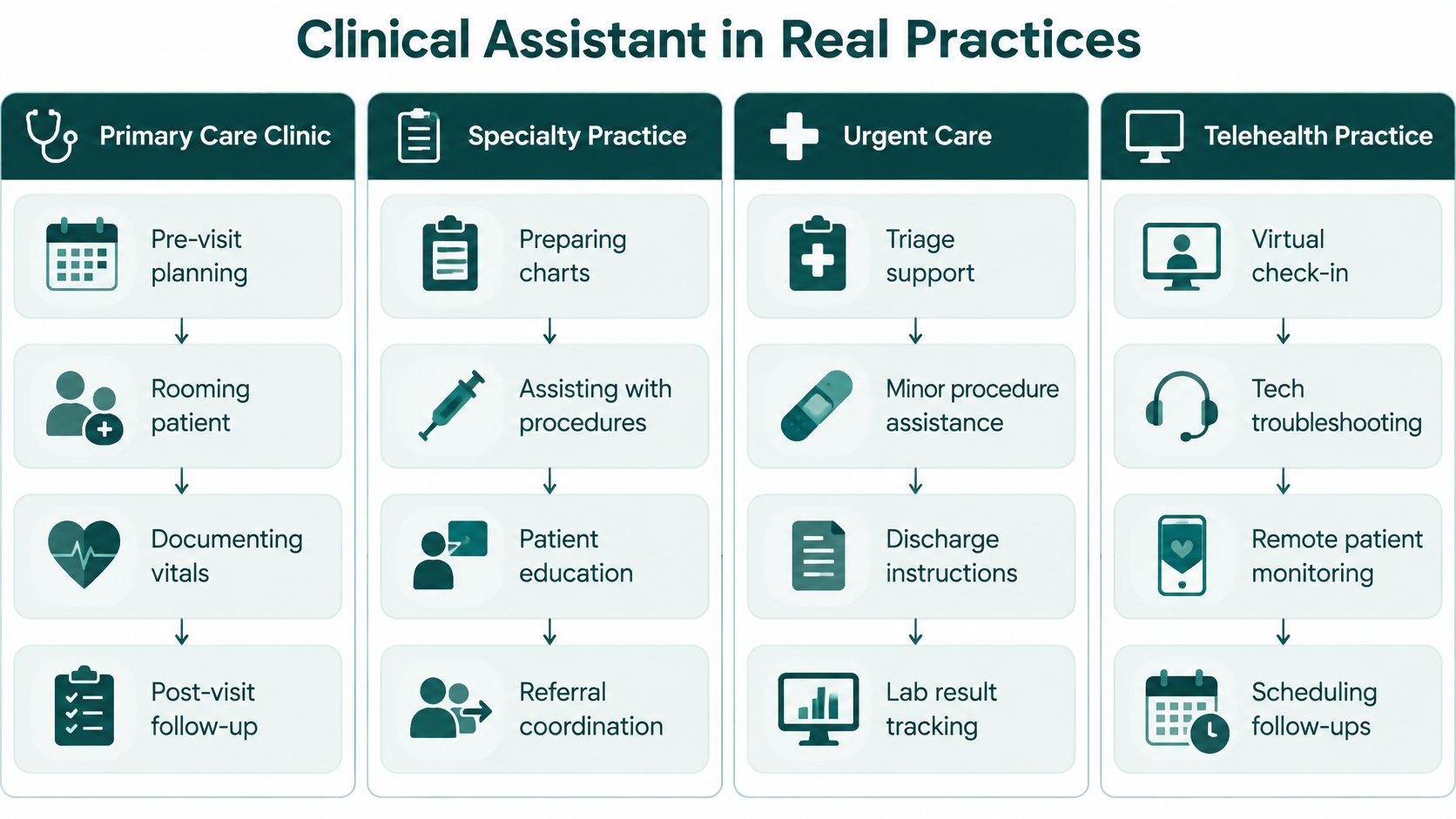
Match the assignment to the specialty
In primary care, an in-office assistant may prepare charts, room patients, record information within the approved workflow, and help coordinate follow-up. A remote assistant could focus on appointment requests, records, inbox routing, or documentation support. The handoff needs to be clear: messages that include clinical questions go to the provider or designated clinical staff, not into a general scheduling queue.
A mental health or therapy practice may place more emphasis on scheduling, consent-form workflows, benefit checks, and records coordination. Those tasks can improve the administrative experience, but a remote assistant shouldn't interpret symptoms or make clinical decisions about a patient's care. The practice should define which messages require a clinician and how urgent concerns are routed.
In a dental or orthodontic office, an onsite assistant may support room preparation and other permitted hands-on tasks. Administrative support can focus on recall scheduling, records, billing follow-up, and treatment-plan coordination. In a multi-site specialty group, a shared coordinator may handle referrals, records requests, and prior-authorization tracking across locations, while each clinical team retains responsibility for care decisions and any onsite work.
Start with one high-friction handoff
Don't delegate an entire department before you've identified the work that consistently falls between people. Pick one recurring queue, document its steps, and name an owner and an escalation path. For a primary care clinic, that might be the gap between a completed visit and a closed chart. For a specialty office, it might be a referral packet that's incomplete or awaiting payer action.
Delegated documentation can also affect the provider's day. Evidence summarized by the National Academy of Medicine in a review of physician burnout indicates that support personnel handling documentation tasks, including EHR data entry and inbox work, can improve clinician satisfaction and reduce burnout. The operational point is straightforward: an assistant helps most when the work connects to a real handoff, rather than being added as an unstructured layer of staffing. For examples of how teams organize those handoffs, see these care coordination examples.
Where AI Stops and the Human Assistant Starts
AI scribing can reduce some documentation work, but it doesn't remove the need for a person to review the output and manage the surrounding workflow. A 2025 evidence summary on ambient AI scribes reported a 20.4 percent reduction in note time per appointment, a 30.0 percent reduction in after-hours work, and a 9.3 percent increase in same-day appointment closure in a cited study. The summary also emphasized that clinicians must review and approve generated notes, and that evidence on accuracy, trust, privacy, and implementation remains limited.
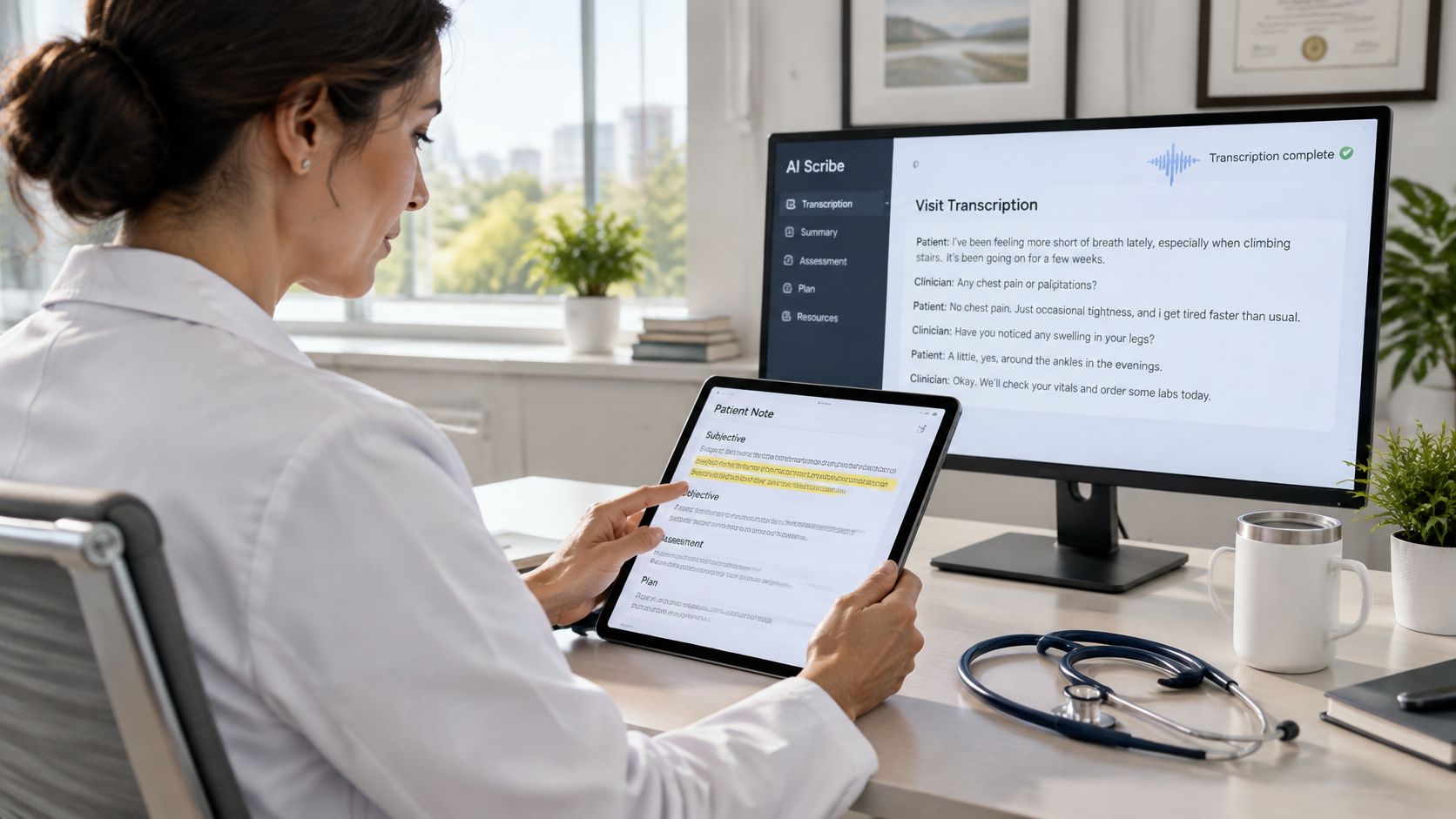
Automate narrow tasks, keep a person accountable
An AI tool may draft a note, but it doesn't own the patient message that arrives afterward, resolve a missing record, or ensure that an authorization request moves through the right payer process. A human assistant can check whether information is incomplete, route work to the correct person, and flag exceptions. That human-in-the-loop approach to automation is also discussed in this overview of HITL automation from Magnitude Marketing.
Start with a narrow automation use case and a review process. Decide which outputs require clinician approval, who corrects an error, and how the practice records that correction. The clinician remains accountable for clinical decisions and the final record. Don't let an AI-generated note or message pass into a patient's chart or inbox without the review your policies require.
Measure the work that remains
Track whether notes close the same day, how often a clinician needs to correct an AI-generated entry, and how quickly the team routes messages and authorization tasks. Those measures show whether automation is reducing one kind of effort while creating another. If staff spend time fixing incomplete drafts or chasing exceptions, the total workflow may not have improved.
Automation can draft or sort. A named person still needs to own review, exceptions, and escalation.
When a Practice Should Hire a Clinical Assistant
Hire against a defined bottleneck, not because another practice uses the title. First identify whether the pressure is in patient access, documentation, authorizations, or hands-on care. Then decide whether the work requires someone onsite, can be performed remotely, or needs a split arrangement. A remote hire is not a safe substitute for a person who must collect a specimen, assist with an in-room procedure, or perform another hands-on task.
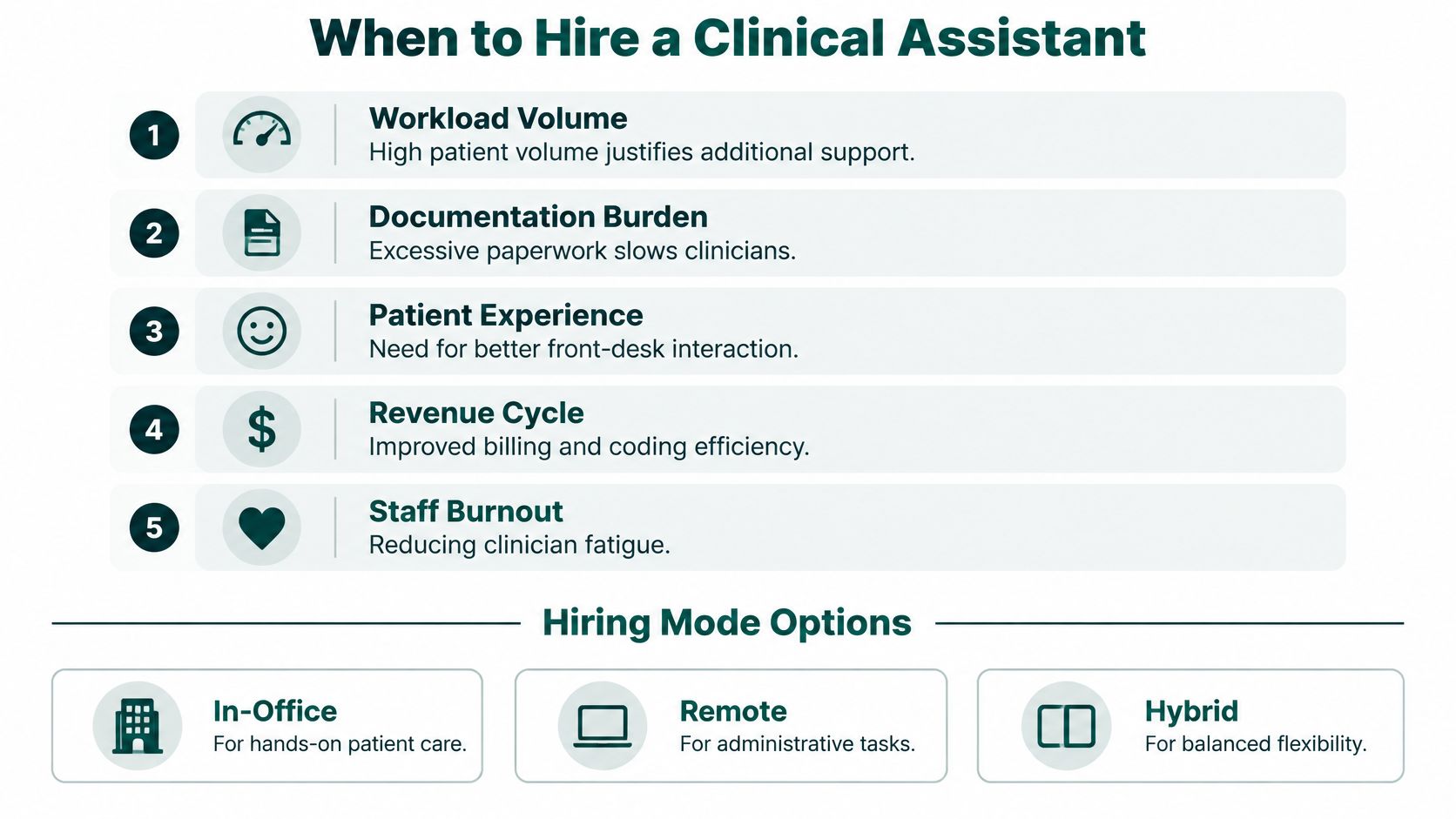
Use a practical hiring checklist
- Confirm scope and supervision: Check state requirements, employer policy, and the supervising clinician's expectations before assigning clinical tasks.
- Name the workload: Review calls, messages, open charts, authorization work, and appointment coordination to see where work is accumulating.
- Account for specialty needs: Separate hands-on duties from tasks such as intake, records requests, and referral coordination.
- Check the privacy setup: Decide which systems the assistant needs, what information is necessary for the role, and how access will be controlled.
- Choose the setting: Hire onsite for work that requires physical presence. Consider remote support for defined administrative and documentation workflows.
A remote assistant who creates, receives, maintains, or transmits protected health information on behalf of a practice may be a business associate. HHS guidance on cloud computing and HIPAA explains that covered entities must obtain satisfactory assurances that a business associate will safeguard electronic protected health information, typically through a Business Associate Agreement. A contract doesn't replace sound day-to-day security practices. Set individual accounts, restrict access to what the work requires, use approved communication tools, and document training and confidentiality expectations.
For prior authorizations, assign the coordinator to gather supporting records, submit requests through approved channels, track status, and escalate urgent or denied cases. The coordinator shouldn't choose a diagnosis or make clinical representations without authorization. CMS released its Interoperability and Prior Authorization Final Rule on January 17, 2024; several provisions for impacted payers begin January 1, 2026, and certain prior-authorization API requirements generally have a January 1, 2027 compliance date.
Measuring Whether the Role Is Working
Set the baseline before the assistant starts. Otherwise, you won't know whether the role improved the workflow or moved work from one person's queue to another. In an AMA Organizational Biopsy survey cited in 2025, physicians reported working an average of 57.8 hours per week, including 13 hours on indirect patient-care activities and 7.3 hours on administrative tasks, according to the AMA's guidance on reducing EHR documentation load.
Choose measures that match what the assistant owns. A documentation assistant should be evaluated differently from a scheduling coordinator, and neither should be judged on decisions reserved for providers.
| Workflow owned | Useful measure | What to review |
|---|---|---|
| Documentation support | Same-day note closure and unsigned-chart volume | EHR note status and provider review |
| Inbox routing | Turnaround time and escalation accuracy | Message queues and exceptions |
| Authorization coordination | Cycle time and aging requests | Payer status, missing items, and escalations |
| Scheduling | Appointment utilization and no-show patterns | Scheduling and practice-management records |
| Billing follow-up | Accounts receivable aging past 90 days | Billing reports and payer follow-up notes |
A metric is useful only if the practice defines it consistently. For example, agree on what counts as a completed authorization task and which cases are excluded because they need clinician input. Review a short dashboard regularly, investigate exceptions, and adjust the workflow when the measure points to a handoff problem rather than an individual performance issue.
For front-desk work such as calls, scheduling, and patient communication, compare the assigned duties with the broader scope of a medical front-office role. If the backlog doesn't change, check whether the assistant has the right access, training, task ownership, and escalation route before assuming the hire is a poor fit.
The Takeaway
A clinical assistant is best understood as an integrated operational role, not a fixed list of tasks. The assistant can connect patient-facing support with administrative work, but the practice must keep clinical decisions with qualified providers and define the scope according to state law, policy, training, and supervision.
This week, choose one bottleneck, write down the tasks and escalation rules, and decide which parts require an onsite employee. If remote support is appropriate, assess access controls and the business associate relationship before sharing protected health information. Then track a measure that reflects the work the assistant will own.
MedicalVirtual connects U.S. medical practices with pre-vetted Latin American assistants for defined administrative and documentation workflows, including scheduling, insurance verification, prior-authorization support, and scribing. If you're evaluating remote coverage, visit MedicalVirtual to discuss the role, workflow, and safeguards your practice needs.