

A medical administrative assistant handles scheduling, phone triage, patient registration, insurance verification, billing support, and records coordination, and does not perform clinical care or make medical decisions. That work sits inside a large U.S. occupation of about 979,000 jobs, with employment projected to reach about 1,026,100 positions, roughly 47,100 added jobs and 5% growth.
You are looking at tomorrow's schedule with open slots, a voicemail box that never cleared, and an imaging order that still has no authorization number. The useful question is which of those tasks you can hand to an administrative person, including someone off site, without handing over clinical judgment.
The job duties of a medical administrative assistant are coordination duties. They attach the right patient, visit, message, and payer detail to the right encounter so the day can run. They are not a stand-in for the clinician in the room.
This guide maps those duties to practice type, shift coverage, and the controls that keep the work accurate and private. You will see what belongs on the phones, what belongs in eligibility and claims, what an authorization queue must track, how remote access should be limited, and when an in-house hire, a direct remote hire, or a staffed assistant is the wrong fit.
What Medical Administrative Assistants Actually Do
Think of the assistant as traffic control and a paperwork hub. Cars still need a licensed driver. The hub decides which lane a request enters, which documents travel with it, and who gets the callback.
The U.S. Bureau of Labor Statistics classifies the occupation as medical secretaries and administrative assistants under code 43-6013, and that profile is the source of the job count and growth projection above. The same profile describes work that goes well past greeting patients. Core duties include transcribing dictation, preparing reports, taking basic medical histories, arranging hospital admissions, processing insurance payments, scheduling appointments, maintaining medical records, and coordinating information among patients, clinicians, laboratories, and insurers.

That mix is why generic clerical skill is not enough. The person has to read diagnostic and procedure language, understand basic coding concepts, and follow the operating rules of a clinic, hospital, or laboratory. A mismatch between patient, provider, appointment type, and payer is how you get the wrong visit length, a claim that never should have been sent, or a second call to a patient who already confirmed.
The pressure is real because administrative work already consumes a large share of clinician time. A 2023 American Academy of Family Physicians review reports that administrative tasks occupy about 50% of physicians' time, and that 57% of family physicians reported burnout, up from 47% in the comparison it cites. Chart review was 32.1% of the EHR-related workload described, visit documentation 23.7%, other clerical work such as order entry 16.6%, and billing and coding 3.9%. A 2017 study cited there found family physicians spent more than half the workday in the EHR, an average of 4.5 hours during clinic and 1.4 hours after hours, with nearly one-quarter of that time on documentation.
Administrative work versus clinical work
Many job posts blend front-office tasks with rooming, vital signs, injections, and specimen collection. Those are not the same job. The Bureau's medical assistant profile states that medical assistants may do both administrative and clinical work, that exact duties vary by employer and location, and that state law can limit clinical activities.
Safe administrative delegation usually includes:
- Scheduling and registration: book, confirm, cancel, and reschedule, and complete intake forms.
- Message routing: send refill requests, lab notices, and symptom messages to the person who is allowed to act on them.
- Insurance paperwork: verify eligibility, assemble referrals, and prepare claim support.
- Records movement: request outside charts, file results, and keep electronic and paper files current.
What you should not delegate is independent diagnosis, symptom interpretation, treatment selection, or clinical advice. An assistant can collect what the patient said and route a refill request. A licensed or properly authorized clinician decides what it means.
Scope line: If the task changes the medical plan, it does not belong to administrative staff, no matter how experienced they are on the phones.
Employer policy and state law still decide the edge cases. A small private practice sometimes trains one person to do both front desk and limited clinical tasks. A remote role cannot absorb hands-on care at all. Veterinary practices show the same paperwork boundary in a different setting. Accurate routing of records, referrals, and travel documents, including coordinating international pet health certificates, fails when nobody owns the document trail, even though no one expects that coordinator to diagnose the animal.
Before you write a remote job post, split the list into two columns. One column is scheduling, registration, eligibility, referrals, authorizations, billing support, records, and documentation support. The other is anything that requires a body in the room or a license. Hire and supervise against the first column only.
Front-Desk Work, Scheduling, and Phone Triage by Practice Type
Front-desk work is not one priority list you can copy from a hospital and drop into a therapy group. Check-in, registration, booking, confirmations, recall, and message triage all matter. Which one breaks the day depends on the practice and on whether a person is working your hours.
Federal occupational data treats appointment confirmation, diagnostic and procedure scheduling, intake-form preparation, and message routing as established tasks of this role, alongside insurance forms and file maintenance, as described in the BLS fact sheet for medical secretaries and administrative assistants. The operating question is which of those tasks you staff first.
What each practice should staff first
Primary care and internal medicine usually lose the morning to call volume and a recall list nobody touched. The costly miss is a chronic-care patient who never got the follow-up slot, not a slightly slow greeting. Mental health and therapy practices live on discretion. A voicemail that names a diagnosis, a cancellation that is left on a shared inbox, or a message routed to the wrong clinician creates harm that a dental office would experience as a mere scheduling error. Dental and orthodontic offices lose money when a chair sits empty. Same-day backfill matters more than a perfect recall letter. Multi-site groups fail at the handoff. A patient booked in the wrong location, or a message that dies between time zones, creates a no-show the original site never sees.
| Practice type | Highest-priority duties | Coverage need |
|---|---|---|
| Primary care and internal medicine | Call response, recall backlog, same-week booking, result-message routing | Live coverage through the clinic day, including the late-afternoon callback window |
| Mental health and therapy | Discreet voicemail handling, cancellation and no-show rules, strict message routing | Coverage that matches session hours, with a written rule for after-hours clinical risk |
| Dental and orthodontics | Chair-time protection, confirmations, same-day backfill from a waitlist | Coverage before the first patient and through the last hygiene block |
| Multi-site groups | Consistent registration scripts, location-correct booking, documented handoffs | Overlap across sites and time zones, not a single front desk that "usually" forwards |
Optometry, med spas, and physical therapy sit closer to the dental pattern when the product is a booked slot with equipment or a therapist attached. Veterinary hospitals often look like high-volume primary care, with the added twist that the caller may not be able to describe urgency clearly. In every case, phone triage for an administrative assistant means sorting and routing. It does not mean telling the caller whether the symptom can wait.
What a live shift can finish
An answering service can take a message at 9 p.m. It usually cannot rebuild tomorrow's schedule, confirm a recall patient, or tell a parent which location has the opening. A person working your U.S. clinic hours can. That is the trade-off owners miss when they buy overnight coverage and still walk into a full voicemail box at 8 a.m.
A message taken overnight is not the same work as a schedule repaired before the first patient arrives.
Measure this work by whether the book is usable, not by how many calls someone touched. Useful controls are appointment-booking accuracy, the share of charts complete before the visit, message-routing accuracy, and whether eligibility was finished before check-in. Call volume alone rewards speed and hides the wrong-patient booking.
If you run two sites, write the handoff in one paragraph anyone can follow. Who owns the unanswered call after 4 p.m. Which location's template is the default. What the assistant may say when a patient asks for clinical advice. Without that paragraph, remote coverage and in-house coverage fail in the same way. Work lands in a queue with no owner.
Insurance Verification and Billing Support Tasks
Front-desk speed does not protect cash. Billing support runs on payer deadlines, not on the comfort of an internal work queue.
The routine that holds up is boring and daily. Before the visit, the assistant confirms the patient, the plan, the subscriber, and whether a referral or authorization is already on file. At check-in, registration should not be the moment everyone discovers the insurance card is for a plan you do not participate with. After the visit, someone enters charges, watches acknowledgments, works clearinghouse rejections, and posts payments or queues them for review. Waiting until month-end reporting is how a fixable rejection becomes a balance you cannot collect.
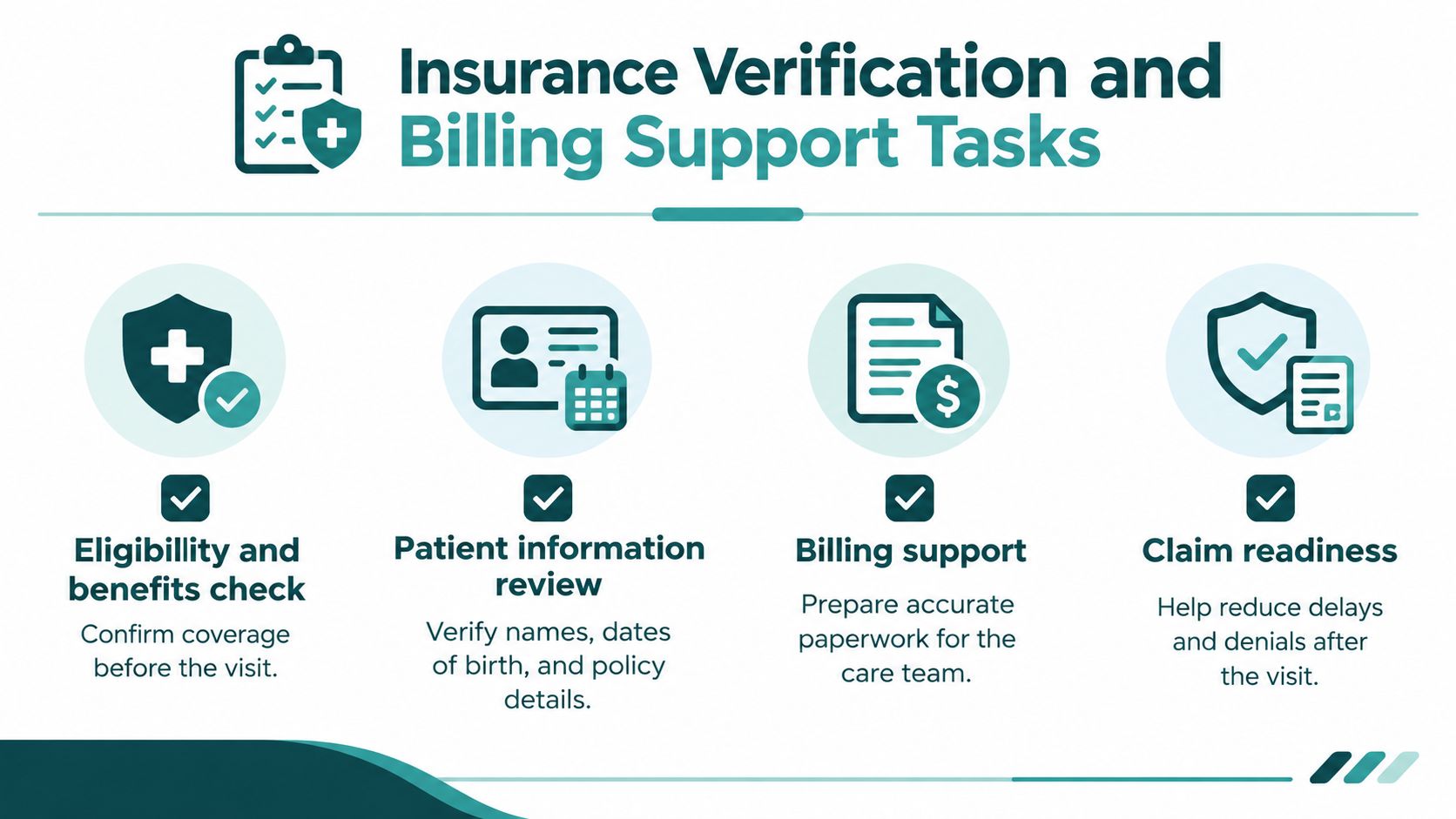
A daily verification and claim routine
Use this sequence as the default, then adjust it for your specialty and clearinghouse.
- Match the encounter. Patient, provider, location, appointment type, and date of service agree before anyone checks benefits.
- Check eligibility and benefits. Confirm active coverage, the network status you care about, and obvious visit limits or referral rules. Tell the patient what you verified and what you did not.
- Review registration data. Names, dates of birth, subscriber IDs, and group numbers match the card and the EHR. A nickname in the schedule and a legal name on the claim is a common rejection.
- Enter charges only from the signed encounter. The assistant prepares paperwork. Coding choices and medical-necessity questions stay with the person your practice has authorized to make them.
- Work the rejection queue the same day. Record payer, status, reason, the correction, and the owner. Do not leave a clearinghouse reject in a folder labeled "billing."
Medicare makes the deadline concrete. CMS states that Medicare professional claims on the CMS-1500 or 837P generally must reach the correct Medicare Administrative Contractor no later than one calendar year after the date of service. Claims after that timely-filing limit are denied, with limited exceptions, and a late-filing denial is not an initial determination you can appeal. When Medicare denies for late filing, the provider generally cannot shift the unpaid Medicare amount to the patient beyond deductible and coinsurance that would have applied if Medicare had paid.
A clean internal queue does not extend a payer's filing limit.
Commercial plans set their own limits, often shorter, so the Medicare year is a ceiling to understand, not a schedule to copy. Bookkeeping and Accounting of Florida's cash-flow insights are a useful reminder that revenue-cycle work is cash timing, not a stack of forms. Daily aging review catches the claim that is 20 days from a deadline. A month-end report often arrives after the money is gone.
What stays with qualified reviewers
Each assistant queue should show date of service, submission date, payer, claim status, rejection reason, correction action, and escalation owner. Claim or charge-entry exception rates tell you whether the handoff is working. They do not authorize the assistant to invent a diagnosis code or to decide medical necessity.
If you are staffing this slice remotely, define it as insurance verification specialist work with a written stop rule. The assistant may check eligibility, enter charges from an approved source, submit claims, monitor acknowledgments, work rejections, and call payers. A coder, biller, or clinician reviews coding, medical necessity, and anything that looks like an exception. That split is slower on day one and much cheaper than a year of unrecoverable denials.
Prior Authorization and Records Coordination Tasks
A provider orders an MRI on Tuesday. The payer wants recent notes, the imaging center wants an authorization number, and the request sits in a task box because the person who faxed it thought submission was the end of the job. By Friday the patient has no appointment and the clinician hears about it in the hallway.
That stall is an ownership problem. Prior authorization coordination turns a payer rule into a trackable sequence. Eligibility review, document collection, submission, status checks, escalation, and a plain update to the patient and the ordering clinician. The assistant assembles and routes. An authorized clinician supplies or approves the medical-necessity documentation. Those roles should not blur just because the deadline is close.
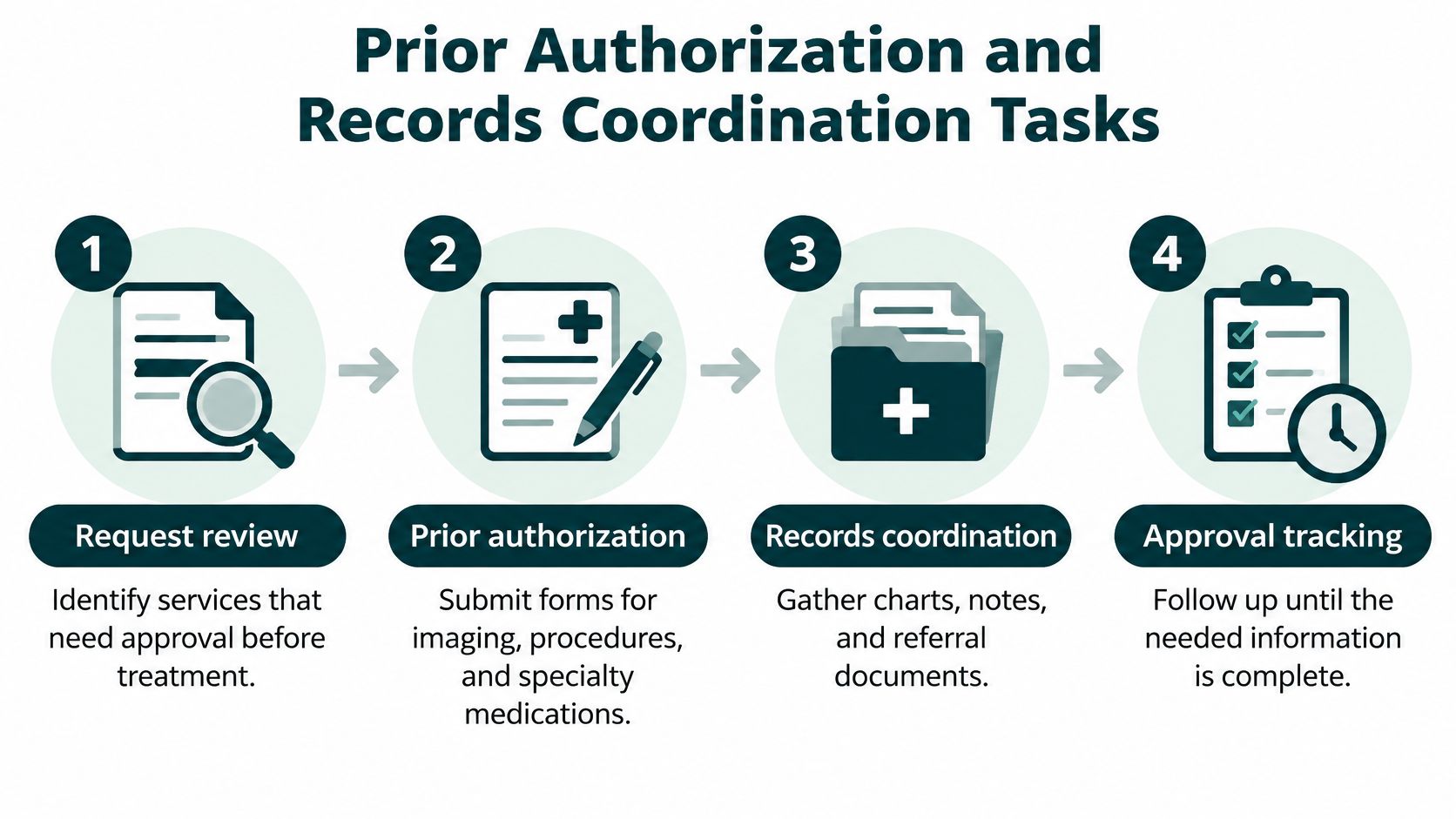
How a stalled request gets owned
The American Medical Association's 2025 survey of 1,000 practicing physicians shows why this cannot be a side task. Physicians complete about 40 prior-authorization requests per week, practices spend about 13 hours weekly on the work, and 40% of physicians have staff dedicated only to prior authorization. 63% reported that prescription drugs require authorization and 62% reported the same for medical services. 27% said EHR authorization information was rarely or never accurate. If your EHR's auth flag is wrong a quarter of the time, "the system will remind us" is not a control.
For the MRI, the coordinator checks whether that plan and that service need approval, pulls the notes and imaging history the payer listed, submits through the portal the plan uses, and writes the reference number down before closing the screen. The next morning the queue shows a follow-up date. If the plan asks for a different note, the request goes back to the clinician with the exact gap, not a vague "they need more information." The patient hears what is pending and what is scheduled. Nobody promises an approval the plan has not issued.
A practical tracker needs fields, not a color code.
- Identity: request date, patient, ordering clinician, service or medication, and site of service.
- Payer trail: payer, reference number, required clinical evidence, and the channel used to submit.
- Clock: next follow-up date, decision, denial reason, appeal deadline, and the named owner.
Daily queue review is the part practices skip. Missing records, a request sent to the wrong plan, and an expired follow-up date are visible a day later. They are expensive a week later, when the slot is gone and someone has to reschedule the patient and explain the delay. If you want a fuller walk-through of the sequence, see how prior authorization work is typically coordinated.
When the standard path is the wrong path
Payer rules differ by plan, drug, and site of care, and they change. Build one fast path before you need it. Define which orders count as urgent, who may interrupt a clinician, and which services you will schedule at risk. An administrative assistant should not decide that a delay is clinically safe. Specialty medication auths, in particular, fail when the assistant is asked to choose clinical alternatives after a denial. Collect the denial reason, note the appeal deadline, and return the decision to the prescriber.
Records work wraps around the same queue. Outside charts, referral letters, and lab attachments have to match the request. Sending the wrong patient's note is both a privacy incident and a failed auth. If your volume looks like the AMA's weekly load, give the queue a named owner for the hours you are open. A shared inbox with five people glancing at it is how the MRI sits until Friday.
Protecting Patient Information When Administrative Work Is Remote
Signing a business associate agreement does not finish the privacy job. It starts the part you can show a regulator. The daily risk is who can open a chart, export it, or talk about it on a personal phone.
HIPAA obligations apply when a remote worker or a staffing organization handles protected health information for your practice. HHS explains that business associates can include entities doing claims processing, billing, practice management, and related services, and that a covered entity must get satisfactory assurances through a business associate agreement. That agreement has to define permitted and required uses and disclosures, bar unauthorized use or disclosure, and require the associate to follow applicable Privacy Rule duties. HHS also states that the contract must require administrative, physical, and technical safeguards for the confidentiality, integrity, and availability of electronic PHI.
What the contract does not do by itself
The agreement does not set your EHR permissions, and it does not stop a shared login. Those are practice controls. HHS does not certify a person, a service, or a tool as "HIPAA certified." Treat any marketing line that says otherwise as a reason to read the contract, not as compliance. Requirements vary, and you should confirm the agreement and your safeguards with counsel or a compliance professional.
For a remote medical administrative assistant, limit access to the workflows you assigned. Scheduling, registration, records, billing, or messages. Convenience access to the entire chart, or an unrestricted export button, creates exposure you do not need. A receptionist who can download every note "just in case" is an incident waiting for a lost laptop.
Own these controls even when a vendor signs the BAA.
- Role-based access: unique credentials, no shared passwords, and permissions that match the written job, not the whole database.
- Approved channels: practice email, the EHR message center, or a documented portal. No patient details in personal texting apps.
- Training record: HIPAA training at onboarding and on a recurring schedule, with a date you can produce.
- Incident path: a same-day report route for misdirected faxes, wrong-patient messages, and lost devices.
- Offboarding: access removed the day the assignment ends, including vendor accounts and forwarded phones.
BoloSign's guide to HIPAA document management is a practical companion if your authorizations and intake packets move as signed files. The signature tool is not the control. The control is knowing which documents contain PHI, who can send them, and where the signed copy lives.
Give the assistant the minimum chart access that lets them finish the assigned queue, and nothing stored "for convenience."
If you are placing this work off site, read a practical guide to HIPAA-aligned virtual assistants beside your own policy, then match it to your EHR's actual permission sets. A policy that says "minimum necessary" and a user role that can export the whole practice are not the same design. Fix the role before the first remote login, not after the first audit.
Choosing In-House, Remote, or Staffed Administrative Support
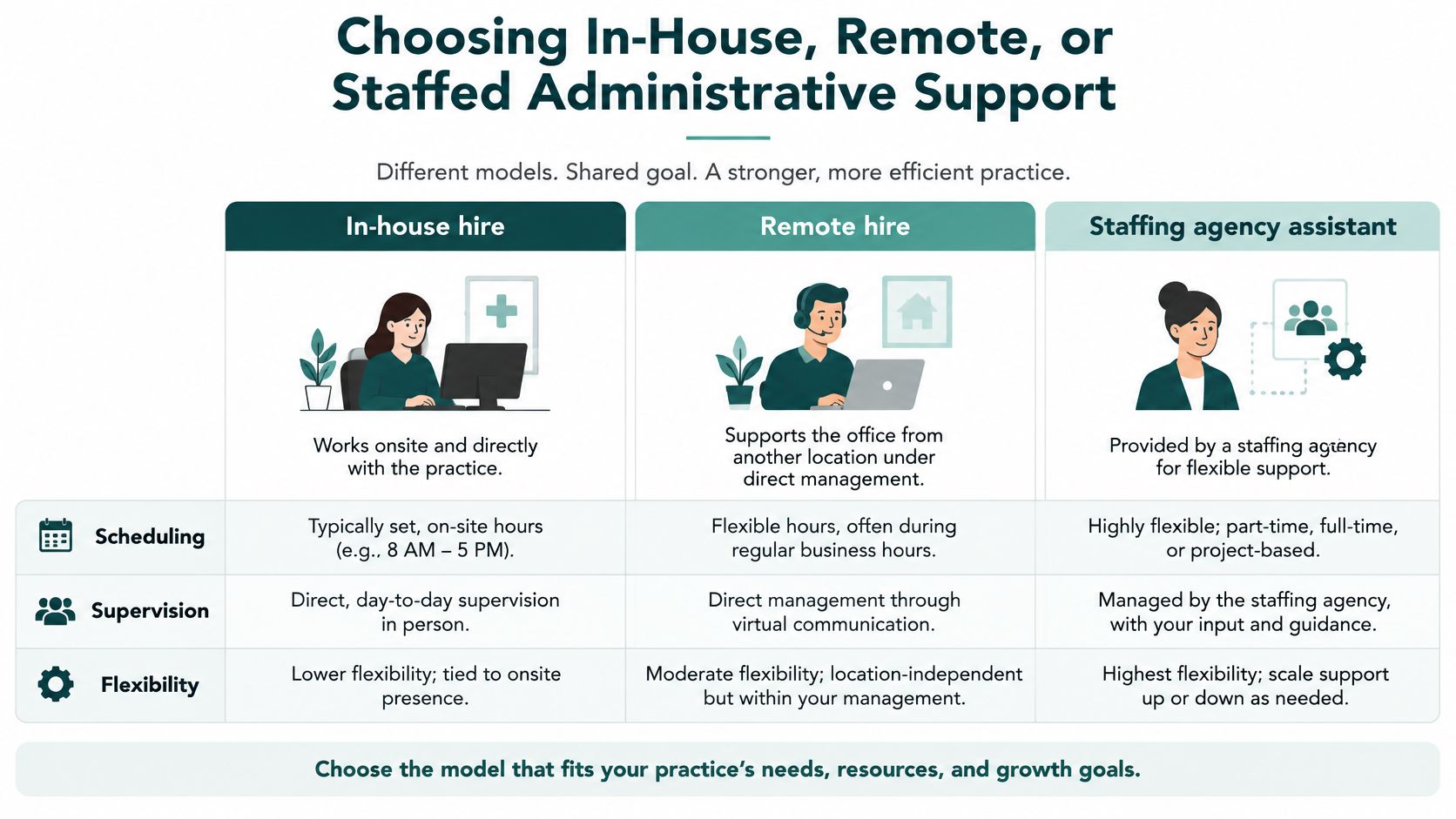
You can cover these duties three ways. Hire in the office, hire a remote person you employ and supervise, or take an assistant from a staffing provider. The duties do not change. Cost, control, vetting, and who carries the privacy workload do.
An in-house hire is the simplest to watch. You can see the front desk, hand over a paper referral, and correct a tone problem between patients. You also carry recruiting time, local wages, benefits, and coverage gaps when that person is out. The model fits when the job needs a body on site, such as rooming support you refused to mix into this role, cash handling you will not do remotely, or a single-site practice that wants one person patients recognize.
A remote hire you manage directly is flexible and often easier to align to U.S. clinic hours than an overnight service. You still own the vetting, the payroll setup, the contract, the BAA if a company is in the middle, and the access review. That is a good fit when you already have a manager who will audit queues every week. It is a poor fit when "remote" means a login and no owner.
A staffing provider moves recruiting, in-country employment, and much of the contract administration off your desk. You give up some say over the individual hiring path, so the intake interview and the written scope matter more, not less. It is a poor fit when the work requires someone physically in the office, or when you want a different person every week. Administrative accuracy comes from someone who learns your payers and your templates.
What software should not own
Automation does not erase the choice. A 2025 U.S. healthcare survey found professionals pointing to prior authorization burdens (67%) and EHR management (62%) as leading areas where generative AI could help, while 55% of respondents were uncomfortable with AI making diagnoses or treatment plans, and payer-related work remained the top practice challenge for 58%. Patients in that survey were more open to help with refills, scheduling, and check-in than with clinical decisions.
Use software for the repeatable pass. Reminders, routine eligibility pings, status checks. Keep a human on the exceptions. Failed eligibility, stalled authorizations, denials, ambiguous messages, no-shows, incomplete forms, privacy-sensitive requests, and payer disputes. AI adoption raises the need for quality checks, escalation rules, and an audit trail. It does not retire the assistant.
One staffing option built for this administrative slice is MedicalVirtual, which places pre-vetted, bilingual English and Spanish assistants who work U.S. clinic hours under a business associate agreement, with human-built shortlists and a single monthly price. Use it, or any similar model, for scheduling, verification, billing support, and authorization queues. Do not use it to cover licensed or hands-on clinical work.
Whichever path you pick, write the stop rules before the start date. Which queues exist, who reviews coding and medical necessity, which messages must reach a clinician the same day, and which EHR permissions are off. A strong hire with a vague scope will still book the wrong visit and open the wrong chart.
The Takeaway
The job duties of a medical administrative assistant involve coordination across patient access, documentation, and billing. They stop where clinical judgment and hands-on care begin. The assistants who help a practice are the ones who own exceptions, including failed eligibility checks, stalled authorizations, denials, and privacy-sensitive requests, instead of only clearing easy phone calls.
Map the duties to your practice type and to the hours you are open before you hire. Decide which tasks require an on-site or licensed person, and leave those off the remote list. Set role-based access, a business associate agreement when PHI is involved, and a queue that records dates, payers, reasons, and owners. Then let software take the repetitive pass and keep a person on the work that breaks when nobody is watching.
If you want that scope staffed by someone already screened for U.S. clinic workflows, start with a written list of queues and stop rules, and use it to request a shortlist rather than a generic receptionist resume.
MedicalVirtual places pre-vetted medical administrative assistants who cover scheduling, insurance checks, billing support, and prior-authorization queues during U.S. clinic hours. If you are separating those duties from clinical work and want a shortlist matched to your specialty and systems, visit MedicalVirtual and scope the role before you hire.