

A patient is scheduled for a procedure, the front desk sees active insurance, and everyone assumes the financial side is settled. Then the payer denies the claim because the provider was out of network, the authorization was missing, or the deductible had not been explained. By that point, the patient is frustrated, the provider's staff is chasing paperwork, and the practice is carrying avoidable revenue-cycle work.
A medical insurance specialist prevents many of these failures by owning the administrative insurance touchpoints between scheduling, clinical care, and billing. The role includes eligibility and benefit verification, referral and authorization tracking, claim preparation, denial follow-up, and clear documentation. It doesn't include diagnosing patients, deciding medical necessity, changing clinical records, or promising that a payer will reimburse a service.
For practice owners and managers, the central question isn't whether this role is useful. It's whether the specialist's duties, authority, and performance measures are defined clearly enough to improve access to care and payment collection. The sections below explain the work from the first eligibility check through claims follow-up, the skills that prevent avoidable denials, the differences between specialties, practical KPIs, and the compliance boundary that must remain in place.
What a Medical Insurance Specialist Actually Does in a Medical Practice
A medical insurance specialist is a non-clinical administrative owner of insurance information. The specialist connects the appointment desk, payer portals, electronic health records, clearinghouses, billing staff, and patients. In a small practice, one person may handle several of these functions. In a larger group, eligibility, authorization, coding, billing, and payment posting may belong to separate teams.
The role sits inside the revenue cycle, but it begins before the visit. The specialist confirms that the patient's plan is active for the date of service, checks the relevant benefit category, identifies network restrictions, and records the patient's likely responsibility. After the encounter, the same workflow may support clean claim submission, rejection correction, denial research, and payer follow-up.
That sequence matters because active coverage isn't the same as payment approval. Eligibility answers whether a plan appears active. Benefits describe what the plan may cover. Authorization determines whether the payer requires approval for a service. Network participation, medical necessity, coding, documentation, and claim adjudication affect the final payment separately.
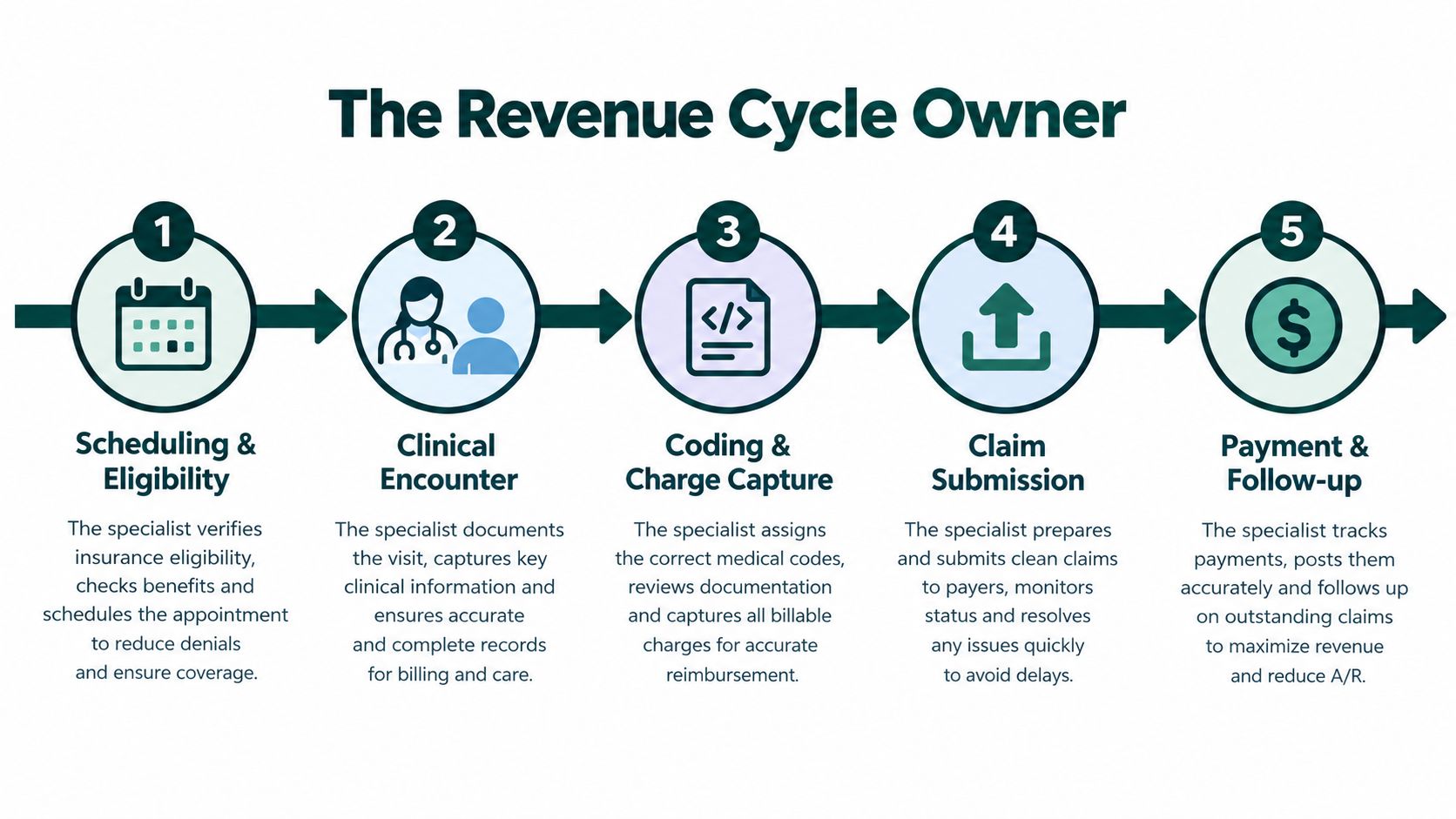
The role across the revenue cycle
The specialist's work commonly follows this path:
- Scheduling and eligibility: Confirm coverage, payer identity, network status, referral needs, and benefit details before the appointment.
- Clinical encounter support: Ensure authorization information and payer requirements are visible to the appropriate staff without interfering with clinical decisions.
- Coding and charge capture: Check that administrative data aligns with the submitted service information and route coding questions to qualified coding or clinical staff.
- Claim submission: Prepare or transmit complete claims through the practice management system or clearinghouse.
- Payment and follow-up: Review payer responses, correct rejections, investigate denials, and follow unpaid balances through the appropriate escalation path.
This is a measurable operational role, not a clerical catch-all. The Bureau of Labor Statistics groups related work under medical records specialists and health-information technicians. That group held approximately 200,700 jobs in 2025, with employment projected to grow 8% from 2025 to 2035, substantially faster than the average for all occupations, according to the Bureau of Labor Statistics overview of medical records specialists.
Practical rule: If a specialist's work can't be connected to a queue, a handoff, a payer response, or a measurable outcome, the job description is probably too vague.
A manager should define whether the position owns only pre-visit verification or also handles authorizations, claim edits, denials, payment posting, and patient financial communication. Those are related tasks, but they require different training and create different accountability.
Core Duties from Eligibility Check to Claims Follow-Up
The strongest workflow is chronological. Each step produces information that the next person can use without repeating the same payer call or searching through scattered messages.
Before the appointment
The specialist starts with the scheduled service, patient identity, payer, provider, location, and date of service. They use the payer portal, clearinghouse, or phone verification process to confirm active coverage and record the response. Benefit review should include the applicable deductible, copayment or coinsurance, out-of-pocket accumulators, service limits, referral rules, authorization requirements, exclusions, and network status.
The record needs a timestamp, payer reference number, portal confirmation, and the service being checked. A response should be reconciled against the planned CPT or HCPCS service and provider location. If the payer's language is unclear, the specialist shouldn't turn an uncertain response into a confident promise to the patient.
For higher-risk services, re-verification shortly before treatment is sensible because coverage and benefit information can change. The CAQH Index report on administrative transaction costs describes materially higher provider costs for manual benefit verification than for standardized electronic eligibility transactions. Electronic checks are useful, but they still need documented human review when the service, network, or payer response is ambiguous.
Authorization and referral control
Authorization work is a queue, not a single form. The specialist should collect the order, diagnosis and procedure codes, clinical notes, relevant imaging or laboratory evidence, treatment history, referring-provider details, payer criteria, submission channel, confirmation number, expected decision date, and appeal deadline.
A behavioral health request may require treatment-plan documentation and a peer-to-peer review. An imaging request may depend on prior conservative treatment or specific clinical notes. The specialist organizes the packet and tracks the payer's response, but the provider remains responsible for clinical information and medical-necessity decisions.
The American Medical Association reported that 94% of physicians said prior authorization delayed necessary care, 88% described the administrative burden as high or extremely high, and practices completed an average of 45 authorization requests per physician per week, consuming about 14 hours of physician and staff time, in the survey summarized by the Healthcare Business Management Association. Those findings support dedicated queue ownership, especially in specialties where an administrative delay can interrupt treatment.
Claims, rejections, and aging balances
After the encounter, the specialist may validate demographic and payer data, support charge entry, check claim completeness, and submit through the clearinghouse. The specialist shouldn't independently rewrite a diagnosis or alter a clinical note to secure payment. Coding questions should go to the coder or provider through a documented escalation process.
A rejected surgical claim may need corrected payer information, a coding review, or a resubmission. A denied claim requires a different analysis. The specialist identifies the denial reason, checks the remittance advice, gathers the needed documentation, and routes clinical or coding issues to the responsible professional. Aging balances then move into a follow-up queue with payer contact dates, reference numbers, next actions, and appeal deadlines.
| Duty | When Performed | Common Failure Point |
|---|---|---|
| Eligibility and benefits verification | Before the visit and when re-verification is triggered | Active coverage is treated as a guarantee of payment |
| Referral and authorization tracking | Before a restricted service | The authorization number never reaches the scheduler, coder, or billing queue |
| Claim readiness review | Before submission | Demographic, payer, location, or coding data doesn't match |
| Rejection correction | Immediately after clearinghouse feedback | Staff corrects the symptom without identifying the source error |
| Denial management | After adjudication | A coverage denial is confused with a coding or documentation denial |
| Payer follow-up | According to aging and appeal deadlines | Calls and reference numbers aren't documented consistently |
A practice that wants to reduce document hunting can also review a practical PDF BIRDS guide on document workflow automation. Automation can organize records and reminders, but it doesn't replace payer-specific judgment or provider review.
For practices that need dedicated pre-visit coverage work, an insurance verification service can be scoped around the practice's payer mix, systems, appointment types, and escalation rules.
Skills and Competencies That Separate Strong Specialists from Average Ones
A strong specialist doesn't merely move tasks from one inbox to another. They recognize patterns, document decisions, and know when an administrative question has crossed into coding, clinical, legal, or compliance territory.
Technical fluency
The baseline includes payer portal navigation, EHR and practice-management software use, clearinghouse workflows, medical terminology, and familiarity with CPT, HCPCS, ICD, and modifier relationships. The specialist should be able to read an eligibility response and an explanation of benefits, then explain what each document does and doesn't establish.
That doesn't mean the specialist replaces a certified coder. It means they can spot a mismatch, identify a missing field, and send a precise question to the right person. Someone who sees a recurring payer rejection and records the exact reason is more useful than someone who resubmits the same claim.
Communication under financial pressure
Patients often hear “your insurance is active” and reasonably assume the practice has confirmed payment. A capable specialist uses careful language, explains deductibles and cost-sharing in plain English, and states that verification is not a guarantee of payment. They should be able to explain the information available without presenting an estimate as a final bill.
Communication also includes internal writing. A good appeal or escalation note identifies the patient, service, payer response, missing requirement, action taken, supporting records, and next deadline. That clarity helps a provider, coder, supervisor, or payer representative act without reconstructing the case.
Bilingual English and Spanish ability can be useful where the practice serves both language communities, but language skill doesn't expand the person's clinical authority. The specialist still needs a clear script for clinical questions and a reliable route to the provider.
Judgment and operational discipline
The difference between average and effective performance is often judgment:
- Verification versus confirmation: The specialist records what the payer said, when it was said, and what remains uncertain.
- Coverage versus authorization: A covered benefit may still require payer approval or medical-necessity documentation.
- Coding versus clinical issues: The specialist identifies the possible problem but doesn't invent a diagnosis or rewrite provider documentation.
- Routine versus urgent: A stalled authorization for a medically time-sensitive service requires escalation, not just another status check.
- One-off versus pattern: Repeated denials from the same payer may point to a workflow defect upstream.
The skills profile for medical administrative roles can help a manager build a role-specific screening process. A practical interview should include a payer-response exercise, a denial categorization task, a patient-facing explanation, and a documentation sample.
How Specialists Differ by Specialty, Practice Size, and Setting
The job title hides substantial differences. A primary-care practice may need speed and consistency across a large appointment volume, while a surgical group may need deep authorization control and close coordination with clinical staff. Posting one generic description for both settings usually produces the wrong hire.
| Setting | Primary Workload Focus | Common Payer Friction | Specialty Knowledge Needed |
|---|---|---|---|
| Primary care | Eligibility, benefits, referrals, and front-desk financial preparation | Network changes, deductible questions, referral gaps | Common plan structures, preventive and evaluation services |
| Dental | Benefits, frequency limits, estimates, and claim support | Downgrades, exclusions, and service limits | CDT terminology, dental benefits, frequency rules |
| Behavioral health | Authorization, session tracking, and coordination across benefits | Carve-outs, treatment-plan requirements, and visit caps | Behavioral-health payer rules and documentation workflows |
| Surgical and specialty care | Prior authorization, medical-necessity packets, and payer follow-up | Delayed decisions, peer review, and global-period edits | Procedure requirements, clinical packet organization, escalation |
| Multi-site groups | Standardized queues, reporting, and cross-coverage | Inconsistent local processes and payer variation | Shared protocols, system permissions, and centralized reporting |
Primary care and dental workflows
Primary care insurance work often concentrates on eligibility, copay information, referrals, and accurate patient demographics. The specialist needs to move quickly without turning a short verification into a misleading financial promise. A front-desk coordinator may also need a defined handoff for patients whose coverage can't be verified before arrival.
Dental practices face a different knowledge burden. Frequency limitations, downgrades, exclusions, and CDT coding can make a benefit estimate difficult to explain. The specialist should record the payer response and distinguish a plan's stated benefit from the amount ultimately allowed after adjudication.
Behavioral health and surgical settings
Behavioral health practices may coordinate commercial coverage, carve-outs, secondary plans, session limits, and treatment-plan requirements. A specialist who understands only general medical eligibility may miss the authorization or documentation condition that controls whether sessions can continue.
Surgical and specialty practices usually need stronger authorization ownership. CMS states that, for impacted payers under its prior-authorization requirements, standard requests must receive a decision within seven calendar days and expedited requests within 72 hours, as described in the CMS prior-authorization process guidance. The rule concerns response timing, not approval, and it doesn't make every payer or service subject to identical requirements.
For a multi-site group, the manager should standardize payer fields, escalation stages, naming conventions, and reporting. Tools that support medical-office workflow organization, such as rednea for medical practices, may be considered alongside the practice's existing EHR, PMS, clearinghouse, and communication controls. The operating requirement is consistency, regardless of which software the group selects.
KPIs That Measure a Medical Insurance Specialist's Real Performance
A practice manager should measure the work at the point where it affects patient access, claim quality, and cash flow. The exact target bands should be set from the practice's baseline, payer mix, specialty, and contract terms. A target copied from another organization can create bad incentives, especially if staff rushes verification or closes authorization tasks without resolving them.
Revenue-cycle measures
The first useful metric is the clean claim rate at first submission. Pull it from the practice-management system and clearinghouse rejection report, then separate payer rejections from internal edits. A rising rejection pattern tied to one payer, location, provider, or service can reveal a registration or configuration problem rather than individual staff carelessness.
Days in accounts receivable shows whether claims and follow-up are moving. Review the aging report by payer and financial class, not just the overall figure. A stable total can conceal a growing group of old commercial claims or a recurring delay in one authorization-dependent service line.
Denial rate by category is more actionable than a single denial total. Categorize eligibility, authorization, coding, documentation, noncovered benefit, medical necessity, and submission errors. If one code or service repeatedly fails, send the pattern to the coder, provider, scheduler, or payer-contract owner instead of asking the specialist to work harder on the same defect.
Net collection rate should be reviewed with contractual adjustments, refunds, and patient balances understood. It's a practice-level outcome, not a pure individual score. The specialist influences it through accurate front-end data and follow-up, while providers, coders, billers, contracts, and patient payment processes also contribute.
Access and service measures
Prior-authorization turnaround should be measured from complete submission to payer decision, with urgent and routine work separated. Compare the result with the payer's stated service-level window, then inspect aging buckets for requests with missing records, pending peer review, or unresolved clinical questions.
Eligibility completion before the appointment is a useful operational measure. Pair it with the number of appointments requiring last-minute correction, the average check-in delay caused by insurance issues, and reschedules linked to missing authorization. These metrics show whether the process helps patients or merely produces completed tasks in a system.
| Duty | KPI | Target Band | Data Source |
|---|---|---|---|
| Eligibility work | Completed verification before scheduled service | Practice-defined high completion level | PMS work queue, eligibility log |
| Claim preparation | First-pass clean claim rate | Practice-defined improvement target | Clearinghouse rejection report |
| Authorization | Turnaround within payer service-level window | Within the applicable payer window | Authorization queue and payer log |
| Denial follow-up | Denial rate by root-cause category | Downward trend for preventable categories | ERA, EOB, denial work queue |
| A/R management | Aging by payer and financial class | Practice-defined aging threshold | Practice-management A/R report |
| Patient access | Insurance-related check-in delays and reschedules | Low and improving | Scheduling and front-desk reports |
The AMA physician workload survey reported an average 59-hour workweek, including 7.9 hours of administrative work, and found that 20.9% of physicians spent more than eight hours per week on the EHR outside normal working hours. Those figures make administrative coverage worth measuring, but they don't justify transferring clinical decisions to an insurance specialist. The right goal is to remove administrative friction while preserving provider authority.
Compliance, HIPAA, and the Limits of What a Specialist Should Sign Off On
A specialist may need chart access to verify coverage, gather records for an appeal, or document a payer conversation. That access should be limited to the systems and information required for the assigned duties. HIPAA requirements, payer contracts, state rules, and internal security policies can differ, so practices should confirm their obligations with qualified compliance or legal professionals.
For a remote worker who handles protected health information on the practice's behalf, HHS generally requires a written business associate agreement. The HHS sample business associate agreement provisions address permitted uses and disclosures, safeguards for electronic PHI, breach reporting, access to records for compliance review, return or destruction of PHI, and equivalent restrictions for subcontractors.
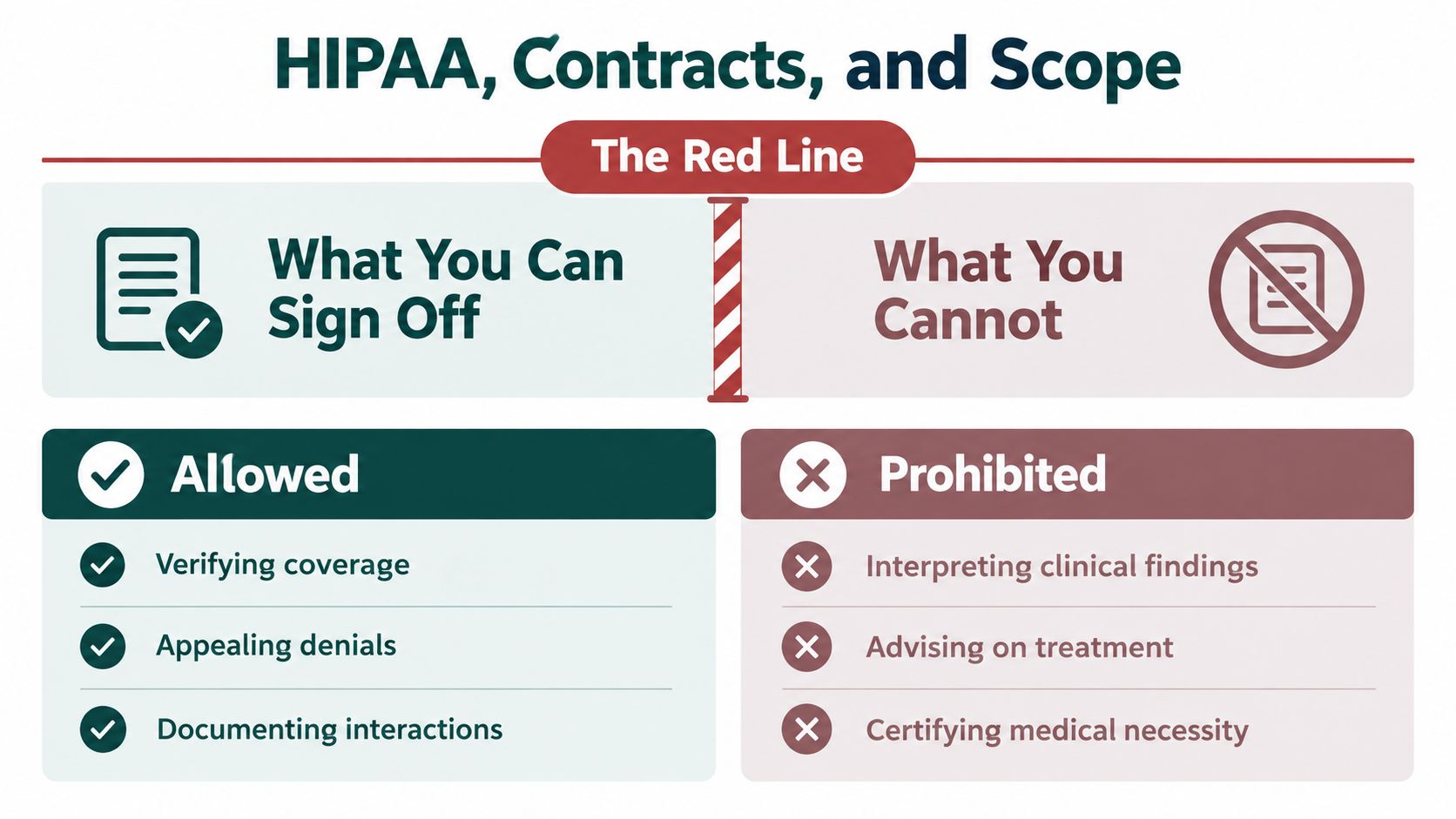
What the specialist may do
A well-scoped specialist may:
- Verify coverage: Review eligibility, benefits, network information, and payer reference details.
- Document interactions: Record portal responses, calls, timestamps, confirmation numbers, and next actions.
- Prepare appeals: Assemble records and administrative information for provider review and payer submission.
- Maintain queues: Track authorizations, claims, denials, deadlines, and unresolved payer questions.
- Communicate financial information: Explain documented benefits and uncertainty without presenting an estimate as a guarantee.
A business associate agreement is necessary in the relevant remote-work arrangement, but it isn't the entire security program. Use role-based permissions, unique user accounts, audit logs, secure communication methods, device controls, confidentiality terms, and a written process for reporting suspected incidents.
The red line
The specialist shouldn't interpret clinical findings, advise treatment, select a diagnosis, rewrite a clinical note, certify medical necessity, or tell a payer that a clinical condition exists when the provider hasn't documented it. They also shouldn't answer a patient's clinical question as though they're licensed to do so.
The manager's day-one checklist should state:
- Route clinical questions to the provider or designated clinical lead.
- Never change clinical documentation to obtain reimbursement.
- Record payer statements accurately, including uncertainty.
- Use only assigned systems and minimum-necessary information.
- Escalate privacy concerns, suspected breaches, and unusual access requests.
- Obtain provider or authorized reviewer sign-off before submitting clinical appeals.
A practice can also keep credentialing and provider-record responsibilities separate from insurance operations through a defined medical credentialing service workflow. Separation of duties reduces the chance that one administrative worker becomes the unofficial decision-maker for clinical, payer, and compliance questions.
The Takeaway
A medical insurance specialist creates value by keeping three different jobs distinct: verification, authorization, and payment follow-up. Verification establishes what the payer reports about coverage and benefits. Authorization controls a payer's approval process for restricted services. Claims and payment work address whether the submitted service was accepted, adjudicated, paid, denied, or still requires action.
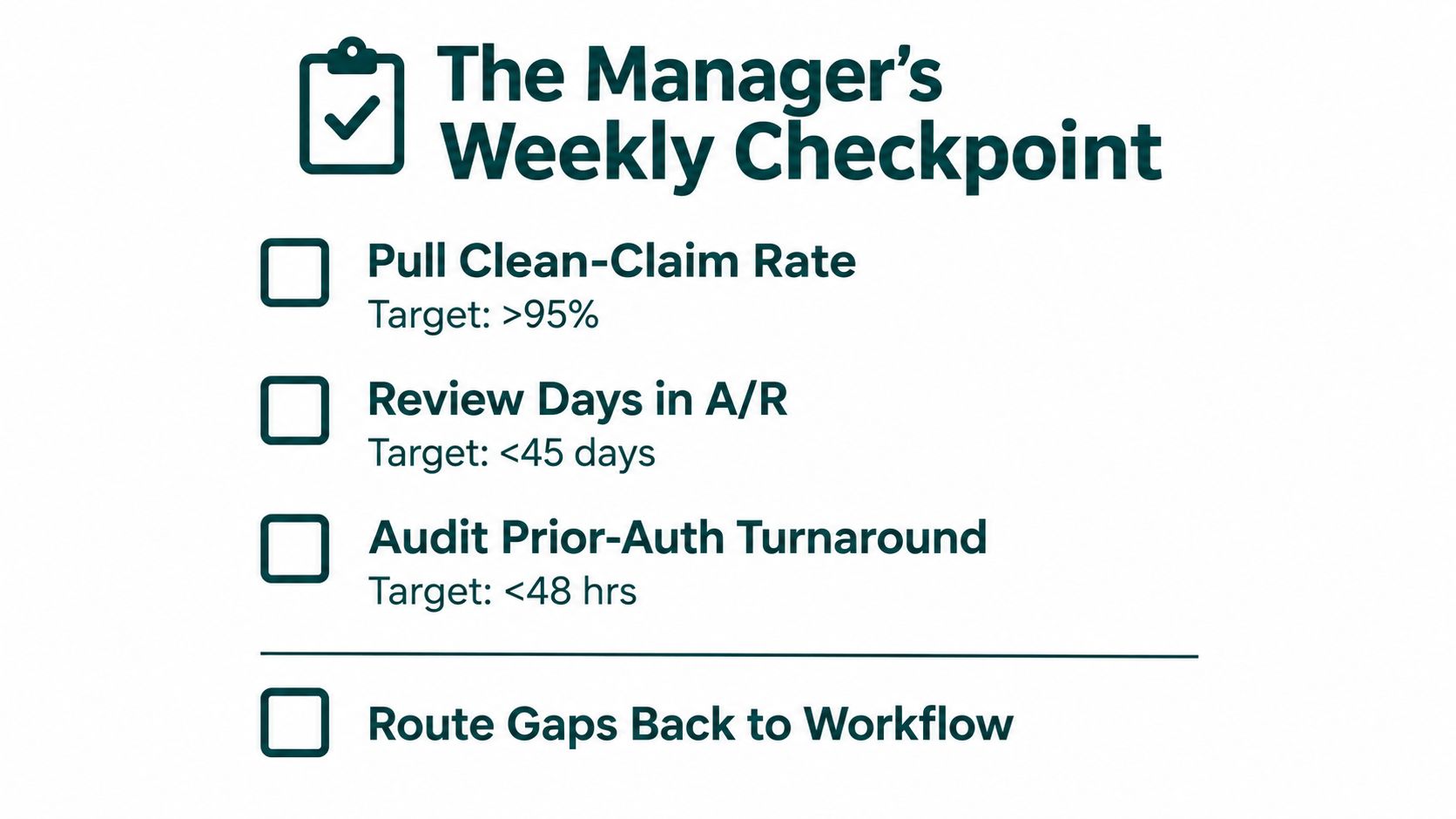
Run one weekly checkpoint. Pull the clean-claim rate, A/R aging, denial categories, authorization turnaround, eligibility completion, and insurance-related appointment delays. Then route each gap back to the workflow that caused it. A repeated eligibility denial may belong to registration, a coding denial may require coder or provider review, and a stalled authorization may need clearer ownership and escalation.
A remote specialist can cover administrative insurance work when the practice defines permissions, handoffs, payer-specific procedures, and clinical boundaries before the person starts. The work should make providers less dependent on after-hours administration while giving patients more accurate, carefully qualified information.
MedicalVirtual provides remote insurance verification and billing support for U.S. medical practices, including eligibility checks, payer follow-up, and authorization coordination within the practice's systems. If your team needs coverage for these administrative workflows, visit MedicalVirtual to discuss the role, hours, and specialty requirements.