
A HIPAA-compliant answering service isn't defined by an HHS-issued certification, because HHS doesn't recognize an official HIPAA certification. It's an operation built around a signed Business Associate Agreement, trained staff, role-based access to protected health information, auditable activity, and minimum-necessary handling.
A practice manager evaluating remote reception may be focused on a practical problem: calls are going unanswered while staff are rooming patients, checking insurance, or helping someone at the front desk. Outsourcing those calls can improve coverage, but the person answering may hear a patient's name, date of birth, insurance details, symptoms, or reason for an appointment. The exposure point is the worker and the workflow, not the phone line.
The right evaluation looks past a vendor's marketing language. You need to understand which HIPAA rules apply, how access and call records are controlled, what the BAA commits the vendor to do, and how the practice will oversee the relationship. This guide gives you a practical way to assess those details, compare service models, and decide what to verify before patient information reaches an outside team.
What a HIPAA Compliant Answering Service Actually Means
A HIPAA-compliant answering service handles patient communications on a medical practice's behalf while following applicable HIPAA requirements for protected health information, or PHI. That means more than using a secure phone platform. A receptionist may hear a patient's name and date of birth, confirm an appointment, record an insurance question, or take a message about symptoms. When those details identify a person in the context of healthcare, they can be PHI.
Four operational elements distinguish a healthcare-ready service from a generic phone vendor:
- A signed Business Associate Agreement (BAA): The agreement sets permitted uses and disclosures of PHI and establishes safeguards and incident-reporting responsibilities.
- Trained staff: Workers need practical instructions for identifying callers, documenting messages, limiting disclosures, and escalating requests outside their role.
- Role-based access: Each worker should be able to use only the scheduling, telephony, and electronic medical record (EMR) functions needed for their job.
- Auditable activity: The practice and vendor should be able to associate system activity with individual users and review records when investigating an access concern.
HHS doesn't issue a formal HIPAA certification for answering services. A vendor that calls itself “HIPAA certified” is using marketing language, not naming a regulatory status. Ask what controls the vendor operates and what documentation it can provide.
Practical rule: Treat “we're compliant” as the start of a conversation. Ask the vendor to demonstrate how an agent handles a real scheduling request, where the message is stored, and who can retrieve it.
The rest of your evaluation should follow the same operational path: understand the rules, inspect the controls, assess third-party exposure, review BAA terms, compare staffing models, and use a repeatable vendor checklist.
The HIPAA Rules That Shape an Answering Operation
HIPAA's Privacy Rule establishes protections for individually identifiable health information and sets rules for its use and disclosure. Congress enacted HIPAA on August 21, 1996, and HHS published the final Privacy Rule on December 28, 2000. The rule became effective on April 14, 2001, with most covered providers, health plans, and healthcare clearinghouses required to comply by April 14, 2003. These dates are part of the framework behind today's outsourced reception and scheduling workflows. HHS's overview of HIPAA privacy laws and regulations provides the regulatory background. For a broader look at how privacy obligations can intersect with business operations, practice owners may also consult data privacy rules for Florida founders.
The Security Rule applies to electronic PHI and requires administrative, physical, and technical safeguards. If a remote receptionist reads a patient message in the EMR, that worker is accessing ePHI. If a call recording captures a patient disclosure and is stored electronically, it becomes another asset the organization needs to protect. HHS's Security Rule overview describes safeguards that support confidentiality, integrity, and availability.
How the rules show up in a call flow
The Breach Notification Rule matters when information is exposed, such as through a misdirected voicemail or an unauthorized person's access to a message. A phone call that seems routine can create several records: a call log, a voicemail, a written note, and an EMR entry. Each handoff needs a defined owner and a controlled path.
There's also an important distinction between a conduit and a business associate. A telecommunications carrier that only transiently transmits calls may function as a conduit and generally doesn't need a BAA. An answering team that routinely records messages, schedules based on patient information, or accesses the EMR is doing more than transmitting a call. HHS explains the business associate framework and conduit distinction.
Controls That Make the Service Genuinely Compliant
Start with the actual work an agent will perform. For a referral call, the receptionist might confirm identity, record the callback number, note that the caller needs help with a referral, and route the request to an authorized staff member. The safeguards should match that workflow, not exist only in a policy document.
Technical safeguards
- Individual accounts: Each assistant should have a unique user ID. Shared logins obscure who accessed or changed a message.
- Role-scoped permissions: Give the receptionist access to the appointment and message functions required for the role, not unrestricted chart access.
- Audit records: Confirm that the system can record and support review of activity such as patient lookups, appointment changes, and message edits.
- Session controls and encryption: Ask how the vendor protects information during transmission and storage, and how unattended sessions are handled. HHS identifies unique user identification as required and automatic logoff as an addressable Security Rule specification.
For example, when an agent schedules a referral appointment, the log should help a supervisor connect the action to the agent's account. If the agent's duties change or the placement ends, access should be adjusted promptly.
Administrative and physical safeguards
Document who trains staff, what training covers, how completion is recorded, and how the vendor responds to suspected misuse. A call about a refill also needs a clear boundary: reception staff can route the request, but they shouldn't make clinical decisions or advise the patient unless their role and authorization permit it.
Ask how workers secure their workstations, avoid shoulder-surfing, and prevent PHI from ending up in personal notes, unapproved spreadsheets, or personal messaging apps. Call-recording rules should be documented, including whether calls are recorded and who can access recordings.
A transcription workflow offers a useful comparison: when a worker enters patient information into a system, the practice needs clear controls over access, documentation, and handling. See this guide to what a medical transcriptionist does for a related role distinction.
A signed BAA is necessary when the vendor is a business associate, but it doesn't implement these safeguards. The controls make the contract meaningful in daily work.
Why Business Associates Carry Outsized Risk
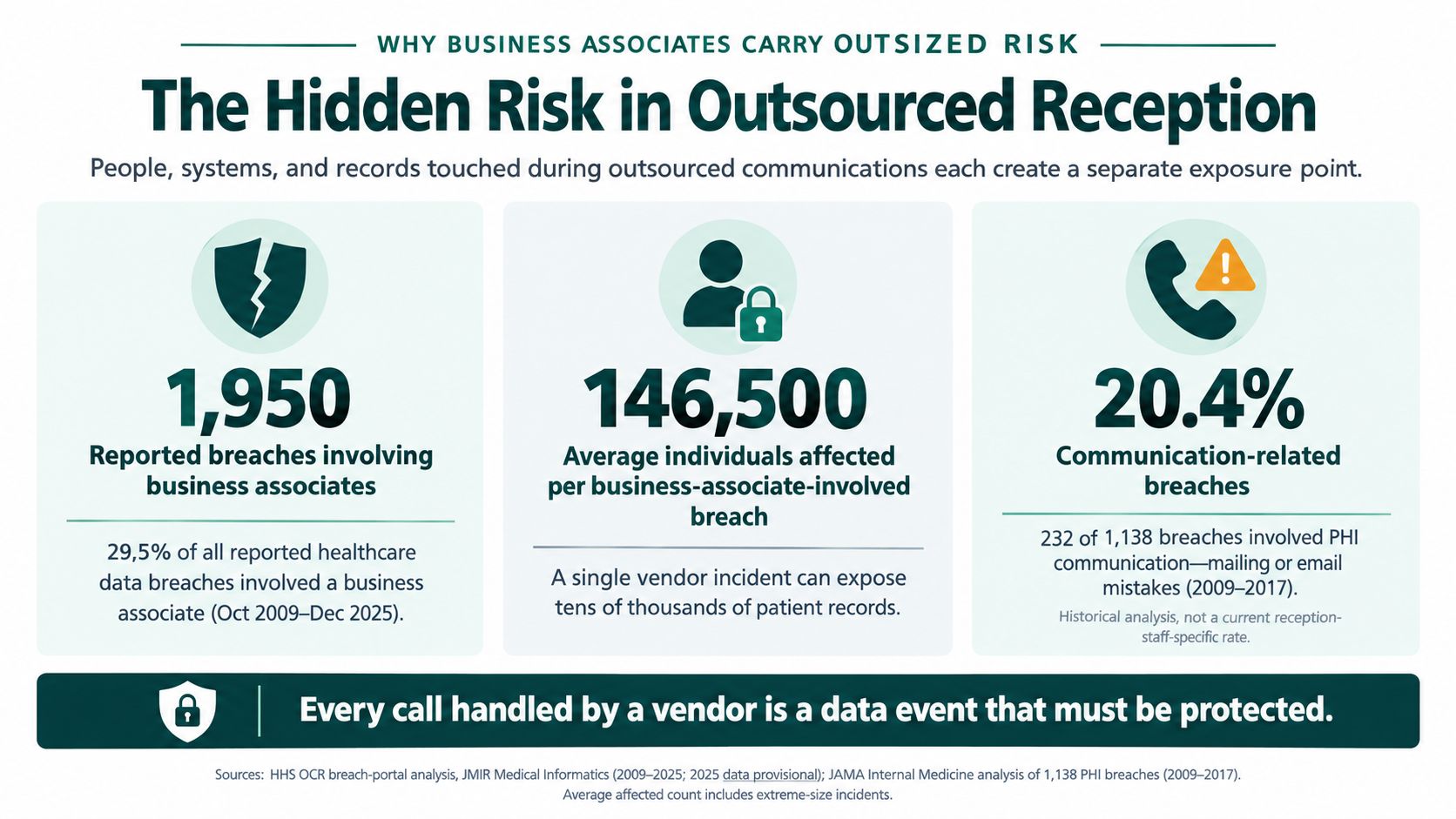
Outsourcing reception can widen the number of people and systems that touch patient information. In its 2024 annual report to Congress, HHS's Office for Civil Rights recorded 663 notifications involving breaches of unsecured PHI affecting 500 or more individuals. Business associates accounted for 106 reports, or 16%, but incidents involving them affected 206,921,071 individuals, or 85% of everyone affected in the reported breaches. HHS's 2024 breach report to Congress provides the figures.
The difference between the share of reports and the share of people affected is a reminder that third-party incidents can reach many patients. A vendor may handle communications for multiple healthcare organizations, so a weakness in its systems or procedures can expose information across more than one practice.
Follow the information, not just the call
Consider a simple callback request. An agent writes a patient's name and phone number in a notebook, leaves the notebook open, then types the message into a shared system. A second worker sees the open screen and sends the callback to the wrong number. The call itself was ordinary; exposure occurred through handling and handoff.
That's why safeguards need to cover every point where a representative receives, records, transmits, or retrieves PHI. The risk isn't addressed by securing only the phone line.
- Vendor oversight establishes whether the service's actual practices match its commitments.
- Role-based access limits what each worker can see and change.
- Audit logs support accountability and investigation.
- Training gives staff clear boundaries for handling calls and messages.
- Incident response defines what happens when something goes wrong.
- A BAA sets the contractual duties between the practice and vendor.
These controls aren't interchangeable. A BAA can't replace access restrictions, and training can't substitute for an audit trail.
The Business Associate Agreement Is a Contract, Not a Checkbox
When an answering service routinely creates, receives, maintains, or accesses PHI on behalf of a practice, the practice generally needs a written BAA before access begins. The agreement should describe the service's permitted uses and disclosures in practical terms, such as taking messages, scheduling appointments, and relaying requests. It shouldn't authorize an activity that would violate HIPAA if the practice performed it itself. HHS's guidance for smaller providers and businesses explains the written-agreement obligation.
A carrier that only transmits calls may fit the conduit exception. A receptionist who documents a message, schedules based on patient information, or enters information into the EMR typically acts as a business associate. For practical questions to raise when reviewing PHI custody and contract terms, see these vendor vetting tips for PHI custody.
Terms to review before granting access
The BAA should require appropriate safeguards and Security Rule compliance, describe incident and breach reporting, and extend applicable protections to subcontractors. It should also set out what happens to PHI when the relationship ends, including return or destruction.
For a breach of unsecured PHI, a business associate must notify the covered entity without unreasonable delay and no later than 60 days after discovery. That is an outer limit, not a recommended operating target. Your agreement should set a clear internal escalation path so the practice can investigate promptly, preserve relevant records, and meet its own obligations. HHS describes the requirements in its Breach Notification Rule guidance.
Request the vendor's most recent risk-analysis summary, evidence that relevant workers completed training, and a documented process for requesting breach-related information. A signed BAA doesn't transfer the practice's responsibility for assessing risks and overseeing vendors. The covered entity also needs to understand how PHI moves through the vendor's people, systems, and subcontractors.
Comparing an Answering Service to a Medical Virtual Receptionist
Different communication models solve different problems. An after-hours service can take calls when the office is closed, automation can route simple requests, and a US-hours virtual receptionist can handle the same kinds of administrative conversations as an in-office front desk. None of those models removes the need to define access, train staff, and control PHI.
| Dimension | After-hours answering service | Automated phone tree or bot | US-hours medical virtual receptionist |
|---|---|---|---|
| Who answers | A human operator, often working from a vendor's process | Software prompts and routing logic | A remote receptionist assigned to the practice's workflow |
| Training and credentials | Confirm healthcare and privacy training, and how completion is tracked | No human agent to train; the practice must review prompts and escalation rules | Confirm role-specific training and boundaries for nonclinical work |
| System access | May be limited to a message platform or include scheduling access | Usually depends on configured integrations and routing | Can use approved phone and EMR functions within assigned permissions |
| Minimum-necessary handling | Depends on scripts, staff practice, and data fields | Depends on what the prompts collect and store | Depends on call scripts, role permissions, and supervision |
| BAA | Needed when the vendor handles PHI as a business associate | Review the vendors and systems that process or store PHI | Needed when the service handles PHI on the practice's behalf |
| Coverage | Commonly used for nights, weekends, or overflow | Can route calls whenever the system is available | Typically aligned to the practice's clinic hours |
| Accountability | The practice oversees the vendor relationship and its workflows | The practice oversees configuration and vendor relationships | The practice oversees the worker's role, access, and handoffs |
Match the model to the work
Automation can be effective for predictable routing, but it won't handle every caller's question or recognize every situation that needs human escalation. A traditional service can extend coverage outside clinic hours, but you should check how its agents document and deliver messages. A virtual receptionist may be a closer fit when the practice needs ongoing scheduling, intake, or front-desk support during operating hours.
MedicalVirtual offers virtual medical receptionist support for practices evaluating a remote human-staffing model. The key question is whether the specific role, access scope, training, and escalation workflow fit your practice, not whether one model is universally preferable.
A Vendor Vetting Checklist You Can Use This Week
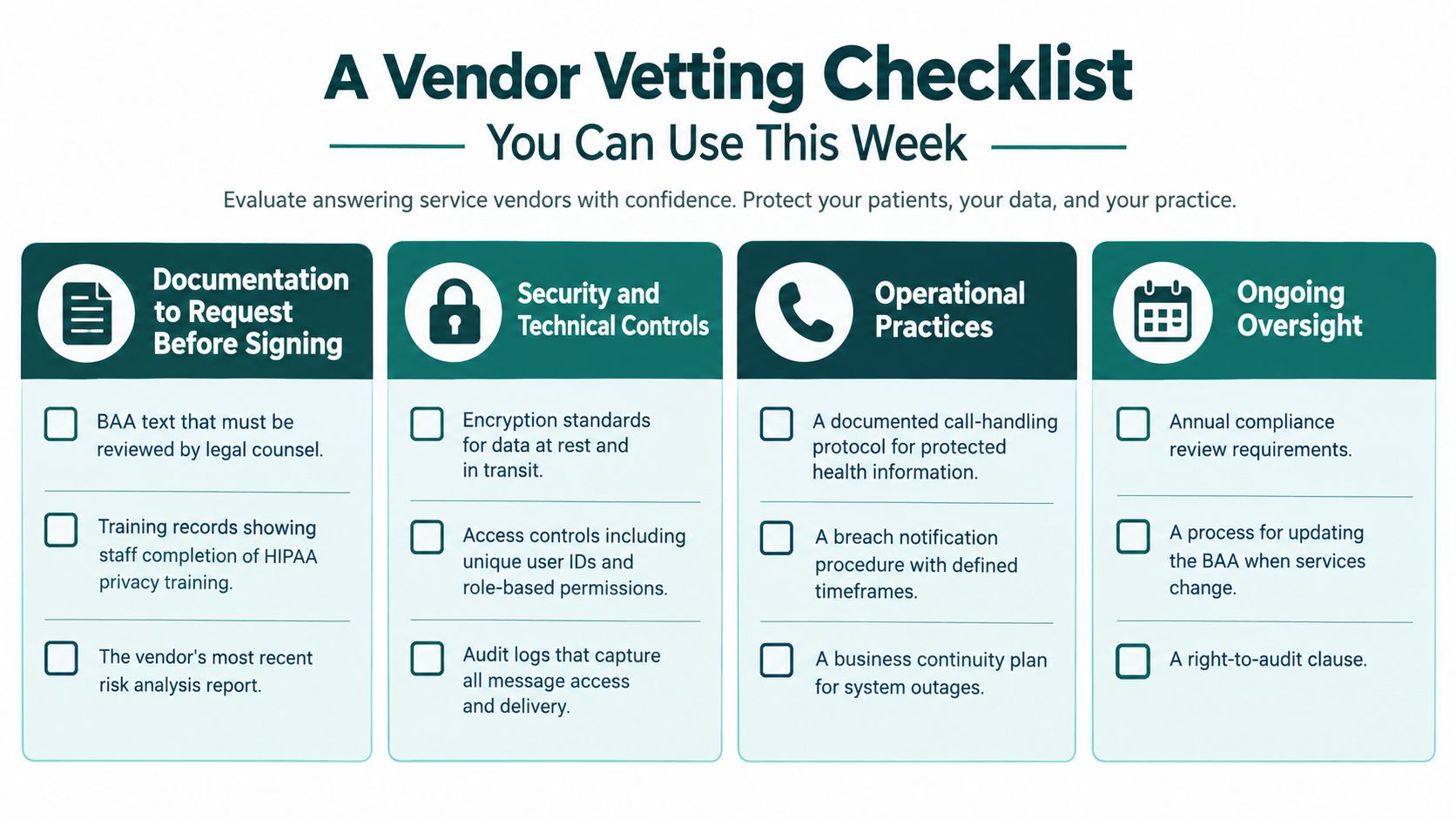
Use the checklist during evaluation and revisit it when the vendor's workflow changes. A demo can show what the service does; documents and clear answers help show how it protects information when calls are handled, recorded, routed, or escalated.
- Request before signing: Review the proposed BAA, training records, the vendor's latest risk-analysis summary, and information about its breach history.
- Ask during the demo: Who handles PHI? What training do they complete? Which access roles are configured? What audit logs can the vendor provide? What's the call-recording policy? How are subcontractors assessed?
- Treat as red flags: Claims of “HIPAA certification,” refusal to share BAA language, shared credentials, missing training documentation, or no clear breach-reporting process.
- Check your own readiness: Confirm your risk analysis is current, EMR permissions are role-based, intake scripts collect only needed information, and a named practice manager owns vendor oversight.
A vendor review should continue after contracting. If call duties, systems, access, or subcontractors change, confirm that the documentation and controls still match the work. For a wider view of assessing a vendor's security practices, consider this resource on how to secure your business with vendor checks.
If you're comparing staffing options, review the workflow and safeguards for a HIPAA-compliant virtual assistant. Requirements can vary by jurisdiction and practice size, so confirm high-stakes decisions with qualified counsel or a compliance professional.
The Takeaway
A HIPAA-aligned answering operation depends on more than a vendor's claim or a signed contract. Verify the BAA, staff training, role-based access, auditable activity, minimum-necessary workflows, and a practical incident-reporting path. Those controls should reflect the actual work the receptionist will perform and the systems they'll use.
Outsourcing calls doesn't outsource accountability. The practice still needs to assess risk and oversee the vendor relationship. If you're ready to evaluate remote reception staffing, ask how the proposed role would fit your call flow, specialty, and EMR, and confirm access and escalation responsibilities before the worker begins.
MedicalVirtual connects U.S. medical practices with pre-vetted remote healthcare staff, including virtual receptionists who work aligned to clinic hours and use practice-approved workflows. Visit MedicalVirtual to discuss whether a receptionist role fits your calls, systems, and access requirements.