

Charge entry is the revenue-cycle step that converts documented clinical services into structured, billable claim data ready for payer adjudication. It includes the procedure and diagnosis codes, modifiers, units, provider, location, date, and charges needed to turn a completed encounter into a claim.
A signed note can sit in the EHR while no billable transaction exists in the practice-management system. That gap is where many practices lose time, create avoidable rework, or miss services entirely. The billing specialist must confirm that the documented care, coded representation, payer information, and financial fields all belong to the same encounter before releasing the charge.
For practice owners and managers, the practical question isn't only what charge entry means. You also need to know where it differs from medical coding, which controls prevent rejected claims, how to measure staff performance, and how a remote billing assistant can work safely inside the process. The right approach treats charge entry as a structured validation checkpoint between clinical documentation and accounts receivable, not as routine typing.
Defining Charge Entry in the Revenue Cycle
A provider finishes a visit, signs the note, and moves to the next patient. From the clinical side, the encounter appears complete. From the revenue-cycle side, the work has only reached the handoff point. Someone still needs to verify what was performed, connect it to the correct codes and diagnoses, apply the required claim details, and release the resulting transaction.
Charge entry converts documented services into billable claim lines. For a professional claim, that generally means recording CPT or HCPCS procedure codes, ICD-10-CM diagnosis linkage, modifiers, units, place of service, rendering-provider details, service date, payer information, and the practice's applicable charge. The result usually feeds an electronic 837P claim or a CMS-1500 workflow.
The historical foundation is the American Medical Association's Current Procedural Terminology system. The first CPT edition was published in 1966 to standardize procedure descriptions for records, insurance claims, and statistical reporting, then expanded in 1970 from four-digit to five-digit codes and beyond surgical services. CMS adopted CPT within the Healthcare Common Procedure Coding System in 1983 and required CPT reporting for Medicare Part B physician services, with Medicaid programs following in 1986. The AMA's history of CPT shows why charge entry evolved from locally interpreted descriptions into standardized data conversion.
Why a signed note isn't enough
The note supports the service, but it doesn't automatically create a complete claim. A missing charge, incorrect modifier, wrong unit count, or mismatch between the procedure and diagnosis can lead to a rejection, denial, downcoding, delayed payment, or inaccurate patient balance.
The control boundary matters because the objective isn't to maximize the billed amount. It's to match the claim to contemporaneous documentation. If the note doesn't support an unusual service or the provider's requested charge conflicts with the record, the correct action is to hold the entry and seek clarification.
Practical rule: Charge entry should preserve what happened, what supports it, and who performed it. It shouldn't fill documentation gaps with assumptions.
Charge entry sits between clinical documentation and accounts receivable. A strong process produces a complete transaction that can move through claim edits and payer adjudication. A weak process sends missing or contradictory data downstream, where correction takes longer and may involve rejected claims, payer correspondence, or patient-account work.
For an overview of how this step fits into broader U.S. revenue-cycle operations, see this guide to medical billing in the United States. The central point is simple: no charge entered means no claim line, while an unsupported charge creates compliance and payment risk.
The Daily Charge Entry Workflow
A reliable workflow begins with reconciliation, not with opening the first billing screen. The specialist compares the completed appointment schedule with the signed encounter note, superbill or encounter form, and the EHR or practice-management charge record. This comparison catches both sides of the problem: services entered incorrectly and services that were performed but never posted.
A practical sequence for each encounter
Reconcile the encounter source. Match the patient, encounter, date of service, provider, location, and appointment status. A completed appointment without a released charge belongs in an exception queue, not in an informal spreadsheet that someone may forget.
Confirm patient and subscriber details. Verify patient identifiers, subscriber information, payer destination, and the applicable authorization or referral information. A correct procedure attached to the wrong payer record can still fail before adjudication.
Review the clinical-to-billing handoff. Confirm that the note is signed or otherwise complete under the practice's workflow. Compare the documented services with the approved code assignment and look for omitted procedures, duplicate lines, unsupported add-on services, or unclear laterality.
Enter the claim fields. Record the service date, patient and subscriber identifiers, rendering and billing providers, place of service, CPT or HCPCS code, ICD-10-CM diagnosis linkage, units, modifiers, fee-schedule amount, authorization details where applicable, and payer destination.
Validate the financial mapping. The charge amount is not the same as expected reimbursement. CMS physician data distinguish submitted charges, allowed amounts, and Medicare payments, so a practice must avoid treating its billed amount as collectible revenue. The AMA's CPT content and history provides useful context for maintaining standardized code data in electronic systems.
Run edits and release the charge. Check for missing fields, invalid combinations, incompatible units, absent diagnosis links, and duplicate entries. Once the record passes the practice's review rules, it can move to claim scrubbing and submission.
A daily exception queue makes the process measurable. Compare completed appointments and signed notes with released charges, assign every unresolved item to a named owner, and record why the charge is held. The queue should distinguish missing documentation from payer-information problems and coding questions, because each requires a different person to resolve it.
For a small primary-care practice, the queue might contain an unsigned progress note, an encounter with no diagnosis linkage, or a service posted under the wrong location. In therapy, dental, or multisite operations, configuration errors can affect repeated encounters, so the manager should inspect patterns by provider, template, and location rather than correcting only individual claims.
Charge Entry vs Medical Coding
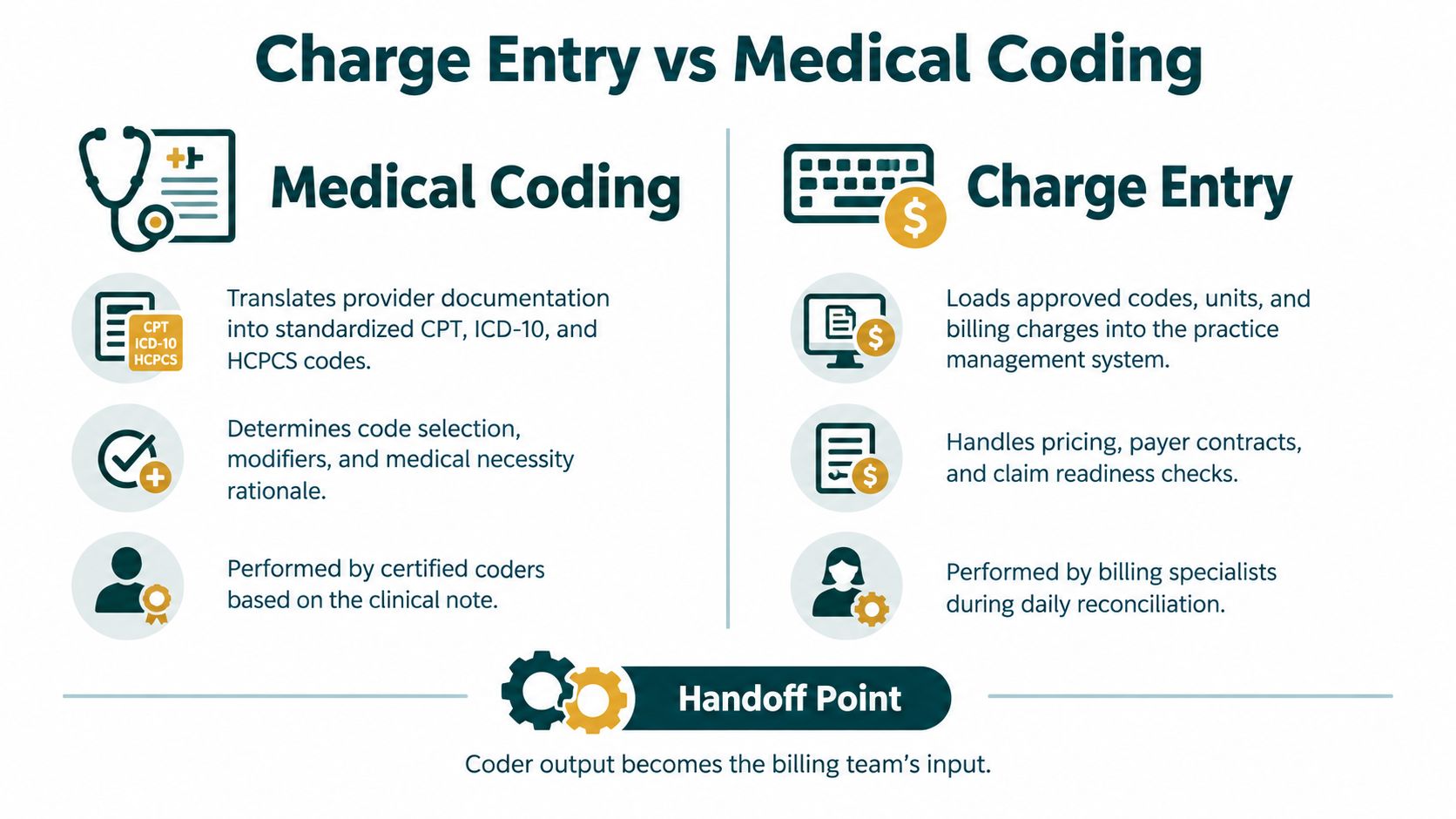
Medical coding and charge entry are connected, but they aren't interchangeable. Coding determines how the documented service should be represented. Charge entry verifies that the approved representation is complete, attached to the correct encounter and payer, and posted accurately before the claim is created.
A coder may select the CPT, HCPCS, and ICD-10-CM representations based on the clinical record. The charge-entry specialist then confirms that those codes appear on the right patient account, with the right date, units, modifier, provider, place of service, diagnosis linkage, and financial mapping. In some small practices, one employee performs both functions. That can be efficient, but it concentrates operational and quality-control risk.
The control boundary in practice
Consider a documented office visit with an additional performed service. The code selection may be technically correct, yet the charge-entry record can still omit the additional line, duplicate the visit, use the wrong rendering provider, attach the service to the wrong place of service, or apply an outdated fee. Coding accuracy doesn't cure a posting defect.
The reverse problem also occurs. A biller may enter every field quickly, but the underlying code may not be supported by the note. Charge entry shouldn't become a second opportunity to choose a more favorable code. When the source record and requested entry conflict, the specialist should place the transaction on hold and route a specific question to the coder or provider.
A clear responsibility matrix helps prevent guessing:
| Decision | Primary owner | Charge-entry responsibility |
|---|---|---|
| What the documentation supports | Provider and coding function | Escalate conflicts |
| Which standardized code represents the service | Medical coder or authorized coding process | Enter the approved code |
| Whether the code belongs to the encounter | Billing specialist | Reconcile patient, date, provider, and location |
| Units and modifiers | Coding process, subject to documentation | Confirm they transferred correctly |
| Fee or contract mapping | Billing or contract-management function | Apply the approved schedule |
| Whether the claim is complete | Billing specialist and quality control | Resolve edits before release |
Charge capture is a related but different control
Charge capture occurs when the practice records that a service was performed, often through the EHR, procedure record, or encounter form. Charge entry places the supported, coded service into the billing transaction. A missing service at capture requires a clinical or front-desk workflow fix. An incorrectly posted service requires a billing-control fix.
This distinction is useful in primary care, physical therapy, dental, and mental-health settings where templates may carry charges forward automatically. Imported data can reduce keystrokes, but it can also replicate an incorrect provider, location, unit value, or diagnosis linkage across encounters. Automation should therefore reduce repetitive entry, not remove the review boundary.
Common Errors and Prevention Strategies
A charge-entry error can stop a claim from being treated as clean. CMS defines a clean claim as one without a defect requiring the Medicare contractor to investigate or develop additional information before adjudication. CMS also explains that incomplete or inconsistent submissions may not be accepted into the Medicare electronic claims system and may not count as filed for timely-filing purposes. The CMS clean-claim guidance supports a production model built around front-end validation.
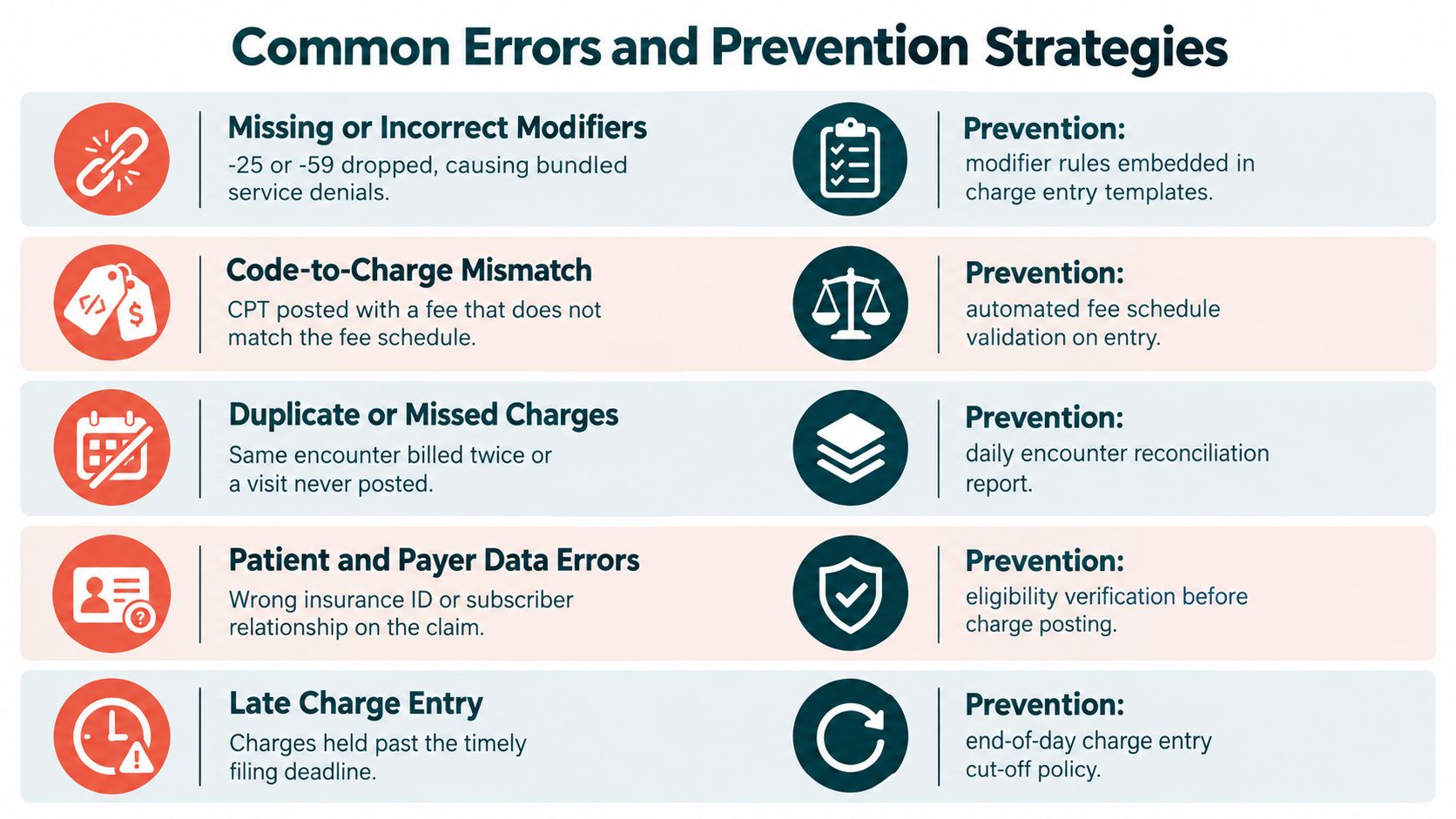
Defects that deserve specific edits
Missing or invalid modifiers can change how a payer interprets a service. The charge-entry rule should flag required or unusual modifiers for review rather than allowing staff to select one only because it makes the line pay.
Incorrect units can understate or overstate the documented service. Unit edits should compare the entered value with the source record and specialty-specific rules, with unusual quantities routed to a senior reviewer.
Absent or mismatched diagnosis links weaken the relationship between the service and its supporting medical-necessity information. The specialist should confirm that each line has the intended diagnosis pointer and that unresolved clinical conflicts go back to the coding or provider function.
Wrong provider or place of service can cause payer edits even when the procedure code is correct. This is common in multisite practices and in workflows where staff copy charges from a prior encounter.
Duplicate or missing charges require a reconciliation report, not just a claim scrubber. Software may identify duplicate lines, but it won't always know that a completed appointment never produced a charge.
Incorrect amounts usually indicate an outdated or mismatched fee-schedule mapping. The submitted charge is a billed amount, not automatically the allowed amount or actual payment, so the practice should correct the mapping without treating the charge as guaranteed revenue.
Reviewing insurance verification procedures can also help separate front-end payer-data problems from charge-entry defects. Eligibility work won't replace charge validation, but it can prevent the billing team from trying to correct a claim using incomplete subscriber information.
Rejections and denials aren't the same
A rejection generally means the claim failed a front-end or format requirement and must be corrected before adjudication. A denial is a payer decision after processing. The distinction matters because a rejection often points directly to a missing field, invalid identifier, or structural edit, while a denial may require reviewing payer policy, documentation, authorization, coding, or the remittance explanation.
Separate production from quality control. The person entering routine charges can resolve standard edits, while a senior biller or manager reviews high-dollar services, unusual units, late charges, conflicting provider details, and modifier combinations. A quality sample should verify that the entered charge matches the note, the diagnosis supports the service, required fields are present, and corrections retain an audit trail.
Medicare's general fee-for-service filing limit is 12 months, or one calendar year, from the date of service, as explained in CMS filing-limit guidance. Commercial and Medicaid deadlines vary, so that federal limit shouldn't become your internal operating target. Daily posting and early escalation leave time to clarify documentation and correct a claim.
Measuring Charge Entry Performance
Raw volume is a poor measure of charge-entry quality. A specialist can post charges quickly while creating duplicate lines, leaving encounters unbilled, or sending avoidable edits to the clearinghouse. Management needs a scorecard that shows speed, completeness, accuracy, exception handling, and downstream consequences.
Reported initial denial benchmarks vary by payer and population, with figures around 10% to 20%, and one 2025 provider benchmark reported that 41% of providers had denial rates of at least 10%. These figures appear in the medical billing statistics reference, but they don't establish that charge entry caused the denials. Eligibility, authorization, documentation, coding, payer behavior, and other factors contribute.
Charge Entry Operating Scorecard
| Metric | Target | Why It Matters |
|---|---|---|
| Same-day or next-day posting | Defined by the practice's daily workflow | Shows whether completed encounters reach billing promptly |
| Encounters with missing charges | Downward trend with named exceptions | Reveals services that never entered the claim workflow |
| Correction rate | Reviewed by error type and owner | Separates training issues from system or source-data defects |
| Duplicate-charge rate | Zero tolerance for unresolved duplicates | Protects claim integrity and reduces rework |
| First-pass acceptance | Tracked by rejection reason | Shows whether front-end edits are working |
| Dollars delayed by unresolved questions | Aging reviewed daily | Connects held charges to cash-flow exposure |
| Exception resolution time | Internal escalation threshold | Prevents unresolved records from aging unnoticed |
The target column should be set from your actual specialty, payer mix, staffing model, and documentation workflow. Don't import a generic productivity standard and reward speed that damages accuracy. A dermatology practice, therapy group, and multisite primary-care organization may need different exception rules even when they use the same practice-management system.
Automation can transfer fields, flag duplicates, and route work queues. CMS describes real-time claims processing as an early-stage pilot, so practices should treat it as an evolving workflow rather than an immediate replacement for human review. Staff still need escalation rules for incomplete notes, unusual modifiers, conflicting documentation, and payer-specific edits.
Integrating Remote Billing Assistants
Remote charge entry can work well when the practice defines the handoffs before granting access. The assistant needs a controlled work queue, specialty-specific instructions, a clear list of fields to validate, and a documented path for questions. Without those controls, remote work just moves an inconsistent process outside the office.
Start with least-privilege access. Give each person an individual login, limit permissions to the tasks they perform, prohibit shared credentials, and review access periodically. HIPAA obligations apply to the practice's handling of protected health information, while security practices such as access controls, audit logs, device safeguards, and workforce training help operationalize those obligations. Practices should confirm their specific contractual and regulatory responsibilities with qualified compliance counsel.
Build the remote role around exceptions
A remote billing assistant can reconcile completed appointments with released charges, identify encounters lacking signed notes, enter approved codes and billing details, and route unresolved questions back to the appropriate provider or coder. The assistant shouldn't diagnose patients, make clinical decisions, select unsupported codes, or guess when documentation is incomplete.
Use a written escalation matrix:
- Missing signed note: Hold the charge and route it to the provider or designated clinical queue.
- Code and note conflict: Send the question to the coding function, with the exact discrepancy documented.
- Unusual modifier or units: Require senior billing review before release.
- Wrong provider or location: Correct only after verifying the encounter source.
- Payer or authorization uncertainty: Route to the appropriate verification or authorization owner.
- System or interface error: Record the failed transfer and prevent duplicate manual posting.
Quality sampling should examine source-to-entry accuracy, diagnosis linkage, units, modifiers, provider and location, duplicate checks, and correction history. The audit trail should show who entered or changed each charge and why. That record is useful for training, accountability, and investigation when a recurring defect appears across a template or provider.
MedicalVirtual is one staffing option for practices that need remote healthcare support. Its Medical Billing Virtual Assistant service includes charge entry and EMR input, claims review, and payment-posting support. When evaluating any vendor, confirm the business-associate arrangement, confidentiality controls, working-hour coverage, specialty experience, EMR permissions, and whether coding ownership is separate from charge posting.
The Takeaway
What is charge entry in medical billing? It's the controlled conversion of documented clinical work into structured claim data. The process sits between coding and accounts receivable, and its quality determines whether services become complete, processable claims or create rework downstream.
Start by reconciling completed encounters against released charges every day. Then review the fields that most often create trouble, including patient and payer identifiers, date of service, provider, place of service, codes, diagnosis links, units, modifiers, authorization information, and fee mapping. Track missing charges, corrections, duplicates, first-pass acceptance, exception aging, and delayed dollars instead of rewarding posting speed alone.
If you're considering remote staff, document the workflow first. Use individual logins, controlled EMR permissions, clear escalation rules, named exception owners, and periodic quality sampling. Whether charge entry stays in-house or moves to a remote assistant, the standard remains the same: enter only what the record supports, resolve uncertainty before release, and submit complete claims while there's still time to correct them.
MedicalVirtual connects U.S. medical practices with pre-vetted LATAM healthcare talent for charge entry, EMR input, claims review, and related revenue-cycle work during U.S. clinic hours. Visit MedicalVirtual to discuss a remote billing assistant matched to your specialty, systems, and charge-entry controls.