
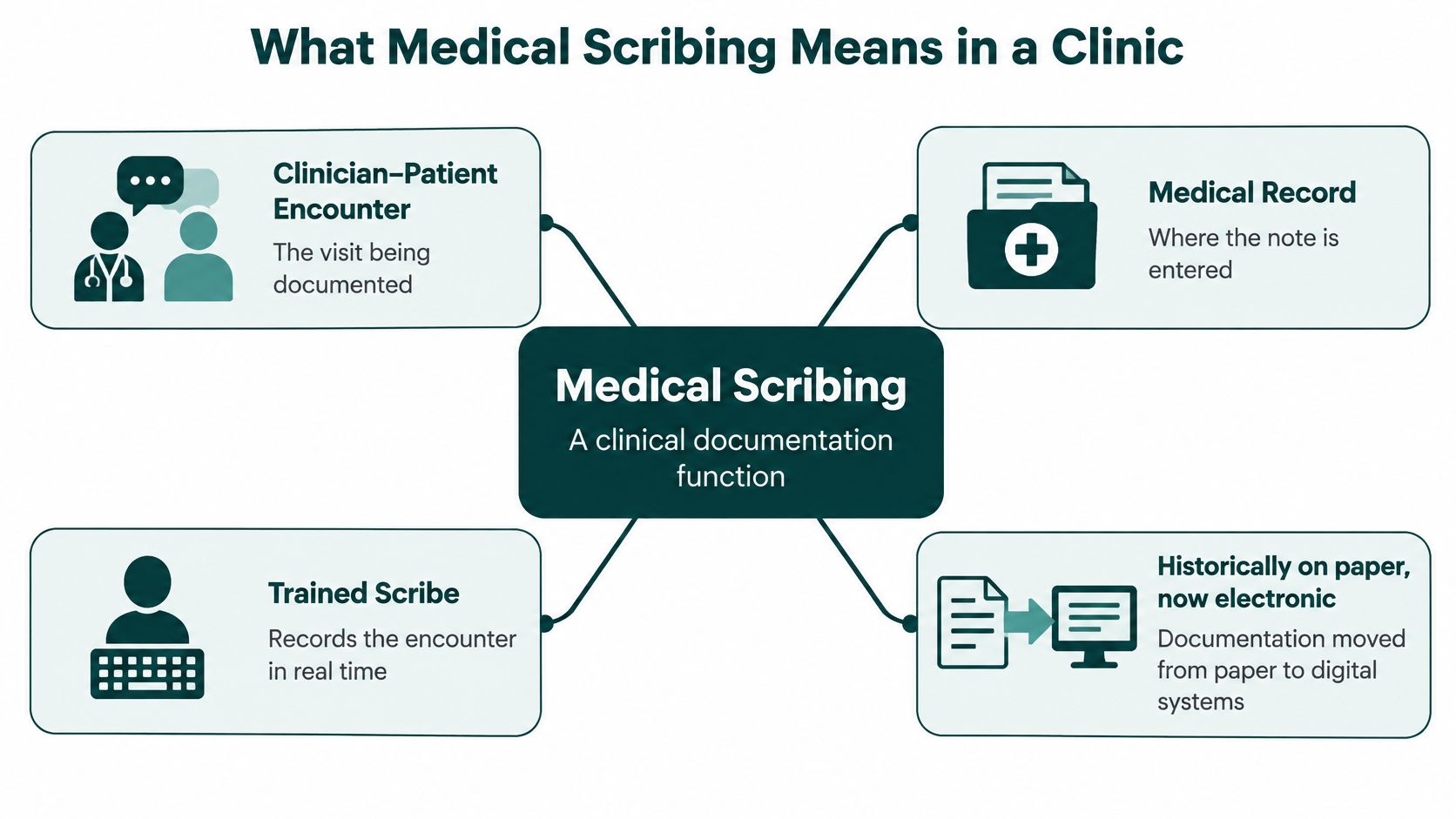
Medical scribing means a trained person records the clinician–patient encounter in the EHR during or right after the visit, while the clinician reviews, corrects, and signs and never hands off diagnosis, orders, or medical judgment.
Your last patient has left, but the provider still has unfinished notes, a medication change to clarify, and tomorrow's schedule waiting. Hiring someone to type faster might help. Hiring someone without deciding who checks the chart, resolves questions, and closes the encounter can create another queue.
For a practice manager asking what is medical scribing, the useful answer is a division of chart work, not a transcription service. A scribe captures and organizes the visit inside your documentation workflow. Whether this reduces the provider's workload depends on the encounter mix, EHR permissions, training, and the provider's willingness to review drafts promptly.
Remote support adds another decision: does your practice need a person navigating the chart during clinic, software producing a draft, or a combination? A routine follow-up and a sensitive psychiatric intake shouldn't automatically use the same arrangement.
The right starting point is your unfinished work. Identify which documentation tasks consume provider attention, which require clinical judgment, and where a draft becomes stuck before signature. Those answers give you a firmer hiring standard than a vendor's promised time savings.
What Medical Scribing Means in a Clinic
Say a family-medicine physician begins an afternoon with a patient who has several ongoing conditions and a new complaint. The patient describes symptoms, mentions a specialist visit, and corrects something on the medication list. A remote scribe listens through the practice's approved connection and organizes that information in the encounter note while the physician continues the conversation.
The physician states the examination findings and explains the assessment and follow-up plan. The scribe captures those statements, flags anything unclear, and saves the draft for review. The useful result isn't a transcript of every word. It's an organized record that the physician can verify without reconstructing the encounter from memory.
Documentation support rather than another clinician
Medical scribing began in emergency medicine approximately 30 years before the publication of a 2020 review of medical-scribe practice, which described its expansion into primary care, specialty clinics, and other outpatient settings, along with generally favorable physician views and insufficient rigorous evidence for early burnout claims. Historically, scribes worked with paper records; contemporary workflows predominantly use electronic health records.
A courtroom reporter is a useful, if imperfect, analogy. The reporter captures the proceedings but doesn't decide the case. A scribe likewise records the encounter without becoming another treating clinician, although a scribe's work involves organizing information into clinical fields rather than producing a verbatim record.
The treating provider remains responsible for the clinical content. A confident-sounding sentence isn't acceptable if it reflects the scribe's inference rather than what the patient reported or the clinician established.
Why the chart matters beyond typing
For managers, the operational issue is that the encounter note serves several readers. Another provider needs to understand what happened, clinical staff need actionable follow-up instructions, and billing staff need documentation that supports the service. A disorganized draft can move typing away from the physician while leaving everyone else with more work.
In the family-medicine example, a useful note distinguishes the patient's account of a medication change from a change the physician authorizes. It separates historical symptoms from current findings. It also makes the follow-up plan easy to locate rather than burying it in conversational detail.
Before you write a job description, separate the documentation problem from adjacent staffing problems:
- Unfinished encounter narratives: Consider dedicated scribe support when the provider knows the plan but struggles to document it during clinic.
- Missing outside records: Assign retrieval and tracking explicitly rather than assuming the scribe will absorb them.
- Unanswered patient calls: Scope receptionist or patient-coordination coverage instead of purchasing documentation support.
- Claims follow-up: Assign billing work to a role trained for that queue.
These jobs can coexist within a remote team, but they shouldn't compete invisibly during a live encounter. A scribe who must stop listening to answer the main phone line can miss the statement that determines what belongs in the note.
Practical rule: Hire against the point where work stalls, not against the broad label of medical virtual assistant.
The strongest fit is a practice that can describe the handoff clearly: what the scribe receives, what the scribe prepares, what triggers a question, and who finishes the encounter. Without that definition, even a skilled hire has to guess what success means.
What the Scribe Enters and What the Clinician Keeps
The scribe prepares the record; the treating clinician authenticates it. Use this responsibility matrix as a quality-control checklist, then adapt permissions to your EHR, organizational policy, and applicable delegation rules.
Who drafts the chart and who must sign it
| Chart task | Scribe may | Clinician must |
|---|---|---|
| History and exam narrative | Draft from what was said and observed | Confirm accuracy before signature |
| Review of systems and exam findings | Enter stated or observed findings | Correct omissions and copied-forward errors |
| Assessment and plan | Record the plan the clinician stated | Own the diagnosis and medical judgment |
| Orders | Enter orders the clinician directs, where permitted | Authenticate orders and medical necessity |
| Coding-supporting detail | Capture elements that match the stated service | Approve codes and level of service through the practice's coding workflow |
| Note status | Edit and pend a draft | Review, amend, and sign |
| Medications and allergies | Update only from a verified source or clinician direction | Verify the list before signature |
| Unclear or sensitive content | Escalate rather than guess | Decide what belongs in the record |
A primary-care literature review describes scribing as documentation support covering encounter elements such as history, examination, assessment, plan, and directed orders, with the clinician retaining responsibility for the final record. Capturing coding-supporting details isn't permission to invent complexity, establish medical necessity, or independently choose a diagnosis.
Pending means ready for review, not finished
An outpatient EHR-audit study found that a common scribe action was pending the progress note, saving an edited draft for provider review rather than finalizing it. That status should trigger a named reviewer and deadline, not an indefinite holding area.
For a diabetes follow-up, the scribe can document the physician's stated treatment plan. If the physician mentions changing a medication without specifying the new dose, the scribe should flag the missing instruction rather than infer it from an older prescription.
A medical scribe note example can help your team agree on structure before onboarding. Put allowed sections, correction procedures, escalation triggers, and a same-day review target in writing, with a defined exception process for visits that can't be completed that day.
What Studies Show About Chart Time and Closure
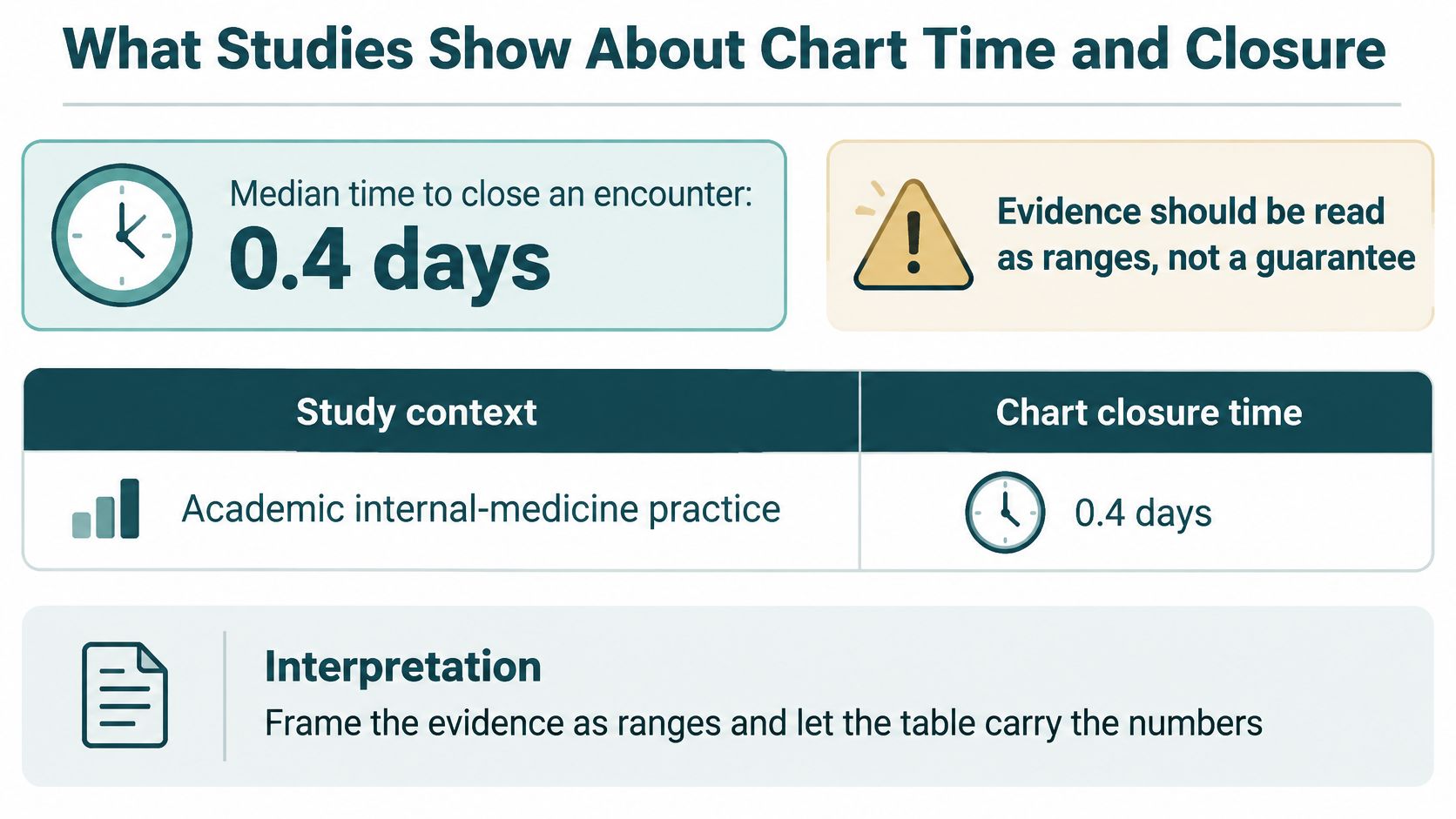
A note can be drafted quickly and still sit unsigned. In an academic internal-medicine practice, the chart-closure evaluation reported median encounter closure of 0.4 days for scribed visits, compared with 1.2 days at baseline and 2.9 days for unscribed visits. Both comparisons were statistically significant at p < 0.001. The evaluation also reported clearer and more complete history-of-present-illness content.
What the studies measured
These findings come from different settings and measure different outcomes. Use them to identify what to track locally, not to forecast a guaranteed time saving.
| Study setting | Measure | Result |
|---|---|---|
| Academic internal-medicine practice | Median days to close encounter | 0.4 days scribed versus 1.2 at baseline and 2.9 unscribed |
| Remote scribe study summarized by the American Medical Association | Physician burnout | 70.3% to 51.4% among supported physicians (n=37); 50.0% to 60.3% among controls (n=160) |
| Quality-improvement study across two hospital systems | Total EHR minutes per appointment | Mean reduction of 5.6 minutes, including 1.3 minutes of note time and 1.1 minutes of after-hours time |
| Academic family-medicine randomized trial | Charts closed within 48 hours | 32.6% scribe-drafted versus 28.5% physician-drafted, unadjusted |
| Primary-care literature review | After-hours charting and visit timeliness | Several studies reported reduced after-hours charting and improved on-time visits |
Measure the handoff, not just minutes
Less EHR time does not guarantee faster closure. A clinician may save typing time but spend it editing a draft later, or use the recovered time for patient care rather than additional appointments. The practical result depends on whether the note reaches the clinician in reviewable shape and whether review happens promptly.
For an implementation example, Applied's Banner Health case study offers context on AI documentation and physician workload. Use it to frame operational questions, then measure your own workflow.
Track note-close time, unsigned-note aging, correction rate, chart completeness, clinician review time, visit length, and throughput separately. A scribe is worth testing when documentation is the bottleneck and clinicians retain time to review every note. Published benefits should not be treated as a promise that all these measures will improve together.
Choosing a Human Scribe Ambient AI or a Hybrid
The choice isn't just a person versus software. In a 2025 NEJM Catalyst report covering more than a year of ambient-scribe use, estimated documentation savings exceeded 15,700 hours, equivalent to 1,794 workdays, while the highest-volume third of users accounted disproportionately for usage. Broad availability didn't mean uniform adoption.
Faster drafting also doesn't necessarily mean a more useful chart. A 2025 JAMA Network Open study found that note length increased 20.6% while clinician-typed content fell 29.6%. A provider may type less yet still need to read, shorten, and correct more text.
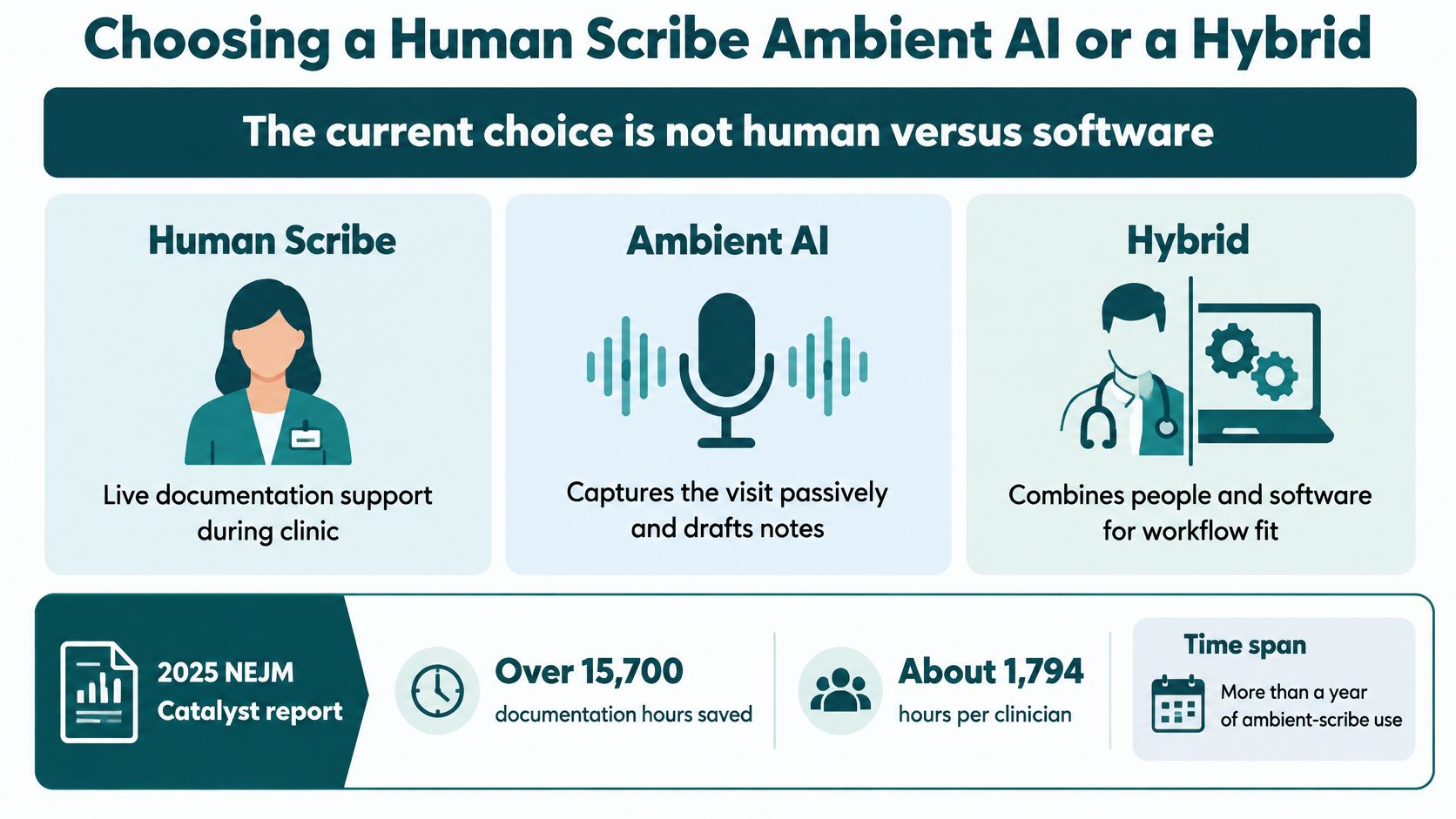
When to use a human scribe, ambient AI, or both
Use encounter requirements to choose the model. These are operating recommendations, not claims that every human or every software product performs the same way.
| Situation | Better fit | Why |
|---|---|---|
| Complex specialty visit or unusual EMR clicks | Human scribe | Needs live navigation, not merely a post-visit draft |
| Routine follow-up with clear audio | Ambient AI or hybrid | Drafting speed helps if the clinician still edits |
| Multilingual encounter | Bilingual human scribe | The note must reflect what the patient said |
| Sensitive behavioral-health discussion | Clinician-only or tightly bounded human scribe | Rapport and content decisions stay clinical |
| Poor audio or noisy room | Human in an approved setup, or no scribe | Unclear audio makes reliable capture difficult |
| Need a same-day structured note | Human or hybrid with a sign-off deadline | A longer draft can still sit unsigned |
| High volume but uneven clinician uptake | Hybrid with named users | Ambient use and savings can concentrate among heavy users |
Match the model to the work inside the encounter
A dedicated human scribe is worth considering when the provider needs help moving through the EHR while speaking with the patient. That could mean locating the relevant prior note, keeping the current narrative separate from historical findings, or entering dictated examination details into an unusual template. Confirm those duties during a demonstration rather than assuming that all live scribe services include them.
Ambient AI is a reasonable candidate for a clearly recorded, conversational follow-up when the main task is producing a structured draft. Ask the vendor to demonstrate how the draft reaches your EHR, how speaker attribution works, and what happens when the encounter includes interruptions or contradictory statements. Don't assume that a note-generation feature includes chart navigation, order workflows, or human quality review.
A hybrid model can combine software drafting with human documentation support or review. It can also mean assigning different visit types to different methods. In either version, identify who checks the draft before it reaches the clinician and who owns the final sign-off.
Role labels deserve the same scrutiny. A comparison of medical assistants and medical scribes can help you avoid assigning patient-care duties to a documentation hire or assuming that an administrative assistant has specialty scribing skills.
Use a realistic encounter mix
Say a primary-care practice tests ambient drafts for stable hypertension follow-ups, assigns a bilingual human scribe to complex new-patient and Spanish-language encounters, and lets clinicians document particularly sensitive discussions themselves. The provider signs every resulting note under the same review standard. The practice compares correction work by encounter type instead of averaging everything into a single productivity score.
A bilingual scribe still isn't automatically a qualified interpreter for every clinical situation. Define the language-support role separately, confirm competence, and follow the practice's interpreter policies. Similarly, choosing a human doesn't solve a poor connection unless the approved setup lets that person hear the encounter clearly.
Choose the model that produces a reviewable record for that visit, not the model that produces the most text with the fewest keystrokes.
Consent procedures, staff training, EHR compatibility, and clinician preference remain practical adoption barriers. In mental-health settings, attention to screens or the presence of another listener can also affect rapport, so the clinician needs a workable way to pause documentation support.
General best practices for automated meeting notes from AONMeetings can inform nonclinical habits such as checking capture quality and assigning follow-up ownership. They aren't healthcare privacy guidance, and an ordinary meeting-notes workflow shouldn't receive patient information without a separate clinical and security assessment.
Before purchasing either model, ask: which encounter types would fail if the draft were merely faster rather than more accurate? Use those encounters in the evaluation, not just the easiest demonstration visit.
Privacy Duties and When Not to Add a Scribe
A remote scribe may encounter protected health information through the EHR, audio connection, patient messages, or recordings. For an external scribe provider acting as a business associate, address that relationship before access begins. A confidentiality promise alone doesn't replace the required contractual protections.
The HHS guidance on business associates explains that covered entities must obtain satisfactory assurances through a written agreement describing permitted uses and disclosures, restricting other uses, and requiring relevant Privacy Rule obligations when the associate performs covered-entity functions. HHS also explains direct liability for certain business-associate duties and the application of requirements to business-associate subcontractors.
Separate contractual duties from operating controls
Have your compliance lead determine the correct arrangement for the staffing relationship, including whether the person is part of your workforce or supplied through an external business associate. For a vendor arrangement, clarify subcontractors, access locations, incident reporting, and what happens to patient information when the engagement ends. The contract should reflect the actual service, not a generic description that omits recordings or downstream processors.
HHS does not recognize an official HIPAA certification. Don't accept that phrase as evidence that a person, tool, or workflow is compliant, and don't treat a signed business associate agreement as a substitute for security controls.
Use the following as an implementation checklist, not a claim that every item is an independently prescribed HIPAA procedure:
- Role-based permissions: Give the scribe access appropriate to approved documentation tasks, without unnecessary prescribing or authentication permissions.
- Unique credentials: Require individual accounts so your team can identify who entered or changed information.
- Limited access: Configure access around the assigned work and confirm minimum-necessary obligations with your compliance lead.
- Documented training: Cover patient information, approved tools, escalation, and refresher expectations.
- Secure communications: Specify approved audio, messaging, and file-sharing channels rather than leaving tool choice to the hire.
- Incident response: Name the person who receives reports of misdirected information, lost devices, or unexpected chart access.
- Access removal: Assign responsibility for disabling accounts and ending sessions when coverage or employment ends.
A HIPAA-aligned virtual-assistant workflow should be evaluated through these concrete controls. Ask how they work in your environment rather than accepting a broad assurance.
Treat patient communication as a workflow
Patient notice or consent requirements can differ by recording method, state, setting, and organizational policy. Explain who is listening, what the documentation arrangement does, and how a patient can raise a concern. Give the provider a clear process for continuing without the scribe when appropriate.
Closer Innovation Labs Corp.’s resource on electronic patient consent forms may help your team think through form routing and signatures. A signed form isn't, by itself, proof that a recording arrangement or documentation service meets all applicable requirements.
Access gate: Don't let a staffing start date become the reason someone receives patient information before the privacy review is complete.
These are general operating considerations, not legal advice. Confirm your obligations with qualified counsel or a compliance professional, particularly when recordings, sensitive records, or cross-border access are involved.
Know when another fix is more appropriate
Very low visit volume or short, well-functioning templates may not justify a dedicated scribe. Unreliable remote EHR access can make a live documentation arrangement impractical. A provider who rewrites every draft may need better templates, clearer dictation habits, or a different documentation model before adding staff.
Also distinguish documentation burden from review avoidance. If notes remain unsigned because the provider has no protected review time, adding drafts may enlarge the backlog. Set aside that review time before hiring.
Before signing a contract, take a baseline sample of unsigned charts across a representative clinic week. Record their age, why they're open, and what must happen to close them. That separates a genuine drafting shortage from missing results, unresolved clinical questions, and an absent sign-off routine.
How a Virtual Scribe Works During Clinic Hours
A live virtual scribe works best when the practice treats the role as part of the clinic session, not an overnight cleanup service. The scribe needs access to the approved documentation pathway and a reliable way to reach the provider while details are still fresh. The provider needs a predictable review point rather than another inbox to remember at home.
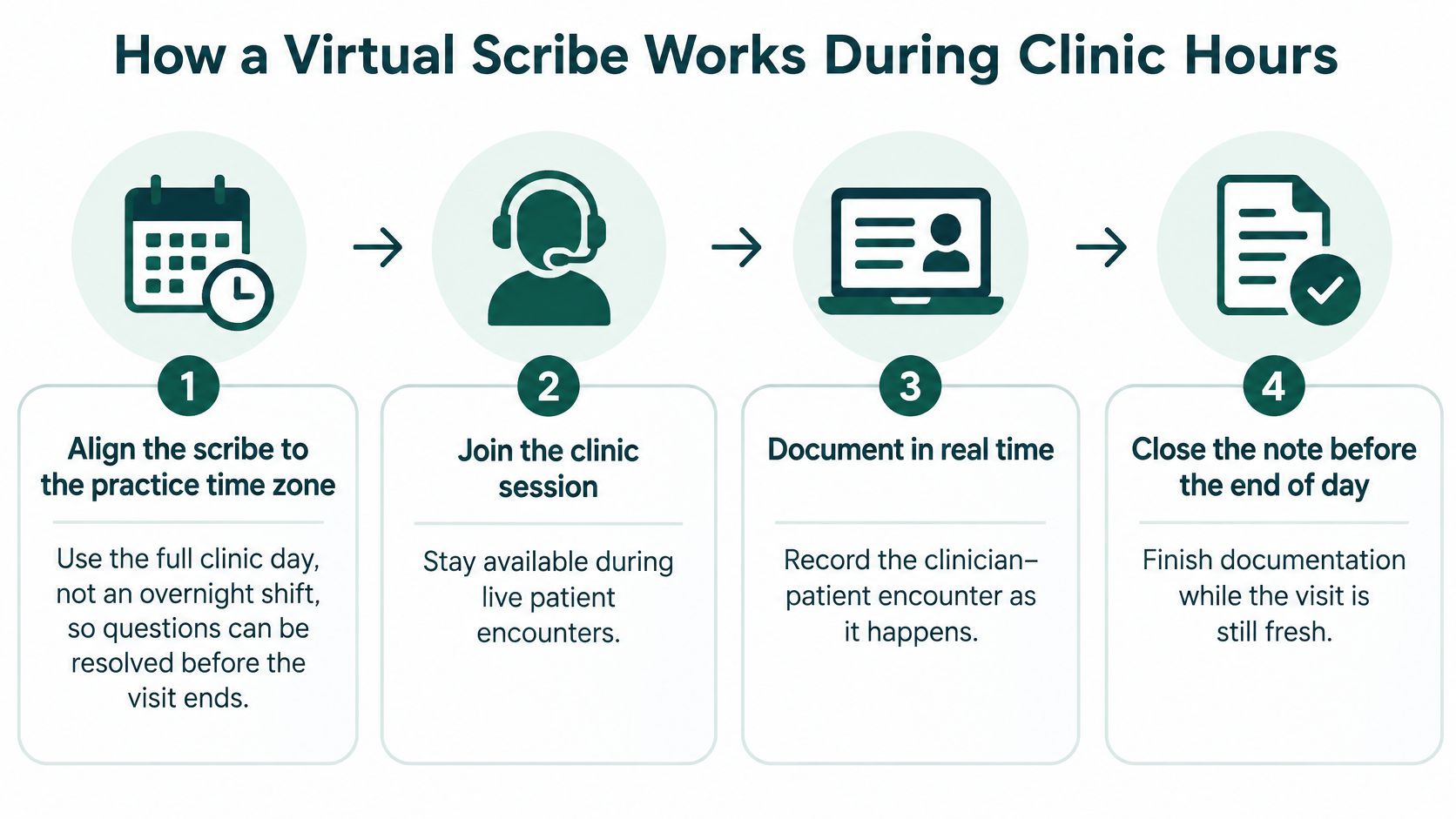
Set up the clinic-day sequence
Align coverage to the practice's time zone. Schedule the scribe for the live clinic session, including the agreed review window. Overnight coverage may suit retrospective work, but it won't let the scribe resolve an ambiguous statement before the provider leaves.
Confirm the patient's notice or consent status through the approved process before connecting the scribe. Use the practice's authorized in-room audio or telehealth pathway, not a personal recording application. If the connection fails or the patient objects, staff should know how to continue without documentation support.
Document directly in the assigned encounter. The scribe uses an individual login and the approved template to enter the history, examination details, and stated plan. Start by verifying the correct patient and visit, especially when the provider moves quickly between rooms or telehealth appointments.
Pend the note the same day rather than leaving a transcript for somebody else to convert later. A draft should be clearly identifiable as ready for review, awaiting clarification, or incomplete because of a specific missing item. Don't let staff use the same status for all three conditions.
Build the clinician's review into the schedule. The provider checks medications, allergies, diagnoses, orders, timestamps, and copied-forward text before signing. The review should focus on whether the record accurately represents the encounter, not merely whether every template field contains text.
Keep a short correction loop. The scribe flags the exact phrase or field requiring clarification, the provider answers through an approved channel, and the scribe updates the draft. Repeated questions should lead to a template change or training discussion rather than a growing collection of workarounds.
Close out access when the engagement ends. Disable EHR, phone, audio, messaging, and other assigned accounts through the practice's offboarding process. Confirm the treatment of retained information under the applicable agreement rather than assuming account removal addresses everything.
Change the sequence for the specialty
In primary care and internal medicine, test whether live capture helps with long narratives and multiple problems. The scribe should distinguish the reason for today's visit from historical information without turning every encounter into an expanded summary of the entire chart. Templates should make the active plan easy for the next reader to find.
Mental-health workflows may require the scribe to leave for part of an encounter or the clinician to write sensitive portions personally. Establish that pause process before a difficult conversation occurs. A smooth technical connection isn't a sufficient reason to keep another listener present.
Dental, optometry, physical therapy, and med-spa practices should inspect their actual notes before assigning dedicated scribe coverage. Short templated documentation may leave little work to transfer, while patient intake, scheduling, insurance verification, or billing support may be the more pressing staffing need. Evaluate the task, not the specialty label alone.
Test candidates on the handoff
Use a fictional encounter for the hiring exercise. Include an unclear medication instruction, a corrected history detail, and a statement that shouldn't be copied into the assessment as a confirmed diagnosis. Assess whether the candidate flags uncertainty and produces a readable pending note, not just whether they type quickly.
Medical Virtual Assistants is one staffing path for this workflow, offering pre-vetted Latin American talent with prior U.S. practice experience, clinic-hours alignment, and an interview before hire. Confirm current terms and pricing directly, and arrange the applicable business associate agreement before EHR access.
I would pilot one provider and one encounter type for two weeks before expanding. Treat that as a limited operating test, not a validated outcome window: compare the provider's review burden, draft corrections, and unresolved notes with the baseline, then decide whether the workflow deserves a broader trial.
The Takeaway
Medical scribing is a quality-controlled division of chart work. The scribe prepares the encounter record inside the EHR, and the clinician remains responsible for its clinical content and signature. When someone asks what is medical scribing, that distinction is more useful than describing it as faster typing.
A human scribe, ambient software, or a hybrid is worth testing when documentation is the actual bottleneck, the access arrangement passes privacy review, and the provider has a workable sign-off routine. Judge the model by encounter type and correction burden, not the speed of the first draft. A shorter path to a reliable, completed record matters more than a larger supply of unsigned notes.
Start with a focused look at a provider's unfinished charts, define the responsibility matrix, and interview against the encounters you need help documenting. Expand only when the trial shows that the handoff works without transferring hidden work to the provider or the rest of the team.
MedicalVirtual connects U.S. practices with pre-vetted Latin American virtual medical scribes who work clinic hours inside the practice's EHR, with an interview before hire and business associate agreement support. Define your drafting, escalation, and review workflow, then visit MedicalVirtual to discuss candidates suited to that role.