

Monday morning starts with pending authorizations, denial notices in the EMR, and patients asking whether they should keep their appointments. The front desk has called the payer, billing has flagged a missing authorization number, and the provider hasn't seen the request for additional clinical information. Everyone has touched the case, but nobody owns its next step.
Prior authorization denials are payer decisions refusing all or part of a requested service before care is delivered. Recovering the associated revenue requires more than resubmitting paperwork. You need an end-to-end workflow that connects benefits verification, clinical documentation, payer review, appeal decisions, scheduling, and claims reconciliation.
The practical answer is to manage authorization as a measurable funnel, with a named owner and documented next action at every stage. Clean submissions help, but practices also need to identify which denied requests remain recoverable and act before the available review window closes.
Remote authorization support can absorb portal checks, records assembly, payer calls, and deadline tracking. It can't replace a provider's medical judgment or fix a poorly defined process. Before hiring, establish where cases stall, what evidence staff must preserve, and which decisions require clinical escalation. Otherwise, you'll add capacity to the same broken queue.
Why Prior Authorization Denials Keep Multiplying
A crowded authorization queue doesn't necessarily mean your staff is careless. More requests create more opportunities for missing records, mismatched information, and unattended follow-up. When authorization work competes with check-in, telephone coverage, and referrals, staff often complete the submission but lose visibility into what happens afterward.
Medicare Advantage plans received 46.2 million requests in 2022, denying 3.4 million, or 7.4%, compared with 5.7% in 2019; request volume increased approximately 24.3% over that period. Only 9.9% of denied requests were appealed, yet 83.2% of submitted appeals produced a full or partial overturn, according to KFF's analysis of Medicare Advantage authorization outcomes.
Separate the decision from the processing problem
Your work queue should distinguish these outcomes:
- Full denial: The payer refuses the entire requested service.
- Partial denial: The payer approves less than requested, such as a narrower treatment scope.
- Administrative rejection: The request isn't accepted for review because information or submission requirements are missing. Track this separately rather than assuming it is a clinical coverage decision.
That distinction determines the next action. A rejected request may need correction, while a medical-necessity denial may need provider review. Treating a partial approval as a complete refusal can also obscure care that the patient can already receive.
Build a recoverability workflow
The useful operating sequence is straightforward: verify benefits, submit a complete request, triage adverse decisions, measure results by payer, and assign ownership. Missing documentation, coding inconsistencies, misunderstood payer rules, and delayed escalation belong in that workflow, not in an undifferentiated denial folder.
Practical rule: A submitted request isn't finished work. It remains an open case until someone records the decision and reconciles it with the planned service.
The historical overturn rate identifies an opportunity among appealed cases, not proof that most unappealed denials would succeed. Still, it's a strong reason to stop treating every adverse decision as final. Authorization recovery should restore access to appropriate care first; revenue follows only when services are delivered and claims are payable.
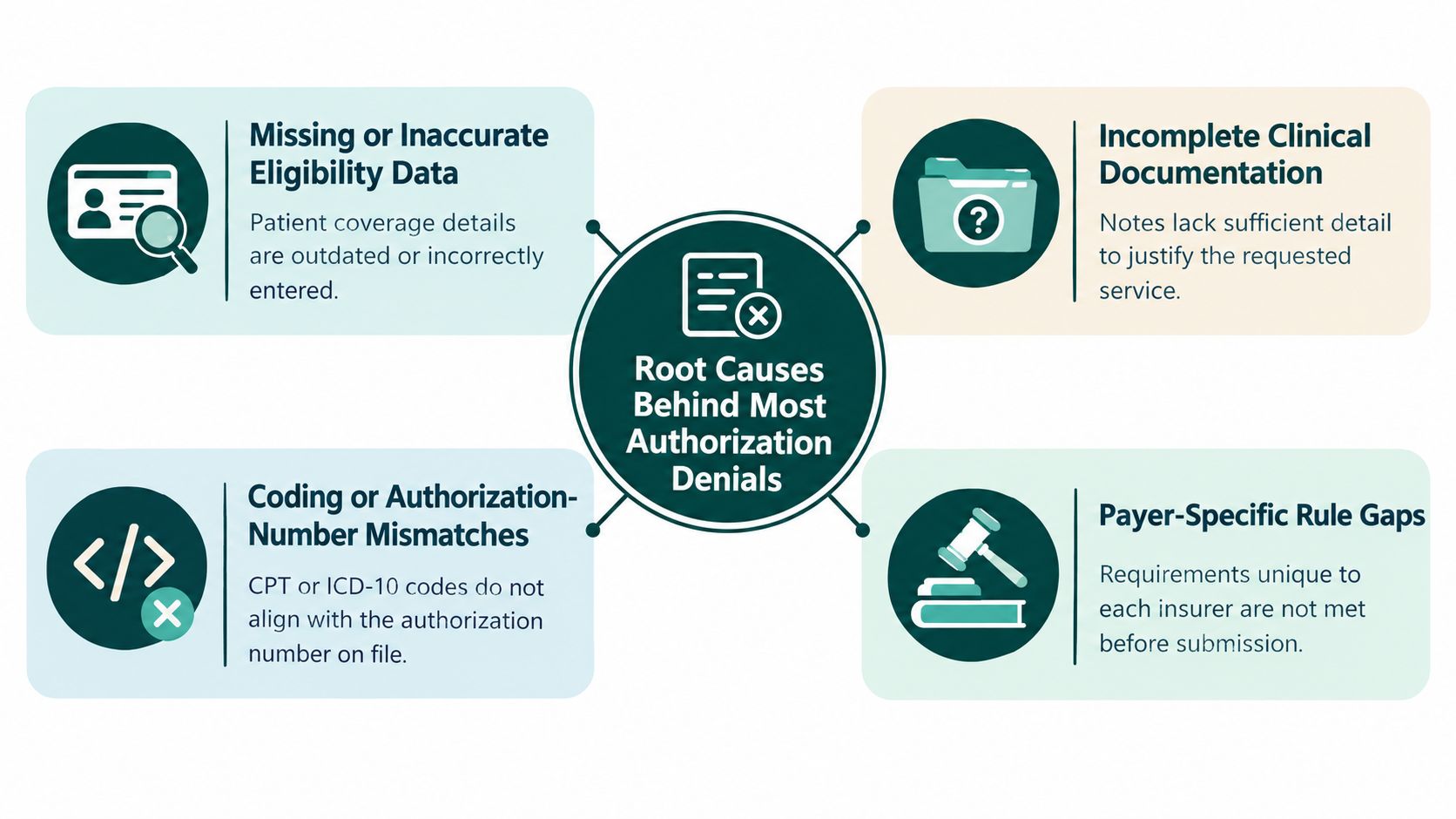
The Root Causes Behind Most Authorization Denials
The denial reason should determine the remedy. Sending another copy of the same packet feels productive, but it won't resolve a coverage exclusion, an incorrect service code, or a missing prerequisite.
An HHS Office of Inspector General review of Medicare Advantage denials found that 13% of sampled prior-authorization denials met Medicare coverage rules and likely would have been approved under original Medicare. That finding identifies a risk of inappropriate denial; it doesn't establish that every such decision was administrative or that the same proportion applies to your payers.
Classify the defect before assigning work
Eligibility errors begin upstream. For example, a returning patient may have changed plans, while staff rely on an old insurance card. The corrective action is to verify the current plan and requirements, not draft a medical-necessity appeal.
Incomplete clinical documentation requires a different response. An imaging request may include the diagnosis but omit relevant examination findings or previous treatment. The coordinator can identify the gap, but the provider must supply the clinical explanation.
Coding and authorization-number mismatches often become visible when the requested service, approval, scheduled procedure, and claim don't agree. Staff should reconcile those records rather than changing codes to obtain approval.
Match the remedy to the service line
Payer-specific rule gaps require a maintained checklist. In a behavioral health workflow, for example, staff should verify the requested level of care and the plan's requirements rather than assuming that authorization for one service covers another.
For substance-use treatment teams seeking patient-facing context, prior authorization help from Addiction Resource Center, offered by Addiction Resource Center LLC, is a supplementary resource. Your operational decisions should still use the patient's actual plan documents and payer instructions.
- Correctable administrative defect: Route to the coordinator with the exact correction needed.
- Clinical disagreement: Route to the provider with the denial rationale and applicable policy.
- Potential coverage exclusion: Verify benefits and escalation rights before committing staff to an appeal.
- Unclear denial: Obtain clarification rather than guessing which evidence the payer wants.
Record the cause before closing or escalating the case. Without that classification, managers can't distinguish preventable submission defects from substantive coverage disputes.
Front-End Verification That Prevents Denials Before They Happen
A payer's statement that authorization isn't required needs an audit trail. A verbal answer without the plan, service details, and reference number leaves billing with little evidence if the claim later receives a contradictory denial.
In a 2025 survey of 856 physical-therapy professionals, 2 in 5 respondents reported that claims were subsequently denied for missing prior authorization more than 25% of the time, despite the payer previously saying authorization wasn't required, according to the APTA administrative-burden infographic. These are respondent-reported experiences, not a measured denial rate across all physical-therapy claims.
Verify the planned service, not just the insurance card
Schedule verification early enough to resolve discrepancies before the appointment. Confirm active coverage, member and plan identifiers, the planned service, provider, and location; check primary care assignment or referral requirements when relevant to the plan.
A reusable insurance verification form can help standardize collection, but completing a form isn't the same as resolving an unanswered question. Give uncertain requirements their own pending status so they don't disappear into a completed verification task.
For a patient-facing intake reference, the California Teen Center insurance check provides an insurance-check destination. Within your practice, keep the distinction clear: collecting insurance information starts verification; it doesn't establish authorization or guarantee payment.
Preserve evidence that billing can retrieve
Your verification record should capture:
- Payer interaction: Representative name, date and time, reference number, and communication channel.
- Service specifics: Codes discussed, provider, location, intended dates, and requested treatment scope.
- Policy evidence: The relevant document or portal response, including its version or retrieval date.
- Unresolved conditions: Any limitation, prerequisite, or instruction requiring further confirmation.
Before check-in, reconcile the verified service with what's scheduled. A changed procedure or treatment location should trigger review rather than automatic reuse of an earlier answer.
Keep authorization verification evidence where the claims team can find it, not only in a receptionist's personal notes.
When utilization management and claims provide conflicting instructions, assemble the verification record and escalate the contradiction. Don't make the patient relay conflicting payer messages between departments, and don't describe verification as a promise that the claim will be paid.
How to Submit Clean Authorizations the First Time
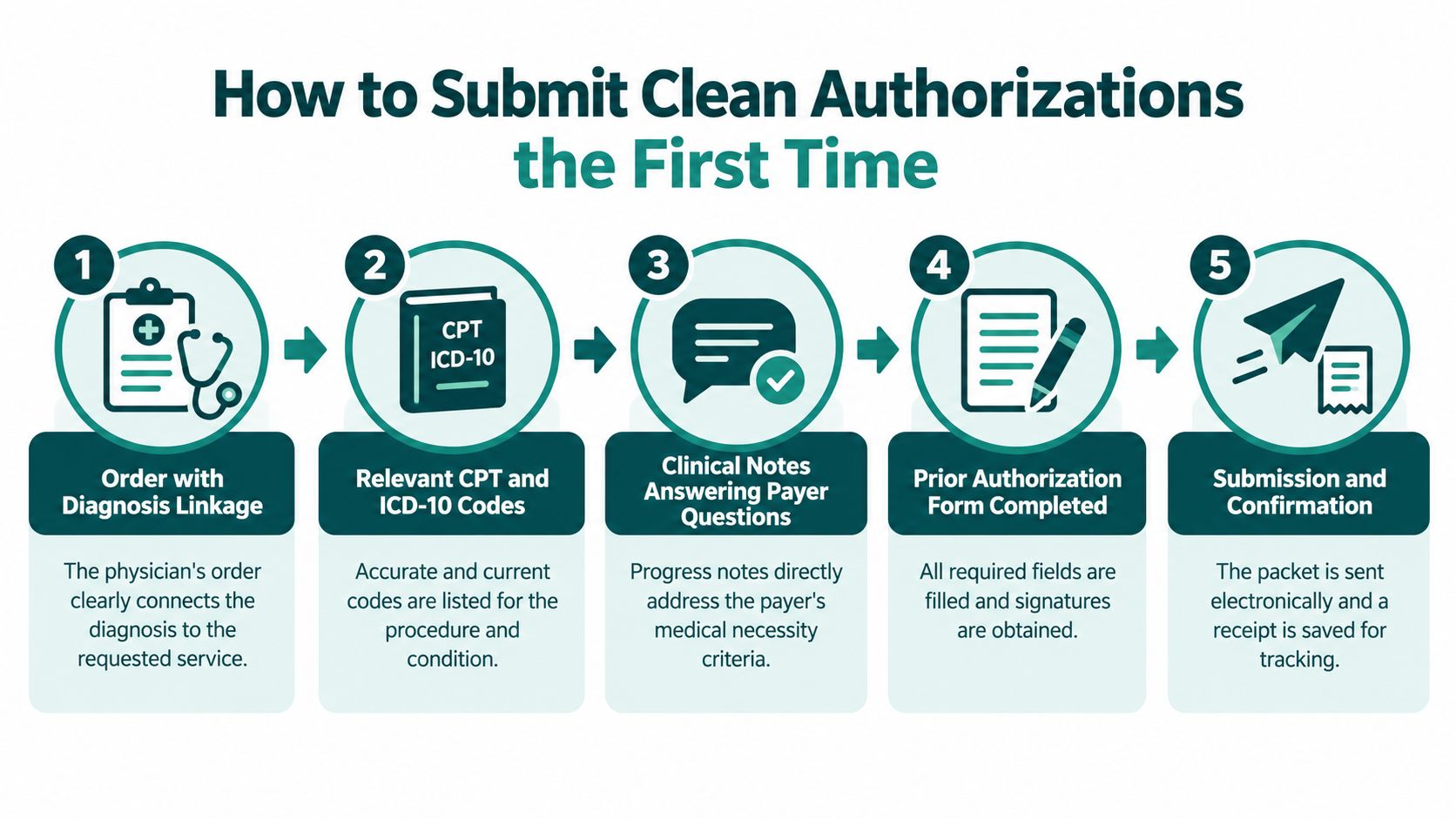
A clean packet answers the payer's stated question. A large packet merely contains many pages. Staff need to know which clinical criteria matter, where the supporting evidence appears, and whether the requested service matches the order.
Make the packet easy to review
Use a payer-specific pre-submission check rather than relying on memory:
- Order and diagnosis linkage: Confirm that the provider's order identifies the requested service and the clinical reason.
- Code alignment: Check relevant CPT and ICD-10 codes against the order and intended service.
- Clinical support: Include findings, treatment history, and documentation addressing the applicable medical-necessity criteria.
- Submission requirements: Use the correct payer form, required fields, signatures, and attachments.
- Transmission evidence: Preserve the submission confirmation, receipt, and payer tracking identifier.
A coordinator should flag missing clinical information, not write unsupported findings into the chart. If a payer requires documentation of conservative treatment, the packet needs the patient's actual treatment history, including relevant exceptions explained by the clinician.
Set the correct review clock
The 2024 CMS Interoperability and Prior Authorization final rule generally requires applicable payers to respond within 72 hours for expedited requests and seven calendar days for standard requests, with certain program-specific extensions of up to 14 additional calendar days, as explained in CMS's prior-authorization process FAQs. These provisions cover specified medical items and services, exclude drugs, and don't apply uniformly to every payer.
Don't mark a request urgent merely because the appointment is approaching. The provider should support urgency based on the patient's condition and the applicable criteria. Staff should record payer receipt, request classification, missing-information notices, and the next follow-up action.
Adapt the checklist to the specialty
For imaging, focus the review on the requested study and supporting clinical findings. For procedures, verify the intended service, provider, location, and relevant prerequisites. For specialty medications, verify the applicable benefit pathway and drug-specific requirements rather than applying the medical-service turnaround rule.
A second-person check is useful for complex submissions, but checking everything identically can become another bottleneck. Concentrate review on high-risk fields and recurring defects, then adjust the checklist when your denial data identifies a new failure point.
Appeals, Peer-to-Peer, and When to Walk Away
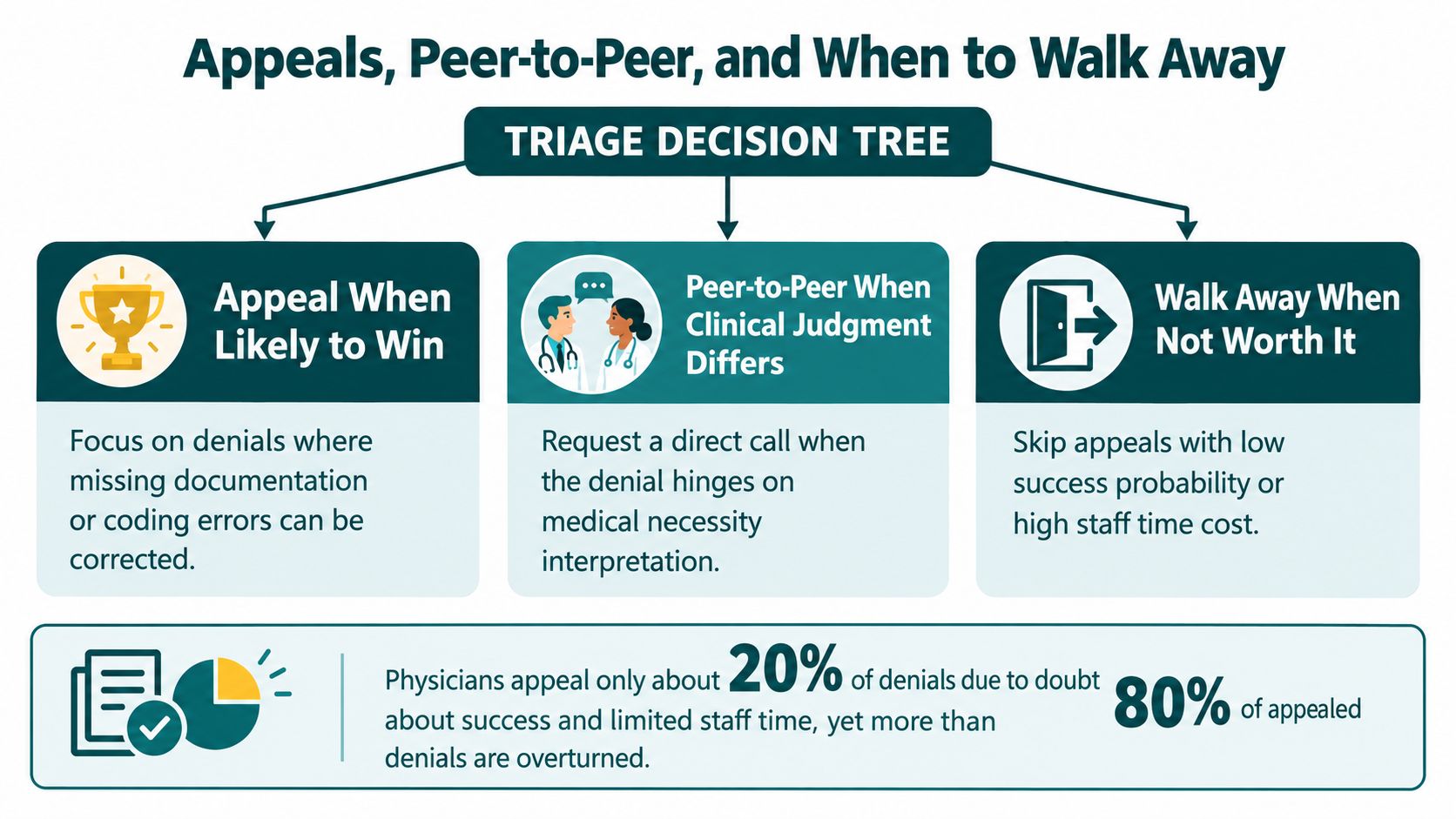
Appeal triage should prioritize clinical harm and a defensible path to reversal, not the largest scheduled charge. Staff time matters, but an apparently low-value service may be essential to a patient's treatment plan.
The AMA's discussion of successful prior-authorization appeals reports that only 18% of surveyed physicians said they always appeal adverse decisions. That measures consistent appeal behavior, not the percentage of all denials physicians appeal. The strong Medicare Advantage overturn results discussed earlier also apply to selected, submitted appeals, not every denied request.
Choose the review path deliberately
Administrative corrections, reconsideration, peer-to-peer review, and formal appeals aren't interchangeable. Verify the plan's available pathway and deadline before acting; don't assume that arranging a peer-to-peer conversation pauses an appeal deadline.
If delay could threaten the patient's health, route the case promptly to the provider to assess expedited-review criteria. The coordinator can schedule the discussion and organize evidence, but the clinician must explain medical necessity.
Assemble a case-specific evidence packet
A strong appeal record should contain:
- Decision details: Denial letter, exact rationale, policy citation, and relevant deadline.
- Case identifiers: Member and provider information, order, diagnosis, and service codes.
- Clinical chronology: Relevant treatment history, objective findings, and the sequence leading to the request.
- Supporting rationale: Applicable guidelines or literature and a clinician-signed explanation connecting the evidence to the requested service.
Have another staff member check identifiers, attachments, signatures, and the requested remedy. Track acknowledgment and the decision, not just the outgoing fax.
For mental health practices assembling patient education materials, insurance denial appeal resources from Children Psych can provide a supplementary reading destination. The actual appeal must remain specific to the patient and plan.
Close cases without abandoning patients
When the payer upholds a denial, verify further appeal or external-review rights where available. Don't promise that every plan offers the same escalation route.
A provider may conclude that another clinically appropriate option is preferable, or that the evidence doesn't support further contest. Document that decision and communicate the next care step. Low expected financial recovery alone shouldn't determine whether a medically necessary request receives review.
Closure standard: Every declined appeal needs a reason, an accountable decision-maker, and a patient communication plan.
KPIs That Actually Move Denial and Appeal Performance
Submission totals tell you how much work staff touched. They don't tell you whether patients obtained care, requests stalled, or recoverable denials expired without review.
The appeal gap persists beyond the earlier historical example: Medicare Advantage plans received more than 50 million requests in 2023, denied 6.4%, and received appeals for only 11.7% of denials, while nearly 82% of appeals produced favorable enrollee decisions, according to Georgetown's Medicare Advantage prior-authorization fact sheet. Those figures support measuring the transition from denial to review, not just the initial decision.
Segment payer performance before setting targets
Payer Variation in 2022 Medicare Advantage Prior Authorization Outcomes
The following historical figures come from Fierce Healthcare's coverage of KFF's insurer-level analysis. Anthem's reported appeal utilization was 15.2%; the table includes only denial and reversal figures available for each listed payer.
| Payer (illustrative 2022) | Reported denial rate | Reported reversal rate on appealed denials |
|---|---|---|
| Anthem plans | 4.2% | Not provided in the cited figures |
| CVS Health's Aetna plans | 13.0% | 90.8% |
| Humana | Not provided in the cited figures | 68.4% |
| Centene | Not provided in the cited figures | 95.3% |
These aren't current performance guarantees or targets for your practice. They demonstrate why a single practice-wide denial percentage can conceal very different payer workflows.
Connect each metric to a management action
- Authorization volume per provider: Use it to allocate capacity, with service complexity considered alongside count.
- Initial denial rate by payer and service line: Investigate repeated reasons and revise the relevant checklist.
- Appeal rate: Identify cases that never receive a documented triage decision.
- Overturn rate on submitted appeals: Evaluate case selection and evidence quality, recording partial outcomes separately.
- Median time from denial to appeal submission: Locate delays in records collection, provider review, or assignment.
- Deadline-related abandonment: Examine routing failures and backup coverage.
Compare imaging, procedures, and specialty drugs separately where those distinctions change the workflow. Also track unresolved age and first-pass completeness so you don't mistake a slow queue for a clean one.
Connect approved and appealed requests to medical billing support through claims reconciliation. Authorization approval isn't recovered revenue: track whether the service occurred, whether the claim matched the approval, and whether payment followed.
Who Owns the Work and When a Remote Specialist Helps
Dedicated ownership matters more than where the coordinator sits. An in-house employee with competing responsibilities can lose a deadline just as easily as a remote employee without clear escalation rules.
An AMA report on physician-practice authorization workload found an average of 39 prior-authorization requests per physician each week, with physicians and staff spending 13 hours weekly completing them. That workload warrants defined capacity, not an assumption that the front desk will absorb it between calls.
Assign responsibility across the complete workflow
Use a simple RACI, identifying who is responsible, accountable, consulted, and informed. Your practice manager can remain accountable for the process while assigning task ownership as follows.
| Workflow stage | Responsible role | Consulted or informed role |
|---|---|---|
| Benefits and requirement verification | Verification specialist or trained front-desk staff | Authorization coordinator |
| Submission and payer tracking | Authorization coordinator | Ordering clinician for documentation gaps |
| Clinical appeal and peer-to-peer review | Provider for clinical content | Coordinator for assembly and scheduling |
| Authorization-to-claim reconciliation | Billing lead | Coordinator and scheduling staff |
| Patient status communication | Patient coordinator | Provider when care decisions are needed |
Every open request also needs a next-action date and a backup owner. A shared queue won't prevent stalls if everyone assumes another person is monitoring it.
Compare in-house and remote support realistically
In-house coordination can work well when staff must collect physical records, support immediate clinical handoffs, or combine authorization with other onsite responsibilities. The tradeoff is interruption: a coordinator covering check-in and telephone calls may struggle to protect follow-up time.
A remote prior-authorization specialist working U.S. clinic hours from Latin America can handle portal work, payer calls, records assembly, status tracking, and escalation. Bilingual English-Spanish communication may help with patient updates where relevant, but language ability doesn't substitute for payer knowledge or accurate documentation.
Compare total operating requirements rather than assuming remote staffing is automatically cheaper. Review compensation or placement fees, supervision, system access, training, backup coverage, and the work your existing staff will retain. A hybrid model may fit practices that need onsite document handling but dedicated offsite follow-up.
A clearly scoped prior-authorization specialist role should specify administrative duties and clinical boundaries. Remote staff shouldn't independently decide medical necessity, sign provider statements, interpret symptoms, or advise patients to proceed without provider review.
Test the work before granting broad access
Ask candidates to work through a fictional denial with missing treatment history and a conflicting service code. A strong candidate should identify the discrepancy, request clarification, record the deadline, and route the clinical gap without inventing documentation.
- Payer follow-up: Assess whether the candidate captures usable reference numbers and next steps.
- Queue management: Look for clear statuses, deadline awareness, and escalation discipline.
- Written communication: Test concise notes that another employee can act on.
- Role boundaries: Confirm that the candidate distinguishes administrative corrections from clinical decisions.
During onboarding, review work samples and payer interactions rather than measuring only submission speed. For a solo practice, designate the provider's review window; for a larger group, identify specialty-specific clinical contacts so escalations don't circulate through a general inbox.
Build privacy and continuity into the placement
Remote access should follow the practice's approved privacy and security process. Recommended controls include individual accounts, access limited to assigned duties, appropriate authentication, approved devices and communication channels, and prompt access removal when an assignment ends.
Confirm applicable business associate arrangements and contractual safeguards with your compliance professional. A BAA supports the contractual framework where applicable; it doesn't establish that every device, conversation, or workflow is compliant, and you shouldn't describe a worker as officially HIPAA certified.
Define backup coverage and a re-match path before the placement starts. If the fit is poor, preserve the queue, outstanding deadlines, payer contacts, and access-transition plan so replacing the worker doesn't leave patients' requests unattended.
The Takeaway
Prior authorization denials should be managed as a measurable funnel, from verification through submission, decision, appeal, service delivery, and claims reconciliation. Every transition needs an owner, preserved evidence, and a clear next action.
Start with unreviewed denials and payer-segmented performance data. The appeal gap makes disciplined triage worth investigating, but it doesn't justify blanket appeals or assumptions that most denied cases will reverse. Build evidence-backed cases and prioritize patient harm alongside operational effort.
Strengthen prevention through reliable verification and payer-specific submissions, then choose in-house, remote, or hybrid staffing around the actual workload. Confirm applicable privacy, contractual, state, and plan obligations with qualified counsel or compliance professionals before expanding access.
MedicalVirtual connects U.S. practices with pre-vetted Latin American healthcare staff who work clinic hours, including prior-authorization specialists for submission, tracking, and administrative escalation. If your process is defined but follow-up keeps slipping, visit to discuss a role scoped to your payer mix, systems, and clinical handoffs.