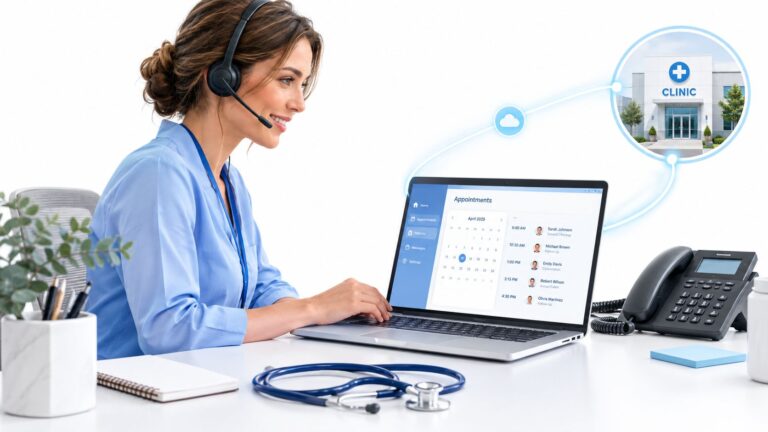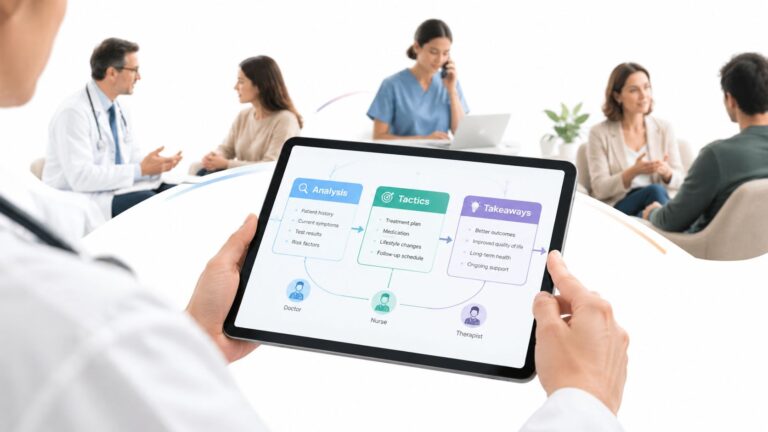

At the end of a busy clinic day, the provider has finished seeing patients but still has a queue of unsigned charts. The practice manager sees the backlog growing, while the clinician stays at the keyboard, reconstructing conversations that happened hours earlier. A remote medical scribe can reduce that burden by capturing encounter details, organizing them in the EHR, and preparing documentation for clinician review from a secure off-site location. The role can improve timeliness and give providers more attention for patients, but it isn't a shortcut around clinical accountability, privacy obligations, or quality control.
The right decision depends on how your practice works. Real-time and asynchronous models create different trade-offs. Specialty, encounter complexity, patient consent, EMR permissions, connectivity, review habits, and staffing coverage all affect the outcome. The strongest implementations measure more than note closure speed. They track factual accuracy, correction patterns, after-hours work, access activity, and the effect on downstream billing and care coordination.
Understanding the Remote Medical Scribe Role
The provider finishes the final appointment, opens the chart queue, and finds several notes still waiting. A remote medical scribe could have listened to the encounters through an approved connection, entered the relevant history and findings into the correct template, and prepared each draft while the visit was still fresh. The clinician would still need to review, correct, and authenticate every note, but the work would shift from rebuilding the encounter to verifying it.
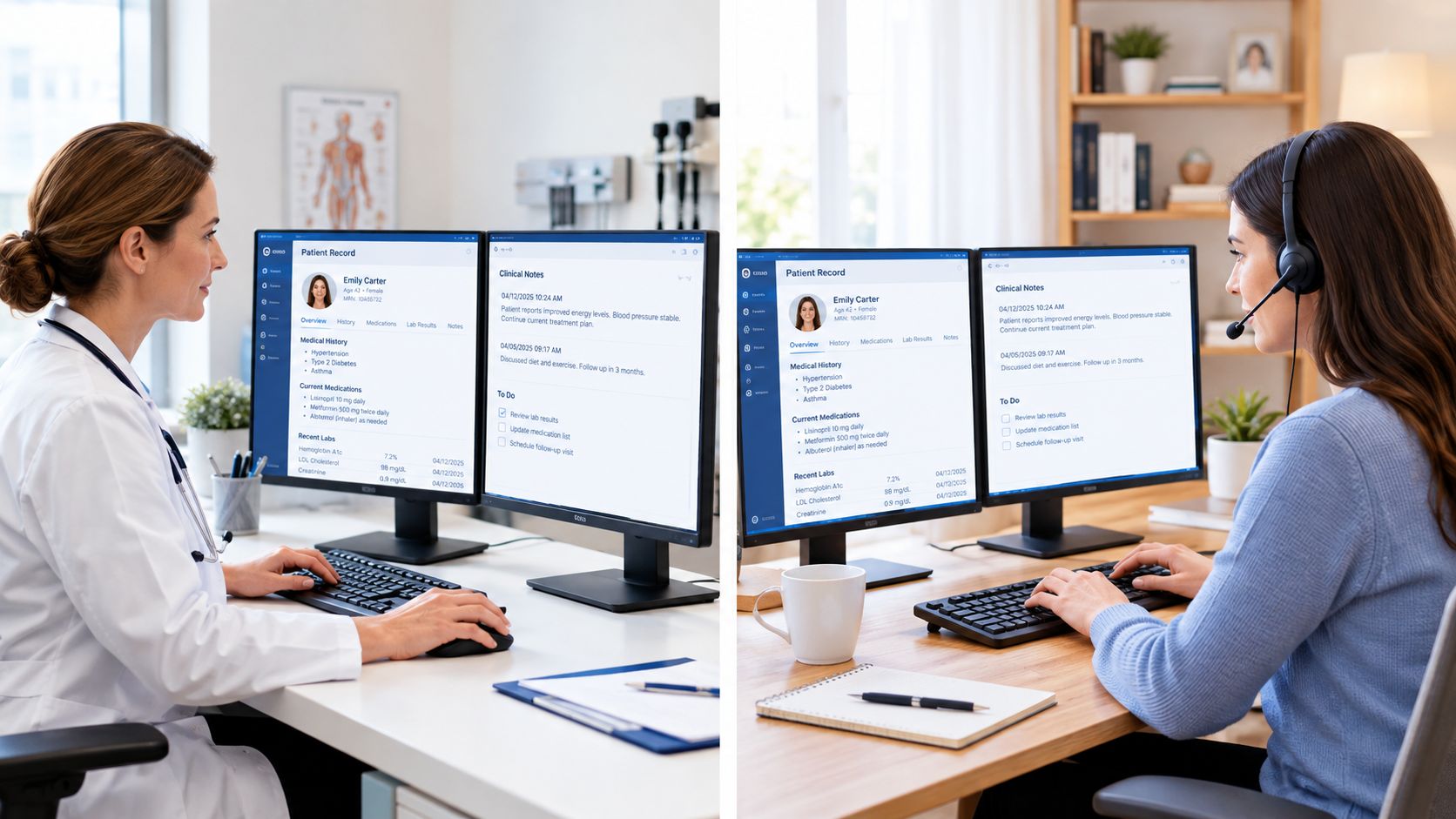
A remote medical scribe is a documentation specialist who works outside the clinic while supporting a provider inside the EHR. Unlike a transcriptionist who may convert dictated audio into text after the fact, a scribe can follow the encounter in real time, organize information into a SOAP note or specialty template, review relevant chart material, and coordinate permitted documentation tasks with the care team. The exact scope must be defined by the practice.
What the role includes
A capable scribe may prepare the history of present illness, review prior information, place content in the appropriate note fields, and capture the clinician's documented assessment and plan. Depending on practice policy, the scribe may also integrate laboratory results, prepare information for clinician-directed orders, or help coordinate follow-up documentation. These tasks make the role more than keyboard support, but they don't transfer clinical judgment.
The licensed provider remains responsible for the medical record. A scribe must not diagnose independently, select treatment, authenticate the provider's note, or make an uncertain statement sound definitive. Every draft needs clinician sign-off before closure, with a clear escalation path when the scribe can't determine whether a detail is accurate or belongs in the current encounter.
How the role fits into daily operations
Remote access can reduce the physical constraints of an in-room scribe, but it introduces workflow dependencies. The clinic needs reliable audio or video, a private workspace, role-based EHR access, clear patient disclosure procedures, and templates that reflect how the provider documents. A scribe trained only in medical terminology may still struggle if they don't understand the specialty's note architecture or the practice's rules for pending orders and corrections.
A practical role description should specify what the scribe may view, enter, edit, or prepare. The medical scribe role overview can help managers distinguish documentation support from broader administrative work when defining responsibilities.
Practical rule: If a task could change clinical meaning, the provider must own the decision and the final review.
Real-Time Versus Asynchronous Scribing Models
The choice between real-time and asynchronous scribing isn't a minor scheduling preference. It determines when the scribe receives information, how much context they can capture, how quickly the provider can review the note, and where errors are most likely to appear.
A real-time scribe follows the encounter as it happens through an approved audio or video connection and enters documentation during the visit. This model works well when the provider wants the note substantially prepared before moving to the next patient, when the encounter includes a complex history, or when the provider benefits from immediate clarification through an established workflow.
An asynchronous scribe works from a recording, dictated summary, rough notes, or other approved source after the encounter. This approach can fit providers who prefer uninterrupted conversations, practices with variable appointment timing, or teams that can tolerate a later review cycle. It also depends heavily on recording quality, patient disclosure and consent procedures where applicable, and the completeness of the source material.
| Feature | Real-Time Scribe | Asynchronous Scribe |
|---|---|---|
| Documentation timing | Entered during the encounter | Prepared after the encounter |
| Provider interaction | Scribe follows the live visit | Provider supplies or authorizes the source material |
| Best fit | Complex histories, immediate review, tightly scheduled clinics | Flexible coverage, provider preference, less interruption |
| Main operational risk | Connectivity gaps or missed live details | Incomplete recording, delayed context, and memory gaps |
| Review pattern | Provider can review near the end of the visit | Provider reviews after the draft is completed |
| Staffing requirement | Coverage must match appointment hours | Work can be scheduled around approved recordings or notes |
| Patient experience | Requires clear explanation of remote participation | Requires clear explanation of recording or post-visit processing |
Choosing by specialty and encounter type
Primary care often benefits from real-time support because visits may move between chronic conditions, medication questions, preventive care, and follow-up planning. A remote scribe who understands the provider's preferred structure can keep those threads separated. Mental-health practices need a more careful assessment because sensitive conversations may be affected by another participant or by recording. Patient disclosure, consent, privacy, and the option to proceed without the scribe should be built into the workflow.
Specialties with procedures, frequent laterality references, measurements, or rapidly changing orders need a high review threshold under either model. A delayed draft may work for a straightforward follow-up, while a live scribe may be preferable when the provider needs documentation to keep pace with a complex encounter. Neither model is automatically more accurate. The practice should test representative visits and measure corrections, omissions, and review time.
Supporting the audio workflow
If your asynchronous process relies on recordings, don't assume any audio-to-text service is suitable for protected health information. A general explanation of audio-to-text workflows for podcasters may clarify the distinction between converting sound into text and operating a governed medical-documentation process. Your healthcare workflow still needs approved systems, defined retention, access controls, and clinician review.
Clinical Benefits and Operational Impact
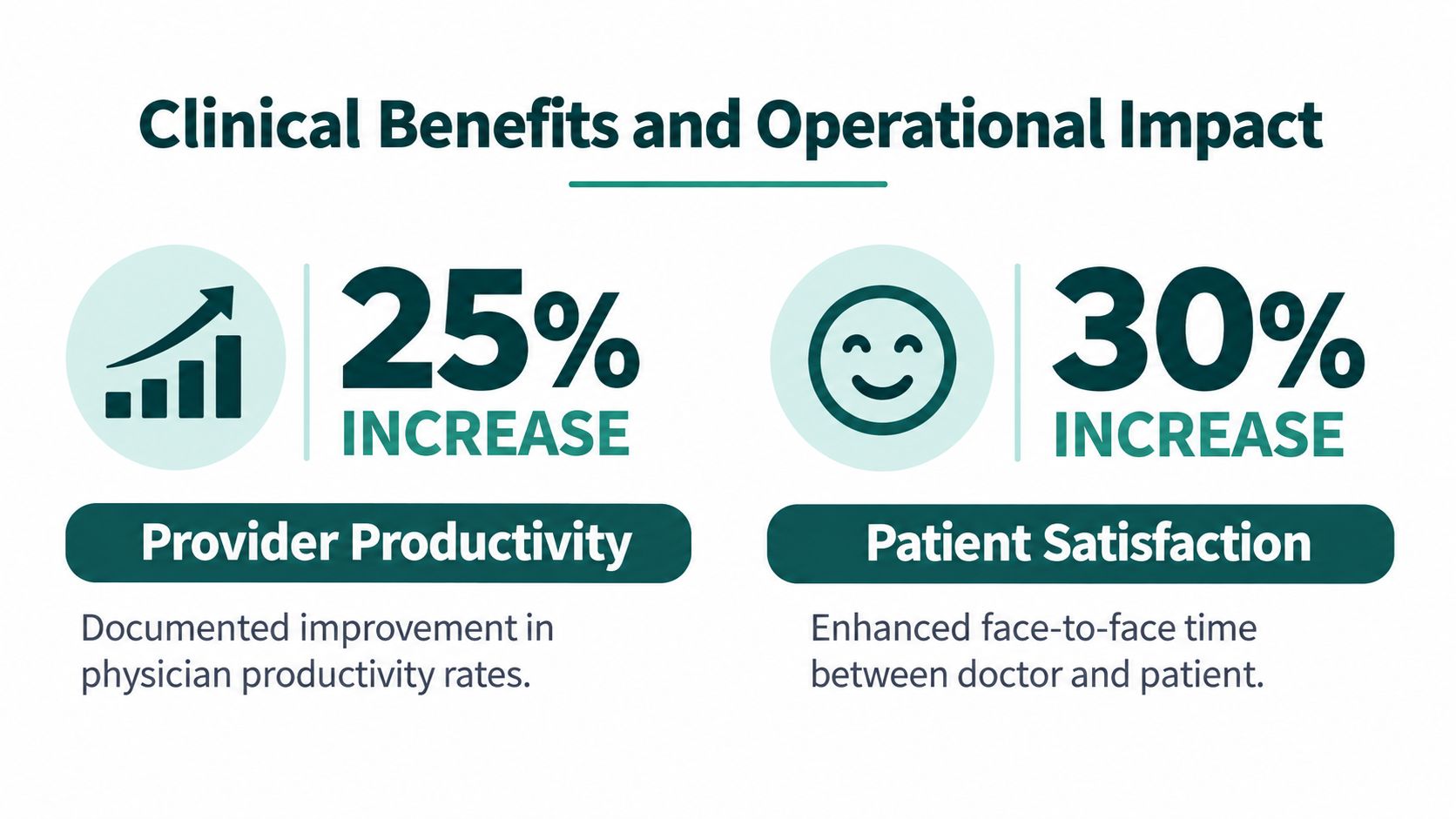
The value of a remote medical scribe should be judged through operational measures, not broad promises. Research supports meaningful documentation relief in some settings, but results vary by clinician, specialty, and workflow.
In a 2021 ophthalmology study, physicians spent an average of 4.7 minutes on total documentation for scribed visits, compared with 7.6 minutes without a scribe, a reduction of 2.9 minutes, or approximately 38% (study details). Documentation during the visit fell from 5.9 to 2.8 minutes, while post-visit documentation changed from 1.7 to 1.9 minutes. The study included seven physicians and also found that scribed visits were associated with a 2.9-minute increase in total office-visit length. Average chart-closure time decreased from 10.5 hours to 9.15 hours.
Those results show why implementation details matter. The scribe moved work into the encounter, but post-visit documentation didn't improve for every clinician. Three of the seven physicians spent more time on after-visit documentation with a scribe. A practice shouldn't assume that a shorter live documentation period automatically produces a shorter total workflow.
After-hours work deserves its own metric
A 12-month crossover study followed 18 primary-care physicians across two facilities. During scribed periods, physicians were substantially more likely to report less than one hour of weekday after-hours EHR work, with an adjusted odds ratio of 18.0, and less than one hour of weekend after-hours EHR work, with an adjusted odds ratio of 8.7 (primary-care study). Encounter documentation was also more likely to be completed by the end of the next business day, with an adjusted odds ratio of 2.8.
The study reported a 77.2-minute reduction in physician documentation time per clinic unit, although that estimate didn't reach conventional statistical significance. Researchers also found significant improvements in productivity, job satisfaction, and face-to-face interaction with patients. For managers, the lesson is practical: measure after-hours EHR minutes, next-day completion, clinician experience, productivity, and patient interaction together.
Human scribes and ambient AI
Ambient AI can draft notes without assigning a human to every encounter. In a 2025 JAMA Network Open quality-improvement study, ambient AI use was associated with a 20.4% reduction in documentation time per appointment, an increase in same-day note closure from 66.2% to 72.4%, and a 30.0% reduction in after-hours work (JAMA Network Open study). A separate comparative study found that human scribes reduced attending documentation time by 3.3 minutes per note, compared with 1.6 minutes for ambient AI scribes. Neither approach increased work relative value units per shift hour.
That last finding matters. Faster documentation doesn't necessarily create greater clinical throughput. Human support may be more useful when the encounter requires clarification, recognition of ambiguity, specialty terminology, multilingual awareness, or coordination around orders and referrals. AI may fit predictable documentation patterns, while a hybrid model can use automation for drafting and a human for review or workflow intervention. The right comparison is not just speed. It includes clinical completeness, correction burden, patient comfort, integration effort, and accountability.
For automated appointment workflows, managers may also review resources on how to automate appointment setting with AI, while keeping scheduling automation separate from clinical documentation permissions.
HIPAA Compliance and Risk Management
A remote medical scribe handles electronic protected health information outside the clinic's physical walls, so access governance must be designed before the first chart is opened. HIPAA doesn't require a practice to use one particular technology, but it does require a risk-based security program and appropriate safeguards.
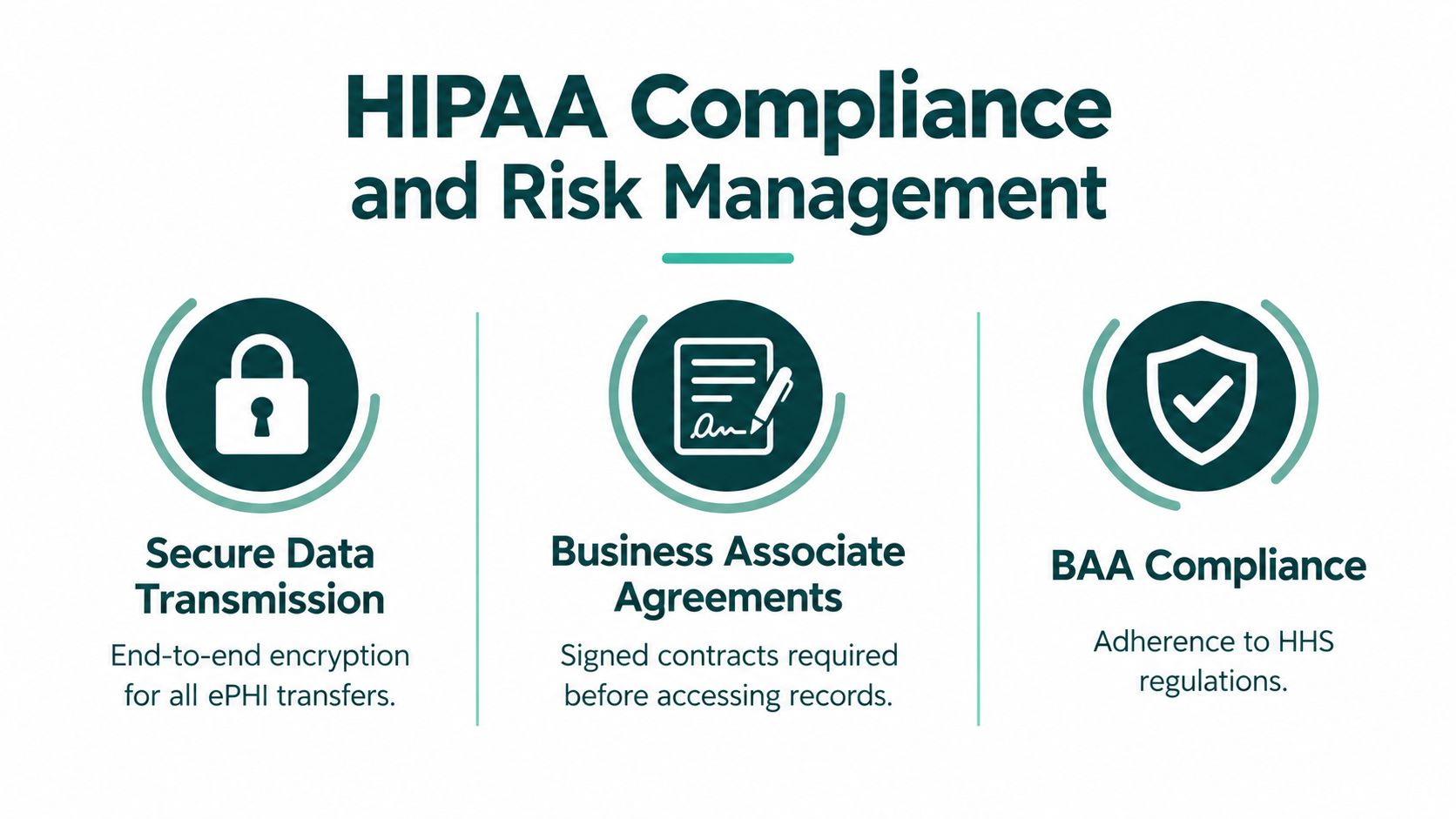
When a remote scribe or staffing company creates, receives, maintains, or transmits ePHI for a medical practice, the practice must obtain satisfactory assurances that the business associate will safeguard that information. HHS explains that those assurances must be documented in a Business Associate Agreement, or BAA, and that the agreement must address Security Rule compliance, incident and breach reporting, and appropriate obligations for relevant subcontractors (HHS HIPAA guidance). A confidentiality form alone isn't a substitute when the worker or organization routinely handles patient information.
Build the contractual chain
The BAA should identify permitted uses and disclosures, security responsibilities, incident notification procedures, subcontractor controls, and what happens to PHI when the relationship ends. HHS also explains that a BAA should require the business associate to return or destroy PHI at termination where feasible. Check every organization that can access the work environment, including an employer, staffing intermediary, technology provider, or subcontractor.
CMS guidance makes the accountability issue clear. When a covered entity uses a business associate for part of a transaction, it must require the business associate and applicable agents or subcontractors to comply with relevant HIPAA requirements, and the covered entity can remain responsible for a business associate's noncompliance with applicable Administrative Simplification requirements (CMS business associate guidance). Assign ownership inside the practice for access provisioning, training records, note-quality review, incident escalation, and credential termination.
Apply least privilege in practice
HHS recommends beginning with a documented risk analysis of remote-access vulnerabilities, followed by safeguards, policies, procedures, and workforce security training proportionate to those risks (HHS remote-use guidance). In practice, that usually means:
- Limit permissions: Give the scribe only the EHR modules and note fields needed for assigned duties.
- Use unique accounts: Never permit shared credentials or informal login handoffs.
- Strengthen authentication: Use multifactor authentication where available, session timeout, and secure communications.
- Control local data: Prohibit uncontrolled downloads, screenshots, personal storage, and unauthorized recordings.
- Review activity: Monitor EHR audit logs, investigate unusual access, and revoke credentials promptly during role changes or termination.
- Train and test: Document HIPAA training, recurring workforce training, incident response, and sanctions for violations.
A compliant workflow still needs human judgment. The provider must review the note, and the practice must be able to show who accessed the chart, what permissions they had, how corrections were handled, and what happened when a problem was reported. Practices should confirm their obligations with qualified compliance counsel because arrangements and state requirements can vary. A vendor describing a service as a HIPAA documentation solution doesn't replace your own risk analysis, contract review, and oversight.
Integrating Scribes with Your EMR Workflow
An EHR doesn't become scribe-ready merely because it has a login screen. The practice needs a defined path from encounter preparation to draft creation, clinician review, authentication, correction, and audit.
Start with the note architecture. Build specialty-specific templates around how providers reason and document, not around every field the software makes available. A primary-care template may separate chronic-condition management from preventive care, while an ophthalmology workflow may require careful laterality and measurement capture. A mental-health template may need different privacy and disclosure procedures from a routine medical follow-up.
Design permissions around responsibility
The scribe should be able to complete permitted documentation tasks without gaining unnecessary control over orders, diagnoses, results, billing, or record release. Role-based permissions should reflect the job description, and the practice should document which fields the scribe may draft, which tasks require provider direction, and which actions are prohibited.
The review loop should be visible rather than assumed. The clinician checks the draft against the encounter, corrects omissions or incorrect attribution, verifies medications and orders, and signs the final note. Audit logs can show access and activity, but they won't prove that a clinically important detail was accurate. That's why note sampling and correction tracking belong beside technical monitoring.
Measure quality beyond closure
A same-day signed note is useful, but it isn't a complete quality measure. Build a dashboard that separates speed from fidelity:
- Timeliness: Same-day note-closure rate, unsigned-note aging, and next-business-day completion.
- Provider burden: After-hours documentation minutes and time spent reviewing or repairing drafts.
- Documentation quality: Sampled completeness, factual fidelity, addenda, and correction frequency.
- Downstream effects: Coding queries, rejected claims, referral delays, order corrections, and patient complaints.
- Security control: Training completion, access-review cadence, anomalous-login alerts, chart-audit results, and privacy incidents.
Track whether an error began with the scribe's capture, the template, a system limitation, or the clinician's final review. If a provider routinely rewrites every note, the problem may be poor role design rather than poor typing. If corrections concentrate in one visit type, update the template or training instead of treating the pattern as an individual failure.
Quality control: A polished note can still be incomplete. Audit clinical meaning, not grammar alone.
Calculating ROI and Staffing Costs
A remote medical scribe can be financially sensible when it reduces provider after-hours work, supports timely chart completion, or lets the practice use clinician time more effectively. The business case becomes weak when managers compare an hourly quote only with a wage and ignore supervision, correction work, security, software, and coverage.
The Bureau of Labor Statistics reported a median annual wage of $51,140, or $24.59 per hour, for U.S. medical records specialists in May 2025 (BLS occupational data). That figure is a useful comparison point, not a direct price benchmark for a medical scribe. The category includes broader health-information and records work, and an employee's wage is only one component of total staffing cost.
Use a fully loaded comparison
Include payroll taxes, benefits, recruiting, training, supervision, turnover, equipment, software access, compliance work, and the manager or provider time required to correct documentation. For an outsourced arrangement, include the service fee, onboarding time, account administration, and any required integration or support costs. Then compare the total with measurable output.
Useful output measures include encounters documented, same-day notes closed, correction rate, provider after-hours minutes, chart turnaround, and any verified effect on patient throughput. Don't assign financial value to every improvement unless your accounting method supports it. A reduction in after-hours work may improve retention and clinician experience without appearing immediately as revenue.
Financial discipline: Compare fully loaded cost per productive hour with documented output, not advertised availability.
Build a baseline before hiring. Review current chart aging, after-hours EHR work, review time, and correction patterns by provider and visit type. Run a limited pilot, then compare like with like. A practice can use the remote staffing pricing information as one input, but it should still calculate its own total cost and expected workload.
Hiring and Implementing a Remote Scribe
Begin with a defined scope, not a generic “medical scribe” title. Specify specialty, visit types, EHR, working hours, documentation fields, prohibited tasks, escalation rules, and the quality measures that determine whether the arrangement continues.
Use a five-stage vetting process:
- Screen identity and background. Confirm work history and complete appropriate background checks.
- Test role skills. Assess EMR navigation, medical terminology, documentation accuracy, and specialty-specific judgment boundaries.
- Assess communication. Review spoken and written English, listening accuracy, and ability to escalate uncertainty.
- Verify privacy preparation. Complete HIPAA training before access and document recurring training requirements.
- Conduct the final interview. Let the provider and manager test workflow fit, availability, and response to correction.
Onboarding should begin with a limited group of providers and representative encounters. Configure unique accounts, least-privilege permissions, templates, patient disclosure procedures, downtime instructions, and a direct escalation channel. Review early notes closely, track corrections and access activity, and use a defined trial period before expanding coverage.
If you're evaluating remote healthcare staffing beyond documentation, the medical talent placement process can help clarify how role-specific screening differs from a general administrative hire.
The Takeaway
A remote medical scribe can reduce chart backlog, support closer-to-encounter documentation, and give providers more attention for patients. The evidence also shows variation, so practices shouldn't treat a scribe as an automatic productivity solution.
Success depends on governance. Use a BAA where required, limit EHR access, train the workforce, require clinician sign-off, and measure both speed and quality. Track corrections, omissions, after-hours work, unsigned-note aging, downstream errors, and privacy incidents before deciding whether to expand.
MedicalVirtual connects U.S. medical practices with pre-vetted Latin American healthcare talent for remote documentation and related administrative workflows. Visit MedicalVirtual to explore candidates aligned with your specialty, EMR, working hours, and compliance requirements.