

If an online vet technician program requires hands-on clinical work, who is supposed to give you access to the patients, equipment, and supervising veterinarian? That question matters more than whether lectures are recorded. Online describes how coursework is delivered, not a fully remote credential. You still need a clinic willing to host you, a qualified mentor or preceptor, and a credential path that your state recognizes.
The workforce case for training is real. A 2024 peer-reviewed workforce analysis estimated approximately 118,000 veterinary technicians and nurses working in the United States in 2019, while approximately 133,000 credentialed companion-animal veterinary technicians would be needed by 2030 to meet projected demand. Demand doesn't make every program the right fit, and it doesn't remove supervised clinical training or state credential checks.
Compare the ten options below by four practical questions. Where does the hands-on work happen, who finds the site, what does the school publish about cost and outcomes, and does the degree match the role you want? Pair that review with practical methods for studying lecture material, because distance programs reward students who can organize dense material without a classroom routine. The Penn Foster career-path summary of Bureau of Labor Statistics projections cites about 9% growth for veterinary technologists and technicians from 2024 to 2034, with roughly 14,300 openings annually, which makes choosing a sustainable pace worth your time.
1. Purdue University Veterinary Nursing Distance Learning
Purdue's Veterinary Nursing Distance Learning program pairs online associate-degree coursework with clinical mentorship at a veterinary clinic. It's built for self-directed students who can study independently while arranging supervised practice locally. Purdue says the degree may be completed in as little as three years, though your pace will depend on course load and mentorship access.
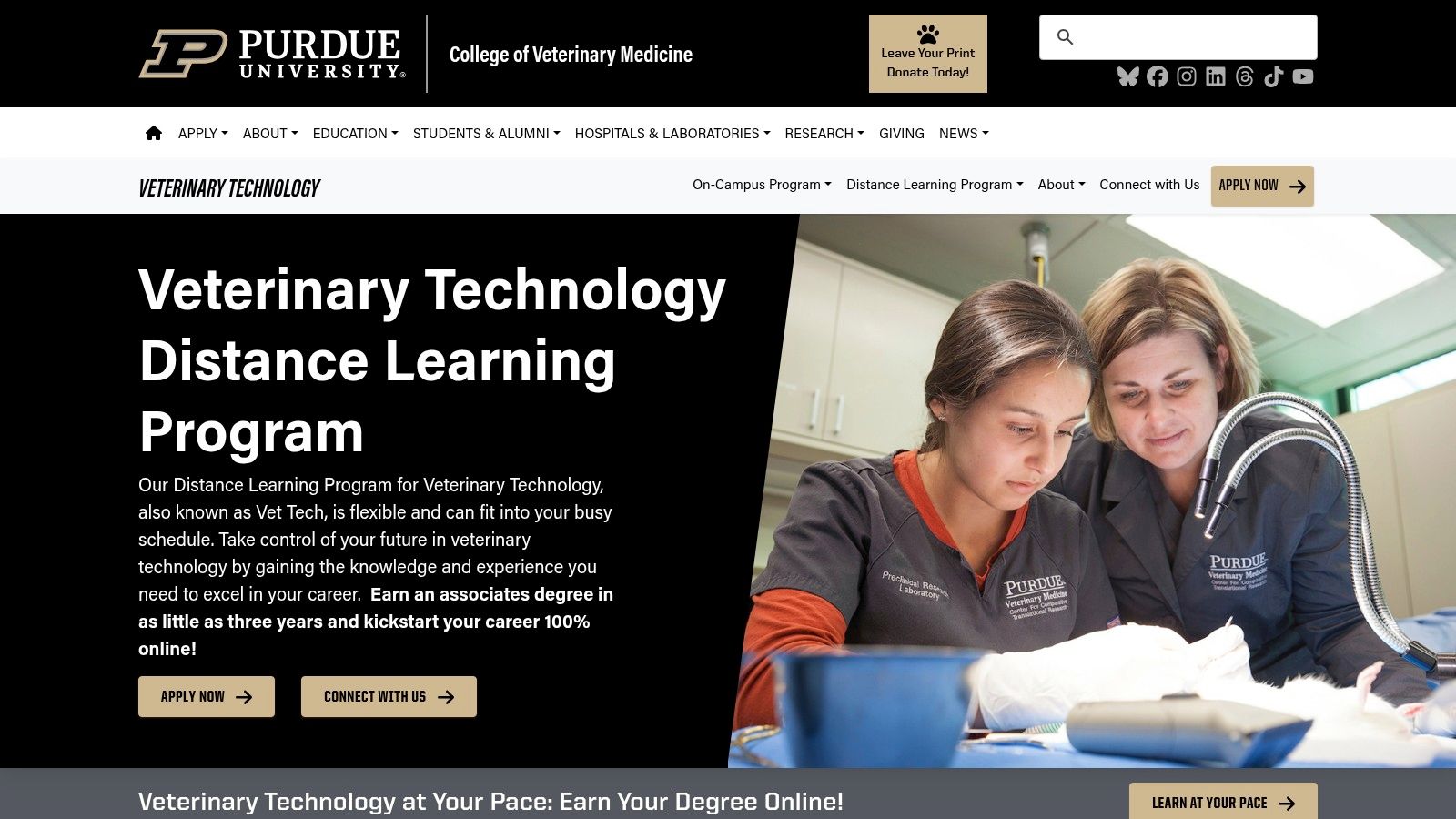
What you would study and arrange
- Broad nursing coverage: Small and large animal nursing, anesthesia, imaging, pharmacy, surgery, and clinical pathology.
- Clinic-based mentorship: Hands-on skills are completed under guidance rather than simulated entirely online.
- Student support resources: Purdue provides pathway information for distance learners balancing work and study.
Interest is growing. Purdue reported enrollment rising 38%, from 452 students in spring 2023 to 624 students in spring 2024. That growth doesn't solve your local placement problem, so identify a mentor before you commit. If you're comparing this route with day-to-day clinic support work, review what vet tech responsibilities actually include and ask which tasks require a credential in your state.
Pros: Clinical experience is integrated, topics are broad, and the format suits working students. Cons: You must secure a clinical mentor and site, the pace demands discipline, and you should confirm current tuition and accreditation directly with Purdue. I would shortlist Purdue if you already have a supportive clinic and want a university-based nursing curriculum, not if you're hoping the school will place you nearby without your own outreach.
2. San Juan College Veterinary Technology AAS Online
San Juan College offers an online Veterinary Technology AAS with clinical instruction at an approved veterinary facility near you. The species range is a strength for students who don't want a companion-animal-only education. You'll still do the legwork to secure a site and preceptor.
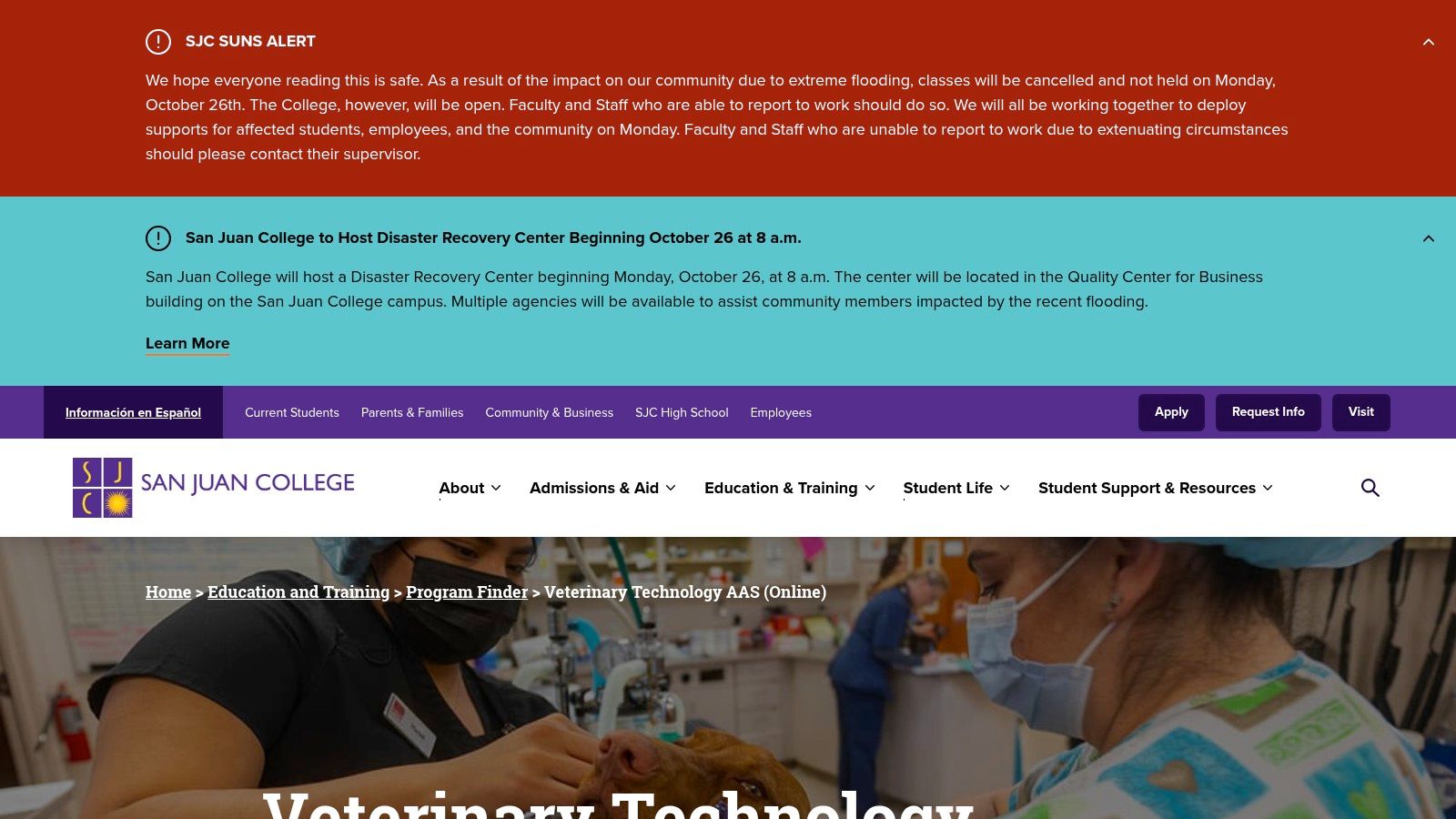
Published outcomes and the travel question
- Species and settings: Companion animals, large animals, exotics, and lab animals, plus emergency care and surgery.
- Fast Track Lab option: A two-day lab in Waco, Texas is available for certain requirements, which means travel costs for some students.
- School-reported outcomes: The college reports an 88.42% three-year VTNE pass rate and 100% employment at graduation for its 2023 to 2025 cohorts, figures published on its program page.
Those outcomes help you compare, but they aren't a guarantee for any individual student. Ask how the employment figure is defined, how many graduates it covers, and whether part-time loads change the timeline. Also ask for one written estimate covering tuition, travel, scrubs, equipment, and clinical expenses, because the program page doesn't provide one total cost.
Practical rule: Treat a published pass rate as a starting question, not a promise. Ask who was counted and how many students finished.
Pros: Published outcomes, part-time loads, and broad species exposure. Cons: You find the approved site, Waco may require travel, and hands-on requirements remain substantial despite the online label.
3. Dallas College Distance Education Veterinary Technology Program
Already working in a clinic? Dallas College's distance veterinary technology program pairs online coursework with clinic-based exercises completed under a qualified preceptor. It is an online delivery model, not training without a clinical site. The fit depends on whether your clinic can provide supervised practice across the skills the curriculum requires.
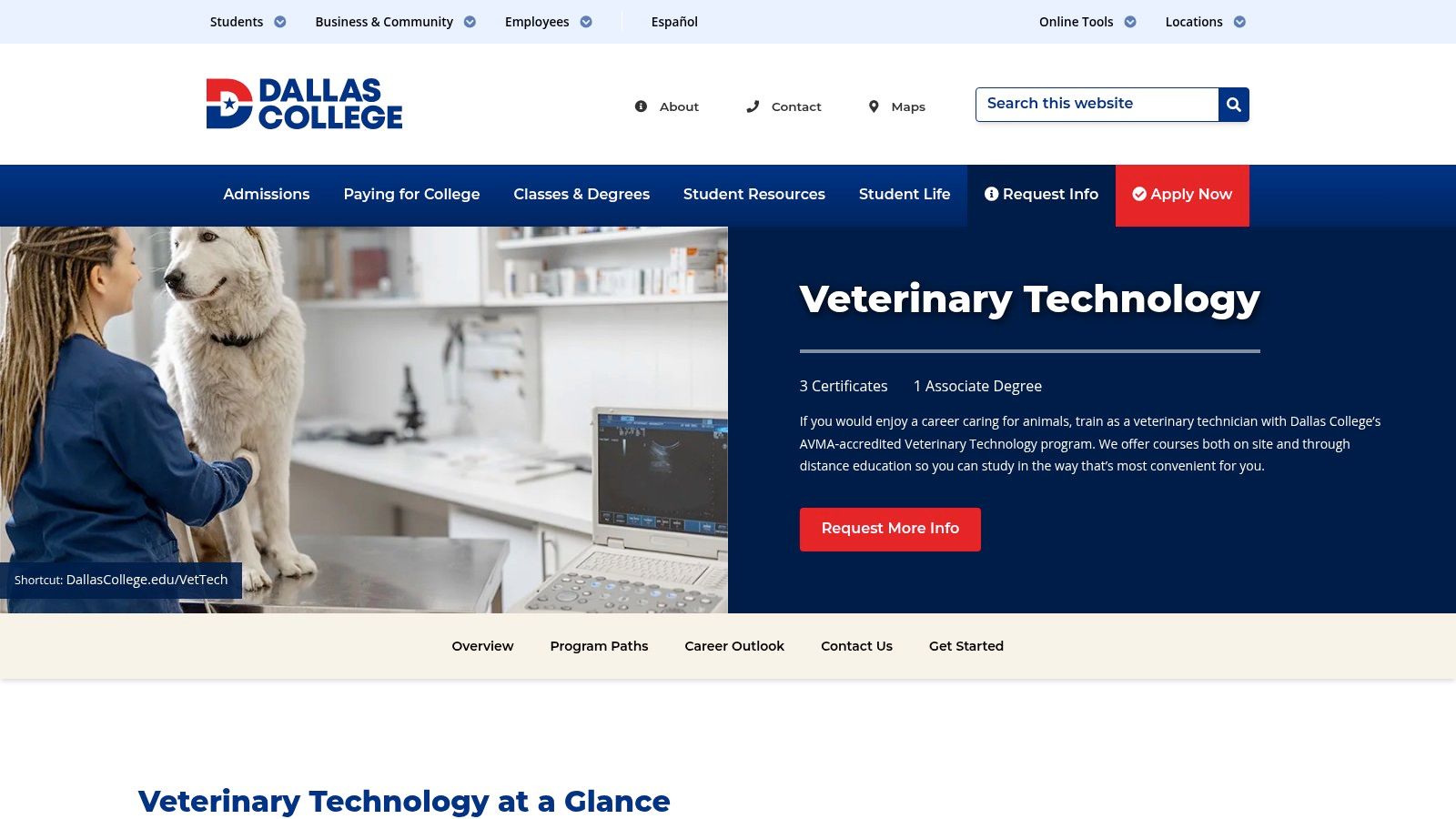
Coursework covers veterinary nursing, pharmacology, surgical assistance, radiology, ultrasound, and laboratory procedures. If your job mainly involves appointments and kennel work, ask your employer whether the clinic can support imaging, surgery, and lab practice. You may need a second site to fill gaps.
Who fits this model
- Current veterinary assistants: Apply lessons during shifts and document supervised skills.
- Students with a named preceptor: The college outlines preceptor expectations, giving you specifics to discuss with your manager.
- Career changers without clinic access: A poor fit unless you can arrange suitable clinical work before starting.
Telehealth also changed how clinics communicate with clients. A JAVMA survey of practices found telehealth use rose from 12% of surveyed practices to 38% within four months during the COVID-19 period. That shift concerns client communication, not a substitute for technician training. Your degree still depends on demonstrating clinical skills in person.
Pros: You can apply coursework at work, and the college provides preceptor guidance. Cons: Without access to a clinic and preceptor, you lack a workable clinical plan. Confirm current admissions and total cost directly with the college, since the program details given here do not establish a total.
4. St. Petersburg College Veterinary Technology Online
St. Petersburg College is useful to compare because it has two distinct levels. Its veterinary technology programs include an online associate pathway and an online bachelor's completion option for technicians building on prior technical training. Don't treat the bachelor's as a shortcut into initial technician work.
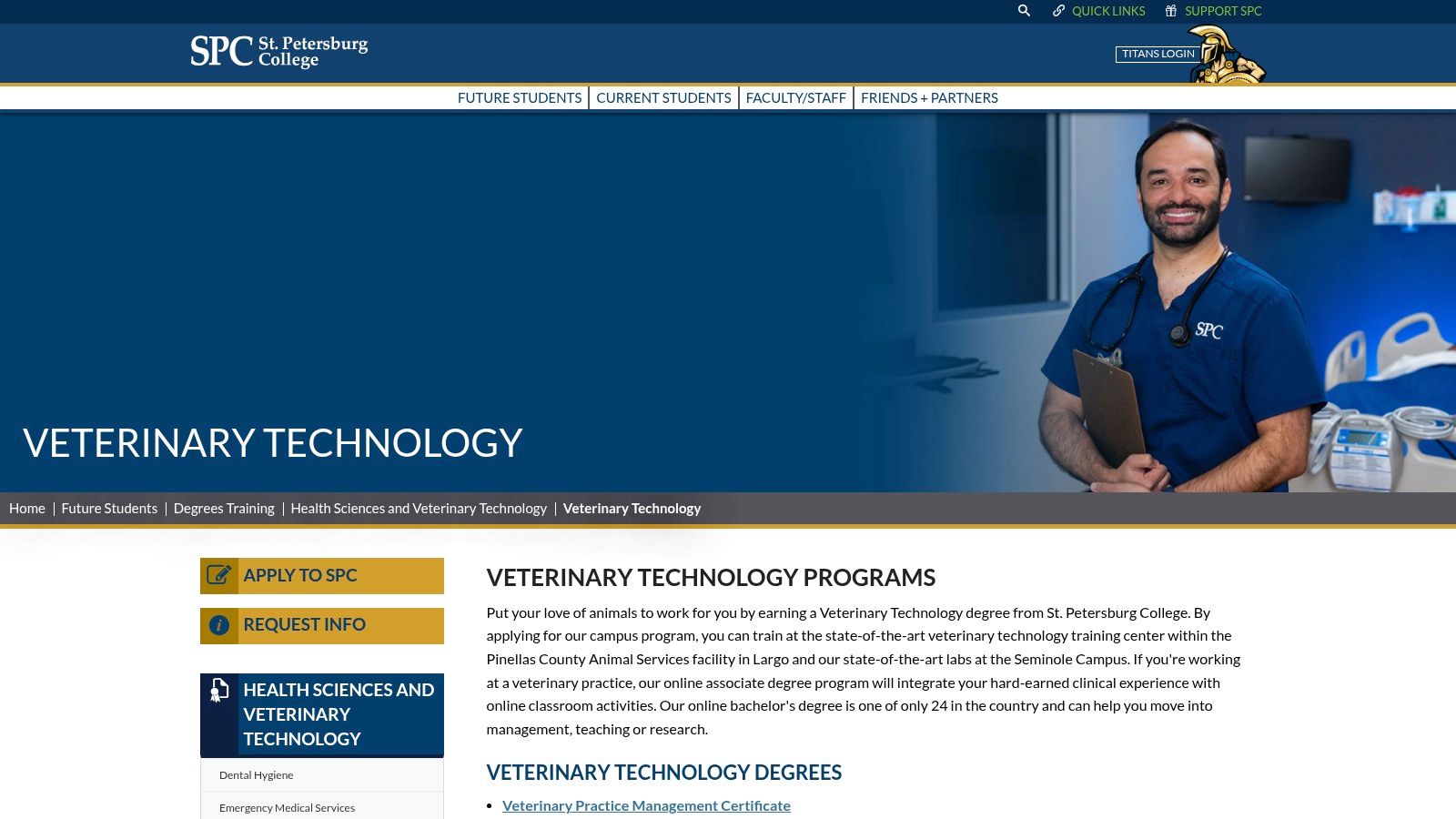
Two pathways with different purposes
- Associate pathway: The starting route for students who need core veterinary technology training and clinical preparation.
- Bachelor's completion tracks: Choose clinical techniques or hospital management, depending on whether you want advanced practice skills or supervisory preparation.
- Published cost guidance: SPC publishes admissions guides and cost estimates, which makes early budgeting easier than with schools that list tuition only by credit.
Its 2025 guide estimated core associate coursework tuition at $5,700 for Florida residents before several additional costs, as shown in the college's program cost information. That estimate excludes general education and support courses. Vaccination, equipment, clinical requirements, and other expenses can move the total, so request a current full estimate for your residency status.
For scale, the AVMA reported 33,590 students enrolled in CVTEA-accredited veterinary technology programs during the 2023 to 2024 academic year. You're choosing within a large, competitive pipeline. If you're weighing technician training against broader support roles, compare the scope with what a clinical assistant does before paying for the wrong credential.
Pros: A progression route after an associate degree and a management track. Cons: Prerequisites matter, published associate costs are partial, and current tuition needs verification.
5. Penn Foster College Veterinary Technician Associate Degree
Penn Foster's Veterinary Technician Associate Degree is the flexibility-first option on this list. Coursework is self-paced and online, which suits students whose work schedules change weekly. Flexibility cuts both ways, because nobody is setting your study rhythm for you.
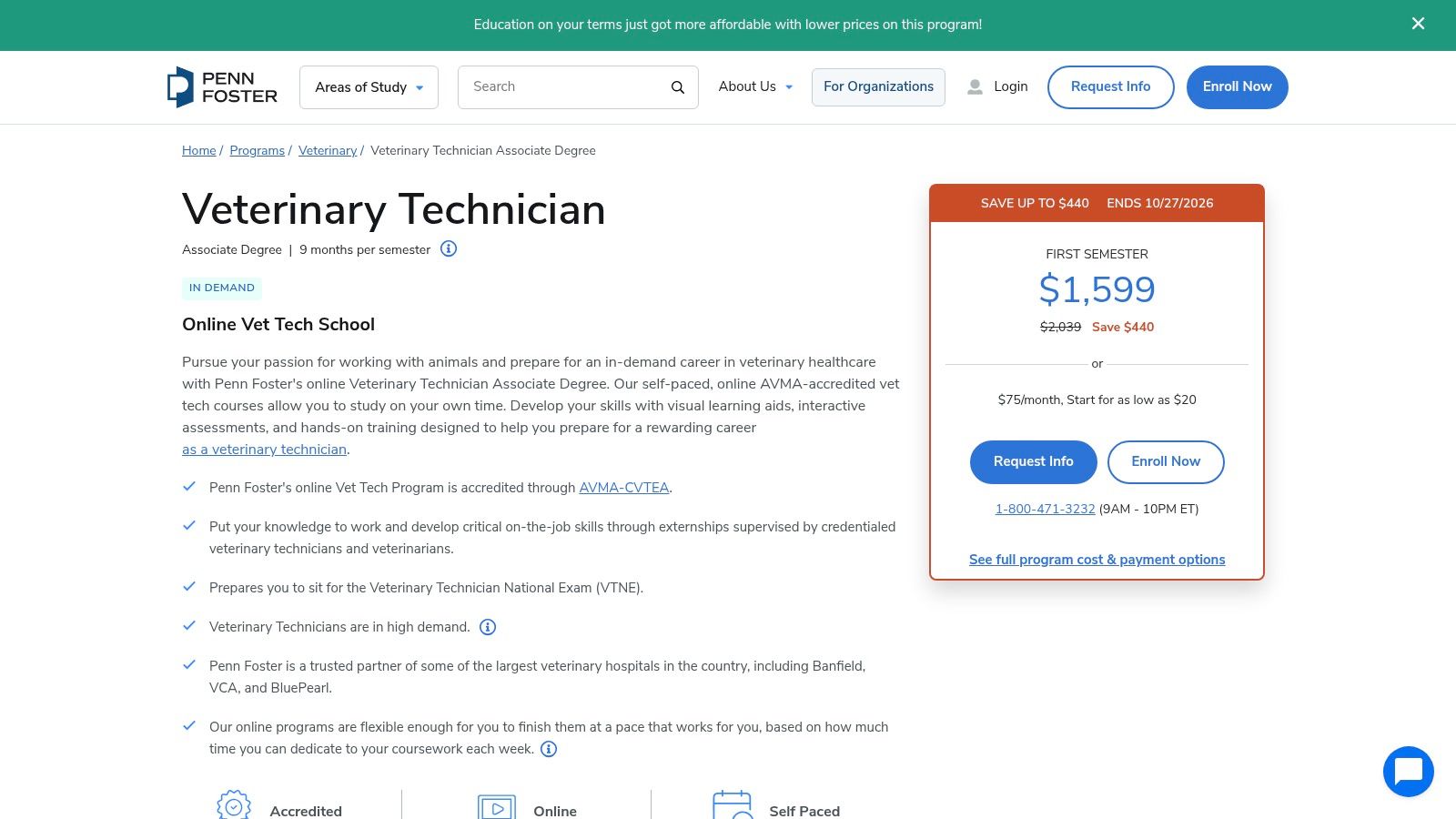
Flexibility with in-person externships
- Self-paced study: Move through online material around work and family commitments.
- Supervised externships: Practical training happens in person under veterinary professionals.
- VTNE preparation: The program prepares students for the national exam, subject to exam and state rules.
- Published semester pricing: Payment options give you a starting point, not a final personal total.
Penn Foster advertises the program as AVMA-CVTEA accredited. Verify that status, your exam eligibility, and your state's credential title before enrolling. The NAVTA credentialing summary describes the usual pathway as graduation from an AVMA CVTEA-accredited program followed by passage of the VTNE, while noting that states may classify technicians as registered, licensed, or certified.
That state variation is not paperwork trivia. The same job title can carry different legal authority across state lines, and some states permit alternate routes or require additional testing. Confirm your credential directly with the relevant state board rather than relying on a school representative or a future employer's job posting.
Pros: Flexible pacing, listed semester pricing, and required externship experience. Cons: Self-paced study demands consistent time management, externships are in person, and accreditation plus state eligibility should be confirmed in writing. I'd choose it for schedule control, not for speed by default.
6. Colby Community College Distance Learning Veterinary Nursing
Colby Community College combines asynchronous online courses with hands-on work at veterinary hospitals in its Distance Learning Veterinary Nursing AAS. The college says students can complete coursework on their own schedule and don't need to visit campus. Optional weekend mentorship sessions may help if your local clinics can't provide access to certain species.
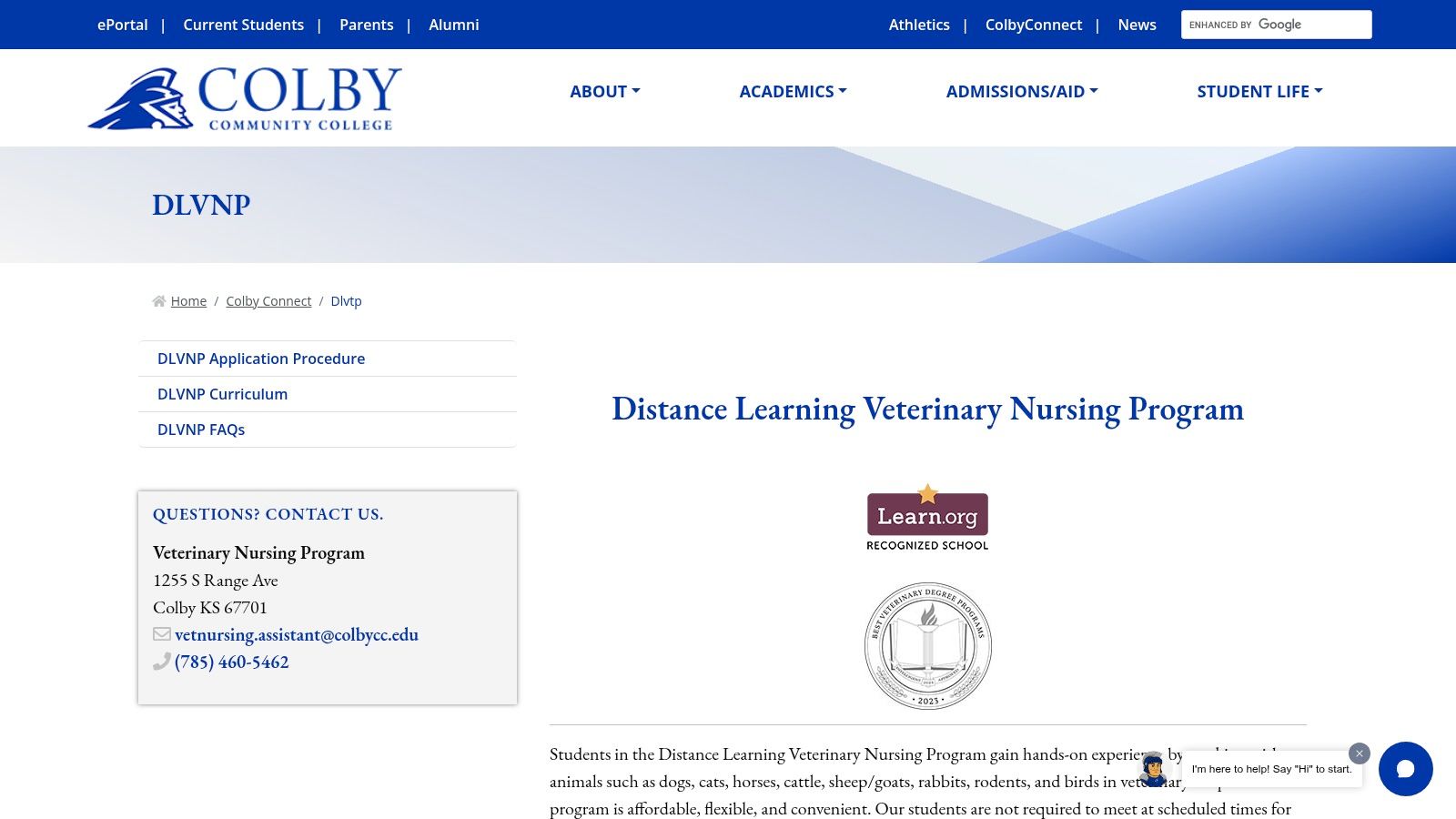
Species access is the deciding factor
- Asynchronous coursework: Many courses have no scheduled class meetings, which helps students with irregular shifts.
- Broad practical range: Work includes dogs, cats, horses, cattle, sheep and goats, birds, and other species.
- Optional mentorship weekends: On-campus sessions may fill gaps when local hospitals don't see the species or cases you need.
Map your species access before your first term. Call mixed-animal and equine practices, not only the small-animal clinic closest to home, and ask who can supervise specific skills. A friendly clinic that sees only dogs and cats may still leave you short on large-animal requirements.
If a clinic cannot name the species, procedures, and supervisor available to you, you do not yet have a clinical plan.
Remote work after graduation has similar limits. A Frontiers in Veterinary Science survey reported teleconsulting use by approximately 39.0% of respondents and telemedicine by 28.0%, but remote support still sits inside supervised workflows. Your hands-on training remains the foundation.
Pros: Flexible scheduling, broad species exposure, and optional mentorship weekends. Cons: You need hospital access, deadlines require self-management, and current accreditation and tuition should be confirmed with Colby.
7. Jefferson State Community College Veterinary Technology Distance Education
Jefferson State delivers theory online and clinical application through approved veterinary facilities in its Veterinary Technology program. The associate-level focus is veterinary nursing skills for technician work. It's not presented as a preparatory route to veterinary school, and that clarity helps you judge fit.
Location is the first filter here. Program materials specify clinical facilities within Alabama, so out-of-state applicants should verify eligibility before spending time on an application. Even Alabama students need to confirm travel distance, schedule availability, and whether an approved facility can take another student in their preferred term.
Questions to ask Jefferson State
- Clinical placement: Which approved facilities are currently accepting distance students, and who initiates contact?
- Schedule fit: How are clinical hours sequenced with online theory, and can they fit around paid clinic work?
- Current standing: What are the current tuition, availability, and accreditation details for the next start?
The structure can reduce commuting for lectures while keeping practical skills in real veterinary settings. That is the right trade for many working students, but only if the clinical commute is manageable for the full program. A site that works for one semester may become a burden when hours increase or your work schedule changes.
Pros: Online lectures, practical skills in veterinary settings, and a community-college option worth comparing. Cons: Alabama clinical facilities limit who should apply, local access and scheduling are on you, and current program details need direct confirmation. I would put Jefferson State high on the list for eligible Alabama students with a confirmed facility, and remove it quickly if eligibility is uncertain.
8. Great Falls College Montana State University Veterinary Technician AAS
How much on-site time can you manage alongside online coursework? Great Falls College offers an online Veterinary Technician AAS with limited on-site requirements, according to its program catalog. Confirm where sessions take place, how often you must attend, and whether travel can fit your work and home schedule.
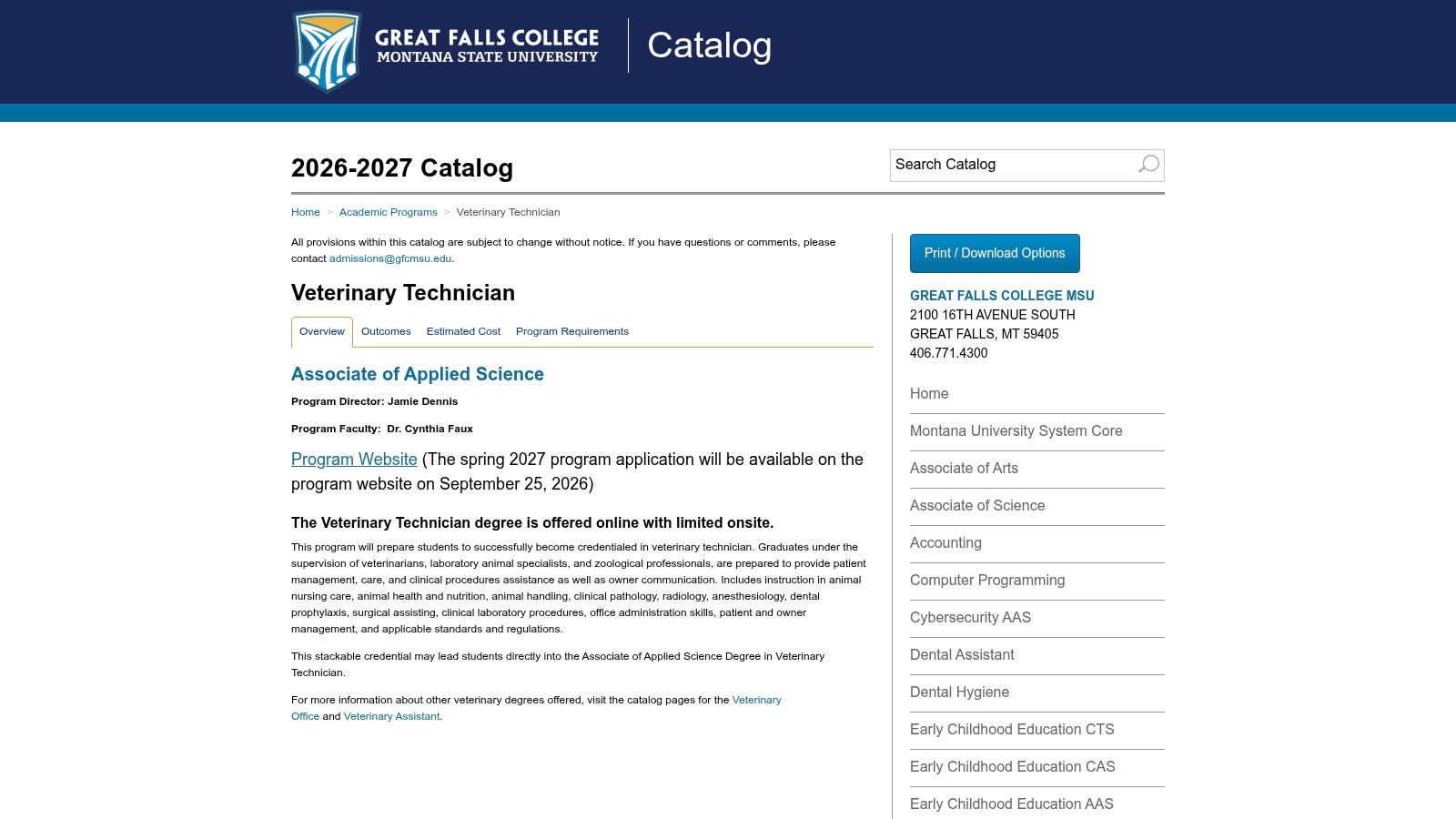
Curriculum and published cost
The listed coursework includes animal nursing, radiology, anesthesia, dental prophylaxis, and surgery assistance. It also covers clinical laboratory work and office administration, skills relevant to practices where technicians handle several functions.
The catalog lists tuition and fees of $10,654 for the Veterinary Technician AAS. Use that published figure as a starting point, then ask admissions what applies to your residency and current enrollment. Check separately whether books, travel, clinical supplies, and repeat courses are included, since those costs affect the total you need to plan for.
Online delivery reduces the need to relocate, but it does not remove hands-on requirements. Before enrolling, confirm that you can meet the on-site obligations and ask about current program availability and accreditation. Those details determine whether the program's delivery and credential fit your plans.
For later remote work, distinguish technician support from veterinary telemedicine. The Chewy Connect with a Vet explanation describes a pet telehealth service, not technician scope of practice. Technician scope and prescribing limits vary by state, and medication decisions generally require veterinarian supervision. This AAS prepares students for supervised clinical work, not independent diagnosis or treatment online.
Pros: Published cost information, coursework beyond basic companion-animal care, and online delivery. Cons: On-site requirements remain, the estimate may not include personal expenses, and availability and accreditation need confirmation.
9. Appalachian State University Online BS in Veterinary Technology
Appalachian State's online BS in Veterinary Technology is the four-year option for students who want a bachelor's-level path from the start. It combines general education and veterinary technology coursework with clinical hours in veterinary settings. The question is whether the broader degree serves your goal better than a direct associate route.
Program information describes advanced concentration options, which may appeal if you're interested in leadership development or broader animal-health roles over time. A bachelor's can also give you more general education to carry into future study. Those benefits cost time, and time has a price if your main goal is entering credentialed technician work as directly as your state allows.
Compare the bachelor's against your state route
- Credential fit: Verify current accreditation and how the degree relates to VTNE eligibility and credentialing in your state.
- Clinical reality: Clinical placement is still required in an animal-health setting, so local access remains decisive.
- Personal cost: Tuition depends on residency, transfer credits, and course load, so request a degree plan with your actual credits applied.
Don't pay for four years on the assumption that every employer values the bachelor's the same way. Ask clinics where you want to work whether they pay differently for it, use it for lead technician roles, or require only the state credential and proven skills. Their answers will be more useful than generic claims about advancement.
Pros: A bachelor's pathway, online coursework, and real clinical experience. Cons: It may be more degree than the direct technician route requires, clinical work remains mandatory, and state credential relevance must be verified.
10. YTI Career Institute Veterinary Technician Distance Education
YTI Career Institute's Veterinary Technician program page describes a hybrid distance program with online instruction, simulated labs, and two clinical externships at an approved veterinary site. The credential is an associate in specialized technology. Students identify an externship site for the program to approve, so securing clinic access is part of the enrollment decision.
Exam preparation and weekly workload
The program materials explicitly include VTNE preparation courses and mock exams, alongside two defined in-person externships for hands-on practice. They also describe recurring start dates, but confirm that enrollment is available in your location before setting a start date.
The practical constraint is coordinating study time with required hours at an approved site. That can be difficult alongside full-time work, particularly during externship terms. Ask whether your current employer can host an externship, what the approval process requires, and when paperwork must be completed.
Before you sign: Get the externship approval criteria in writing and ask clinics whether they can meet them before relying on a start date.
Remote veterinary care adds another reason to understand records, triage boundaries, and escalation, but it does not replace supervised clinical experience. The Veterinary Virtual Care Association 2024 industry report analyzed more than 506,000 virtual veterinary-care interactions across the United States, Canada, and the United Kingdom. For applicants, the distinction is practical: online coursework can prepare you for knowledge-based work, while clinical skills still require access to an approved veterinary site.
Pros: Defined externships, explicit VTNE preparation, and recurring starts. Cons: You must identify a site for approval, coordinate study with clinical hours, and confirm current tuition and financial-aid terms.
How the ten programs compare on delivery format, cost disclosure, accreditation signals, and clinical requirements
| Item | Delivery format | Published cost | Accreditation signal | Clinical requirement |
|---|---|---|---|---|
| Purdue University, Veterinary Nursing Distance Learning | Online coursework with clinical mentorship | Not stated; confirm current tuition | Not specified; confirm with the university | Secure a clinical mentor and site |
| San Juan College, Veterinary Technology AAS Online | Online AAS with local clinical instruction | No total cost stated; request an estimate | Not specified | Approved local clinical site and preceptor; some requirements may involve travel |
| Dallas College, Distance Education Veterinary Technology Program | Online coursework with in-clinic exercises | Not stated; confirm with the college | Not specified | Clinic access and a qualified preceptor required |
| St. Petersburg College, Veterinary Technology Online | Online associate pathway and bachelor's completion option | 2025 estimate: $5,700 for Florida-resident core associate coursework; additional costs apply | Not specified; confirm current status | Clinical requirements apply; verify details with the college |
| Penn Foster College, Veterinary Technician Associate Degree | Self-paced online coursework with externships | Semester pricing listed by the school; confirm current rates | Advertised as AVMA-CVTEA accredited; confirm current status | In-person externships supervised by veterinary professionals |
| Colby Community College, Distance Learning Veterinary Nursing | Asynchronous online coursework with optional mentorship weekends | Not stated; contact the college | Not specified; confirm with Colby | Hands-on work at veterinary hospitals |
| Jefferson State Community College, Veterinary Technology Distance Education | Online theory with clinical training at approved facilities | Not stated; confirm with the college | Not specified; confirm with the college | Approved clinical facility; materials specify Alabama locations |
| Great Falls College Montana State University, Veterinary Technician AAS | Online coursework with limited on-site requirements | Catalog lists $10,654 in tuition and fees; verify current estimate and inclusions | Not specified; confirm current status | Limited on-site requirements; verify location and timing |
| Appalachian State University, Online BS in Veterinary Technology | Online bachelor's coursework with clinical experience | Varies by residency, transfer credits, and course load | Confirm current accreditation and state credentialing relevance | Clinical hours in veterinary settings |
| YTI Career Institute, Veterinary Technician Distance Education | Online instruction with simulated labs and externships | Request a current full cost estimate | Not specified | Two externships at an approved veterinary site |
The Takeaway Verify Clinical Access Before You Enroll
Choose an online vet technician program by confirming three things first. Where does the hands-on work happen, who secures the clinical site, and does the accreditation and credentialing path fit your state? If a school can't answer those questions clearly, its lecture format and start date don't matter yet.
Start with clinical access. Name the clinic, the veterinarian or credentialed supervisor, the species you'll see, and the procedures you can practice. Then ask what happens if that site withdraws, reduces hours, or can't cover large-animal, surgical, imaging, or laboratory skills. A backup site is not pessimism. It's how you protect a multi-year degree from one staffing change at a busy practice.
Next, separate education from remote employment claims. An online vet technician graduate may later support scheduling, client communication, records coordination, follow-up education, and teletriage documentation. That doesn't authorize independent diagnosis, prescribing, or treatment changes. The AVMA 2025 Model Veterinary Practice Act states that only a veterinarian licensed in the state where the patient is located may provide telemedicine services to that patient, and it requires a VCPR established through an in-person examination or medically appropriate premises visit before telemedicine.
Medication workflows show why state detail matters. The AVMA summary of VCPR requirements reports that 43 states and the District of Columbia used language largely similar to the federal VCPR definition, while 22 of those states expressly required an in-person examination or visit. Rules also vary for virtual VCPRs, prescription length, refills, and controlled substances. Confirm your obligations with your state board and qualified counsel rather than building a career plan on another state's exception.
Then compare total costs using current figures in writing. Include tuition by residency, general education, books, travel to labs, clinical clothing and equipment, vaccinations, background checks, exam fees, and lost work hours during externships. Ask for completion and VTNE outcomes with cohort sizes, not only percentages. When you're preparing applications for clinic roles or externships, StoryCV's surgical tech resume guide offers a useful model for presenting hands-on skills clearly, even though your credential and clinical setting differ.
My recommendation is simple. Shortlist two or three programs, secure clinical interest from at least one suitable site, verify accreditation and state eligibility, and only then compare pace and price. The strongest online vet technician choice is the one you can complete with real patients, competent supervision, and a credential your future employer and state board both recognize.
If your veterinary clinic needs help with appointment booking, client reminders, records support, and front-desk communication while your credentialed technicians focus on patients, MedicalVirtual connects practices with pre-vetted remote healthcare support staff who work your clinic hours. Visit the site to discuss the tasks you want covered and the experience your next assistant should bring.