

The most common staffing advice for an eye-care practice is to hire an “assistant” and let the job evolve around whatever needs doing. That's how practices end up with someone answering calls while referrals go untracked, testing records remain incomplete, and patients arrive unprepared. The title doesn't tell you what the person is qualified to do, where the work must happen, or who owns a safety-critical decision.
An eye doctor assistant may be a trained ophthalmic technician working directly with patients, or an administrative support professional coordinating appointments, records, insurance questions, and follow-up. Those jobs overlap in the patient journey, but they aren't interchangeable. The right staffing model assigns hands-on clinical work to appropriately trained on-site personnel, gives remote staff clear administrative ownership, and reserves diagnosis and clinical decisions for providers.
That distinction matters when you're hiring, setting up remote coverage, or trying to improve patient access without adding confusion. This guide covers the role's development, typical duties, skills and credentials, the tradeoffs between in-clinic and remote support, and a practical hiring and onboarding process. State scope-of-practice rules and your own clinical protocols still control what each employee may do.
Why the Eye Doctor Assistant Role Needs a Clear Definition
A practice may have one person answering calls and another updating charts, yet still have gaps in referral follow-up, testing documentation, and patient preparation. The common mistake is treating every eye-care assistant as either a clinician or a generic receptionist. In practice, the label can describe materially different work, and hiring against the title alone leaves the boundaries unclear.
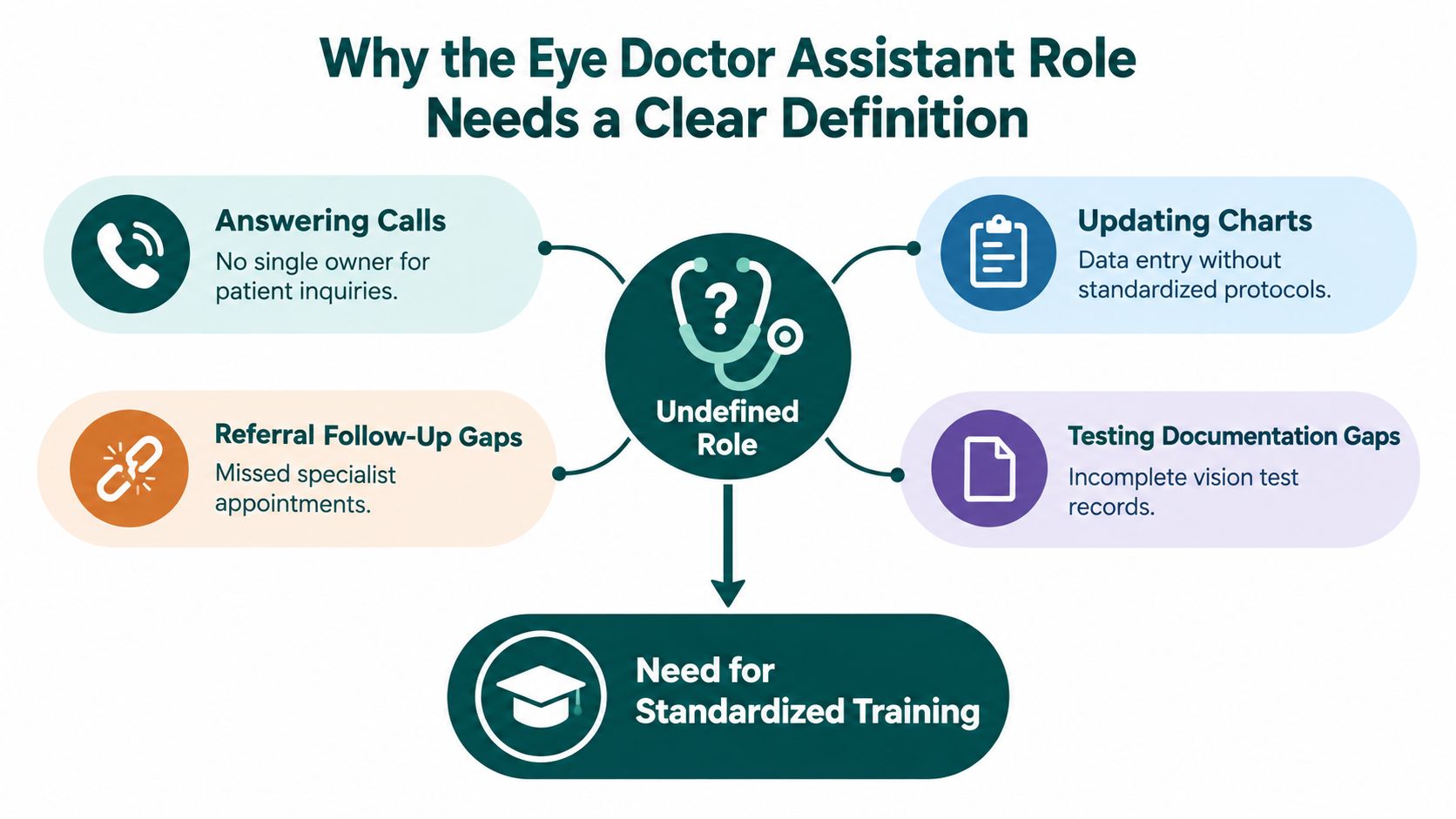
A clinical ophthalmic technician works near the provider and may perform standardized testing, prepare patients, operate diagnostic equipment, and assist with procedures, subject to training and applicable requirements. An administrative assistant manages coordination work, which can include scheduling, records requests, referral tracking, reminders, and insurance communication. Remote administrative staff can own many of these tasks, but they can't substitute for someone who needs to examine a patient or operate equipment.
| Role category | Typical work | Remote suitability |
|---|---|---|
| Clinical ophthalmic technician | Patient preparation, visual-acuity testing, tonometry, imaging, and procedural support | Generally requires an appropriately trained person on site |
| Administrative support | Scheduling, records coordination, referral follow-up, insurance checks, and recall outreach | Often suitable when workflows, access, and escalation are defined |
| Provider | Diagnosis, treatment decisions, interpretation, and clinical oversight | Requires the provider's direct involvement under applicable rules |
Managers should start with the work, not the job title. For each task, assign an owner, specify what information or equipment is needed, and name the person who handles exceptions. A useful starting point is to compare medical assistants with medical scribes by their actual responsibilities, then map those distinctions to the needs of an eye-care practice.
Practical rule: A remote assistant can coordinate a clinical workflow, but coordination isn't clinical judgment.
That rule helps a practice add capacity without blurring who performs tests, interprets results, or responds to urgent symptoms.
How the Eye Doctor Assistant Role Has Evolved
The modern eye-care assistant role didn't emerge as a simple extension of front-desk work. During the second half of the twentieth century, ophthalmic support developed into a more structured allied-health function, with expectations for trained, consistent performance. The Joint Commission on Allied Health Personnel in Ophthalmology was founded in 1969 to establish competency standards and credentialing for ophthalmic personnel. The associated credential pathway came to include Certified Ophthalmic Assistant (COA), Certified Ophthalmic Technician (COT), and Certified Ophthalmic Medical Technologist (COMT). By the mid-1980s, approximately 8,000 allied ophthalmic personnel held these credentials.
That history has a practical implication for hiring: don't assume that familiarity with a clinic's routines is the same as demonstrated competency. Eye care relies on measurements and diagnostic workflows where technique and documentation matter. The transition from Schiotz to Goldmann tonometry illustrates how expectations for accurate, trained measurement increased as clinical practice adopted more advanced methods. Commercial optical coherence tomography technology arrived in 1996, further increasing the importance of reliable image acquisition and test workflow support. These historical milestones are summarized in the Bureau of Labor Statistics' overview of medical assistants.

Why a job title isn't a competency test
Contemporary eye-care support includes both clinical and administrative responsibilities. Administrative work may involve telephone communication, patient intake, scheduling, insurance and billing touchpoints, and records coordination. In some settings, assistants also provide specialty-specific instruction. The BLS notes that medical assistants working with ophthalmologists and optometrists may teach patients how to insert, remove, and care for contact lenses.
This mix makes a generic title particularly unhelpful. One practice may use “assistant” for a person doing patient pretesting; another may mean a remote employee handling appointment changes and records requests. Write the duties explicitly, then assess candidates against those duties. If the job includes clinical testing, ask about training and observed competency. If it's administrative, test the candidate's follow-through, accuracy, and ability to route clinical questions to the appropriate person.
Typical Eye Doctor Assistant Duties by Workflow
A well-run assistant workflow follows the patient from first contact through follow-up. Some tasks happen in a clinic room and require direct patient contact. Others are coordination work that can be handled remotely when staff have appropriate system access, privacy safeguards, and a clear escalation route.
From first call to check-in
Front-desk and administrative support starts with calls, scheduling, appointment confirmations, intake forms, and routine reminders. An assistant might confirm the reason for a visit, explain what records the patient should bring, and make sure the appointment type matches the practice's scheduling rules. Insurance eligibility checks and benefits communication can help the practice identify missing information before arrival, but they shouldn't be presented as a guarantee of coverage or payment.
The job also includes handling messages. Administrative staff can collect the caller's name, callback number, and stated concern, then route the message according to practice protocol. They shouldn't diagnose or independently decide that a symptom can wait. For an example of how administrative responsibilities are commonly organized across a practice, review this guide to key duties for office admins.
During the visit
An on-site ophthalmic technician may document medical history, measure visual acuity, perform tonometry, operate autorefractors or phoropters, conduct visual-field or ocular-motility tests, administer ophthalmic medication when permitted, assist with procedures, and sterilize instruments. These duties depend on training, access to equipment, supervision, and applicable rules. O*NET's ophthalmic medical technician occupation profile describes this broader clinical scope.
A remote administrative assistant can support the encounter without performing those tasks. For example, the remote employee may prepare the chart, verify that outside records have arrived, and flag a missing referral. The person on site performs the examination-related work, and the provider interprets findings and makes clinical decisions. A virtual medical receptionist role can be scoped around calls, appointment coordination, confirmations, and routing rather than physical patient care.
| Task | Remote administrative support | On-site clinical support |
|---|---|---|
| Appointment scheduling and reminders | Can manage within practice rules | May help at check-in or when coordinating in person |
| Records requests and referral tracking | Can request, organize, and flag missing records | Can reconcile records with the patient and visit |
| Visual-acuity testing and tonometry | Can't perform physical measurements remotely | Trained staff may perform under practice protocols |
| Imaging acquisition and medication administration | Can't operate equipment or administer medication | Requires appropriately trained, locally available personnel |
| Symptom escalation | Can collect details and route promptly | Clinical staff or provider assesses and responds |
After the visit and between appointments
Administrative work continues after the patient leaves. Staff may send records requests, track prior authorizations, coordinate referrals, support billing workflows, and maintain recall lists. A completed referral requires more than a booked appointment: staff need to confirm that the receiving office has the relevant information and that missing records or outside imaging have been identified. When something is incomplete, the assistant should flag it for the responsible team member instead of filling gaps with assumptions.
Consider a patient referred for an eye evaluation whose referral packet is missing outside imaging. An administrative assistant can contact the referring office, note what remains outstanding, and alert the practice's designated clinical reviewer if the patient reports a concerning symptom. The assistant doesn't diagnose or set clinical urgency independently. The practice's provider or clinical staff decides the next step under the established escalation protocol.
Remote support adds value by reducing coordination friction, not by replacing clinical staff. The practice should document who owns each handoff, what information must be recorded, and when a message needs immediate review.
Skills and Certifications That Matter for Eye-Care Staffing
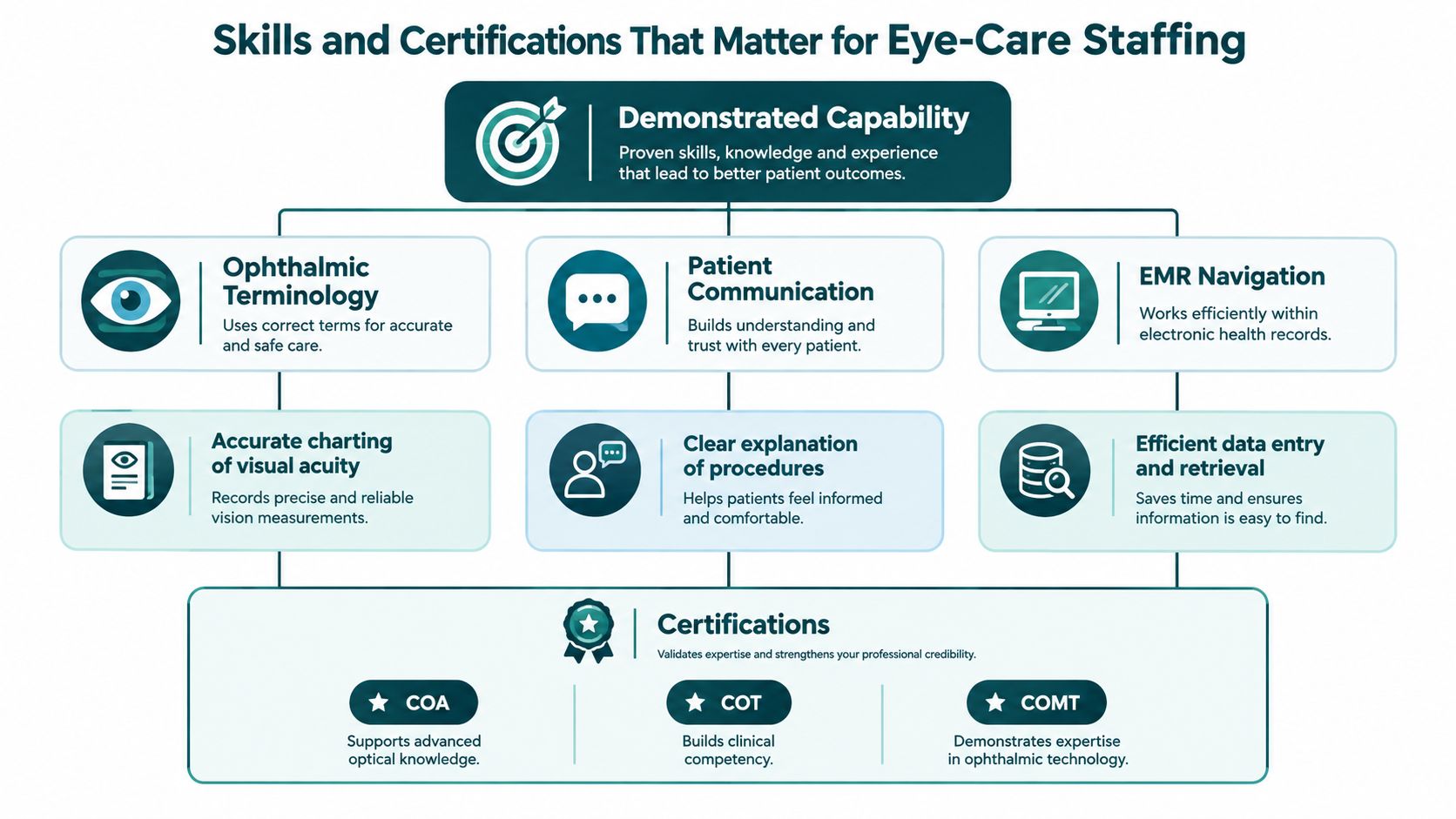
Hire for demonstrated ability, not an impressive-sounding title. A candidate may communicate well but struggle to manage a referral queue; another may know clinical terminology but lack the training needed to perform a particular test. Build separate profiles for administrative and clinical roles, and assess each against the work the person will do.
Administrative capability
For remote or on-site administrative candidates, assess clear patient communication, scheduling discipline, accurate data entry, EMR navigation, insurance verification, referral coordination, and message routing. Ask how the candidate would handle a referral with an incomplete record, a patient who wants to change an appointment, or a caller reporting a sudden change in vision. The desired response is not a clinical opinion. It's accurate information gathering and prompt routing under your protocol.
Test practical work, not just interview answers. A short scheduling exercise can reveal whether a candidate checks appointment type and provider availability. A mock referral task can show whether they track what's missing and record follow-up clearly. For an insurance verification exercise, listen for precise language that distinguishes an eligibility check from a promise about coverage.
Clinical capability and credentials
Clinical technician candidates need role-specific evaluation. Depending on the position, managers should verify competence with visual-acuity testing, tonometry, ophthalmic equipment, patient-history documentation, contact-lens instruction, and infection-control procedures. O*NET reports that ophthalmic medical technicians usually need one or two years of training involving on-the-job experience and informal instruction from experienced personnel. Treat that as useful occupational context, not a substitute for checking a candidate's actual experience, required supervision, and local scope-of-practice rules. See the O*NET occupational details for ophthalmic medical technicians.
Certification can help distinguish a candidate's preparation, but it doesn't establish that the person is qualified for every task in your practice. The American Optometric Association describes CPO, CPOA, CPOT, and CPOC examinations as pathways intended to assess knowledge associated with the respective designations. Ask what the credential covers, which duties the person has performed, and how those duties were supervised. Confirm relevant state requirements and assess competency in your own setting.
A remote medical virtual assistant can be an excellent fit for administrative work without being qualified to perform clinical testing or make independent medical decisions. Keep those expectations separate in the job description and in daily supervision.
Comparing In-Clinic and Remote Eye Doctor Assistant Support
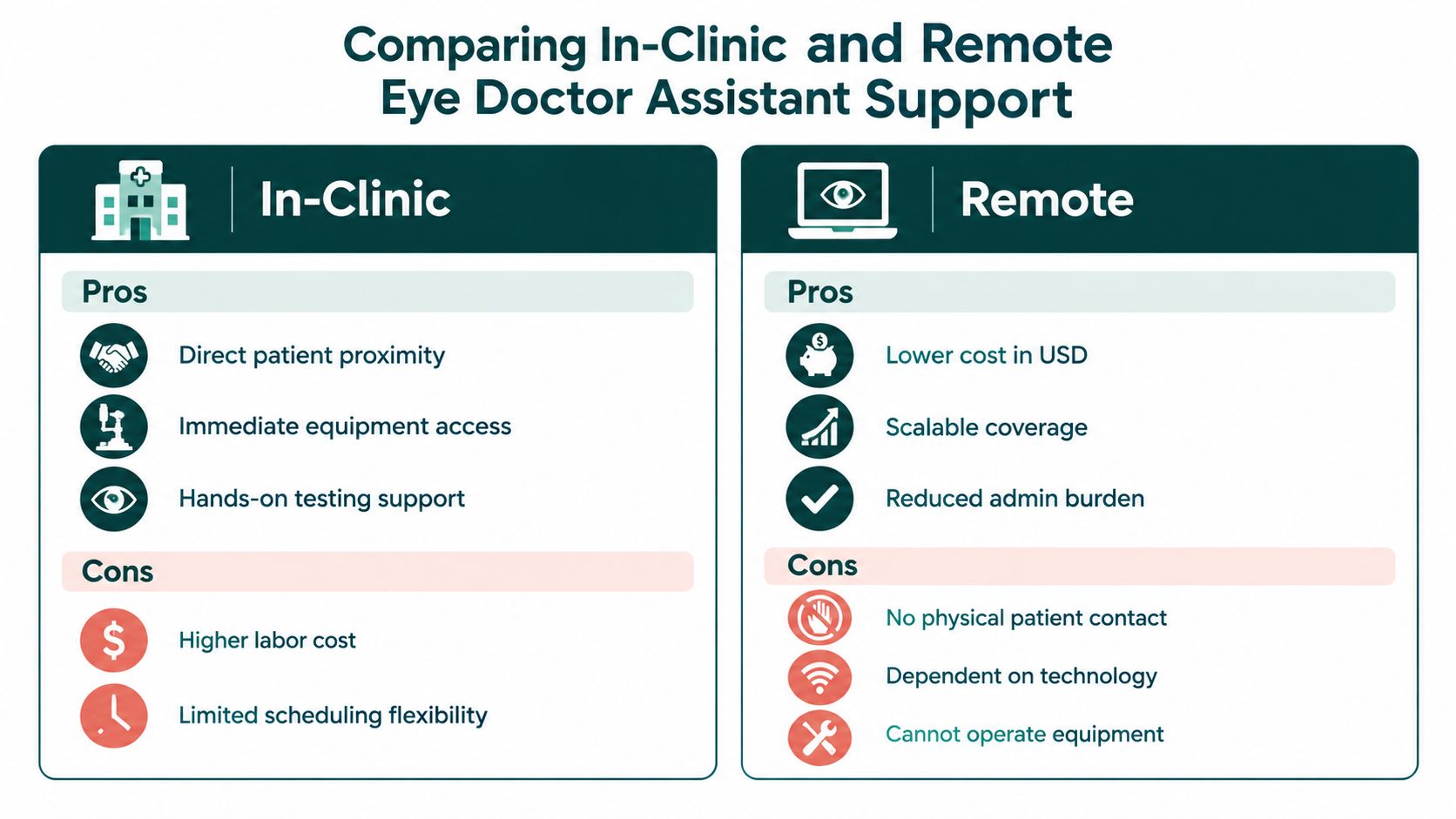
An in-clinic technician and a remote administrative assistant solve different staffing problems. The first brings patient proximity and access to equipment. The second can provide consistent coordination coverage for calls, records, scheduling, and administrative follow-up. Choosing between them as if they were interchangeable usually leaves one side of the workflow uncovered.
| Decision area | In-clinic ophthalmic technician | Remote administrative assistant |
|---|---|---|
| Patient proximity | Can prepare patients and support in-person workflows | Communicates by phone or approved digital channels |
| Equipment and testing | Can access instruments and perform assigned hands-on tasks when trained | Can't perform measurements, imaging, or equipment operation |
| Scheduling and calls | Can handle these tasks between clinical duties | Can focus coverage on calls, confirmations, and recall outreach |
| Records and coordination | Can gather information during the visit and support chart completion | Can manage records requests, referral tracking, and administrative follow-up |
| Supervision | Requires clinical oversight appropriate to assigned duties | Requires an operational owner and a defined escalation path |
| Hiring criteria | Verify clinical training and task-specific competency | Verify communication, systems skills, privacy awareness, and follow-through |
Match the model to the bottleneck
If patients wait because no one is available to prepare them or operate diagnostic equipment, a remote hire won't fix the constraint. If the clinic's staff spend time chasing records, returning routine calls, and confirming appointments, remote administrative coverage may free them to focus on in-person work. A virtual medical receptionist can handle scheduling, confirmations, reminder calls, message routing, and recall outreach during the practice's operating hours, provided the practice defines what to escalate.
Remote staff can't examine patients, take measurements, administer medication, or independently triage symptoms. Their work depends on reliable technology, appropriate access, privacy safeguards, and reachable on-site contacts. If a message signals possible urgency, the assistant should follow the practice's escalation instructions rather than deciding what the symptom means. Practices reviewing remote patient communication can also consider how to design a compliant telehealth workflow, while confirming their own applicable privacy and compliance obligations.
The strongest arrangement is often a scoped extension of the clinic team. Let on-site personnel own hands-on care and let remote staff own well-defined administrative queues. Then track whether handoffs are completed, not merely whether calls were answered or appointments were entered.
Hiring and Onboarding an Eye Doctor Assistant
Vague postings produce vague hires. Define the eye doctor assistant role in operational terms before you interview anyone. List tasks, system access, coverage hours, reporting line, systems used, and escalation rules. “Help with the office” invites the wrong applicants and sets up the wrong expectations. A written scope tells you whether you need an on-site clinical employee or remote administrative support.
A remote medical virtual assistant can be an excellent fit for administrative work without being qualified to perform clinical testing or make independent medical decisions, and the scope can be defined with a virtual medical assistant placement. Keep that boundary in the job post. Referral tracking, scheduling, records chasing, and message routing belong on the remote list. Patient workup, measurements, and instrument operation stay on site.
A practical hiring scorecard
Judge every candidate against the same criteria, then add role-specific tests.
| Hiring stage | What to define or test | Evidence to look for |
|---|---|---|
| Scope | Administrative or clinical duties, hours, system access, reporting line | A written task list with clear exclusions |
| Interview | Communication, reliability, judgment, and relevant experience | Specific examples tied to comparable work |
| Work sample | Referral tracking, scheduling, call handling, or clinical skills | Accurate completion, clear notes, appropriate escalation |
| Verification | Credentials, employment history, and role requirements | Confirmed records and references where appropriate |
| Onboarding | Training, privacy expectations, workflows, and supervision | Signed acknowledgments and observed task completion |
| Review | Accuracy, timeliness, handoffs, and workload ownership | Regular quality checks against agreed measures |
Give administrative candidates a live scenario. Hand them a referral with a missing record. Ask them to explain how they would track the request, document status, and flag it if it stayed outstanding. Add a mock insurance verification call or patient message. Strong candidates communicate clearly. Weak ones promise coverage or drift into medical advice.
Clinical candidates need a different screen. Observe task-specific competency under your protocols and within applicable state requirements. Ask how they were trained to perform each duty in the description, then verify what they have done under supervision. A general customer service interview never proves clinical readiness. Check it directly.
Onboarding should make the boundaries real
Provide documented workflows for scheduling, referral follow-up, records handling, and escalation from day one. State what the employee may access, how patient identity gets verified before chart work, what information must be recorded, and which situations require an immediate handoff. Use confidentiality agreements plus role-appropriate privacy and security training. Match system permissions to responsibilities. Practices should confirm specific compliance obligations with qualified counsel or compliance professionals.
Split the rest of training by location. Clinical staff get supervised practice with the instruments and procedures they will use, followed by a documented competency review. No sign-off, no independent work. Remote administrative staff get reviewed sample calls, message routing, and chart entries before they own a queue. Managers should check early work closely and correct omissions, unclear notes, or delayed escalation fast. Waiting invites backlog and missed referrals.
Measure completed work, not activity. Track referral completeness, timely status updates, documentation quality, and whether messages reached the right person. If your practice tracks access, review completed referrals and schedule gaps alongside appointment volume. The question is simple. Are handoffs reliable, and can clinical staff spend their time on patients instead of paperwork?
Match pay comparisons to the actual job. O*NET lists a 2025 median wage of $21.91 per hour, or $45,570 annually, for ophthalmic medical technicians. That U.S. figure is not the full employer cost of an in-person hire, and it does not establish what remote administrative support should cost. Compare candidates by scope, hours, clinical responsibility, and supervision rather than by the shared word “assistant.”
The Takeaway
An eye doctor assistant can mean a trained clinical technician or an administrative support professional. That distinction determines the candidate profile, work location, equipment access, supervision, and systems required. Treating the title as a complete job description invites missed handoffs and unsafe expectations.
Start by mapping the patient journey and listing the work that currently falls between people. Assign each task to an on-site clinical employee, an administrative employee, or a provider, then document who handles exceptions. Verify applicable requirements, hire against a role-specific scorecard, and supervise the work rather than assuming that a strong interview guarantees reliable performance.
Review practical outcomes such as completed referrals, timely status updates, no-show rates, cancellation backfill, and documentation completeness. These measures help you see whether administrative coordination is reducing friction and whether the clinic is handling handoffs consistently. Keep privacy controls, system access, and clinical escalation rules tied to the role.
For remote administrative support, MedicalVirtual offers pre-vetted Latin American healthcare talent, U.S.-hours coverage, interview-before-hire, placement support, and compliance documentation. If you're evaluating remote support for scheduling, records coordination, or other administrative work, discuss the scope and escalation needs with the team before selecting a candidate.
If your practice needs help with eye-care scheduling, referral follow-up, or records coordination, explore MedicalVirtual and discuss a role scoped to your workflows. Keep hands-on testing and clinical decisions with appropriately trained in-clinic staff and providers.