

Which single sentence in your patient care coordinator job description does the most work, and why is it almost always missing?
It's the sentence that says what the coordinator must never do without clinical authorization. Postings overflow with tasks: schedule appointments, coordinate referrals, support care plans, communicate with patients. Almost none of them state where the administrative role ends and licensed judgment starts. That gap produces the problems you feel, a coordinator answering a medication question because nobody told them not to, a referral marked closed because the fax went out, a new hire who spent three weeks learning the wrong scope at full pay.
The fix isn't a longer posting. It's building the description in a different order. Define the clinical limits first, then the duties that sit safely inside them, then the systems, escalation rules, access controls and workload numbers that make the role measurable.
This guide gives you that structure as a working template. You'll get a field-by-field skeleton to paste and edit, a function-based duties section, a responsibility matrix to hand to a supervising clinician for sign-off, role variations across primary care, behavioral health, dental and specialty settings, screening criteria, privacy and access language, a two-week onboarding sequence and the metrics to publish before you interview anyone. Every field comes with sample wording, so you're editing a draft rather than staring at a blank page.
Patient Care Coordinator Job Description Template
Write the posting in the order you fill it in, not the order a candidate reads it. Three decisions come first because everything downstream depends on them: who the role serves, who supervises the work, and what the role must never do without clinical authorization. Once those sit at the top of the page, the rest becomes an editing job.
Start with the role summary, one paragraph naming the practice type, the patients served and the number of providers supported. A coordinator covering three internists in a suburban primary care office has a different week from one supporting a solo behavioral health provider, and the sentence should show that. Then the reporting line: the practice manager for scheduling and workflow questions, and a named nurse or provider for clinical questions. Naming a person matters more than naming a department, because a remote coordinator can't read a hallway signal.
Then the scope statement. List the administrative duties in plain verbs, then close with one sentence that draws the line: supports referrals, records requests and care-plan tracking, does not diagnose, does not advise on medications and does not change orders. That single sentence does more compliance work than a page of responsibilities, and it gives you something to point at when a task starts to drift.
| Field | What to Write | Sample Wording |
|---|---|---|
| Role summary | One paragraph naming the practice type and patients served | Coordinates intake, referrals and follow-up for a multi-provider primary care practice |
| Reporting line | Supervisor and clinical lead the coordinator escalates to | Reports to the practice manager; clinical questions go to the supervising RN |
| Scope statement | Administrative duties and explicit clinical limits | Supports referrals and care-plan tracking; does not diagnose, advise on medications or change orders |
| Core duties | Four to six grouped duties with the system used | Tracks referrals in the EHR referral queue until the receiving office confirms receipt |
| Escalation rules | Triggers that move work to licensed staff | Symptoms, medication questions or missing discharge details go to the nurse the same day |
| System access | Systems and access levels granted | Scheduling, referral and messaging modules only, with access set by the practice |
| Qualifications | Experience, software and language requirements | Front-desk or care-coordination experience, EHR proficiency, clear spoken and written English |
| Performance measures | Metrics and workload expectations | Closed-loop referral rate, documentation completeness and same-day outreach logs |
Four to six duty groups follow, each naming the system where the work happens. "Track referrals" is a wish. "Tracks referrals in the EHR referral queue until the receiving office confirms receipt" is a job. Keep moving through escalation rules, the access levels the coordinator receives, qualifications and performance measures. Finish with hours, time zone and language requirements spelled out rather than assumed, since "full time" tells a candidate in another country nothing about whether they'd be answering phones at 7 a.m. Eastern.
The skeleton you can paste and edit
- Role summary: [practice type] serving [patient population] with [number] providers; the coordinator owns intake, referrals and follow-up.
- Reports to: [practice manager] for scheduling and workflow; [named RN or provider] for clinical questions.
- Scope: [administrative verbs]; does not diagnose, advise on medications or change orders.
- Core duties: four to six functions, each with the system named.
- Escalation: [triggers] reach [named clinician] within [timeframe].
- Access: [modules] only, granted and removed by [role].
- Qualifications: [experience], [EHR], [language requirement].
- Measures: three to five metrics reviewed [cadence].
- Hours: [schedule], [time zone], [language].
The median annual wage for the related patient-care-coordinator occupation was $41,350 as of May 2025, according to TCWGlobal's summary of Bureau of Labor Statistics figures. Confirm the current release on bls.gov before you publish a number, since occupational data is revised annually and a stale figure undermines an otherwise careful posting.
If you want the generic structure underneath the clinical version, MyCulture.ai's job description template guide covers the standard sections, and you can layer the scope and escalation language on top of it.
Core Duties Grouped by Function
A flat list of twenty tasks hides who owns the work. Group the duties by function and each one needs an owner, a system and a definition of done. Weak postings skip all three. The grouping below follows the responsibilities in the 2024 New York State care coordinator competency specification, which defines the role as organizing care among at least two participants, providers, social service organizations, payers and the patient, and making sure information moves safely between them. That definition rules out a job that is only "answer phones and schedule appointments."
I would not post any duty that lets the coordinator change a care plan, interpret a result or tell a patient what to do about a medication. Those actions need a licensed clinician. The description should say what the coordinator may complete alone and what stops until clinical authorization.

Intake, eligibility and reminders
Screening new patients for coordination needs, confirming eligibility and collecting forms before the first visit are the front half of the job. Reminder calls belong here too. They cut missed appointments and give the coordinator a reason to catch a missing referral packet two days early instead of five minutes before the visit. Write the system next to the duty: eligibility in the clearinghouse portal, forms in the intake queue, reminders from the scheduling module. The coordinator confirms what the portal returns. They do not decide whether a benefit covers the visit.
Referrals and the closed-loop rule
This function generates the most false "done" statuses. The coordinator sends the packet, confirms receipt, and records the receiving provider and the appointment date. The referral counts as closed only when the receiving office confirms it. A sent packet is an open referral until that confirmation lands. Put the distinction in the posting. It separates a coordinator who checks from one who assumes. Choosing the receiving specialty, or telling the patient the referral is medically necessary, stays with the ordering clinician.
Records, authorizations and approved wording
Records requests carry their own deadline: what has to reach the chart before the visit, and who chases the outside lab when it does not arrive. Authorization work splits cleanly. The coordinator handles submission and status checks. Clinical justification stays with licensed staff. Patient communication about consent, costs and patient rights uses the practice's approved wording, not an improvised explanation of coverage or risk.
Care plans and community resources
Coordinators track goals the licensed team set, confirm that the services were delivered and report changes. They do not adjust the plan. They also identify community resources and arrange the logistics around them, such as transportation, home-health intake and support programs. Booking the ride is administrative. Deciding the patient needs home health is not. Post-discharge outreach falls in this group and needs a firm deadline instead of a vague timeframe. CMS transitional care management guidance requires contact with the patient or caregiver within 2 business days of discharge from an inpatient or partial hospitalization setting, so the posting should state whether the coordinator makes that contact independently or only after clinical review.
Test for a finished duty: name the system, name the person who closes the item, and name the evidence that proves it's closed.
Take your current posting and run every line through that test. Where a line fails, you have found the spot where work stops moving and nobody notices. Staff care coordination as intake, referrals, records and follow-up, and keep every clinical decision with licensed staff.
Where Coordination Ends and Clinical Work Begins
A patient calls back two days after a visit. The pharmacy has not filled the new prescription, and the patient wants to know whether to take half a tablet while waiting. Nothing about that call is unusual, and nothing about it is administrative. The coordinator can confirm the prescription was sent, document the call, and route the question to the nurse. The moment they answer the dosing question, the practice has an unlicensed person giving medical advice and no record of who said what.

Coordinator titles cover a wide range of duties, and in some settings those duties include clinical tasks. One posting may mean referrals, recalls, care-plan logistics, and follow-up. Another may include collecting vital signs or samples. Both use the word coordinator. A U.S. posting that lists scheduling, referrals, care plans, patient education, benefits support, and follow-up, without saying which of those requires licensed judgment, hands the ambiguity to whoever accepts the job.
Build the matrix before you write a duty
Three columns, filled in by the supervising clinician, not by whoever drafts the posting.
| Task | Coordinator Completes | Needs Clinician Review | Escalate Immediately |
|---|---|---|---|
| Appointment booking and reminders | Yes, under the practice's scheduling rules | No | Patient reports urgent symptoms during the call |
| Records requests and receipt logging | Yes | When clinical content is unclear | Missing records are delaying a scheduled visit |
| Referral transmission and status tracking | Yes | Changes to referral urgency | Referral unanswered past the practice's deadline |
| Prior authorization status follow-up | Yes, status checks and submission | Clinical justification | Denial that threatens scheduled treatment |
| Patient questions about medications | No | Yes | Any question about doses, side effects or interactions |
| Explaining an approved care plan | Restating the approved plan | Any change to the plan | Patient cannot follow the plan or reports harm |
| Post-discharge outreach | Contact and same-day documentation | Assessment of condition | Patient reports worsening symptoms or cannot be reached |
| Safeguarding or abuse concerns | Document and route only | Yes | Immediately, under the practice's reporting policy |
Treat the matrix as a starting template. It is not a licensure determination. The line depends on your state's rules and on what the supervising clinician will authorize, and it can move as a coordinator gains experience. What does not change is the division of labor: clinical decisions, diagnosis, and treatment stay with appropriately licensed healthcare professionals, while the coordinator provides administrative and documentation support.
I would not post the role until that clinician has answered one question on paper.
What must this person never do without checking with me first?
Put that answer in the job description, not only in the interview. Dosing, symptom interpretation, changes to a care plan, and any statement that sounds like diagnosis or treatment belong on the "never without authorization" list. Scheduling, status checks, records logging, and restating an already approved plan can stay with the coordinator when the matrix says so.
Titles do not set the clinical line
A dental office may use the title for treatment-plan presentation and payment arrangements, with every clinical decision belonging to the dentist. A behavioral health practice may use it for consent tracking and care-plan continuity across prescribers. A multi-site group adds another constraint: shared-system access can show patients from locations whose disclosure rules differ. The risk sits in the task, not the label. The distinction between a medical assistant and a medical scribe is a useful reminder of that. Coordinators who arrange home support also cross into social care, and material on helping people live safely and independently is a reasonable reference for where support-worker duties end.
Remote staff need the rules in writing
A coordinator working from another location cannot resolve a question by turning around. Escalation triggers, the named clinician, the approved channel, and the expected response time all have to be documented before the first patient call. The practice defines the duties, provides supervision, grants only the access the role requires, and maintains the privacy, security, clinical, and workplace policies the coordinator works inside. Have the supervising clinician sign the matrix, then keep the signed copy in the onboarding file where an auditor or a new manager can find it.
Role Variations by Specialty and Practice Setting
The core structure holds across settings. The emphasis and the risk profile do not. Write the posting for the setting you run, because a generic version understates the specialty-specific work a new hire will meet in week one.
Primary care and internal medicine
Care transitions dominate here: post-visit outreach, referral tracking, recall lists for overdue chronic-condition visits, and the follow-up calls that keep a hospital discharge from turning into a readmission. The coordinator can place those calls, confirm appointments and record what the patient reported. Medication changes, triage decisions and symptom interpretation stay with the provider or nurse.
Behavioral health and therapy practices
Consent rules and appointment continuity shape this version of the role. A coordinator may need to reach a outside agency, a school, a prescriber or a family member, and can only do so when the release on file allows it, so verify what the disclosure covers before writing outreach duties into the posting. No-show follow-up and care-plan tracking are the daily work. Clinical questions route to the treating clinician every time, including questions that sound administrative, like whether a medication can be paused during a trip.
Specialty, dental and physical therapy settings
Specialty practices live on referral intake and prior authorization status, with clinical justification written by licensed staff and the coordinator chasing the timeline. Dental and orthodontic offices center on treatment-plan scheduling, recall and payment arrangement conversations, while treatment decisions stay with the dentist. Physical therapy depends on visit continuity, authorization limits and home-program reminders, with any exercise progression going to the therapist. The pattern repeats: the coordinator owns the logistics and the record, the licensed professional owns the judgment.
Titles, multi-site routing and the rest
Patient care coordinator, patient coordinator, care coordinator and patient navigator can all describe overlapping work, so match the title to the duties posted rather than to what the last practice called it. Multi-site groups need cross-location referral routing and access limited by site, checked against each location's own rules. A coordinator covering two offices should have that stated, along with which schedule they follow when the two differ.
Qualifications, Skills and Screening to Require
Would you hire someone who sounds warm on the phone and then answers a refill question instead of escalating it? Screen for that limit first. Experience and software matter, but a coordinator who treats clinical judgment as part of the job creates more rework than a slower typist.
Split the posting into required and preferred so candidates can see what will disqualify them. The common hiring error is locking preferred payer experience into the required line and losing capable front-desk people, or hiring on energy and finding in week two that nobody tested EHR fluency.
Required experience and software fluency
Ask for medical front-desk, intake, or care-coordination experience, working knowledge of medical terminology, and real use of the EHR and scheduling system this practice runs. Name the systems. A candidate who has used your EHR, or a close relative of it, usually needs less hand-holding in the first week. I would rather wait for that match than train someone from a blank chart.
Preferred experience that shortens ramp-up
List prior authorization work, payer portal use, and referral platform familiarity as preferred. Those skills pay off more in specialty and multi-site work than on a simple primary care schedule. Add bilingual ability only if the panel needs it.
How to screen without guessing at fit
Interview impressions are a weak filter for this role. Shortlisted candidates should complete role-specific tests on EMR navigation, medical terminology, documentation accuracy, or payer and billing knowledge, plus spoken and written English. For patient-facing work, weigh clear spoken English, a professional phone manner, scheduling accuracy, and whether they keep patient questions inside the boundaries you wrote. Front-desk and intake roles fill faster. Billing, coding, and prior authorization roles take longer to match well, so publish a realistic timeline instead of rushing the search.
- EMR navigation test: can they find a referral in a queue and document the status correctly?
- Terminology check: do they know what a co-pay, a prior auth, and a recall mean in daily work?
- Documentation sample: write the note for a call where the patient asked a clinical question and was routed to the clinician.
- Boundary scenario: role-play a refill request and score whether they refuse to advise and escalate.
Score three to five items the duties depend on, including at least one item that disqualifies the candidate if they give clinical advice. Record the reason for every rejection. Keeping that record is part of HR's role in recruitment and payroll, separate from whether the person can stay inside the clinical line you set.
Privacy and System Access Controls to Write In
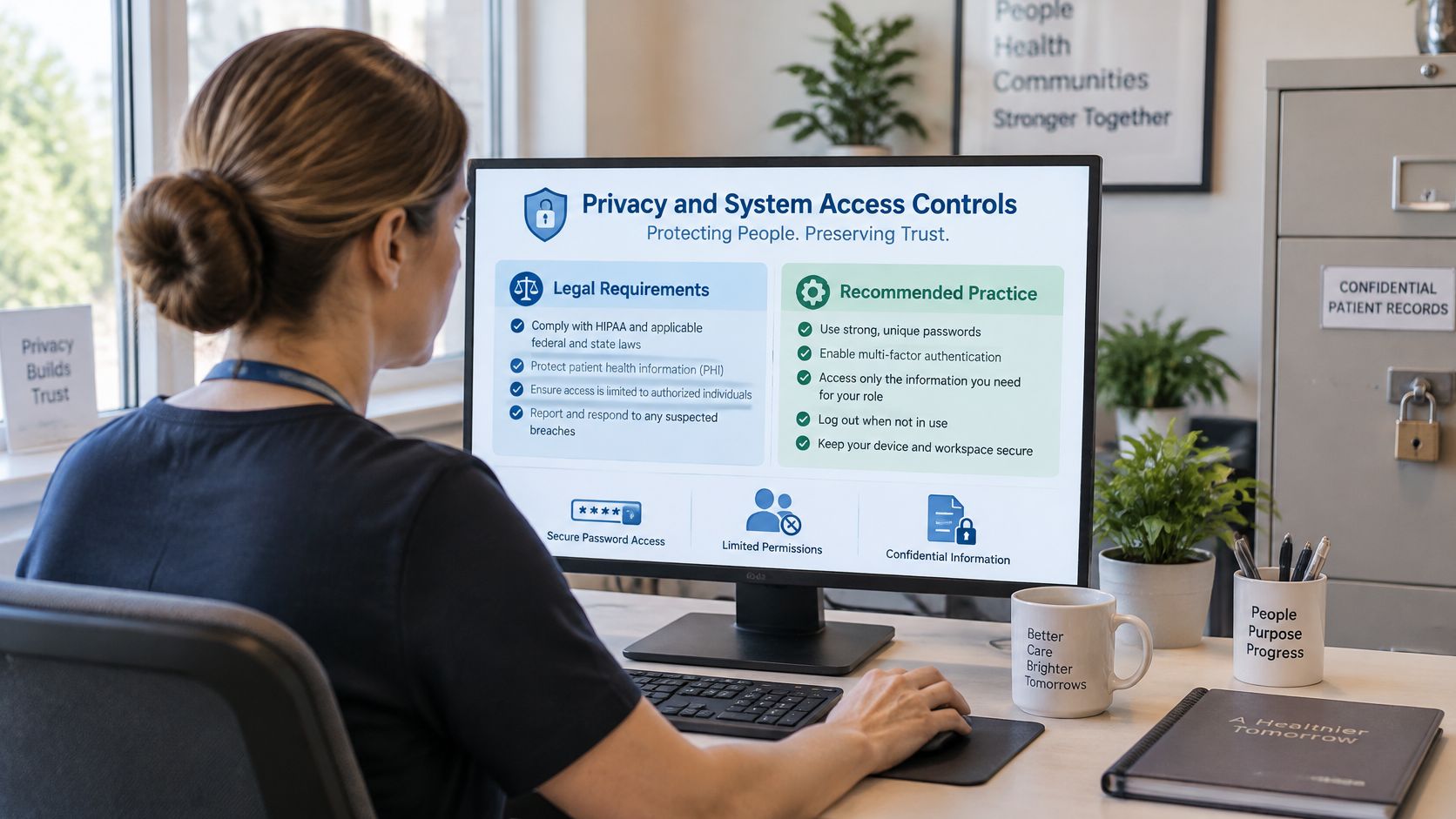
Coordinators touch protected health information constantly, through referrals, scheduling, records, billing coordination and outreach. The posting should say so, then say what the practice expects. Keep the legal floor and the recommended practice in separate sentences, because they're different obligations.
The legal floor for privacy and access
Under HIPAA, an outside party that handles protected health information on the practice's behalf is generally a business associate, and HHS's HIPAA privacy rules identify claims processing, data analysis, utilization review and billing among the activities that definition covers. A written business associate agreement is required in that arrangement. Workforce members need privacy and security training before they access patient information. HHS does not issue an official HIPAA certification, so no vendor, tool or individual is "HIPAA certified," whatever a sales page says.
The controls worth adding beyond the requirement
Role-based EMR access, unique credentials for each person, minimum-necessary use and disclosure, approved secure communication channels, identity verification before releasing information, and documented consent or authorization workflows where they apply. Incident escalation belongs in the same paragraph: a suspected misdirected disclosure gets reported immediately under the practice's policy, not at the end of the week. State who grants access and who removes it when the role ends, because access that nobody owns is access that outlives the employment.
Write the access list as a two-column table: what the coordinator gets, and who can revoke it.
The practice approves the software, access levels and patient-facing workflows the coordinator uses, and it can withdraw them, so the posting should read that way. Requirements vary by state and specialty, and it's worth confirming your obligations with counsel or a compliance professional before access terms go into a posting. More on how these controls fit together across a practice is covered in this guide to regulatory compliance in healthcare.
Onboarding Sequence for the First Two Weeks
Sequence decides safety. Get the order wrong and the first patient task runs before the escalation rules exist.
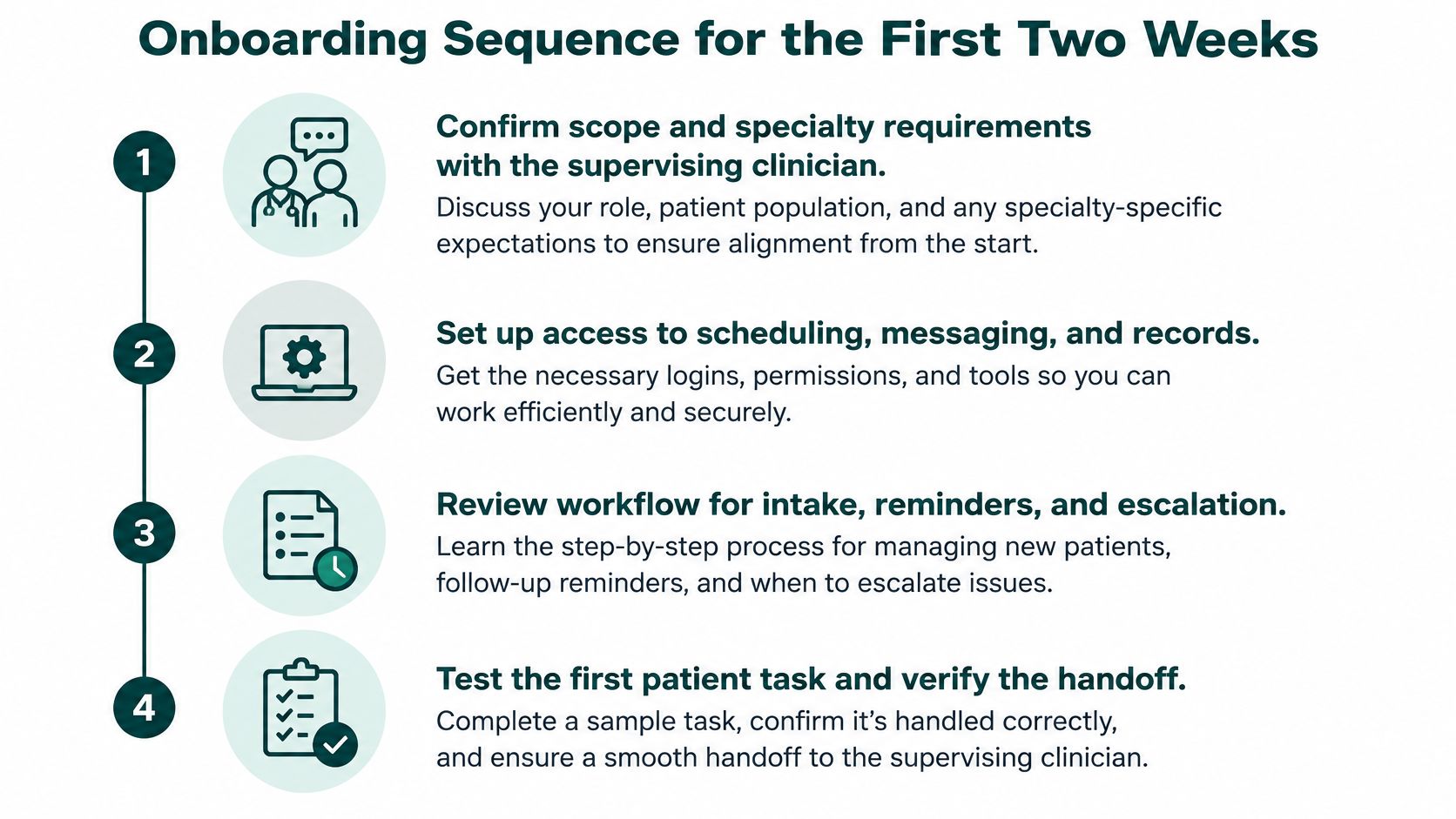
- Confirm scope and specialty requirements with the supervising clinician. The matrix and the escalation triggers get a final read before anyone is hired into them. The common slip is treating this as a formality and skipping it entirely.
- Sign the service agreement and business associate agreement before any patient data is visible. That order is deliberate; a signature collected after the first shift is a compliance problem you created yourself.
- Approve the workstation and remote access setup. Screen, connection, phone system and headset. The slip here is a first day spent troubleshooting a laptop instead of learning the practice.
- Create role-specific accounts for the systems the duties require, and share written procedures. Not full EHR access "for convenience." The slip is admin-level permissions granted on day one and never narrowed.
- Run practice-specific onboarding covering the EHR setup, scheduling rules, call scripts, documentation standards and the escalation process. A new hire who has the scripts but not the escalation path will improvise at the worst moment.
- Review the first batch of work together, referral packets, intake calls or outreach notes, and correct errors with the coordinator rather than fixing them yourself.
- Adjust the workflow and update the written procedures to match what the first week taught you. If two people handled a task because the rules were unclear, rewrite the rule.
You know the sequence is complete when you can point to three things: signed agreements on file, an approved access list with a named grantor, and a reviewed first batch with the corrections documented. Anything less means the first live patient interaction is doing your quality control for you.
Set Caseload Limits and Metrics Before You Post
How many active patients can one coordinator hold before a stalled referral sits for a week with no owner? Postings that describe the job as booking and follow-up leave that blank. The new hire then meets the volume on a bad Monday: a queue with no ceiling, systems that disagree, and nobody named on the item that stopped moving.
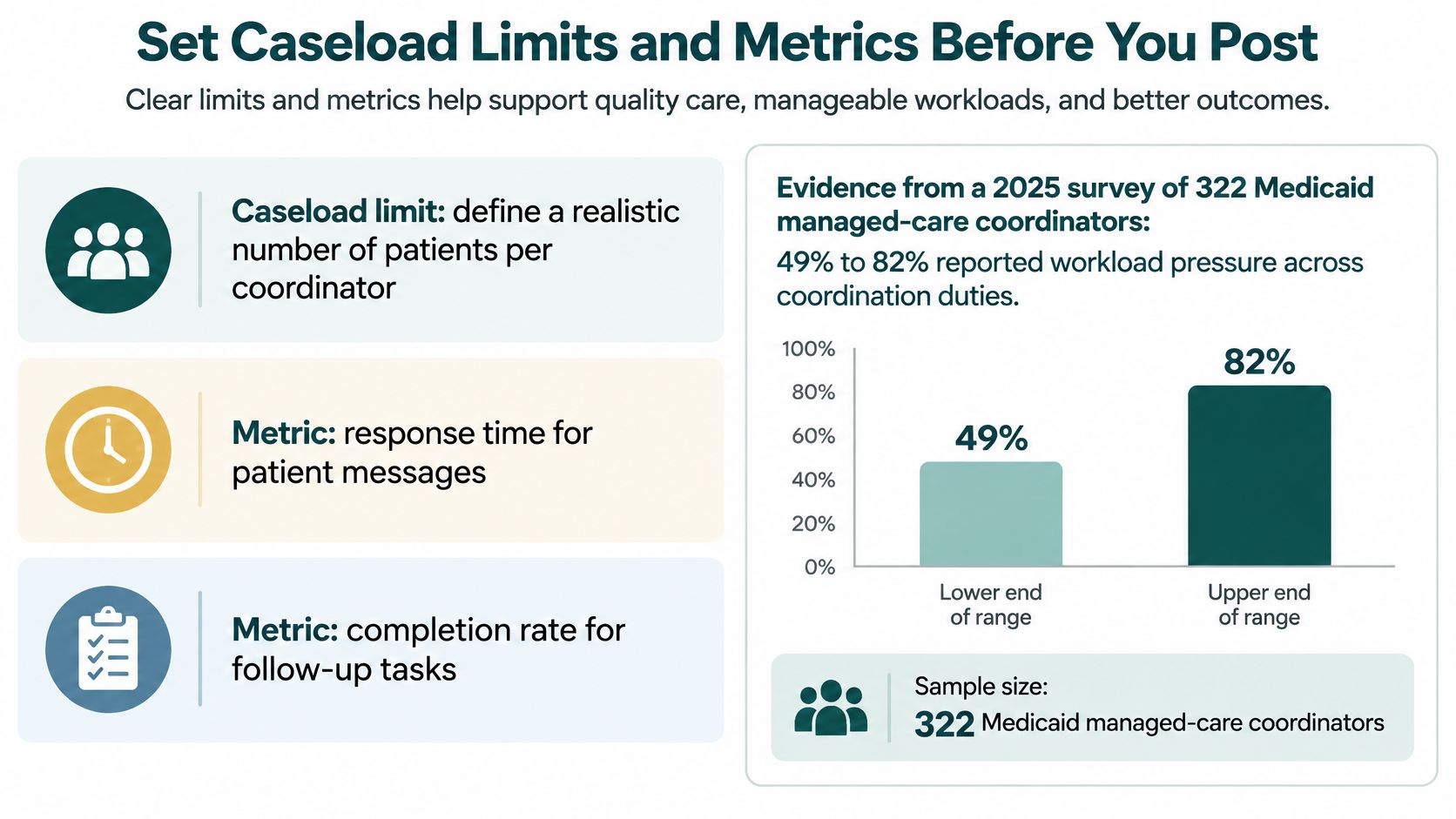
The evidence on workload pressure is specific. In a 2025 survey of 322 Medicaid managed-care coordinators, 49% to 82% reported major or moderate barriers across resource access, authorization delays, administrative burden, caseload size, regulatory changes and disconnected data systems, as reported in the American Journal of Managed Care. Those barriers are a design problem. A description that promises open-ended coordination, with no ceiling and no owner for the stalled item, builds the same failure into the role.
Write the workload into the posting
Answer the questions candidates ask and templates skip. How many patients or referrals are active at once? Who owns a stalled authorization? What happens when the EHR, the payer portal and the referral platform disagree? How much protected time exists for escalations, and what gets deprioritized when the queue spikes?
Put one limit in that same block of the posting. The coordinator never interprets a result, changes a care plan, or tells a patient a clinical next step without authorization from the licensed clinician. Caseload pressure is when that line gets crossed, because clearing the queue feels faster than escalating. The metric is administrative follow-through inside a written scope, not clinical judgment under a deadline. A posting that states both the volume and that limit attracts people who want a defined job.
| Metric | What It Shows | Data Source |
|---|---|---|
| Closed-loop referral rate | Share of referrals confirmed as received and scheduled | EHR referral report |
| Time from referral to appointment | How quickly patients reach the next step | Scheduling system timestamps |
| Abandoned call rate | Patients who hung up before reaching staff | Phone system report |
| Overdue recalls | Patients past their recall date without contact | Recall list in the EHR |
| Authorization aging | Days each prior authorization has stayed open | Authorization tracker |
| Documentation completeness | Share of outreach and referral notes with required fields | EHR audit or spot check |
Set targets from your own baseline
Pick three to five metrics, not the whole table. Run them for 30 days before you set a target. No outside benchmark knows your payer mix, your no-show rate, or how many portals your staff juggles. A number copied from another practice's dashboard is a number your coordinator will miss for reasons outside their control.
A posting that names the caseload and the three metrics a manager will watch attracts candidates who want the job and discourages those who wanted a title without accountability.
I would not publish a speed target without a quality pair. Closed-loop referral rate next to time to appointment. Calls answered next to documentation completeness. Speed alone rewards the person who closes the note before the required fields are in, or who answers a clinical question just to empty the queue.
Publish the range and the metrics in the posting before interviews begin. The conversation then stays on how the work gets done, and on what stays with the clinician, rather than on whether the work will be measured.
The Takeaway
A patient care coordinator job description should define each duty by function, system, and completion point. It should also state what the coordinator must not do without clinical authorization. Clinical decisions, diagnosis, and treatment belong to appropriately licensed healthcare professionals; the coordinator supports administrative workflows and documentation within the practice's defined boundaries.
Before posting, complete the template and have the supervising clinician approve the responsibility matrix. Set caseload limits and three to five performance metrics based on your practice's baseline. Then read the posting from a candidate's perspective. If the limits of the role are unclear, revise it before hiring.
For remote hiring, MedicalVirtual matches healthcare practices with pre-vetted candidates based on specialty, software, and time zone. Its assistants can support intake, scheduling, records requests, and referral coordination using the access and workflows the practice approves. Interview candidates before making a decision, and visit MedicalVirtual to scope the role.