

94 percent of physicians in a December 2022 American Medical Association survey said prior-authorization requirements delayed patients' access to necessary care, and one in three said the process had contributed to a serious adverse event for a patient in their care (AMA physician survey). Medical prior authorization is the coverage check a payer runs before imaging, a procedure, or a specialty drug can be delivered. It answers a billing question, not a clinical one. The patient still needs the test; the payer has to agree to pay for it first.
The practical mistake practices make is treating this work as paperwork that happens between other tasks. It behaves much more like a production line. Requests have arrival times, service-level deadlines, defect rates, rework loops, and a measurable cost in staff hours. Once you frame it that way, the questions get sharper. Which payer deadlines apply to which program. Which steps staff can own and which require a provider's signature. Which denials are reversible. Which metrics tell you where the queue is stalling rather than how busy everyone feels.
This guide works through those questions in the order a practice manager meets them. You'll see how authorization volume lands on a schedule, what the CMS decision timeframes require by plan type, an eight-step workflow that survives an audit, a triage model for denials, the metrics worth tracking weekly, where electronic submission still falls short, and which parts of the job can safely be delegated to remote staff without moving clinical judgement off the provider's desk.
What Medical Prior Authorization Means for Your Schedule
Insurers made 49.8 million prior-authorization determinations for Medicare Advantage enrollees in 2023, up from approximately 37 million in 2021 and 46 million in 2022, and more than 90 percent (46.6 million decisions) were fully favorable, meaning the requested service, item, or treatment was approved in full (KFF analysis of Medicare Advantage prior authorization). How much of that volume hits your front desk depends on payer mix. It shows up as an open slot a scheduler cannot fill because imaging, a procedure, or a specialty drug is still waiting on a coverage decision.
A single request can occupy a staff member for the better part of a morning once eligibility checks, chart pulls, portal uploads, and follow-up calls are counted.

What one request actually involves
Each request is a small project with seven moving parts. Any one of them can stall the queue.
Eligibility review confirms the patient is covered on the date of service. Documentation collection pulls the diagnosis, prior treatment history, imaging, and clinical notes out of the chart. Clinical justification is the provider's step: why this service, for this patient, now. Staff can assemble the file. They should not invent the clinical reason.
Then the back half. Payer submission goes through the correct portal or channel. Follow-up chases a status that rarely updates itself. Corrections answer a payer who wants something that should have been attached the first time. Escalation starts when the deadline is close and there is still no answer. Skip follow-up and the request does not fail loudly. It sits, and the appointment stays blank.
A knee MRI that costs a week
A family medicine practice refers a 58-year-old patient with three months of medial knee pain to orthopedics. The specialist wants an MRI before deciding on injection versus further referral. The order is written on a Tuesday. Eligibility has to be rechecked because the patient changed plans in January. The payer's criteria ask for documented conservative therapy, so the clinical note and physical therapy records get pulled and attached. The request goes in Thursday. The practice hears nothing until the following Wednesday.
That is a week of a patient in pain, a scheduler holding a slot they cannot fill, and a provider answering a portal message that says only "under review." For the patient, the waiting is the experience of care. While the request is pending, they also ask what the study will cost, and front-desk staff who are clear on understanding deductibles and coinsurance can answer that in one call instead of three.
The tradeoff to name out loud. Most requests get approved. That does not make the process cheap. The work still consumes staff time and can delay scheduling or treatment, which is why it needs its own queue rather than spare minutes between patients.
Size your own exposure in a week
Before changing staffing, measure. For one week, have staff log every authorization request with four fields: payer, service category, submission date, and whether it was urgent or standard. At the end of the week, sort by payer.
Most practices find that two or three payers generate the majority of requests and the majority of the follow-up calls, and that a handful of service categories (advanced imaging, sleep studies, injections, specialty drugs) account for most of the delays. That sort is your first work queue. It is also the honest basis for deciding whether eligibility checks, chart pulls, portal submission, and status calls belong with a dedicated person, while the clinical justification stays on the provider's desk.
Decision Deadlines by Plan Type and Program
Deadlines are the part of this work that changed most recently, and older checklists are now wrong. Beginning January 1, 2026, for many Medicare Advantage, Medicaid, CHIP and federally facilitated Marketplace plans, affected payers generally must issue an expedited decision within 72 hours and a standard decision within seven calendar days after receiving the request (CMS prior authorization process FAQs). If your staff still work from a document that says two weeks, they're monitoring the wrong date.
| Program or plan type | Standard decision | Expedited decision | Notes |
|---|---|---|---|
| Medicare Advantage | 7 calendar days | 72 hours | Standard requests previously had up to 14 calendar days |
| Medicaid managed care and CHIP | 7 calendar days | 72 hours | An extension of up to 14 additional calendar days may apply where program rules allow |
| Federally facilitated Marketplace plans other than qualified health plans | 7 calendar days | 72 hours | Extension rules as above where applicable |
| Qualified health plans on federally facilitated exchanges | Not subject to the standard-decision requirement | 72 hours | Standard timeframe does not apply |
| Prescription drugs (all programs) | Outside these timeframes | Outside these timeframes | Confirm drug-specific rules with the payer |
How the clock runs on a real request
Take an urgent physical therapy request for a Medicare Advantage patient, submitted Monday at 9 a.m. with the clinical notes attached. The expedited deadline is 72 hours, so the practice should see a decision by Thursday at 9 a.m. A standard request for the same patient, submitted at the same moment, runs seven calendar days, which means the following Monday. Those are different queues, different escalation triggers, and, in most practices, different people watching them unless you build one worklist that carries the urgency flag.
The history matters for calibration. Before January 1, 2026, Medicare Advantage plans generally had up to 14 calendar days for standard requests while expedited requests stayed at 72 hours, and CMS implementation materials list Medicare Advantage organizations, state Medicaid agencies, Medicaid managed-care plans, state CHIP agencies and CHIP managed-care entities among the affected payer categories (CMS final rule implementation presentation). If your team's habits were built under the two-week standard, their sense of "still early" is a week too generous.
What falls outside these timeframes
Three exclusions catch practices repeatedly. Prescription drugs are excluded from these particular medical-item timeframes, so a specialty drug request needs its own rules pulled from the payer. Qualified health plans sold through federally facilitated exchanges are not subject to the standard-decision requirement, though expedited decisions still run to 72 hours. And commercial employer plans outside these CMS programs aren't governed by these timelines at all, so contract terms and applicable state rules decide, not the federal schedule.
One more limitation: the rule permits a potential extension of up to 14 additional calendar days where the applicable program rules allow it. A pending status on day seven can therefore be legitimate rather than a payer failure, which is why your queue needs a field for "deadline extended" instead of a single universal due date.
For practices where Medicare Advantage dominates the schedule, Medicare prior authorization support is worth reviewing alongside your internal queue design, because the escalation path differs from commercial work. A decision deadline is a payer obligation, not a guarantee of approval. Practices still need an internal policy for missing records, peer-to-peer reviews, denials and appeals, and requirements can vary by program, so confirm obligations with qualified compliance professionals.
How to Run an Authorization Workflow Step by Step
The workload justifies treating authorization operations as a measurable production process rather than an ad hoc clerical task. The American Medical Association reports that physicians complete approximately 40 prior-authorization requests per week, that physicians and staff spend about 13 hours weekly on these activities, that 40 percent of surveyed practices employ personnel dedicated exclusively to prior authorization, and that 32 percent of physicians say requests are often or always denied (AMA survey on prior authorization reform). Thirteen hours a week is a part-time job. It should have a job description.
Here's the sequence that holds up when a denial gets appealed and someone asks what happened on which day.
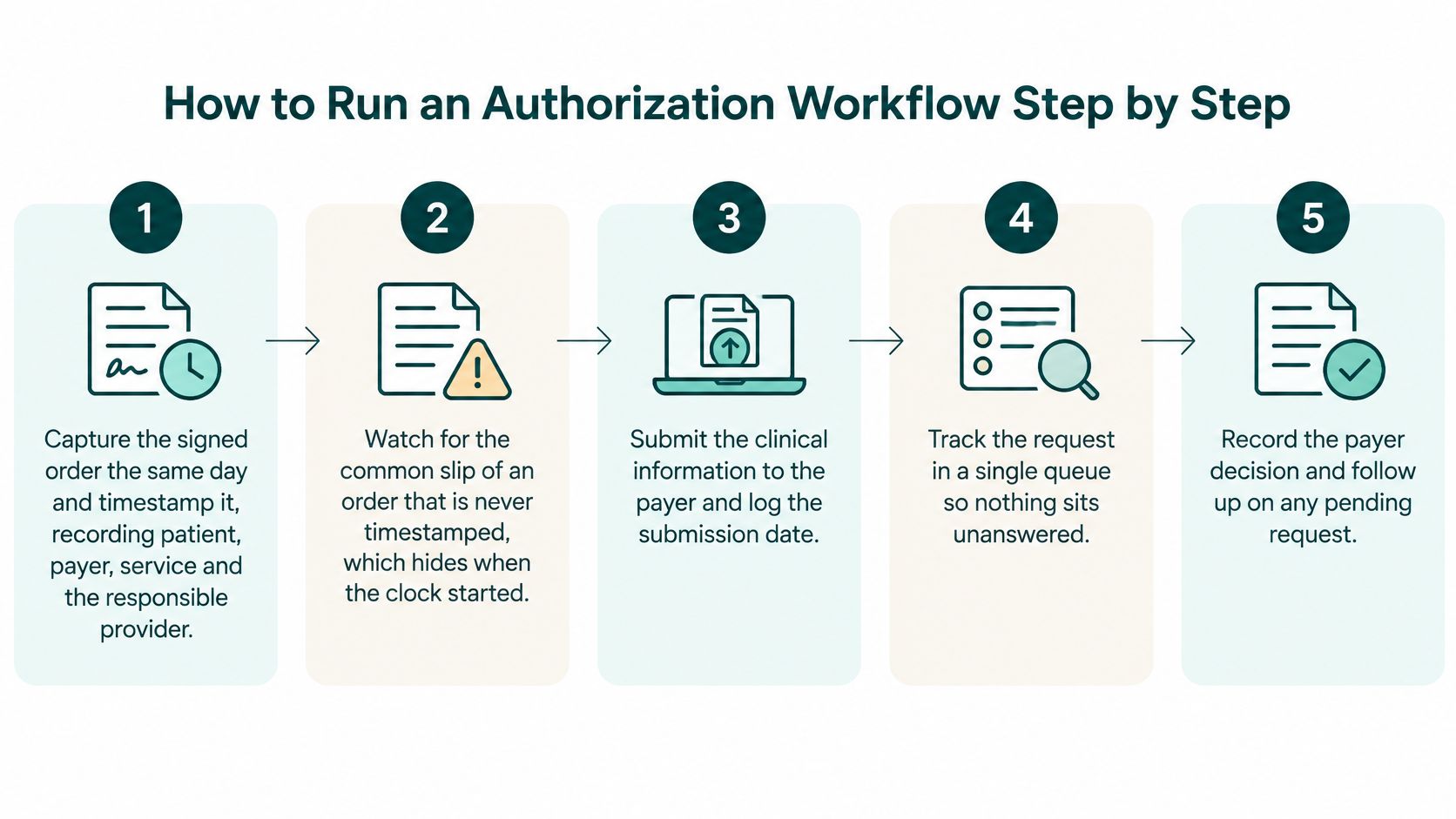
- Capture the signed order the same day and timestamp it. Record the patient, payer, requested service and responsible provider. The most common slip is an order that never gets a timestamp, which hides when the clock started and makes every later delay unattributable.
- Classify the request as urgent or standard. The label drives the deadline, so it's a clinical decision, not an administrative convenience. Staff who upgrade everything to urgent create noise; staff who downgrade an urgent request create a clinical risk.
- Verify eligibility and the payer's rule for the specific service code before assembling anything. A current insurance verification form run before the visit prevents the worst version of this step, which is discovering a terminated plan after the chart is pulled and the note is written.
- Assemble the documentation set. Diagnosis, prior treatment history, imaging and clinical notes come from the record. Route the medical-necessity rationale to the provider, who reviews and signs it. Staff can gather sources; they cannot invent a rationale.
- Submit through the payer's portal or approved channel and record the reference number. Write the number into the same row as the submission date. Reference numbers stored in an email thread are effectively lost.
- Track every request against its deadline and route missing items to an exception queue. Pending is a status, not a plan. Anything without a response at the midpoint of its window belongs on someone's list for that day.
- Escalate to the provider before the deadline when the payer signals a problem. That includes peer-to-peer review requests, which often come with a short window and require the treating clinician, not a coordinator.
- Record the decision and send any denial into the denial process. Same-day routing matters more than same-day filing, because appeal deadlines are unforgiving and documentation is easiest to assemble while the case is fresh.
The handoff that keeps clinical judgement with the provider
Every step above splits into two kinds of work, and the split is not a formality. Assembling records, checking portals, recording reference numbers and tracking deadlines are administrative tasks with a clear right answer. Clinical classification, medical-necessity attestation and peer-to-peer participation are provider work. A coordinator who starts deciding which diagnosis codes will "look stronger" has crossed a line that creates compliance exposure and bad documentation at the same time.
Practical rule. If the request can't be explained using the provider's own note, the file isn't ready to submit. Send it back with a specific question, not a general "needs more documentation."
Documentation quality is also specialty-specific. A wound care request that depends on measurements, prior debridement and conservative therapy history needs that detail attached in the payer's expected format, and a provider guide to specialty wound evaluation shows the level of clinical detail reviewers commonly expect. The same principle applies to any specialty where the coverage criteria are procedural rather than diagnostic: attach the evidence the criteria name, in the order the criteria name it.
Denials, Pain Points and How to Respond
A denial is a queue item with a clock, not a closed case. Federal audits have found that many prior-authorization requests denied at first were later overturned on review. Classify the letter, name an owner, and move it before the appeal window closes. Treating that first decision as the last word is an access problem the practice created.

A documentation gap and a necessity dispute are different problems
In a typical practice, both denial types land on the same coordinator. That mix is the breakdown. A documentation denial is a records problem with a short cycle. A medical-necessity denial is a clinical disagreement with a discussion attached. Leave them in one pile and the records cases age past their appeal windows while a provider reviews a file that never needed a provider.
| Denial reason | What it usually means | First response |
|---|---|---|
| Missing or incomplete documentation | Clinical notes or results did not reach the payer | Pull the record and resubmit with the missing items attached |
| Medical-necessity disagreement | The reviewer does not accept the clinical rationale | Provider reviews the criteria and requests a peer-to-peer discussion before the deadline |
| Wrong code or service | The requested item does not match the signed order | Check codes against the order with the provider before resubmitting |
| Coverage or eligibility issue | Plan dates or benefits do not match the request | Re-verify eligibility and the plan on the date of service |
| Expired authorization | The approval window closed before the service | Request a new authorization before rescheduling |
Take the two cases side by side. A denial that cites a missing sleep study is a pull-and-resubmit job: locate the report, attach it, and send the file back. Coordinator time is the cost, not a new clinical argument. A denial that says the service does not meet criteria needs the provider to read the payer's stated rule and request a peer-to-peer discussion before the deadline. No amount of record assembly will change a clinical disagreement.
The pain points that show up in every practice
Four problems account for most avoidable delay, and none of them are exotic. Incomplete documentation at first submission starts a rework cycle that consumes more staff time than the original assembly. Missed payer follow-up leaves requests sitting in a portal nobody opened that day. Slow escalation turns a recoverable denial into a missed appeal window, and the service date slips with it.
The fourth never shows up on a status board. Patients abandon treatment while they wait, and the practice often never learns it, because the patient stops calling. A queue that looks acceptable on a spreadsheet can still lose the case.
Appeal rules vary by program and payer, and the specifics change. Confirm appeal steps and deadlines with qualified counsel or compliance professionals rather than relying on last year's process letter. Payers publish criteria, and specialty groups publish their own translations of those rules, which are often more useful for staff training than the payer's own language. The medical necessity rules for vein treatment published by one vascular practice are a good model of how a coverage rule becomes a documentation checklist a coordinator can use.
I would split the denial queue by type the day the letter posts. Documentation defects go to the coordinator with a pull list and a resubmit target. Necessity disputes go to the provider with the criteria excerpt and the days left on the appeal clock. Administrative reversals stay with staff. Clinical judgement stays with the clinician.
Tracking Metrics That Show Where Requests Stall
Total authorization volume is a weak production number. A busy month can hide a clean process. A quiet month can hide requests that have sat unanswered past the program deadline. Split the queue into preventable administrative defects and payer-level delays. Those problems have different fixes and different owners.
CMS's 2024 Interoperability and Prior Authorization final rule requires impacted Medicare Advantage, Medicaid, CHIP and federally facilitated Exchange plans to publish selected prior-authorization metrics, including approval, denial, post-appeal approval and average submission-to-decision time (CMS Interoperability and Prior Authorization final rule fact sheet). Impacted payers must also implement a Prior Authorization API using HL7 FHIR-based standards, with API compliance set later than the rule's other provisions. Measuring the queue the same way every month is now a compliance habit, not only an operations habit.
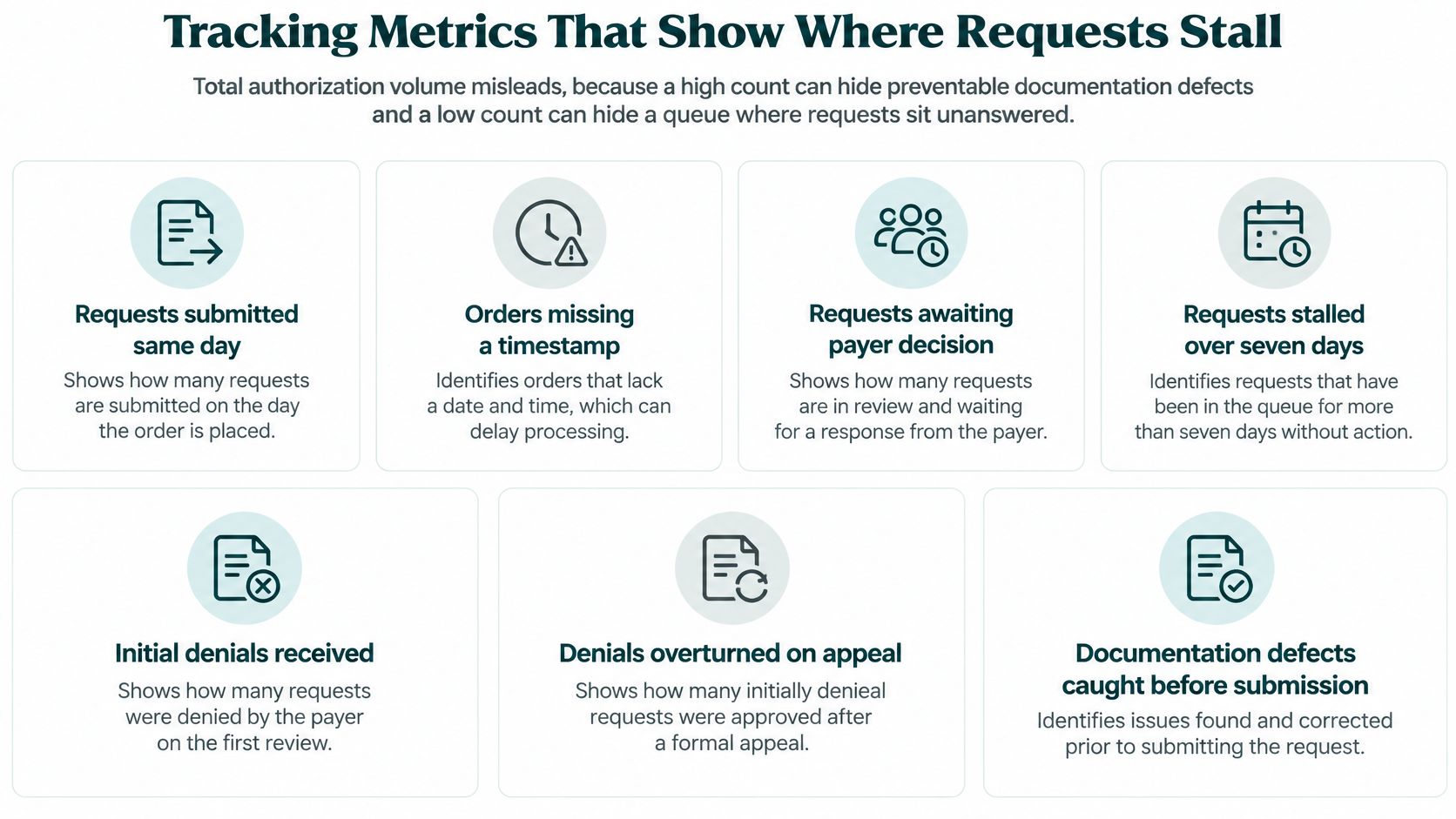
| Metric | How to calculate | What it tells you |
|---|---|---|
| Clean-submission rate | Requests complete at first submission divided by total requests | Intake and documentation quality |
| Average days to decision | Total submission-to-decision days divided by decisions | Whether payers meet the applicable deadline |
| First-pass approval rate | Approvals on first decision divided by total decisions | Payer delays versus preventable denials |
| Escalation rate | Requests escalated divided by total requests | Where queues stall |
| Avoidable-denial rate | Denials caused by missing or wrong information divided by total denials | Staff training gaps |
| Appeal overturn rate | Appeals approved divided by appeals filed | Whether denials were reversible |
| Age of open requests | Days since submission for unresolved requests | Items close to a deadline |
Read the row, not the monthly total. If first-pass approval is high and average days to decision still miss the program deadline, the stall is the payer clock, not intake. If the clean-submission rate falls while the appeal overturn rate stays high, staff are sending incomplete packets and then winning them back. That burns coordinator time twice on a denial that was reversible.
Start from your own baseline, not someone else's numbers
Capture one month of data before you set a target. Compare average days to decision with the deadline that applies to each payer and program. Read the gap payer by payer. A strong commercial average can mask a Medicare Advantage queue that is running long.
Clean-submission rate targets vary widely by specialty, so set them from your own baseline, payer mix and service categories, then move them deliberately.
Every metric needs a named action
A dashboard nobody acts on is decoration. Tie each measure to a person and a response with a deadline.
A rising avoidable-denial rate should trigger retraining on the documentation checklist for the service categories driving it. A cluster of escalations on one payer should produce a standing rule that those requests go to peer-to-peer review earlier, while the decision window is still open. A clean-submission rate that drops after a staff change tells you onboarding never covered that payer's portal.
The one review that pays for itself. On Monday, sort open requests by age and work the oldest ten first. That single habit catches deadline risk before it becomes an appeal.
I would freeze the metric definitions with your provider lead and compliance contact before the second month of reporting. A definition that drifts makes month-over-month comparison meaningless, and the meeting turns into an argument about the formula instead of the queue.
Where Automation and Electronic Submission Fall Short
Health plans have pledged standardized FHIR-based submissions, greater transparency and real-time approvals, and participating plans have reported an estimated 11 percent reduction in prior-authorization volume in some cases, according to CMS materials on electronic prior authorization (CMS electronic prior authorization industry commitments). Fewer requests and faster submissions are genuine wins for the queue. A shorter queue is not, by itself, a fairer decision.
Many physicians report that denials have risen over the past five years, and many are concerned that payer use of AI could increase them. A faster queue that produces more denials is not progress for the patient waiting on an imaging study. Time saved on submission does not help if the denial lands two days before a scheduled scan and the appeal clock is already running. The question that matters is whether automation shortens the queue while shifting more responsibility onto clinicians and patients.
What faster processing does not fix
An automated approval for a routine lab saves days with no downside. A complex oncology imaging denial produced by a rules engine still requires a clinician to read the criteria, judge whether the documentation supports a different argument, and take a peer-to-peer call. Automation compresses the easy cases and leaves the hard ones exactly where they were. The remaining work is more clinically dense per hour, not less.
That density is a staffing problem as much as a technology problem. Easy approvals can move through the portal with little human time. Denials that can still be reversed need a person who can read the stated reason, check the attachment set, and decide whether the next step is a records resubmit or a clinician conversation. Delegating the first of those tasks does not move clinical judgement off the provider. It keeps the provider's time on the cases that need it.
Payer APIs are also not yet a foundation you can build a workflow on. Until electronic exchange of coverage requirements and clinical documentation is fully live, and until payer rules are unambiguous in machine-readable form, human review stays necessary whenever attachments are incomplete, a rule is unclear, or a request is denied. Design the queue so the portal does the submitting and people do the judgement.
Controls to build regardless of the technology
These four controls cost little staff time and protect you when a decision arrives with no explanation.
- Capture the denial reason in structured form. A free-text note saying "denied" tells you nothing in aggregate. Record the stated reason, the cited rule if any, and the appeal deadline as separate fields.
- Route every automated denial to a human reviewer. No denial should reach a patient as a final answer without a person confirming whether it's a records problem or a clinical one.
- Keep an audit trail per decision. Submission timestamp, documents attached, payer response, reviewer, next action. If a payer's reasoning is opaque later, that trail is your argument.
- Keep a staff-assisted phone path. Some patients can't use a digital payer system, and a portal-only process excludes them. Staff escalation by phone is a safeguard, not a fallback for people who failed to use the tool.
A practice often cannot tell whether a denial came from a reviewer who read the note or from a model that scored it. Ask. Document the answer. Where the reasoning is opaque, escalate through the appeal channel and keep the record of having asked.
Staffing Scope, Access and Poor Fits for Remote Prior Authorization
A prior-authorization specialist submits, tracks and escalates requests for imaging, procedures and specialty drugs, validates that required attachments are present, records reference numbers, checks payer portals and pushes stalled requests forward before a deadline passes. That's a well-defined administrative role, and it maps cleanly to remote work because almost all of it happens inside systems the practice already owns. The prior authorization specialist role is scoped in exactly those terms, which is why it can be handed to remote staff without moving clinical judgement off the provider's desk.
The boundary is what makes the role safe. A specialist does not give medical advice, diagnose, provide treatment or write medical-necessity attestations. MedicalVirtual provides administrative staffing and related services and does not provide medical advice, diagnosis, treatment or emergency services, and a prior-authorization specialist submits, tracks and escalates authorizations rather than deciding whether a request should be granted. Nothing about that split should feel restrictive. It's the same split you'd enforce with an in-office coordinator.
| Task | Specialist handles | Provider decides or signs |
|---|---|---|
| Attachment and record validation | Confirms documents are complete and attached | Decides whether clinical content supports the request |
| Reference numbers and portal checks | Records and updates request status | Responds only when the payer requests clinical input |
| Deadline tracking | Monitors request age and escalates before the deadline | Decides whether to request peer-to-peer review |
| Medical-necessity rationale | Assembles source records for review | Writes, reviews and signs the rationale |
| Code or order changes | Flags mismatches between codes and the order | Confirms or changes codes |
| Appeal content | Gathers records and tracks the appeal deadline | Decides grounds for appeal and signs |
Before you grant access
A signed Business Associate Agreement comes first, then HIPAA training for the assistant, then access limited to the specific systems and payer portals the role needs. Those three are HIPAA requirements. Everything beyond them (unique logins, no local storage of patient information, session timeouts, a named practice contact for escalation) is recommended security practice rather than a legal mandate. Be careful with vendors who claim to be "HIPAA certified," because HHS does not recognize an official certification of that kind.
Hiring criteria that predict performance are narrower than most job posts suggest. Look for payer portal experience with the plans that dominate your schedule, working medical terminology, familiarity with your specialty's coverage criteria, and comfort with a high-volume tickler list. Then test with a practice-specific scenario: hand the candidate a redacted denial and ask them to write the next three actions with dates attached. Generic prior-authorization experience from another specialty transfers unevenly, and a scenario test shows you whether they read the denial or just recognized the form.
When dedicated staffing is the wrong answer
Honest exceptions exist, and naming them saves practices from buying capacity they don't need. If you're a small practice with low authorization volume and one trained staff member who clears the queue daily with room to spare, a dedicated role adds coordination cost without fixing a problem. Fix the documentation checklist instead.
A second poor fit is a payer mix dominated by prescription drugs, since drug authorizations fall outside the medical-item timeframes described in the CMS rule and follow different payer procedures entirely. Bring in someone with drug-specific experience or leave the role where it is. As a matter of policy, MedicalVirtual does not promise a guaranteed approval turnaround in writing, and no staffing arrangement changes what a payer decides. Staffing shortens internal delay. It doesn't shorten a payer's review.
The Takeaway
Medical prior authorization is a workflow with fixed decision timeframes, a finite set of steps, and a denial rate that is partly your own doing. The two facts that should reframe your operations sit side by side. Requests are mostly approved, and the work still consumes enormous staff time while delaying care. Both are true at once, which means the goal isn't to argue with the process. It's to run it so that preventable defects stop costing your patients weeks.
The next step is a 30-day audit. Pull the last month of authorization requests, classify each one by payer, urgency and outcome, and calculate the measures in the KPI table. Start with the age of open requests and the escalation rate, because those two flag items that are about to miss a deadline. You'll usually find one or two payers and three or four service categories producing most of the delay. Then write down which tasks staff may own, which need a provider's signature, and what the escalation rule is at the midpoint of every deadline window.
If you're evaluating remote prior-authorization support, ask two questions before sharing any patient information with anyone. Request a sample Business Associate Agreement so you can review the terms first, and ask for a written description of the systems and payer portals the specialist will access. A dedicated specialist should work inside your own practice management system and payer portals, under your approved access and your escalation rules, which keeps the clinical judgement where it belongs and the queue somewhere it can be managed. Requirements vary by payer and program, so confirm your own obligations with qualified counsel or compliance professionals.
If authorization work is eating hours your team doesn't have, MedicalVirtual places pre-vetted, HIPAA-trained prior-authorization specialists from Latin America who work your clinic hours inside your own practice management system and payer portals. They submit, track and escalate imaging, procedure and specialty drug requests, and hand every clinical decision back to your providers. Visit MedicalVirtual to see how the process works and request a sample BAA before any patient information changes hands.