

The usual advice is to fill out a medical records request form and wait. That's incomplete. A form won't prevent delays if it goes to the wrong organization, leaves the record categories unclear, or doesn't establish who's authorized to receive the information.
Knowing how to request medical records means getting four things right: the record holder, the requester's authority, the scope, and the delivery method. Send the request to the organization holding the information, identify the patient and the records needed, supply appropriate identity or authorization documents, and retain confirmation of submission. For medical practices, the corresponding responsibility is to turn that request into a tracked workflow rather than leave it in a shared inbox.
This matters whether you're helping a patient transfer care, collecting outside records before a specialist appointment, or evaluating a remote medical records coordinator. Administrative staff can gather documents, clarify scope, and follow up. They shouldn't independently resolve sensitive access questions or decide whether an exception permits withholding information.
The practical challenge isn't usually writing a longer request. It's writing one a records clerk can process without guessing, then assigning someone to follow it through delivery. State requirements can change the details, so practices should have qualified counsel or a compliance professional review their release procedures.
Who Can Request Records and What Proof They Need
Identity and authority are different checks. A photo ID may establish who someone is, but it doesn't establish that they can obtain another person's chart.
The HHS guide to medical records access explains that patients and their personal representatives generally hold the right to inspect and obtain information in the designated record set. That includes more than visit notes: laboratory reports, X-rays, billing and insurance information, consent forms, and ordinary clinical notes can belong in the accessible record.
Who can request records and what to provide
These are typical documentation starting points, not universal requirements to demand from every requester.
| Requester | Proof to Provide | Scope and Notes |
|---|---|---|
| Adult patient | Government photo ID matching the chart name | Full designated record set, including billing and consent forms, subject to access exceptions |
| Parent or guardian of a minor | Birth certificate plus own photo ID; court order for guardianship | Minor-consent limits can restrict access to particular information |
| Legal guardian or healthcare agent | Court order or healthcare power of attorney | Confirm the document covers medical records and that the authority is effective |
| Estate executor or personal representative | Letters testamentary or state equivalent | Authority rules are set by state law |
| Attorney | Signed HIPAA authorization from the patient | Authorization must name the recipient and scope |
| Treating provider | Written request stating the treatment purpose | Separately maintained psychotherapy notes typically need separate written authorization |
A spouse, adult child, or friend doesn't automatically qualify to receive a complete chart. For an ordinary release to that person, obtain written patient authorization unless another lawful pathway applies. Treatment requests from other providers generally follow a different disclosure pathway from requests made by relatives or attorneys.
Keep verification proportional
Ask the records office what documentation it accepts before sending sensitive identification. A name change, inactive healthcare power of attorney, or limited guardianship order needs clarification, not an automatic assumption that the requester lacks rights.
A privacy-conscious virtual assistant workflow should separate document collection from release approval. Guardianship, minor-consent, and estate rules change by state; the records office should apply those rules through its compliance process, not treat its own form as the final legal authority.
How to Submit a Complete Records Request Step by Step
Start with the information the receiving clerk needs to locate and deliver the correct record. The HHS right-of-access guidance addresses patient identification, requested information, format, and delivery, and requires covered entities to act within 30 calendar days of receiving an access request.
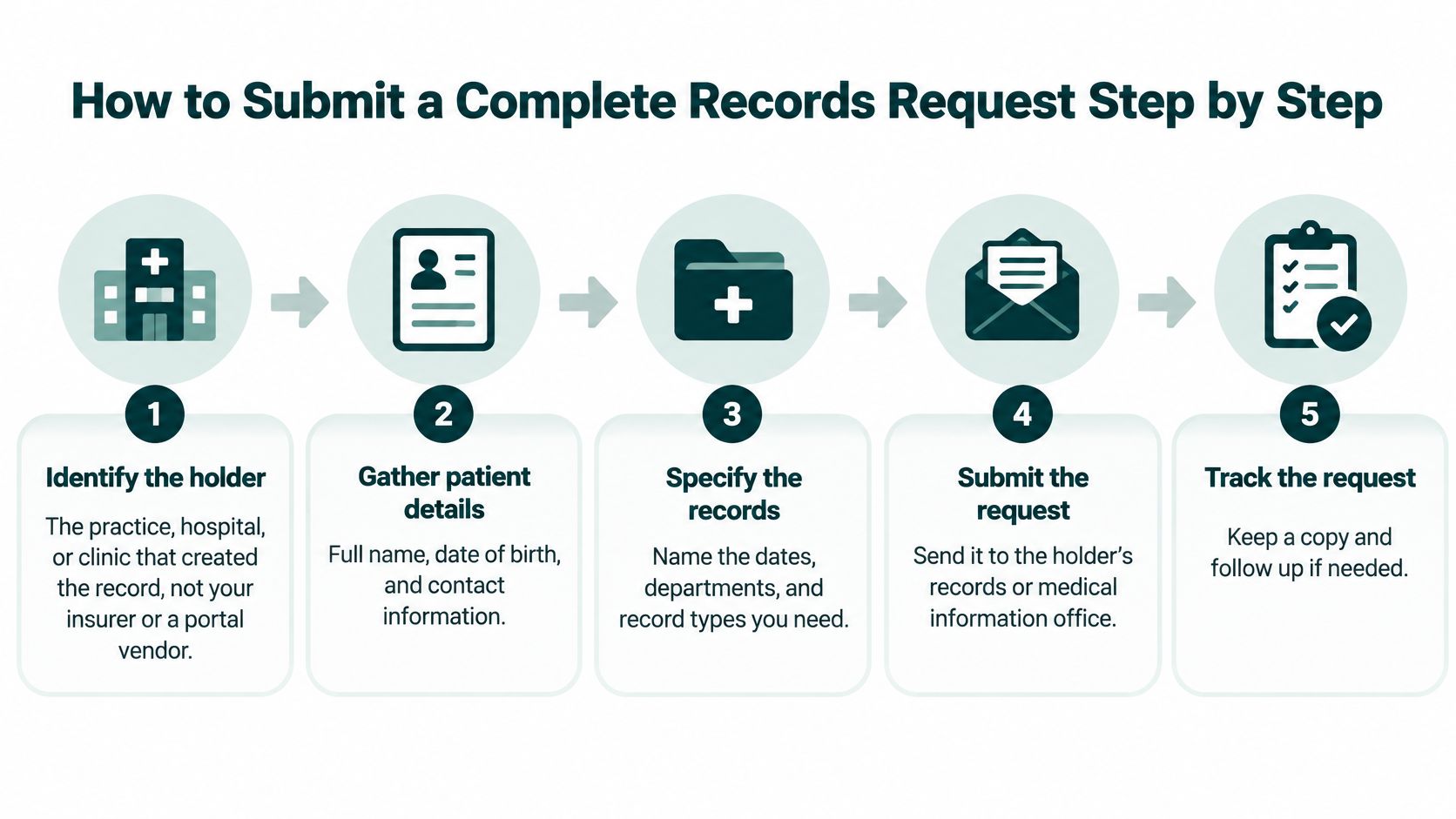
Build a request that doesn't need a callback
Identify the record holder. Contact the practice, hospital, clinic, or other organization holding the information you need, rather than assuming a portal vendor stores the complete chart. If care occurred across unrelated organizations, prepare separate requests; an insurer can supply its own records but isn't a substitute for the treating provider's chart.
Find the accepted submission route. Use the provider's request form when available because it captures the fields its staff expect. If submitting a signed letter, confirm where it should go and include the same identifying, scope, and delivery information.
Name the patient and the records precisely. Include the patient's full name, date of birth, contact details, relevant dates, and departments. Specify clinical notes, laboratory results, imaging reports and actual images, billing records, portal messages, or outside records received by the practice, rather than assuming a request for the entire chart will mean the same thing to everyone.
Choose the format and recipient. State whether you need an electronic PDF, paper copies, or imaging files on available media. If another provider should receive the records, include the recipient's name, organization, address, and approved delivery destination.
Attach only necessary proof. Supply the identity and authority documents appropriate to the requester, and sign and date the request where needed. Don't attach unrelated legal or financial documents when the relevant authorization or appointment document will establish authority.
Confirm secure delivery and save submission evidence. Use the records office's designated portal, secure transmission method, mailing address, or approved fax route. Retain the submitted form, attachments, and confirmation so staff can investigate a missing request without reconstructing it.
Create a follow-up entry. Record the receipt date, responsible office, expected response deadline, and any reference number. A sent message isn't always confirmation that the correct records department received it.
Make the scope usable
For example, a cardiology referral may need consultation notes, ECG reports, laboratory results, and imaging from a defined treatment period. A patient changing primary care practices may need a broader longitudinal record. Those are different requests, even when both patients describe wanting their medical records.
FaxZen's guide to accessing your personal health information can help you organize the request-form details before submission. Use the receiving organization's instructions to choose the actual transmission route.
Practical rule: A complete request should tell the clerk whose records to find, what to include, who may receive them, and where to send them.
Ask separately about psychotherapy notes. Don't assume they follow the same process as ordinary clinical documentation.
Delivery Methods Compared and What Fees to Expect
Check the patient portal first when you need information already available there. Downloading an existing result can avoid a separate copying and mailing workflow, but portal access doesn't establish that every requested document is present.
For broader requests, choose delivery based on record completeness and recipient usability, not speed alone. An imaging report in a PDF isn't the same deliverable as the underlying imaging files a specialist needs.
Delivery channels compared
The speed descriptions below concern delivery readiness, not promises about how quickly staff will assemble a chart.
| Channel | Typical Speed | Typical Cost | Security Notes |
|---|---|---|---|
| Patient portal | Often immediate once released | Usually no separate copy fee for existing portal downloads | Login protected; confirm the requested record is visible |
| Encrypted electronic file or secure link | Within the applicable processing window | Permitted copying labor and media charges may apply | Use the secure method the practice names |
| Processing time plus transit | Permitted copy fees and postage | Check the address and consider tracked delivery | |
| Fax | Prompt transmission once prepared; queue and retries can delay receipt | Per-page charges may be proposed, subject to applicable limits | Confirm the number by phone before sending |
| In-person pickup | Available when records are ready | Permitted copy fees; no postage | Bring accepted identification and check office hours |
Ask for the fee before fulfillment
The HHS access-fee guidance permits reasonable, cost-based copying charges, including allowable copying labor, supplies, media, and postage, but not a separate search or retrieval fee. A provider generally can't deny access because the patient has an unpaid medical bill.
Ask for an estimate and clarification of unexpected charges before records are copied. State law may provide lower fee limits, and the rules applicable to a patient access request shouldn't be assumed to govern every attorney, insurer, or other third-party request.
Don't send protected health information through an unfamiliar website contact form. Patient records and protected health information shouldn't be sent through our general website forms or email unless we've expressly instructed the sender to use an approved secure channel.
Deadlines, Tracking and What Happens Next
The federal deadline is an outside limit, not a recommended queue length. Under the HIPAA access regulation at 45 CFR §164.524, a covered entity must act within 30 days of receipt and may take one extension of no more than 30 additional days only if it supplies written reasons and an expected completion date within the original period, creating a 60-day maximum ordinary response window.
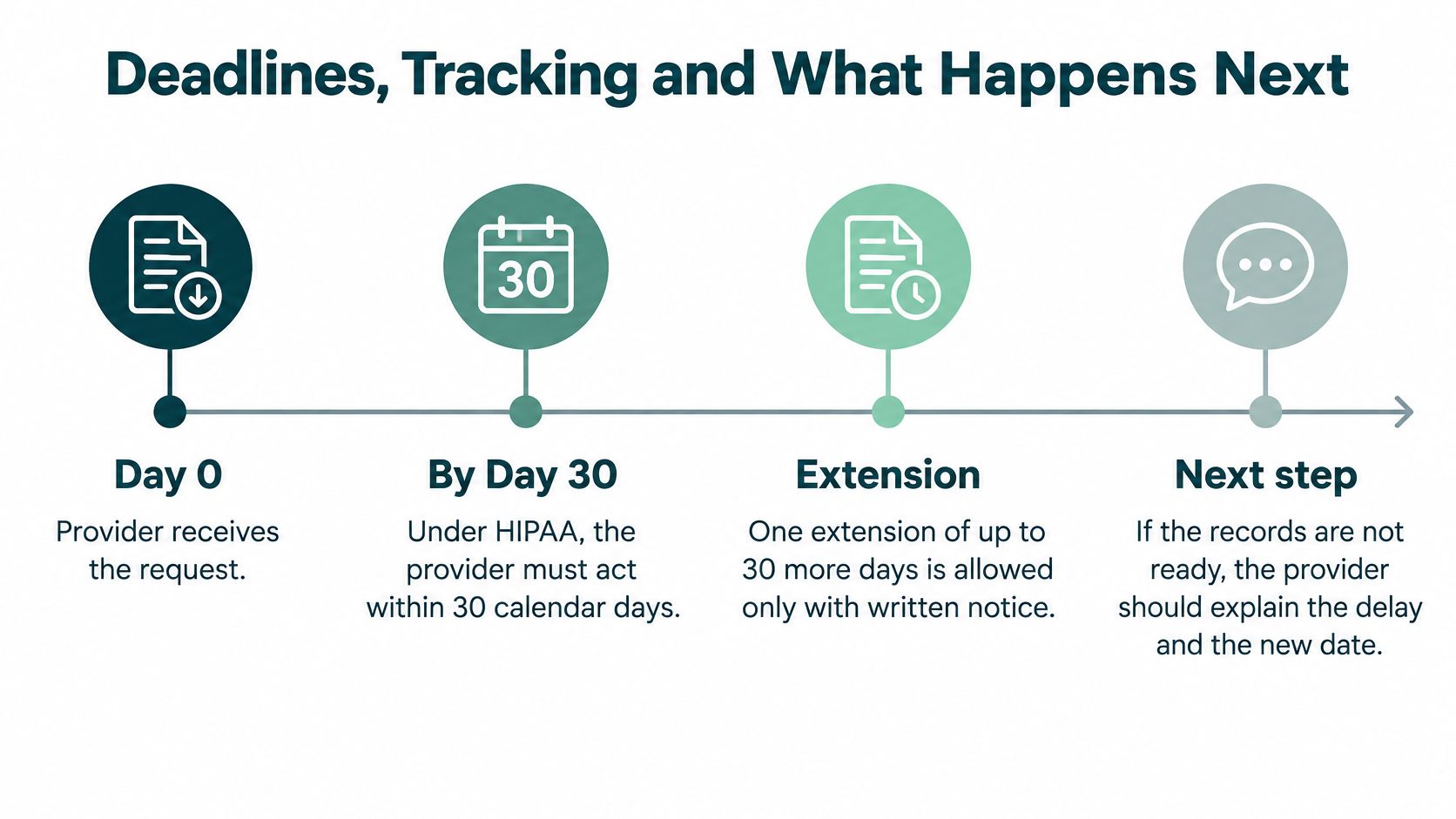
HIPAA access timeline by stage
| Stage | Day | What Happens |
|---|---|---|
| Receipt | Day 0 | Practice logs receipt and begins identity and authority checks |
| Routine processing | Days 1 to 30 | No separate guaranteed processing milestone; partial releases are possible |
| Written extension notice | By day 30 | Practice provides the reason for delay and expected completion date |
| Standard deadline | Day 30 | Access action is due, or a valid extension must already be in place |
| Outer federal limit | Day 60 | Maximum ordinary response window with a valid extension; state rules may be shorter |
Track actions rather than promises
Keep the confirmation, reference number, and a dated record of conversations. If nothing arrives, follow up during the processing period and ask a specific question: has the office located the records, identified missing documentation, or scheduled delivery?
A partial release can be useful when a current treatment summary is ready but archived records still need preparation. Ask the office to identify what it has sent, what remains outstanding, and when it expects to finish. Don't let a partial delivery become an undocumented closure.
A verbal promise to send records isn't the same as a written extension notice.
State requirements may be shorter than the federal framework. If the office misses the applicable deadline without a proper response, send a written escalation to the practice's privacy officer with the submission confirmation and communication history attached.
Special Cases for Minors, Deceased Patients and Mental Health Notes
Being a parent or close family member doesn't always confer access to everything in a chart. The records office must establish the requester's legal role and identify information subject to additional restrictions before releasing it.

Minors and deceased patients
Parents usually act as personal representatives, but state minor-consent rules can change access to particular services. Mental health, substance use, and reproductive-care information may require a more specific review rather than a blanket release of the entire chart.
Ask which categories need review before paying for a broad request. For remote staff, the task is to flag the issue and collect the relevant documents, not interpret state consent law independently.
For a deceased patient, ask what establishes personal-representative authority under applicable state law. Letters testamentary or the state equivalent may be needed; a family relationship alone shouldn't be treated as proof of authority to obtain a complete chart.
Psychotherapy notes aren't ordinary progress notes
The HHS explanation of mental-health information protections distinguishes routine treatment disclosures from disclosures of separately maintained psychotherapy notes, which typically require written authorization even when another provider requests them for treatment. General behavioral-health documentation shouldn't automatically be classified as psychotherapy notes.
For a mixed request, ask the records custodian whether the ordinary chart can be processed separately while restricted material receives authorization review. This avoids making every document wait for an issue affecting only part of the request.
Practical care coordination workflows need that distinction: collecting a referral packet isn't permission to release every sensitive document. Route uncertain requests to the privacy or compliance lead, and document the decision.
Access can be denied in limited circumstances, including certain safety-related situations. The requester should receive written reasons rather than an unexplained refusal from administrative staff.
Fixing Denials, Delays and Incomplete Records
A request that goes quiet after its response deadline needs diagnosis, not another open-ended voicemail. Ask whether the office received it, whether anything is missing, and whether it issued a written extension or denial.
Don't assume every delay reflects the same problem. An identity mismatch needs a different fix from missing imaging files or a request routed to an unrelated organization.
Common request problems and fixes
| Problem | Likely Cause | Fix |
|---|---|---|
| No update past the response deadline | Missing ID, unclear scope, or no tracking reference | Request the written extension notice, expected date, and reference number |
| Records arrive incomplete | Broad scope was interpreted narrowly | List the missing imaging, labs, billing, and outside records within the requested date range |
| Request denied | Missing authority or unsuitable authorization | Ask which document is missing; correct it or request review where available |
| Partial denial | Some information withheld under an exception | Request the releasable portion and written reasons for withholding the rest |
| Fee higher than expected | Search charges or unexplained copying rates | Request an itemized estimate and clarification of the applicable cost-based rule |
| Portal shows nothing | Another organization holds the records, or release is pending | Contact the actual record holder and confirm portal availability |
Match the response to the problem
A phone call can resolve a misspelled name, confirm an address, or identify a missing attachment. Follow it with a short written confirmation when the correction changes scope or delivery instructions.
A denial requires more than a receptionist saying the office can't help. Ask for the written basis and any available review process. Some denials are reviewable; requesters may also submit a complaint to the HHS Office for Civil Rights.
Escalation standard: When routine follow-up produces no accountable owner or completion plan, stop repeating the same call and put the unresolved issue in writing.
For incomplete records, compare the delivered files against the original categories before submitting a new request. Describe the missing portion as an outstanding item so staff don't mistakenly start a duplicate fulfillment process.
A partial denial shouldn't prevent release of information that can lawfully be provided. Ask the office to distinguish information withheld under an exception from information it never located or doesn't hold.
Running Release-of-Information Intake in Your Practice
Requests stall when no one owns the next step. Assign an intake owner and maintain a shared log with the receipt date, submission channel, requester type, patient identifiers, requested scope, assigned custodian, applicable deadline, and delivery status.
Define a medical records clerk's responsibilities before delegating preparation or tracking. Administrative support can organize records and document requests, while the practice's designated custodian retains release authority and final sign-off.
A repeatable intake sequence
- Log receipt. Preserve the original request and confirmation of how it arrived.
- Verify identity and authority. Record the evidence supporting the requester's identity and role.
- Clarify scope. Confirm dates, record categories, recipient, and requested format.
- Flag sensitive material. Route psychotherapy notes, minor-consent questions, and uncertain behavioral-health disclosures for compliance review.
- Deliver through the approved channel. Confirm the destination and retain proof of delivery.
- Reconcile completion. Record partial releases, outstanding items, and the next follow-up action.
A remote coordinator can handle intake, collection, scope clarification, and tracking under the practice's procedures. The custodian should make release decisions and approve the final response.
Keep paper handling controlled
If an outside provider prints physical packets, confirm its privacy, transport, storage, and disposal controls before sending any patient information. The medical services at Camelot Print & Copy can be a starting point for discussing print requirements, but the practice must assess the provider's controls before sharing records.
MedicalVirtual assistants provide records organization and documentation support in the practice's approved systems, and escalate questions to the appropriate team member. MedicalVirtual does not store PHI locally. Confirm the full workflow with qualified counsel or a compliance professional when state requirements affect access or authorization.
Send One Complete Request This Week
For a patient, the next action is straightforward: establish the requester pathway, gather the appropriate proof, name the record categories, and select a usable delivery method. For a practice manager, the decision is whether the existing team can consistently own intake and follow-up or needs dedicated administrative support.
Outsourcing can add capacity for collection and tracking, but it also adds a vendor to the privacy chain. A signed Business Associate Agreement and controlled system access should come before work involving patient information begins. We can provide a sample BAA for review before access is arranged.
Finish these checks
- Resolve ownership. Name the person responsible for each open request and the custodian who approves release.
- Test completeness. Review an actual request for missing authority, unclear categories, or an unusable delivery destination.
- Close the tracking gap. Make sure staff can distinguish pending, partially delivered, denied, and completed requests.
MedicalVirtual offers Medical Records Retrieval Services, Insurance Verification Services, and Medical Credentialing Services. Records organization can take place inside the practice's approved systems, but medical records release and ROI handling are a separate service that a dedicated verification specialist doesn't replace.
Don't purchase a general administrative role and assume it includes every release responsibility. Define the duties, escalation rules, and approval boundary first, then have qualified counsel address state-specific compliance questions.
The Takeaway
Knowing how to request medical records means removing ambiguity before the request reaches the records office. Establish authority, specify the information needed, choose an approved delivery route, and keep a record of what happened after submission.
For medical practices, reliable fulfillment depends on clear ownership and documented handoffs. Remote staff can support collection and tracking, while the practice retains responsibility for access decisions, sensitive exceptions, and release procedures.
We offer medical records retrieval and administrative support to help practices organize requests and follow up within approved systems. Visit MedicalVirtual to discuss your records workload, define the role you need, and review the access and BAA arrangements before patient information is involved.