

At lunchtime, your reception team is checking in patients while calls roll to voicemail. Someone is trying to verify coverage between interruptions, and the billing backlog keeps growing despite everyone staying busy. Hiring another person might help, but only if you know which unfinished work that person will own.
BPO services for healthcare means contracting defined administrative workflows to an outside team that operates inside your systems, follows your policies, and works against agreed service levels. The useful question isn't whether remote staff cost less. It's whether you can transfer a queue of work without losing control of its accuracy, handoffs, or patient impact.
For medical practices, that distinction matters. An outsourced receptionist can answer calls without resolving scheduling exceptions. An authorization specialist can submit requests without getting clinical questions answered. A billing team can touch accounts without moving them toward payment.
The model works when you specify what enters the queue, what counts as completed work, and who handles exceptions. Evaluate the roles, costs, access controls, and vendor commitments around those decisions, rather than starting with a promised payroll reduction.
What BPO Services for Healthcare Actually Cover
Say an internal medicine practice has several providers, lunch-hour voicemail overflow, and claims waiting for follow-up. Those are separate operational problems. Giving an outside assistant a broad instruction to help the office leaves the practice manager deciding priorities all day.
A defined BPO arrangement assigns responsibility for a process, such as answering inbound scheduling calls and documenting every unresolved request. The vendor owns the agreed execution and quality controls, the scope is written down, and payment follows a service contract rather than an employee payroll line. Your practice still owns its policies and the decisions reserved for its staff.
BPO versus hiring remote help
Hiring a temporary worker is like renting a line cook for a shift. Managed BPO is more like handing a kitchen station to a caterer who brings a recipe, checklist, and supervisor. Both can work, but they require different amounts of management from you.
The distinction matters when comparing proposals:
- Staffing or placement: The provider finds an individual, while your practice generally assigns work and manages performance.
- Medical virtual assistant placement: A remote professional fills a defined administrative role, with supervision and backup determined by the contract.
- Managed BPO: The vendor takes responsibility for an agreed workflow, including reporting and whatever quality assurance and coverage the contract specifies.
- Full revenue-cycle outsourcing: The scope extends across billing functions rather than a single administrative queue.
Practical rule: Buy the operating model you need, not the label on the proposal.
Where the model fits
Primary care, behavioral health, dental, optometry, physical therapy, and multi-site groups can all define administrative work for outside support. Veterinary clinics can use similar staffing arrangements for calls and scheduling, although human-healthcare privacy requirements shouldn't be applied to them indiscriminately.
A practice with only a small amount of part-time front-desk work may not have enough volume to justify a managed service. A practice without documented workflows has a different problem: it needs to decide how work should happen before assigning it elsewhere.
Start with a bounded service, not a department name. Diagnosis, treatment decisions, and clinical advice remain with appropriately licensed staff.
Which Administrative Roles Can Be Outsourced Safely
Use this role matrix to separate administrative execution from decisions that require a provider, qualified specialist, or designated practice authority.
Outsourceable roles, tasks and clinical boundaries
| Role | Core tasks | Keep with licensed staff | Systems involved |
|---|---|---|---|
| Virtual medical receptionist | Calls, scheduling, confirmations, recall lists, administrative message routing | Symptom advice and urgent clinical triage | Phone system, practice management or EMR scheduling |
| Patient intake coordinator | Onboarding, forms, records requests, reminder calls | Clinical interpretation and validation of patient history | EMR patient portal, forms software |
| Insurance verification specialist | Pre-visit eligibility and benefits checks, documentation of results | Medical-necessity judgments | Payer portals, clearinghouse, practice management system |
| Prior authorization specialist | Submission, tracking, status calls, deadline monitoring, escalation | Clinical justification and peer-to-peer discussions | Payer portals, fax, EMR |
| Medical billing assistant | Charge entry, claims, denial work, payer follow-up, statements | Provider documentation and final code selection by qualified coders where required | Billing system, clearinghouse |
| Medical scribe | Real-time documentation and preparation of notes for timely review | Clinical content, corrections, and provider sign-off | EMR |
| Medical records specialist | Records requests, release tracking, referral coordination | Clinician review when needed; release authorization stays with the designated practice authority | EMR, fax, secure file transfer |
| Medical administrative assistant | Calendars, correspondence, credentialing paperwork | Clinical attestations; payer credentialing decisions remain with the payer | Office software, payer portals |
The clinical-boundary column also includes decisions reserved for authorized nonclinical specialists. A records-release decision, for example, doesn't automatically require a clinician, but it does require someone authorized under practice policy.
Boundaries that need explicit scripts
Message routing isn't clinical triage. A receptionist can recognize a practice-approved trigger and immediately transfer a caller to clinical staff. The receptionist shouldn't interpret symptoms, suggest treatment, or decide that a patient can safely wait. Give the assistant a live escalation route, including what to do when the usual contact doesn't answer.
Scribing needs similar discipline. The scribe records what the provider says and does, without adding diagnoses, findings, or clinical reasoning. The provider reviews and signs the note; documentation standards and permissible arrangements should be confirmed with compliance advisers because state, payer, and specialty rules can differ.
For billing, distinguish entering approved codes from independently choosing them. A missing diagnosis or conflicting procedure description should return to the designated provider or coding specialist, not become an assistant's guess.
Which role should come first
Start with the most repeatable unresolved work. Missed calls point toward reception coverage; missing benefit information points toward verification; stalled requests point toward authorization support.
Don't combine unrelated queues merely to fill someone's schedule. Behavioral health intake may require careful appointment matching and privacy-sensitive communication, while procedure scheduling may require linked authorization and preparation checks. Test candidates against the actual workflow.
Benefits, Limits and Risks to Weigh First
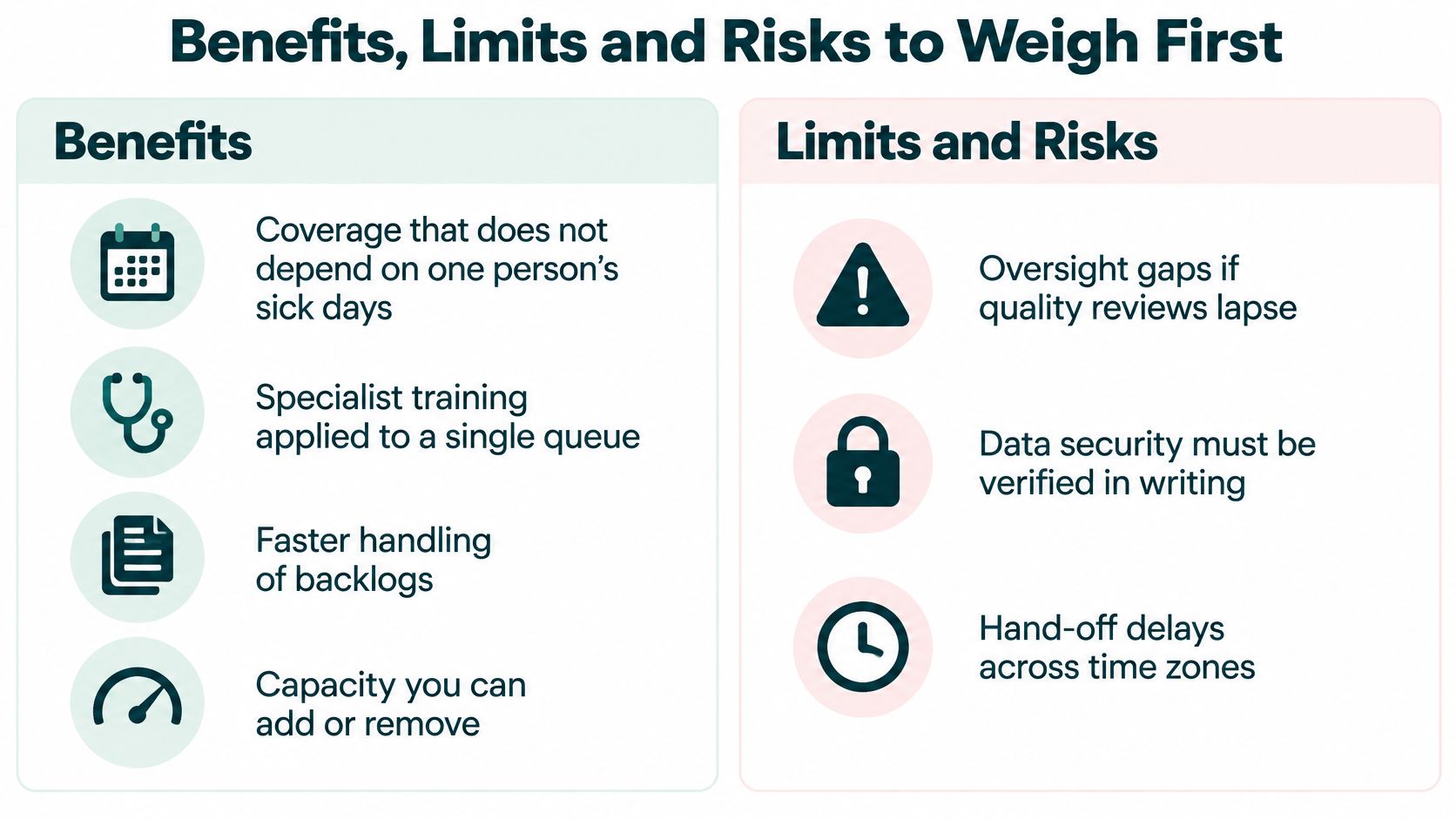
Can you describe the backlog precisely? Can someone complete the work without repeatedly asking a provider what to do? Can you measure completion without relying on the assistant's own activity count? If not, clarify the process before outsourcing it.
A well-designed arrangement can provide coverage beyond an individual's sick days, apply specialist training to a focused queue, and give backlogs dedicated attention. Capacity can also change with workload, provided the contract explains how staffing changes, minimum commitments, and notice periods work.
Automation doesn't eliminate exception work
The MGMA discussion of the prior-authorization landscape highlights the staffing pressure surrounding authorization work. Operationally, an electronic submission still needs an owner when a payer requests missing documentation or a portal status doesn't explain the next action.
Outsourcing won't repair an unclear process. If local staff disagree about which appointment types require authorization, a remote team will either interrupt them constantly or apply inconsistent rules.
An inexpensive handoff isn't a saving if your manager has to reconstruct every case afterward.
When to pause
BPO is a poor fit when the proposed work involves clinical decisions, volume is too low to justify the fee, or the vendor can't obtain approved access to essential systems. Complex specialty billing may also require local expertise when documentation, coding, and procedural context can't be separated cleanly.
Watch for operational risks as well:
- Data exposure: Staff download records, use unapproved messaging, or retain patient information outside controlled systems.
- Continuity gaps: Work stops during an outage or absence because nobody else knows the queue.
- Knowledge loss: An assistant leaves with undocumented payer instructions and unresolved exceptions.
- Quality drift: Review becomes less rigorous after onboarding, while errors accumulate unnoticed.
The practical test is straightforward: outsourcing should remove a defined constraint without creating a larger exception queue for your existing team. If you can't identify the receiving owner for unresolved work, you're moving the bottleneck rather than resolving it.
How Prior Authorization and Billing Queues Run Under BPO
Prior authorization needs a queue with visible status, deadlines, and named owners. An inbox full of submitted forms isn't enough. Your scheduler should be able to tell whether a case is awaiting payer review, missing clinical information, or ready for the next scheduling action.
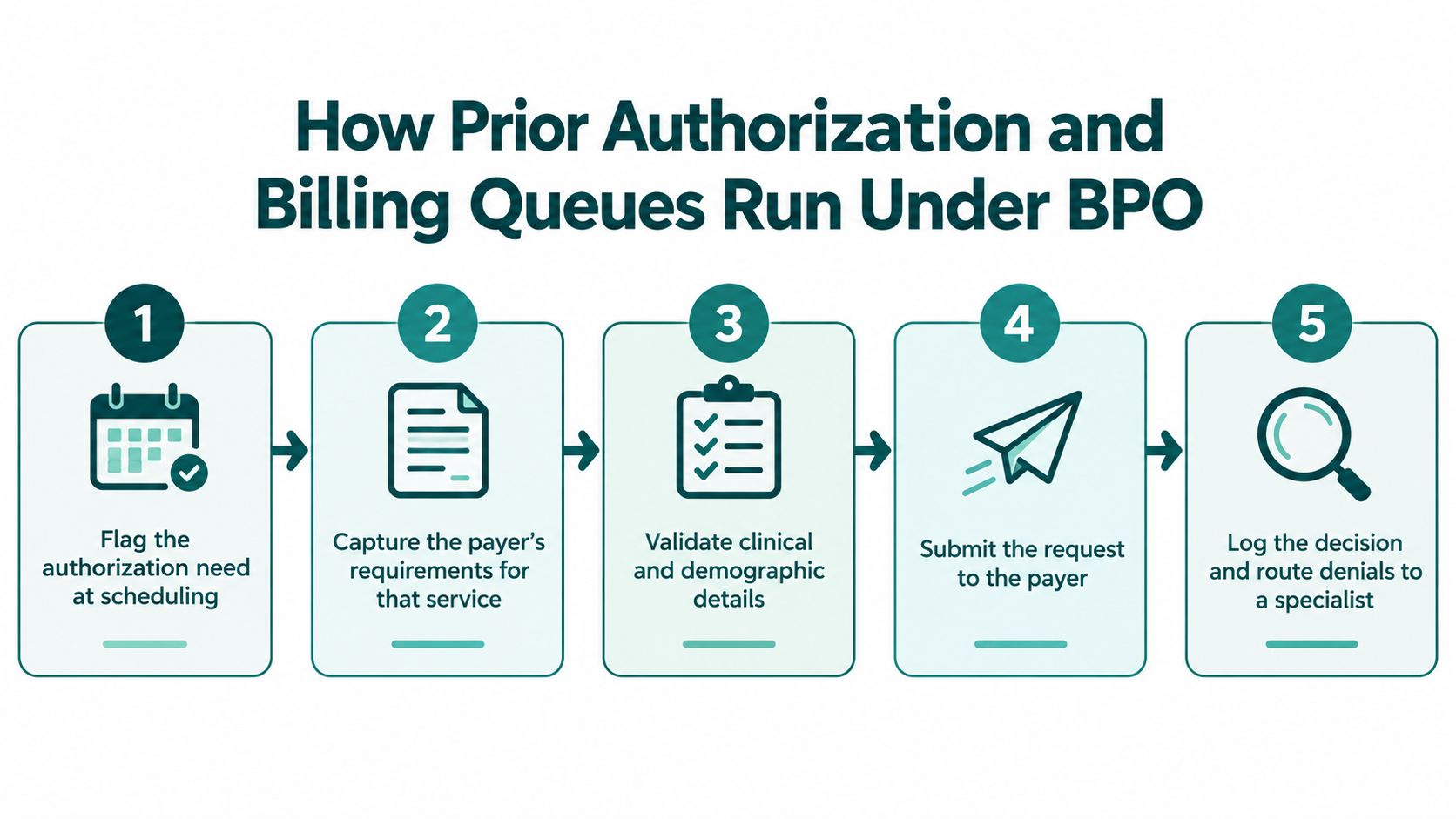
Build the authorization sequence
- Flag the need at scheduling. Identify potential authorization requirements early enough to avoid discovering them when the patient arrives.
- Capture the payer's requirements for the specific service. Use the current payer instructions rather than assuming the last similar case establishes the rule.
- Validate clinical and demographic fields before transmission. Match the patient, coverage, ordering provider, requested service, and supporting documentation.
- Submit through the approved portal, fax, or phone channel, then record the reference number and applicable deadline. This gives the next worker a traceable case.
- Check status daily. Document the result and next action, including unsuccessful contact attempts, so a pending case doesn't become an unattended case.
- Escalate approaching deadlines and denials to the designated owner. Include the payer's stated issue and the appointment impact, not just a request to review.
- Route peer-to-peer requests and clinical appeal content to the clinician. Administrative staff can organize records and coordinate availability without supplying clinical judgment.
- Record the outcome in the EMR and notify the scheduler. Closure means the next person knows what to do, not merely that the payer responded.
Physicians in the AMA's 2024 prior-authorization survey reported an average of 43 requests per week, and 35% employed staff exclusively for prior-authorization work. That supports dedicated ownership, not an assumption that outsourcing guarantees approval.
Separate specialty requirements and measure outcomes
Imaging, specialty medications, and procedures need distinct checklists because their documentation and escalation paths differ. A specialty-drug request may await treatment-history documentation, while a procedure request may need clarification of the planned service.
Track clean-submission rate, median days to decision, first-pass approval rate, denial reasons, appeal turnaround, and authorization-related cancellations. These measures distinguish faster administrative execution from payer decisions the team can't control.
A written procedure can incorporate a plain-language explanation of how prior authorization works while keeping payer-specific instructions separately maintained.
Apply queue discipline to billing
Billing support should move approved charges into claims, separate rejected submissions from adjudicated denials, and assign follow-up by reason and age. A missing member identifier requires a different response from a denial involving clinical documentation.
For managers mapping those payment stages, the MyOfficeOps guide to healthcare payments provides broader revenue-cycle context. Require each unresolved account to carry a next action, owner, and follow-up date, rather than counting touches as progress.
What BPO Costs and How to Measure Return
No verified market rate is cited in this guide. Prices differ by local market, workload, coverage, and contract structure, so compare written proposals against your own operating baseline. Each billing model places financial risk somewhere different.
Pricing models for healthcare BPO and in-house staffing
| Model | How it is billed | Who carries the main risk | What to check before signing |
|---|---|---|---|
| In-house hire, full time | Salary, payroll taxes, benefits, software seats, recruiting and training | Practice carries turnover, idle hours, and retraining | Include replacement and training time |
| Single remote assistant, placement model | Monthly fee per assistant | Practice carries unused capacity and uncovered work unless the contract provides coverage | Included hours, absence coverage, overtime, and extras |
| Per-unit BPO, such as per claim or per call | Price per transaction or unit | Practice carries volume growth and chargeable rework | Volume bands, minimums, and rework policy |
| Full revenue-cycle outsourcing | Percentage of collections or fixed fee | Allocated between practice and vendor by contract | Ownership of denials, write-offs, payer disputes, and collections after termination |
A monthly fee makes the invoice predictable, but not necessarily the cost per completed task. Per-unit pricing follows workload more closely, yet can reward activity rather than resolution unless the unit is defined carefully. Collections-based pricing also needs a precise definition of which receipts qualify and how refunds or reversals are treated.
Calculate retained work, not just replaced wages
Build the comparison from the loaded cost of the current workflow: compensation, payroll costs, benefits, software access, recruitment, and training. Allocate shared costs reasonably rather than charging the whole office overhead to a single task.
Then calculate the proposed state: vendor fees, retained internal work, management oversight, system access, and transition effort. Subtract only costs you'll actually avoid.
Cost check: Reassigning an employee's time creates capacity. It doesn't create a cash saving unless spending falls.
For an illustrative practice moving eligibility checks outside the office, record how much verification work remains with local staff. If they still investigate every benefit exception and correct the vendor's entries, those hours belong in the proposed-state calculation.
Measure revenue-cycle results
In its medical and dental analysis, the 2023 CAQH Index identified eligibility and benefit verification as 51% of total annual transaction spend, claim submission as 23%, and claim-status inquiry as 15%. Those are useful priorities for investigation, not a forecast of your practice's savings.
Evaluate medical billing support against pre-visit verification completion, front-end edit pass rate, encounter-to-submission time, claim-status aging, denial rate by payer and code family, and dollars recovered through follow-up. Keep definitions consistent before and during the pilot, and account for changes in visit volume or payer mix.
Compliance and Security Controls to Require
Separate HIPAA obligations from the additional controls you choose to require contractually. Where a vendor acts as a business associate by creating, receiving, maintaining, or transmitting protected health information on your behalf, establish the appropriate business associate agreement before sharing that information.
Minimum necessary is a Privacy Rule standard, with applicable exceptions, rather than a Security Rule standard. Security Rule duties include unique user identification, audit controls, and security awareness and training; business associates also have direct regulatory obligations, not merely promises passed through a contract.
HIPAA duties and recommended controls for a BPO assistant
| Control | Requirement or recommended practice | What to ask the vendor |
|---|---|---|
| Business associate agreement | Required for an applicable business-associate relationship | Executed BAA before PHI access |
| Minimum-necessary standard | Privacy Rule requirement for applicable uses, disclosures, and requests | Permissions mapped to the job scope |
| Unique user IDs | Required Security Rule implementation specification | Named accounts, no shared logins |
| Audit controls | Required Security Rule standard | Demonstration of activity recording and log review |
| Workforce HIPAA training | Required applicable privacy training and security awareness and training; annual refreshers are a recommended schedule | Dated training records and role-specific instruction |
| Breach notification | Required business-associate notification duties; contract can require faster incident reporting | Written notice process and escalation contacts |
| Multi-factor authentication | Require contractually as a protective control; confirm current regulatory and system-specific obligations | Demonstration for supported EMR, email, and phone accounts |
| Access revocation | Termination procedures are part of Security Rule workforce security; same-day revocation is a recommended contractual commitment | Written offboarding process and accountable owner |
| Claimed HIPAA certification | HHS does not recognize an official HIPAA certification | Policies, training evidence, and control demonstrations instead |
Verify access rather than accepting assurances
The American Hospital Association's cybersecurity review on third-party risk highlights vendor risk as an operational concern. A signed agreement doesn't show whether an assistant can export records, save call recordings locally, or access unrelated charts.
Ask the vendor to demonstrate a restricted account on a screen-share using test information. Check who approves access, who reviews logs, which devices are permitted, and how downloads, printing, recordings, and local storage are controlled.

Include tools and downtime in the review
Offshore or nearshore location alone doesn't establish security. Evaluate identity controls, EMR permissions, logging, supervision, and enforceable contractual commitments, while confirming any location restrictions imposed by your own agreements.
The same scrutiny applies to software introduced by the vendor. Yellow.ai's discussion of BAA requirements for healthcare chatbots is relevant when patient messages pass through an additional tool; don't assume your staffing agreement covers every downstream service.
When evaluating a HIPAA-aligned virtual assistant arrangement, require a downtime procedure that identifies backup communications and rules against uncontrolled workarounds. Confirm the legal details with qualified counsel or your compliance adviser, including state requirements and the services performed in practice.
Choosing a Vendor and Confirming Scope Before You Sign
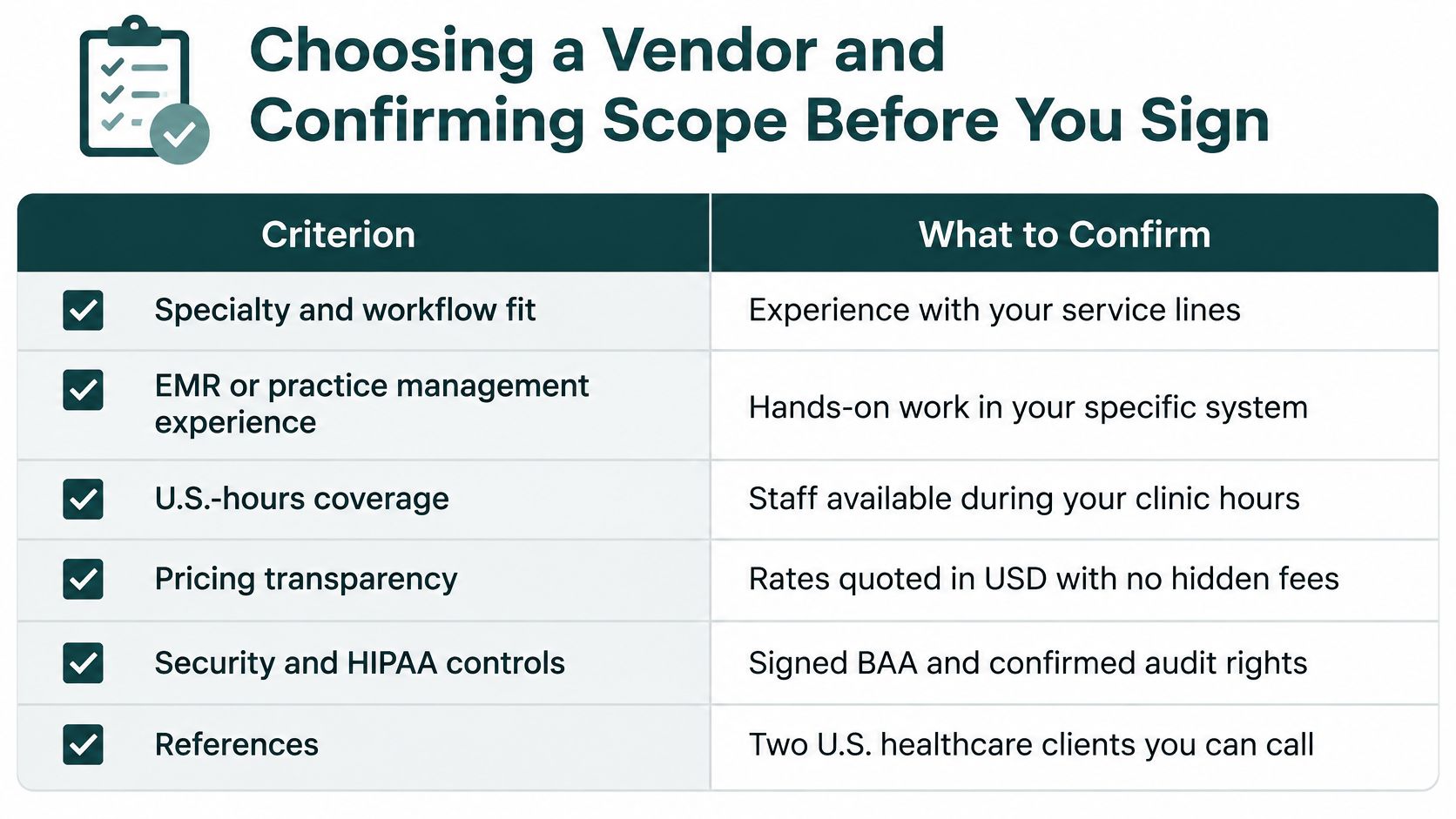
Compare proposals using evidence of how the vendor will perform your work. A polished interview establishes communication ability, but it doesn't establish payer-workflow knowledge, supervision, or backup coverage.
Vendor selection scorecard
| Criterion | What good looks like | Red flag |
|---|---|---|
| Specialty and workflow fit | Relevant specialty and billing-workflow experience | A generic promise to handle everything |
| EMR and practice management experience | Demonstrated workflow in your system or a close equivalent | Refusal to demonstrate with test information |
| U.S.-hours coverage | Named coverage aligned to clinic hours | An unspecified rotation or pool |
| Pricing transparency | Written fees, inclusions, and extra charges | Add-ons disclosed after commitment |
| Service levels | Measured response and completion standards | Anecdotes instead of reporting |
| Continuity | Identified backup and documented coverage | All knowledge held by an individual |
| Exit terms | Notice terms, transition records, and handover duties | Lock-in without transition support |
| Pilot option | Scoped trial with agreed measures | Long commitment before testing |
Ask candidates to work through a synthetic scheduling conflict, incomplete eligibility result, or payer follow-up case. They should explain what they'd document and when they'd stop and escalate, not merely demonstrate fast navigation.
For a broader procurement perspective, AnyBPO's framework to compare BPO vendors beyond price can supplement the practice-specific scorecard. Your signed scope should still identify the responsible supervisor, included queues, exclusions, reporting, and escalation contacts.
Run a pilot that can answer a decision
- Choose a small set of measurable workflows. Select work with visible demand and a clear completion point, rather than miscellaneous office help.
- Write a short procedure for each queue, including required fields, exceptions, escalation contacts, and the definition of done. Have the receiving team use it to process sample cases before launch.
- Grant only approved access. Test permissions and communication routes before introducing live work.
- Establish a baseline across a representative operating period. Include unresolved work and correction effort, not just completed transactions.
- Review the pilot regularly. Inspect samples, discuss exceptions, and record whether failures came from training, unclear instructions, system limits, or vendor execution.
- Expand, adjust, or exit against the agreed measures. Don't let a pleasant working relationship substitute for evidence that the queue improved.
Confirm who manages the worker
A placement provider and a managed BPO vendor may both supply capable people, but the practice's supervisory workload can differ substantially. Ask who coaches the assistant, updates procedures, investigates errors, and arranges coverage during leave.
Bilingual English-Spanish ability can matter for patient communication, but test both languages against realistic administrative conversations. Prior U.S. practice experience is useful only when the candidate can apply it to your appointment rules, payer processes, and documentation expectations.
Finally, make transition records part of ordinary work. A current queue, maintained procedures, and accessible case notes should let another authorized person continue without rebuilding the operation from email.
The Takeaway
BPO services for healthcare work best when you transfer a defined workflow, not an undefined staffing problem. The outside team needs clear completion standards, reliable escalation routes, and a scope that keeps clinical judgment with the appropriate professionals.
Find the queue causing the most disruption, establish its baseline, and compare the full cost of outside support with the work your practice will retain. Verify access and continuity controls, then use a measured pilot to decide whether the arrangement deserves a larger scope. A vendor should make ownership clearer, not add another person for your manager to chase.
MedicalVirtual offers pre-vetted Latin American healthcare assistants, including bilingual English-Spanish professionals who work agreed U.S. clinic hours, as an option for practices evaluating remote administrative staffing. If calls, prior authorization, or claim follow-up are your bottleneck, visit MedicalVirtual to discuss a scoped role and candidate shortlist, then apply the scorecard above to the proposal.