
A provider finishes a full clinic day with twelve open charts, including a new-patient visit whose history still needs to be organized. A medical scribe note example can help, but only if it shows more than polished wording. It needs to fit the visit type, make clear what the scribe may document, and show how the provider reviews and authenticates the record.
The six examples below cover new-patient primary care, chronic disease follow-up, acute visits, minor procedures, behavioral health, and telehealth. Each pairs a practical note structure with the workflow behind it, details a scribe must not guess, and risks such as stale copied-forward findings or unclear attribution. Each also addresses redaction when a note is shared outside the electronic health record for billing, referrals, or audits. A sample clinical report can help orient teams to report structure, but a scribe's draft still needs to reflect the actual encounter and the practice's review process.
A scribe's job is to record what the patient reports and what the provider says or does, not to supply clinical judgment. That distinction matters whether a person is typing in real time or preparing a draft for later review. The examples are starting points, not ready-made policy: practices should adapt the fields, access controls, attestation steps, and sharing rules to their own workflows.
1. New Patient Comprehensive Visit Note for Primary Care and Internal Medicine
A new-patient note establishes the baseline that clinicians may rely on in later encounters. Its structure usually includes the reason for the visit, history of present illness, relevant medical and surgical history, family and social history, medications and allergies, review of systems, examination findings, and the provider's assessment and plan. A scribe can organize this information in the practice's template while the provider interviews and examines the patient, but must not fill gaps with assumptions.
For example, a primary care practice might use a remote scribe for new-patient visits on select clinic afternoons. The provider reviews each draft shortly after the visit and corrects medication entries before signing. That workflow keeps the clinician in control of the clinical record while giving the scribe a defined documentation role.

Fields, limits, and review
The scribe should distinguish patient-reported history from provider-observed findings. If the clinician hasn't stated an examination finding, it doesn't belong in the examination section merely because the template offers a familiar normal phrase. The same principle applies to diagnoses, codes, and medical decision-making: the scribe records the provider's documented conclusions rather than creating them.
Useful safeguards include a short required-field checklist, a rule against entering unstated findings, and a defined provider review step. The provider should verbalize examination findings clearly enough for accurate capture, then verify that the note reflects the visit before signing. Practices should also confirm payer-specific attestation expectations with a qualified compliance professional.
Practical rule: A complete-looking template isn't evidence that the provider performed every documented examination element.
Before sharing the note for a referral, billing review, or audit, use the practice's approved disclosure process. Remove information that isn't needed for the recipient's purpose, while preserving the clinical context required for continuity or review. Keep the original record intact in the EMR, and follow the practice's policies for authorized access and disclosure.
2. Chronic Disease Follow-Up Note for Diabetes, Hypertension, and COPD
For chronic disease follow-up, the note should make the change since the last visit easy to find. A practical structure includes interval history, patient-reported home readings, medication reconciliation, relevant laboratory review, current examination findings, assessment, and follow-up actions. The assessment and plan should make clear what the patient reported, what the provider decided, and which orders or monitoring steps follow.
A family medicine group managing a diabetes panel might ask its scribe to flag an older A1c result for the provider to review. The scribe can bring forward a prior value as historical context, but shouldn't present it as current or decide whether new testing is needed. That decision belongs to the clinician.
Keep current information separate from copied history
Templates can make recurring documentation more consistent, but copy-forward creates a specific risk: a past medication list, reading, or examination finding may look current even when no one has verified it. A practice should define what must be reviewed at every visit and how the note shows that the provider confirmed it. The scribe shouldn't silently reuse a value just because it appears in the prior chart.
For example, the provider might confirm a patient's reported home blood-pressure readings and medication use during the visit, then decide whether to adjust therapy or order laboratory work. The note should preserve that sequence rather than turning the scribe's chart review into a clinical decision.
- Mark historical values clearly: Keep prior results identifiable as prior results, and route uncertain or outdated entries to the provider.
- Make medication changes explicit: Record the provider's stated change and ensure the plan matches the medication information entered.
- Review for stale text: Have the clinical team inspect recurring notes for copied findings that don't reflect the current encounter.
Practices comparing staffing roles can use this guide to understand the difference between a medical assistant and a medical scribe. The distinction matters in chronic care: a scribe documents the encounter, while clinical staff and providers retain their assigned responsibilities for patient care and decisions.
When a note is shared outside the EMR, redact unrelated history and identifiers according to the purpose and the practice's policies. Don't strip out a medication change or prior value that's necessary to understand the care being reviewed. The goal is a limited, purposeful copy, not an altered source record.
3. Acute Same-Day Sick Visit Note for Urgent and Walk-In Care
Acute visits move quickly, so a concise note must still show the complaint, relevant timeline, pertinent positives and negatives, provider-stated examination findings, assessment, and plan. When testing, treatment, or escalation is considered, the record should make clear what the provider decided and what follow-up or disposition was documented.
In a walk-in clinic, a patient might report chest pressure during an evening visit. The scribe should alert the provider according to the practice's escalation protocol, then document the provider's assessment and actions as directed. The scribe must not infer a diagnosis, downgrade a symptom, or create a treatment decision to make the note seem complete.
Capture the provider's reasoning without slowing the visit
The main trade-off is speed versus clarity. Short standard phrases can help with common visit structures, but they can't replace the details that explain why the provider ordered a test, chose a treatment, or referred the patient for further evaluation. If a red flag symptom is mentioned, the scribe should follow the clinic's written process for notifying the clinician in real time rather than waiting to finish the note.
A useful urgent-care workflow gives the scribe clear escalation instructions, a dependable route for contacting the provider, and a backup plan for connection or EMR outages. Practices evaluating a dedicated emergency-room scribe workflow should distinguish fast documentation from clinical triage. The scribe records and routes information; the clinician evaluates and acts.
A brief note can be complete. It can't be vague about the provider's decision or the next step.
For sharing, remove unrelated personal history and avoid sending the full chart when a focused encounter record will meet the referral or review purpose. Preserve the original note and use the organization's approved method to prepare any external copy. If the note describes an escalation, don't redact the details needed to understand what happened and why.
4. Minor Procedure Note for Joint Injection, Skin Excision, and Laceration Repair
Procedure notes need more than a diagnosis and a brief description. Depending on the procedure and the practice's requirements, the record may need to capture the indication, consent process, anatomical site and laterality, technique, materials, complications, and aftercare instructions. A scribe can enter details as the provider states them, but shouldn't infer a dose, technique, specimen disposition, or consent.
An orthopedic practice performing knee injections might have the provider state the side, medication details, and procedural steps aloud while the scribe documents. The provider reviews the entry before leaving the room. That arrangement can work well when the provider uses a consistent sequence and pauses to confirm details that are easy to confuse.
Make the sequence auditable
Laterality, medication information, lesion measurements, closure details, and specimen handling are examples of fields that deserve explicit provider confirmation when relevant. If the provider doesn't state a detail, the scribe should leave it unresolved and ask for clarification through the approved workflow. A template should match the procedures the practice performs, not invite the scribe to fill every field by guesswork.
- Use a procedure-specific template: Align required fields with the practice's coding and documentation guidance.
- Have the provider state critical details: Confirm site, laterality, medication, and specimen information as applicable.
- Review against the performed procedure: Make sure the final note reflects what happened, including any complications or aftercare.
Before sharing a procedure note for billing review, referral, or audit, redact unrelated patient information and follow the practice's disclosure rules. Don't remove details needed to understand the service documented, and don't revise the EMR source note as a substitute for preparing an appropriate external copy. The provider remains responsible for reviewing and authenticating the final record.
5. Behavioral Health Progress Note for Therapy and Psychiatry Sessions
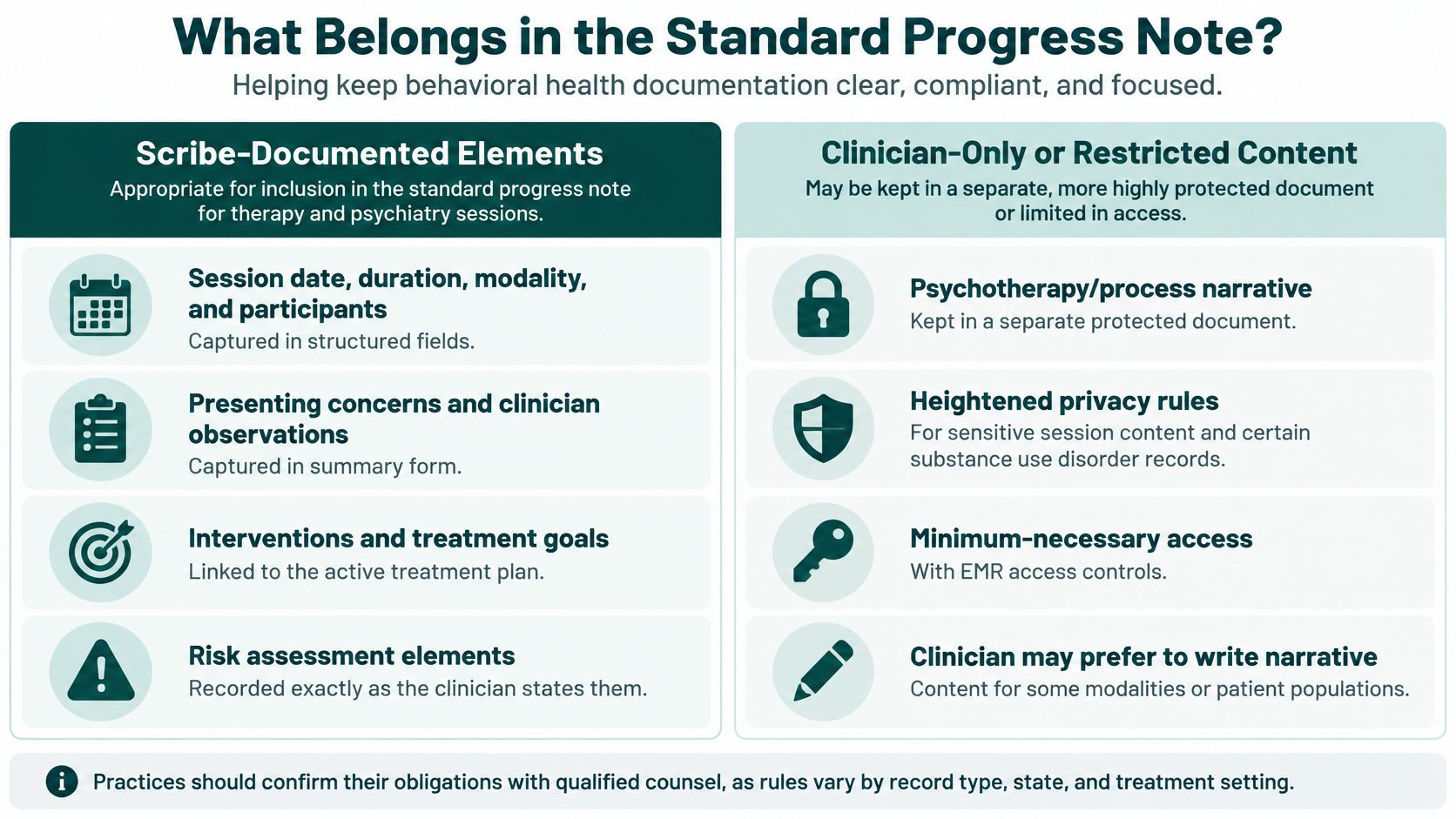
Behavioral health notes require careful choices about what the scribe can access and record. A routine progress note may include the session focus, clinician observations, interventions, the patient's response, relevant risk-assessment findings, and the treatment plan. It shouldn't automatically contain every detail discussed in a session.
A group therapy practice might allow a scribe to prepare an administrative and clinical summary while clinicians write their own session narrative in a separate, restricted document. That division can help a practice limit access to especially sensitive material, but it must match the record types and rules that apply to the setting.
Separate the progress note from clinician-only content
Psychotherapy notes have additional protections under HIPAA, and state requirements or federal rules for certain substance-use-disorder records may impose other restrictions. Which rules apply depends on the record and the care setting, so practices should confirm the workflow with qualified counsel or compliance professionals. A scribe should receive only the access needed for the assigned task, and the EMR should reflect the practice's approved permissions.
The note should distinguish what the patient reported from what the clinician observed or assessed. The scribe must not create a risk assessment, infer a diagnosis, or turn a clinician's brief statement into a more detailed interpretation. The clinician reviews the draft and authenticates the documentation.
Access should follow the note type: Don't assume that permission to document a progress note means permission to view every sensitive record in the chart.
When a behavioral health note leaves the EMR, apply the practice's rules for authorization, minimum necessary access, and redaction. A billing or referral copy may require different content from an audit copy. Preserve required clinical meaning, but don't include separate clinician-only material just because it is available in the same system.
6. Telehealth Visit Note for Video and Audio-Only Encounters
A telehealth note should make the encounter's modality and limitations clear. Depending on the practice's current requirements, relevant documentation may include the patient's and provider's locations, whether the visit used video or audio, consent, technical problems, and what the provider could or couldn't observe. A scribe should document these details as the provider confirms them, not assume them from a calendar entry or platform setting.
A multi-site primary care group might use separate EMR workflows for video and audio-only visits. If a video connection fails and the provider completes the encounter by phone, the scribe should record the modality change and any limitation the provider identifies. The note should reflect the visit that actually occurred.
Handle location, consent, and technical interruptions
Telehealth requirements can change across payers and jurisdictions. Practices should verify current billing, licensure, and practice-location obligations before relying on a template. The scribe should route any missing location or consent detail to the provider, rather than filling it from a previous visit or making an assumption based on the patient's usual address.
For a remote medical scribe workflow, establish how the scribe joins the visit, what information they can access, and how interruptions are handled. The provider remains responsible for the clinical record and final review. A note can save time while still requiring careful verification.
- Record the actual modality: Keep a video visit distinct from an audio-only encounter when the workflow requires it.
- Document limitations: Capture technical failures and examination limits in the encounter record when the provider identifies them.
- Refresh the template: Review it when payer or state requirements change, rather than treating an old configuration as permanent.
For copies shared with a referral partner or reviewer, redact information not needed for that purpose and use the practice's approved disclosure process. Keep the original note intact, and don't remove modality or limitation details that are relevant to understanding the service.
Comparison of 6 Medical Scribe Note Examples
| Note Type | Implementation Complexity | Resource Requirements | Expected Outcome | Ideal Use Case | Key Advantage |
|---|---|---|---|---|---|
| New Patient Comprehensive Visit | High; extensive history and structured fields | Detailed intake checklist, EMR template, provider review | Complete baseline chart and same-day note | New patients in primary care or internal medicine | Reduces repeated history-taking at later visits |
| Chronic Disease Follow-Up | Moderate; recurring workflows with update checks | Condition-specific templates, current readings and labs, quality audits | Clear record of changes, care gaps, and follow-up | Diabetes, hypertension, or COPD management | Supports consistent longitudinal documentation |
| Acute Same-Day Sick Visit | Moderate; fast-paced and time-sensitive | Concise templates, reliable real-time communication and connectivity | Timely note with treatment, escalation, and return precautions | Urgent care, walk-in, and same-day appointments | Helps reduce delays and end-of-day chart backlog |
| Minor Procedure Note | High; precise, procedure-specific details | Procedure templates, verbal confirmation of site, dose, materials, and technique | Detailed record of procedure and aftercare | Joint injections, skin excisions, and laceration repairs | Improves accuracy of real-time procedure documentation |
| Behavioral Health Progress Note | High; sensitive content and access restrictions | Minimum-necessary EMR access, privacy controls, clinician-defined note boundaries | Consistent summary while keeping restricted content protected | Therapy and psychiatry sessions where scribe access is appropriate | Reduces documentation burden while supporting treatment tracking |
| Telehealth Visit Note | Moderate to high; requirements vary by modality and payer | Updated telehealth templates, location and consent checks, reliable connectivity | Clear record of modality, limitations, and technical issues | Video and audio-only encounters | Supports billing review and captures visit-specific limitations |
Turning These Examples Into Your Practice's Documentation Standards
These six medical scribe note examples are starting points, not finished policy. Each practice should convert the relevant example into a specialty-specific standard that names required fields, identifies actions a scribe must never take, and explains how the provider reviews and authenticates the draft. That standard should also tell staff how to handle uncertainty, corrections, and incomplete notes.
Set a regular quality review that checks whether notes reflect the encounter, whether copied-forward details were verified, and whether assessment and plan entries match. Define a separate redaction rule set for notes shared outside the EMR for billing, referrals, or audits. The person preparing an external copy should know what information the recipient needs and which internal process authorizes disclosure.
Before implementation, confirm payer attestation expectations and state-level restrictions with qualified counsel or compliance professionals. CMS guidance describes provider authentication responsibilities for scribed documentation, but practices should verify requirements applicable to their setting and payers rather than rely on a generic template. A scribe's documentation role doesn't transfer clinical responsibility from the treating provider.
If you're scoping a remote role, test the workflow against these examples before assigning access. Review how candidates capture patient-reported information, separate it from clinician findings, flag ambiguity, and route drafts for timely provider review. MedicalVirtual offers remote medical scribe support for real-time documentation and draft notes prepared for provider review and signature. Use the examples to define the work first, then choose a staffing approach that fits your practice.
MedicalVirtual connects U.S. medical practices with experienced remote healthcare staff, including medical scribes who support real-time documentation and EMR note workflows under provider supervision. If you're defining a scribe role around these examples, visit MedicalVirtual to discuss staffing that fits your clinic's workflow.