

Just 42.2% of U.S. physicians worked in physician-owned private practices in 2024, according to the American Medical Association's Physician Practice Benchmark Survey. To define private practice accurately, start with ownership: in the United States, it generally means a medical practice wholly owned by physicians, rather than by a hospital, health system, insurer, private-equity firm, or government entity.
That definition clears up several common misunderstandings. A small neighborhood clinic isn't necessarily private practice, and a physician-owned group doesn't stop being private because it hires employees or contracts with an outside billing company. The building, office size, and location of administrative staff don't settle the ownership question.
For owners and practice managers evaluating remote healthcare staff, the practical issue goes beyond the label. You need to know who approves workflows, who controls patient-information access, who signs contracts, and who answers when a task isn't completed correctly.
Private ownership can give physicians meaningful authority over those decisions. It also requires someone to manage the business behind the care. Understanding the organizational model, employment arrangements, privacy obligations, and staffing trade-offs helps you decide whether ownership fits your plans and where outside support belongs.
Ownership Is What Makes a Practice Private
In the United States, a private medical practice is wholly owned by one or more physicians. The AMA's private-practice guidance treats private practice principally as an ownership and governance category, not as a description of office size or staffing arrangements.
A physician-owned organization can operate as a solo office or a group, employ physicians, and engage contractors. Conversely, an outpatient clinic can look independent while belonging to a hospital or corporate owner. Independence from a particular hospital isn't enough to establish physician ownership.
Where private practice sits among other models
Ownership includes several distinct arrangements. The table puts them alongside direct hospital employment, which is an employment category rather than ownership of a separate practice.
Physician ownership and employment shares, 2024
| Ownership or employment type | Share of physicians, 2024 | Share of physicians, 2012 |
|---|---|---|
| Physician-owned private practice | 42.2% | 60.1% |
| Hospital-owned practice | 34.5% | 23.4% |
| Directly employed by or contracted with a hospital | 12.0% | 5.6% |
| Private-equity-owned practice | 6.5% | Not reported in the cited summary |
The figures come from the AMA benchmark survey linked above; its cited summary does not provide a corresponding private-equity figure for the earlier year.
These distinctions affect who can authorize hiring, select scheduling software, negotiate payer arrangements, or invest in another location. Physician owners may delegate those activities to a manager, but delegation doesn't transfer the ownership stake.
Say a physician group contracts with an outside billing vendor. The vendor submits claims and follows up on denials under an agreed scope; the physicians retain ownership and authority over the engagement. Buying administrative services isn't the same transaction as selling equity.
Ownership test: Identify who holds the ownership stake first. Then identify who has authority to sign payer contracts and approve major operating decisions.
Applying the test beyond physician practices
Dentists, psychologists, and therapists also use the term private practice. However, state rules governing professional ownership and entity structure differ by profession, so don't assume the physician model applies unchanged.
Veterinary ownership has its own financing considerations. Veterinary Practice Loans' guide to avoiding costly vet practice financing pitfalls is a profession-specific resource for readers assessing that separate ownership path, not a substitute for medical-practice legal advice.
Before committing to a purchase or partnership, ask qualified advisers to review both the ownership documents and the actual decision-making rights. A job title alone won't tell you who controls the business.
Solo, Group and Multispecialty Practice Models
Private ownership doesn't prescribe a single operating structure. A solo office, a single-specialty partnership, and a multispecialty organization can each be physician-owned, but they need different administrative systems.
The AMA's practice-characteristics report reports that approximately 78% of private-practice physicians worked in solo or single-specialty settings, compared with 31.3% in hospital-owned practices; about 21% worked in multispecialty practices, compared with 44.3%, respectively. Those figures describe physicians' workplaces, not the percentage of organizations in each category.
How the structures change daily work
| Model | Organizational structure | Administrative pressure point |
|---|---|---|
| Solo practice | A physician owns the business and makes most major decisions personally | Backup coverage when the owner or a key employee is unavailable |
| Single-specialty group | Physicians in the same specialty share overhead, staff, and operating rules | Consistent scheduling, message routing, and provider preferences |
| Multispecialty group | Different specialties operate under shared ownership | Referral handoffs, specialty-specific requirements, and cross-location coordination |
In a solo internal medicine office, a receptionist's absence may leave the physician answering billing questions between visits. A remote receptionist could cover calls, but someone onsite still needs to manage arrivals, physical paperwork, and tasks requiring direct patient contact. The useful staffing question is which work can move, not whether the entire front desk can disappear.
A single-specialty group needs more standardization. If each dermatologist uses different appointment lengths or accepts different visit types, the scheduler needs an approved provider matrix rather than informal instructions. Shared staff can otherwise book technically available appointments that don't fit the clinician's schedule.
Scale changes the management job
A multispecialty organization needs reliable handoffs between departments. A referral coordinator might confirm that records arrived and route the request, while licensed staff determine clinical urgency and suitability. Shared ownership doesn't eliminate differences between specialty workflows.
Some physician-owned groups grow large enough to need centralized administration resembling a health system's. Dental owners face a related coordination problem across scheduling, treatment-plan communication, and collections; this guide to dentistry practice management addresses that profession's operating context.
Ask how much provider activity your current administrative team can support before calls, referrals, or billing follow-up stop receiving consistent attention.
Measure the work by queue and handoff. Provider headcount alone won't reveal whether your bottleneck is appointment demand, incomplete records, or unresolved claims.
Private Practice Versus Employed and Hospital-Based Roles
Separate two questions: Who owns the practice? Who employs the physician? A physician can be an employee of a physician-owned private practice, so employment doesn't automatically mean hospital ownership.
Likewise, a physician owner may receive compensation through the practice while also holding equity. The employment agreement describes the working relationship; ownership documents describe the stake and associated governance rights.
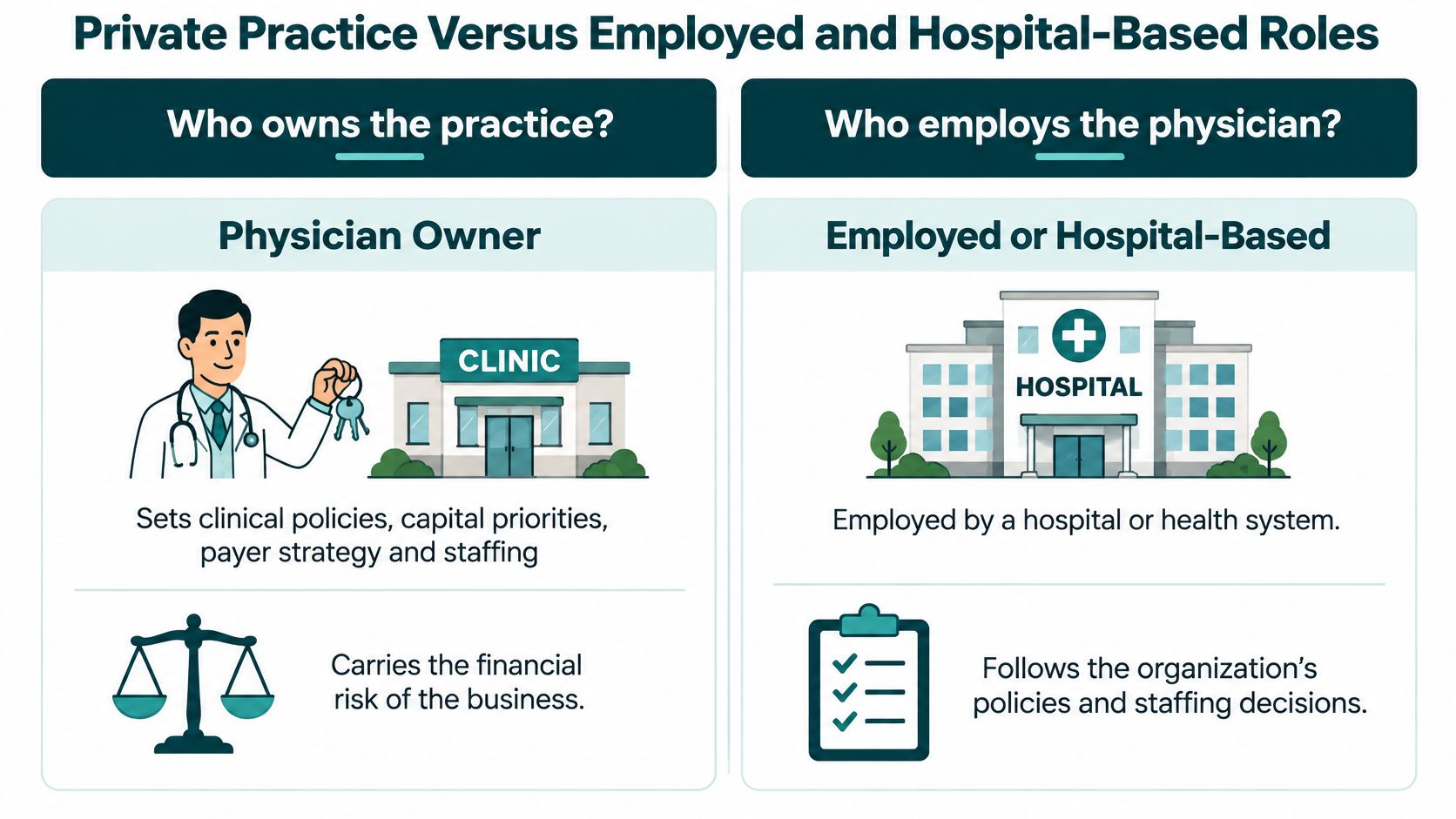
Owner and employed roles compared
The comparison below contrasts a physician-owner position with employment by a hospital, health system, or other outside organization. An employed role within a physician-owned practice is a separate possibility.
| Decision or obligation | Physician-owned private practice | Employed or hospital-based role |
|---|---|---|
| Who holds the ownership stake | Physicians | Hospital, health system, or other entity |
| Clinical policies and protocols | Owners establish organizational policies, within professional and legal requirements | Employer policies apply, alongside professional obligations |
| Staffing and technology selection | Owners decide or delegate authority | Employer decides, often through central systems |
| Payer contracts | Owners authorize negotiation and signing | Employer or system contracts |
| Compensation | Owner income is tied to practice performance | Usually salary and benefits, sometimes with variable compensation |
| Compliance and cybersecurity | Owners oversee the practice's responsibilities | Employer's program handles organizational functions; individual duties remain |
Say a neurologist joins a health-system clinic while another buys into a physician group. They may treat similar patients, but the owner participates in decisions about scheduling software and payer strategy through the group's governance process. The employed neurologist may offer input without having final authority.
Ownership doesn't necessarily give an individual partner unilateral control. Partnership agreements may reserve major purchases or contracting decisions for a vote, and joint ventures can divide authority in ways that aren't obvious from the clinic's name.
Why physician practice is a different term
For certain physician-organization and self-referral-law purposes, CMS's physician self-referral guidance describes a physician practice as a practice comprising two or more physicians organized to provide patient care, regardless of legal form or ownership. Under that regulatory definition, physician ownership isn't determinative.
An LLC, professional corporation, or nonphysician-owned entity may therefore qualify as a physician practice without being physician-owned private practice. The terms answer different questions.
Don't use either label as a compliance shortcut. Have qualified counsel assess applicable Stark Law considerations, state corporate-practice-of-medicine restrictions, professional-entity requirements, and payer enrollment obligations against the actual arrangement.
What Stays in Your Control When You Use Outside Staff
Staffing location and ownership are separate questions. A virtual receptionist, scribe, billing specialist, or authorization coordinator can support your practice without acquiring an ownership interest. The operational boundary to manage is access to patient information and authority to act.
Under the HHS HIPAA Privacy Rule guidance, an outside organization performing covered functions involving protected health information may be a business associate, requiring an appropriate written agreement and safeguards. Where that relationship applies, the agreement should address permitted uses, safeguards, breach reporting, subcontractors, and return or destruction of information.

Establish access before assigning work
Use a documented setup process rather than sending a new assistant a shared login.
- Map the information involved. Identify what the role can encounter in calls, scheduling notes, claims, records, and patient messages.
- Limit permissions to the job. A scheduler shouldn't automatically receive the same access as a billing manager.
- Complete the applicable agreement before access begins. At MedicalVirtual, we sign a Business Associate Agreement with each client practice.
- Train for your workflow. Explain identity verification, message routing, approved communication channels, and privacy-incident escalation.
- Review and remove access. Set a recurring review schedule and revoke accounts promptly when the assignment ends.
Your practice controls access to its EHR, practice management software, phone systems, and other tools. Our assistants operate within the access and patient-facing workflows your practice approves.
Separate legal duties from implementation choices
HIPAA's applicable agreement and safeguard obligations are legal requirements. Unique accounts, role-based permissions, multifactor authentication where available, audit logs, approved devices, and private workspaces are practical security controls to evaluate within your risk-management process, not a universal checklist that by itself establishes compliance.
When evaluating healthcare business-process outsourcing, name the practice manager who will review exceptions and supervise the handoff. A signed agreement doesn't configure software or teach someone how your clinicians want messages escalated.
PracticeReady's tips for running an accounting practice offer a cross-professional management reference for organizing delegated work. Keep that general management perspective separate from healthcare privacy obligations, which need healthcare-specific review.
A vendor agreement supports accountability. It doesn't replace your own access decisions, configuration, training, or supervision.
Confirm state-specific obligations and the status of each working relationship with qualified counsel or a compliance professional.
Pros, Cons and Real-World Fit in Private Practice
Private ownership isn't automatically more flexible, more profitable, or less bureaucratic. It gives owners authority to make business choices, but they still need enough time, money, and management capacity to carry those choices through.
The AMA's analysis of changing practice arrangements reports that 35.4% of physicians were practice owners in 2024, while 57.5% were employees and 7.1% were independent contractors. These describe individual working arrangements, which is why the owner share differs from the share working in physician-owned organizations.
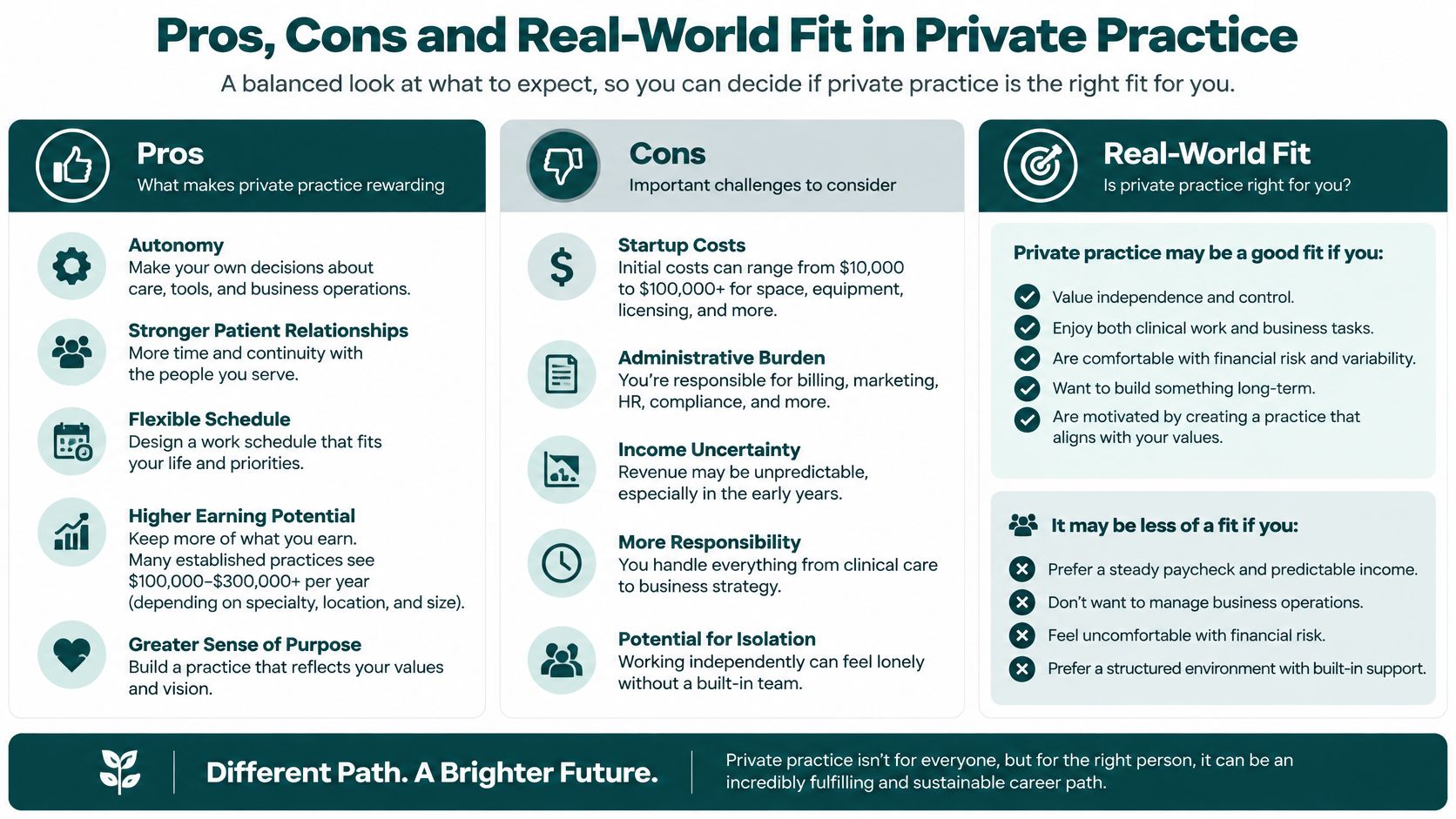
What owners gain and take on
Potential advantages
- Operating authority. Owners can shape scheduling, technology selection, and organizational protocols within applicable requirements.
- Direct accountability. Patients and employees have a clearer route to the people who can change practice operations.
- Equity participation. Owners have a financial stake and a voice in the practice's direction.
- Staffing and payer choices. The practice can evaluate relationships against its own service model and financial goals.
Corresponding costs
- Capital exposure. Owners must plan for equipment, leases, payroll, and interruptions in collections.
- Variable income. Practice performance affects what owners can take home.
- Management responsibility. Revenue cycle, compliance, cybersecurity, and personnel issues need designated oversight.
- Limited backup. A lean team can leave owners absorbing unresolved work after clinic hours.
Illustrative practice scenarios
The following are hypothetical operating examples, not customer results.
A solo internal medicine practice. The physician owns the business, an onsite medical assistant handles rooming, and a receptionist manages arrivals and calls. As authorization requests accumulate, the physician begins spending evenings checking their status.
A remote coordinator could prepare administrative submissions, track payer responses, and flag missing documentation. The physician still determines medical necessity and supplies clinical reasoning; onsite staff still perform hands-on work. The manager should measure outstanding requests and unresolved exceptions before deciding whether authorization support or call coverage is the first priority.
A member-owned therapy group. A hypothetical group of three psychologists sets its own scheduling and cancellation policies and shares an onsite administrator. The owners are considering a remote billing role because claim follow-up interrupts patient intake.
The remote worker could check claim status, organize payer correspondence, and route documentation requests through approved systems. Licensed psychologists retain diagnosis, treatment planning, and clinical documentation responsibility. Before hiring, the owners should settle who approves corrections and handles sensitive patient billing disputes; medical billing support for small practices should be scoped around that division of work.
A multisite orthopedic and physical therapy group. Assume the ownership arrangement is permitted under applicable professional-entity rules. Onsite staff handle examinations, therapy, rooming, and equipment, while a remote coordinator manages referral records and denial follow-up across locations.
This role needs site-specific scheduling instructions and a named escalation contact. It shouldn't determine treatment, alter clinical documentation independently, or interpret symptoms. If each location follows different instructions, standardizing the handoff may be more urgent than adding another worker.
Test the management burden, not just payroll
Outsourcing creates a supervision job even when it reduces task volume for onsite employees. The linked discussion of outsourcing HR without a senior HR leader offers a useful parallel when considering who will direct an external function.
A growing group's coordination costs can outweigh some autonomy gains. Test the arrangement against your specialty, payer mix, local hiring conditions, available management time, and actual workload. A remote hire won't fix contradictory instructions or an approval queue that no owner reviews.
Confirm Whether Private Practice Fits Your Plans
Before choosing an ownership structure or expanding your staffing model, answer these questions with your advisers.
- Are you prepared to be an owner? Consider the financial and governance responsibilities attached to compliance, payer arrangements, and cybersecurity oversight.
- Can you fund the operating plan? Account for leases, equipment, startup expenses, and working capital while collections develop.
- Does the revenue model work at realistic utilization? Test patient volume and payer mix against fixed costs rather than assuming every appointment slot will fill.
- Who will manage administration? Name the responsible person and budget for office management, outside billing, or remote coordination.
- What is the exit plan? Address buy-in and buy-out terms, continuity of operations, and patient-record responsibilities.
Turn the answers into a responsibility map
High capital needs, heavy administrative demands, and limited decision authority may make employment or a carefully structured hybrid arrangement more suitable. Clear governance, workable finances, and a realistic management plan strengthen the case for ownership, but don't remove its risks.
This week, write a one-page responsibility map naming who approves owner decisions, signs payer contracts, grants system access, and answers privacy questions. Share it with your advisers before speaking with staffing vendors; individual legal, tax, and compliance questions need qualified, state-specific advice.
At MedicalVirtual, we can provide a sample BAA for review before access to patient information is arranged. Use that review to clarify responsibilities, not merely collect a signature.
The Takeaway
To define private practice, start with who owns the organization, not its size, location, or use of outside help. Then distinguish ownership rights from employment terms and identify who has authority to make each business decision.
For staffing decisions, turn that understanding into a clear division of work. Assign administrative tasks, preserve licensed clinical responsibilities, and document access and escalation rules before anyone begins handling patient information.
MedicalVirtual connects U.S. practices with pre-vetted remote healthcare administrative talent from Latin America who work within the practice's approved systems and agreed hours. Visit MedicalVirtual to discuss your responsibility map, scope an appropriate role, and request a sample BAA before arranging patient-information access.