

A medical records coordinator keeps each patient file complete, accurate, findable, and confidential so clinicians, billing, and compliance can rely on it. The work sits in a large national occupation, with a mean hourly wage of $27.30 in May 2025.
Your front desk scans a thick referral packet at 10:15. The task is marked done, the PDF sits in the chart, and the physician still cannot find the last A1C before the visit. A record can be received and still fail the patient in front of you.
That gap shows up when a patient asks for a copy, an insurer requests a date range, or a specialist never got the packet your team assumed was sent. The coordinator owns the space between arrival and readiness: log the request, match the patient, chase the missing page, index the result where the clinician will look first.
The line is firm. The coordinator routes ambiguity, confirms identity, and stops when disclosure, consent, or clinical meaning needs a compliance lead or licensed clinician.
What a Medical Records Coordinator Does Every Day
The day usually starts with a queue: two release requests, a referral packet that arrived as 40 loose pages, and a chart flagged because a lab result is filed under the wrong encounter. A medical records coordinator turns that incoming material into a chart the team can use. The work links documentation, care delivery, and claims, and it stops at diagnosis, treatment, and any disclosure decision that needs compliance.
Most of that work now happens inside electronic systems. The Office of the National Coordinator for Health IT reports certified-EHR use among office-based physicians reached 91% in 2024. The 2009 HITECH Act accelerated adoption. When every document can be copied, routed, and indexed in seconds, a wrong patient match or missing date range can travel just as fast.
| Core duty | What it involves | Why it matters |
|---|---|---|
| Compile and maintain patient files | Gather documents into the chart and index them by patient and encounter | The chart is the single source clinicians rely on |
| Verify completeness and accuracy | Check demographics, insurance data, signatures, and missing results | Gaps stall care, claims, and referrals |
| Assign classification codes | Apply clinical classification codes to documents and encounters | Codes support billing, reporting, and retrieval |
| Protect confidentiality | Limit access to the minimum necessary and log every retrieval | Privacy rules apply to every copy and disclosure |
| Retrieve records for authorized requesters | Respond to clinician, insurer, patient, and third-party requests | Delays affect treatment and legal deadlines |
The boundary is clear. A coordinator can check completeness, confirm whether a requester is authorized, organize incoming pages, and flag a chart that is not usable. A licensed clinician decides care; a compliance or privacy lead decides hard disclosure questions; hands-on clinical tasks stay with in-house clinical staff. Remote administrative help can carry indexing, tracking, and follow-up inside approved access, but it does not replace that judgment.
A quick need test
Count three things before you add headcount: monthly request volume, how many EHRs and scanned archives you still search, and how many people touch one chart. High counts with no named owner mean the work is already happening in fragments. Practices comparing whether to hire or outsource records support should apply the same test before choosing where the queue sits. A packet can be in the portal and still be unusable if pages are partial, misindexed, or tied to the wrong dates.
How Records Requests Move From Intake to Delivery
Treat every request as a tracked case with an owner, not as an email someone might see. The path below is the one that holds up when a patient, a lawyer, or a payer asks what happened.
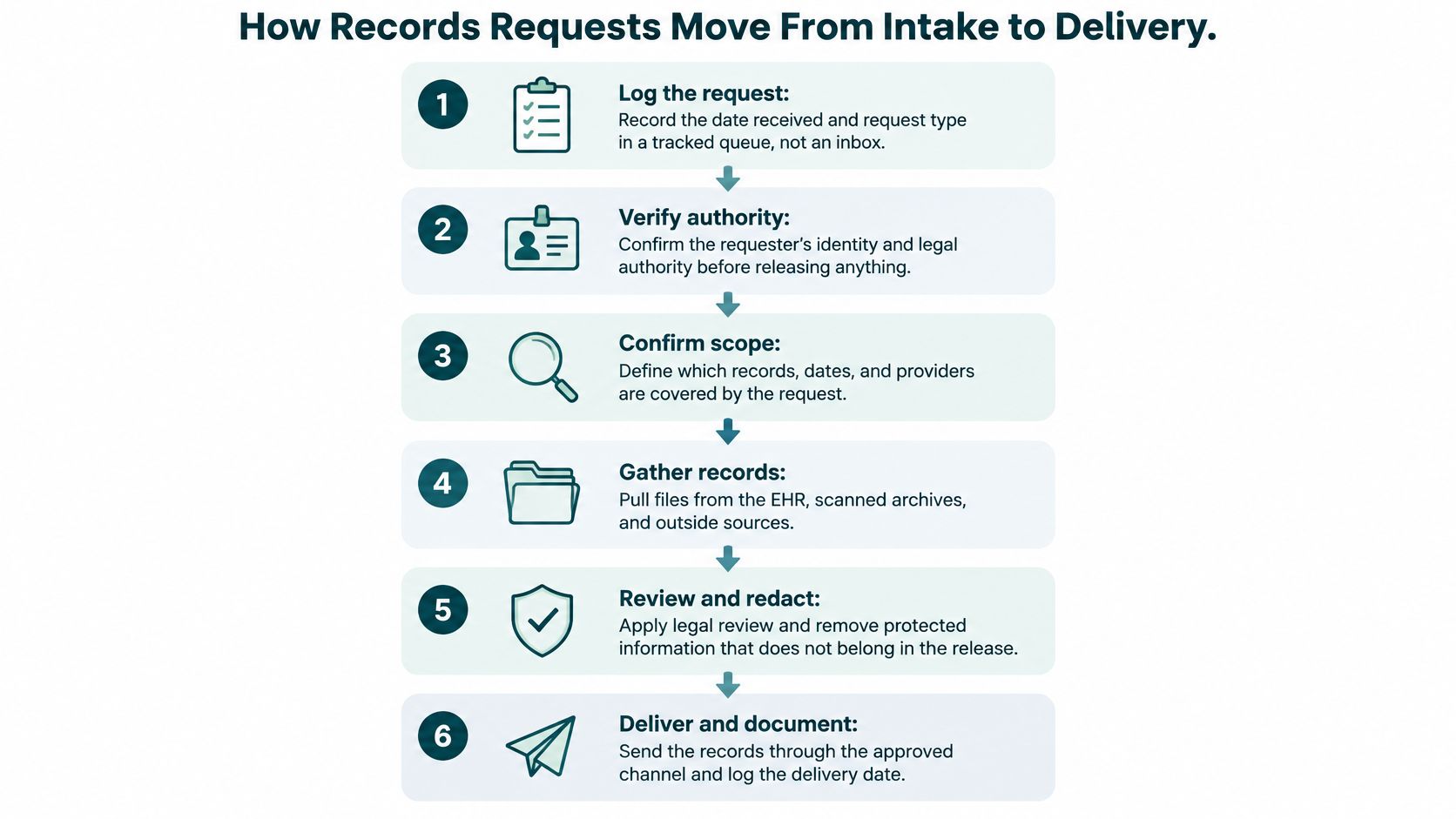
- Log the request. Record the date received and the request type in a queue, not a shared inbox. An unlogged email starts the clock with nobody watching it.
- Verify authority. Confirm identity and whether a personal representative or third party holds a valid authorization. Releasing on a familiar name is how the wrong person gets a chart.
- Confirm scope. Write down which dates, providers, and document types the request covers. A vague "send the records" pull is how you over-disclose or miss the one note they needed.
- Gather records. Pull from the approved EMR, scanned archives, and outside sources, and note where each set lives. Skipping an old archive is a common reason a "complete" packet is not complete.
- Review fees, redaction, and the deadline. Under HIPAA, a covered entity generally must act on a patient's access request within 30 calendar days. One extra 30-day extension is allowed only if a written explanation and the expected completion date go out inside the original 30 days, and patient-copy fees are limited to reasonable, cost-based labor, supplies, and postage, with no separate retrieval fee, per HHS guidance on the right of access. Electronic copies can't be priced on an old per-page habit. State law can set a shorter clock or a lower fee, so use a state matrix. Quoting a page-count fee, or letting day 31 pass in silence, is the usual slip.
- Deliver and document. Send through a secure channel and record what went, when, and to whom. A portal upload with no log is not a close-out.
A workable queue shows a received date, a named owner, and a documented close for every row. Teams that add business workflow automation still need that human owner. Software can stamp dates. It can't decide that a guardian form is valid.
Practical rule: Speed is not compliance. A fast release with no identity check is a worse outcome than a tracked request that finishes inside the deadline.
New-patient onboarding, forms, records requests, and reminder calls that cut no-shows can sit with an intake coordinator, with odd questions escalated to the right person. For the patient-facing side of a copy request, walk staff through how patients request medical records so your internal clock and the patient's instructions match.
Access Rules, Retention and Disclosure Logs
A coordinator executes a written authorization policy. That person does not independently decide what to withhold or release. Ambiguous cases go to the privacy officer or compliance lead, with the reason written down.
Patient access is not a third-party disclosure
Patient access, a personal representative, and a third-party release are different decisions. Confirm representative status before anything leaves the practice. Behavioral-health and substance-use records can carry extra federal and state limits, including rules such as 42 CFR Part 2. Don't guess. Confirm the category with counsel before you apply a routine medical-records template.
Information exchange is better than it was, and it still breaks. In 2025, 71% of health information organizations reported at least one potential information-blocking instance, 19% of hospitals reported possible information blocking, and artificial technical, process, or resource barriers showed up in 14% of those hospital cases, according to the Assistant Secretary for Technology Policy. A delay that is only "we're busy" can look like obstruction. Your log should show acknowledgment, identity verification, status, the exception reason, and an audit trail.
Retention and the six-year accounting
For practices subject to CMS medical-record rules, records must be maintained for seven years from the date of service, per CMS medical record maintenance guidance. That period is not universal. State statutes, payer contracts, malpractice rules, minors' records, and some federal programs can require longer. Set the governing rule by location and record type. Index by patient, encounter date, document type, and destruction-eligibility date. Put a legal hold on anything in an audit, appeal, complaint, or open episode of care, and lock down who can delete.
Patients can also request an accounting of certain disclosures. HHS explains that the maximum period is the six years before the request, subject to HIPAA exclusions, in the HHS privacy summary. Keep the date, recipient, description, purpose, and the exception or authorization you relied on. Don't rebuild that history from memory or an outbound fax list. Routine treatment, payment, and operations disclosures are not the same bucket as disclosures that belong on an accounting. A remote staffer can search and draft. Final release still needs role-based access, an audit trail, and supervisory review.
Charts stay in the practice's approved EMR and storage. A personal laptop or a consumer cloud folder is a privacy incident waiting for a staff change.
Work organized only inside your systems, with no local PHI store on the staffing side, still needs your access rules. A written retention schedule is easier to defend than a shared drive nobody wants to purge. For a plain-language starting point, compare your schedule with HIPAA-ready record retention guidance, then confirm it against your state and payers. Broader duties are covered in regulatory compliance for healthcare practices.
Keeping Referrals and Incoming Records Usable for Care
A file that landed in the inbox is not a file a clinician can use. Referrals still arrive as faxed PDFs, messy exports, duplicate packets, or charts from several EHRs. Technical limits were extremely difficult or challenging for 68% of healthcare professionals in one cited survey, and 55% pointed to regulatory complexity and delays, as described in Tieto's interoperability review. Automation can sort and route. It does not reliably match identity, drop duplicates, chase a missing result, honor a consent restriction, or know what a specialty needs.
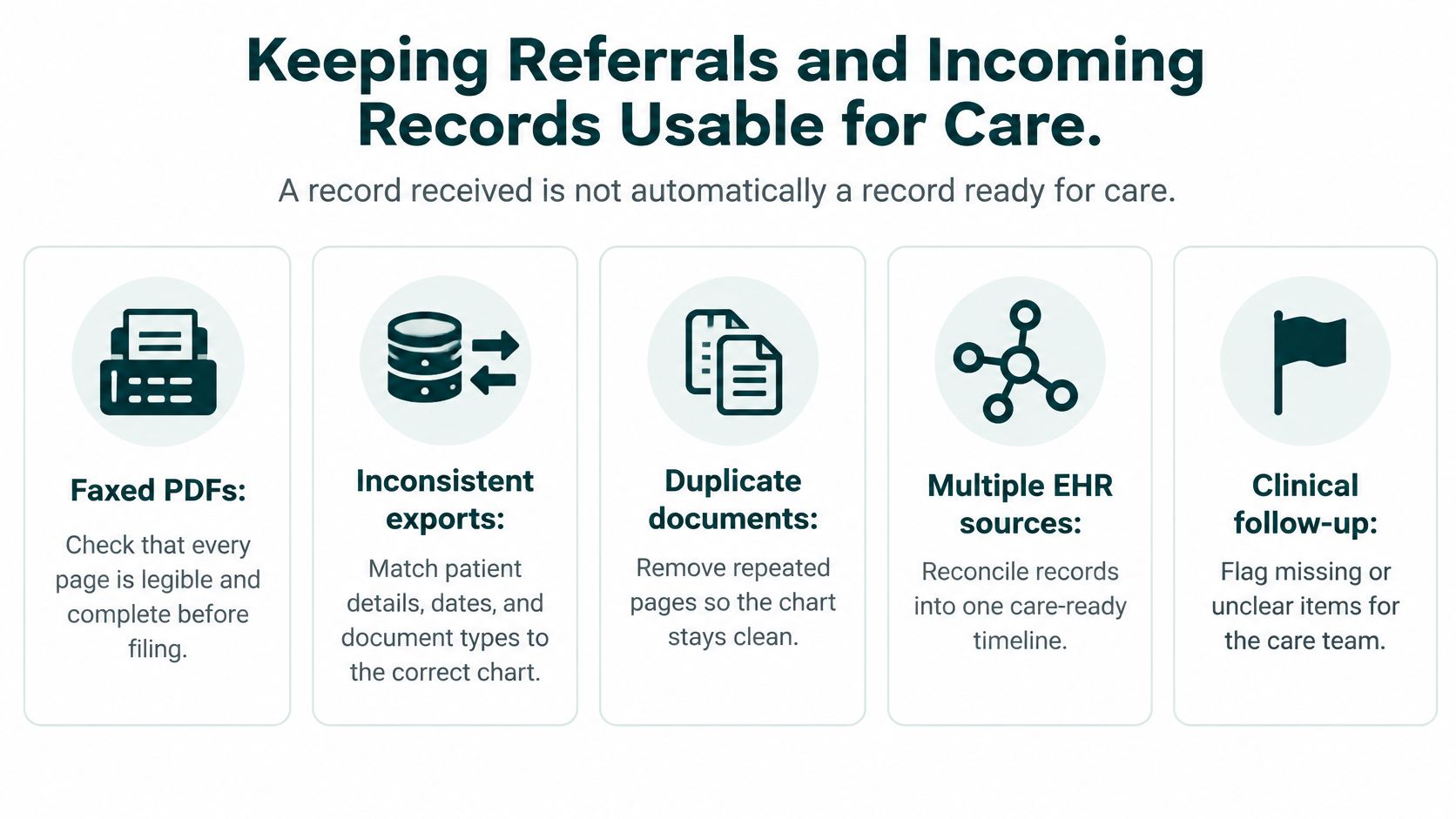
Use this quality check before anyone marks the referral done:
- Verify the source. Confirm the sender and that the packet matches the referral you expected. A wrong-clinic fax filed under the right name still pollutes the chart.
- Match the patient on two identifiers. Name plus date of birth, or another pair your policy names. A near-match is an exception, not a file.
- Check completeness against the order. Look for the result, the date, and the pages the referring clinician asked for. "Records received" with the key lab missing is the failure this step exists to catch.
- Index to standard document types. Use the same labels every time so the next person can retrieve the note without opening twenty PDFs.
- Queue the mismatches and set a pass-forward deadline. Missing pages, illegible faxes, and unclear consent go to an exception list with a date to reach the ordering clinician.
For outgoing referrals, log the date sent, receipt confirmation, and whether the appointment happened. A referral that vanishes after the fax is one of the most common breaks, especially when the other office still lives on paper.
The coordinator routes and flags. Licensed clinicians interpret results and choose treatment. Remote administrative staff do not replace licensed clinicians or hands-on medical assistants. Clinical decisions stay with appropriately licensed professionals. Administrative staff handle documentation support only.
How Practice Settings Change the Coordinator Role
The same title does not mean the same Tuesday. Volume, sensitivity, and how many systems you run should set the first priority.
| Practice setting | Main records pressure | Coordinator priority |
|---|---|---|
| Primary care and internal medicine | High volume of lab results, referrals, and outside records | Result routing and referral loop closure |
| Mental health and therapy clinics | Sensitive behavioral-health information and consent rules | Access restriction and consent verification |
| Dental and orthodontic practices | Imaging, treatment records, and insurance identifiers | Identity and insurance matching |
| Multi-site groups | Several EHRs, duplicate charts, and location-specific retention rules | Cross-system reconciliation and a shared retention schedule |
| Solo practices | One person covers records, reception, and billing | Backup coverage and a written request procedure |
Primary care lives or dies on loop closure. A normal CBC that never reaches the ordering clinician is an operations failure, not a scanning success. In a solo or group therapy practice, the risky moment is access. A routine ROI template can release notes that need a narrower consent. Dental and ortho charts fail when images and payer IDs don't match the patient on the claim, so matching beats volume.
Multi-site groups inherit duplicate charts and retention rules that differ by state. One shared destruction date, applied everywhere, will be wrong somewhere. Solo practices rarely need a full-time specialist. They need a written request procedure and a backup, because the same person is also on the phone and in the billing queue.
Veterinary clinics and optometry practices follow their own record rules. Don't copy a physician-office workflow onto those charts until someone checks the applicable requirements. Size and specialty decide full-time, part-time, or shared coverage. A high-volume internal medicine group with three archives is a different hire from a two-provider therapy practice with tight consent rules.
Pay, Demand and Hiring Benchmarks in Numbers
Use separate Bureau of Labor Statistics snapshots. Don't average them into one wage.
| Measure | Value | Period |
|---|---|---|
| Employment, medical records specialists | About 185,690 jobs | May 2023 |
| Mean annual wage | $53,690 ($25.81 per hour) | May 2023 |
| Employment, medical records specialists | 200,700 jobs | 2025 |
| Mean hourly wage | $27.30 | May 2025 |
The Bureau of Labor Statistics occupational profile reported that May 2025 mean hourly wage of $27.30. The May 2023 mean, $53,690 a year or $25.81 an hour, is an earlier snapshot for about 185,690 jobs. Treat each mean as a budget starting point. Then adjust for region, experience, release-of-information volume, and whether coding sits in the job.
What to test before you hire
Usual entry is postsecondary training, often a certificate. Employer and state rules still differ, so don't treat a certificate as a license to release records.
Score candidates on medical terminology, accurate data entry, indexing by patient, encounter, and document type, the 30-calendar-day access clock plus one written extension, cost-based copy fees, and minimum-necessary handling of protected health information. If a résumé lists a privacy course, verify it with the issuer. HHS does not recognize an official HIPAA certification. A course certificate is training evidence, not a compliance seal.
Retirements and job changes, not only brand-new positions, keep vacancies open. Budget for coverage when your one records person is out. A wage at the national mean with no backup is how the 30-day clock gets missed in July.
In-House or Remote Records Support
Pick in-house, remote, or a mix from the work, not from a staffing trend.

- Count monthly access requests and how often the 30-day clock is already tight.
- Count EHRs, scanned archives, and outside sources someone must search.
- Note how often behavioral-health, substance-use, or minor records appear.
- Decide whether someone must handle paper, film, or walk-in pickup.
- Confirm a privacy officer or compliance lead can take escalations the same week.
Remote support fits steady intake, indexing, referral tracking, and drafting inside approved systems. An on-site coordinator fits paper-heavy archives and physical release. Any remote arrangement needs a business associate agreement before PHI access, workforce HIPAA training, a confidentiality agreement, role-based access, audit logs, and a ban on personal devices and ordinary email. The practice keeps the final release decision. Retrieval support is not authorization to disclose.
I would write the one-page role scope, the approved system list, and the escalation rule before the first interview. MedicalVirtual can sit beside an in-house hire or other staffing as pre-vetted LATAM administrative help for intake, retrieval, and referral tracking, not clinical decisions. HIPAA-trained assistants and a signed BAA come before PHI access. A dedicated verification specialist does not replace a separate release-of-information service, and records should not go through general website forms or ordinary email unless an approved secure channel was expressly provided. If you are comparing healthcare BPO services, put that limit in the written scope so nobody treats a retrieval queue as permission to disclose.
The Takeaway
A medical records coordinator makes the chart complete, findable, and lawfully shared. Requests sit on a real deadline, incoming referrals get reconciled until a clinician can use them, and retention plus disclosure logs can survive an audit. The person doing the work executes policy. A privacy or compliance lead decides the hard cases.
Specialty, practice size, and paper versus EHR workload decide full-time, part-time, or shared coverage. Remote help can carry intake and tracking. It does not replace a privacy officer, a licensed clinician, or an on-site person when the archive is still paper.
This week, draft the one-page scope, name the approved systems, assign a deadline owner, and write the escalation path. Interview against that page, not against a generic job ad.
MedicalVirtual places pre-vetted bilingual remote administrative staff who can support records intake, indexing, and referral tracking inside your approved systems and clinic hours. Clinical decisions and final releases stay with your practice. If you want to interview candidates before you hire, visit MedicalVirtual.