
Most medication prior authorizations don't finish within a day: in a large prescription analysis, only 35% were processed within one day, while multi-day prescriptions had a median processing time of 6 days. Payer decision deadlines range from 24 hours to 7 calendar days depending on the program and urgency, but those deadlines aren't the patient's total wait for medication.
That distinction matters when a patient calls your practice asking whether a prescription is ready. Prior authorization is a coverage review, not a dispensing appointment. Before the insurer reviews anything, someone must identify the correct benefit, gather supporting records, obtain the prescriber's clinical rationale, and transmit the request successfully. After approval, the pharmacy may still need to process the prescription.
For practice managers asking how long does prior authorization take for medication, the useful answer isn't one national average. It's a plan-specific estimate tied to the request's current stage, with a named staff member responsible for the next action.
A remote prior-authorization coordinator can help with preparation, tracking, and communication. That person can't shorten a regulatory deadline, dictate a payer's clinical decision, or replace the prescriber's judgment. The operational opportunity is more practical: stop requests from sitting unnoticed between the people who need to act.
How Long Medication Prior Authorization Takes Across Payers
Most medication prior authorizations take several days from prescription to access, even when the payer's review is relatively short. The applicable deadline depends on the benefit and request type, not the insurer's name.
CMS's prior-authorization FAQs distinguish Medicare Part D coverage determinations of 72 hours for standard requests and 24 hours for expedited requests, alongside a CMS-described 24-hour target for Medicaid and CHIP drug requests. Those aren't interchangeable with medical-item-and-service standards.
Payer decision deadlines for medication prior authorization
| Request type | Who sets the deadline | Decision deadline | Caveat |
|---|---|---|---|
| Medicare Part D coverage determination, standard | Part D plan operating under CMS requirements | 72 hours | Measured from the plan's receipt of the request |
| Medicare Part D coverage determination, expedited | Part D plan operating under CMS requirements | 24 hours | Used when the standard timeframe could seriously jeopardize health |
| Medicaid and CHIP drug prior authorization | State Medicaid or CHIP program | 24 hours after receipt | CMS-described target for drug requests; confirm state implementation |
| Medicare Advantage, Medicaid managed care and CHIP managed care, standard item or service | Health plan operating under applicable CMS requirements | 7 calendar days | Applies to covered items and services from January 1, 2026; may not match drug rules |
| Medicare Advantage, Medicaid managed care and CHIP managed care, expedited item or service | Health plan operating under applicable CMS requirements | 72 hours | Same item-and-service scope as the standard row |
| CMS 2026 proposed drug rule, expedited | Medicaid FFS, Medicaid managed care, CHIP, qualified health plan issuers | 24 hours | Proposed rule, not a current universal deadline |
| CMS 2026 proposed drug rule, standard | Same entities as the expedited row | 72 hours | Proposed rule, not a current universal deadline |
| Commercial employer or individual plan | Plan document and applicable state law | Confirm the plan's standard or urgent timeframe | No single federal figure applies across these plans |
The CMS metrics reporting guidance identifies January 1, 2026, as the start of the applicable 7-calendar-day standard and 72-hour expedited item-and-service deadlines. CMS distinguishes those requests from drug-specific requirements, so don't automatically apply a medical-service deadline to a pharmacy-benefit prescription.
Calendar-day deadlines include weekends and holidays. Record the actual receipt timestamp rather than assuming a Friday submission begins counting on Monday, and verify the applicable rule for incomplete requests. The payer's receipt of a sufficiently complete request is operationally different from the moment a prescriber orders medication.
Why an average doesn't predict an individual patient's wait
The frequently repeated three-day estimate isn't a service promise. An Arthritis Foundation survey of more than 3,000 patients found an average prior-authorization wait of three days, but 31% waited longer than a week, according to the American Medical Association's discussion of response times.
A real-world analysis of 205,896 prescription transactions found 35% processed within one day; the remaining 65% required multiple days, with a median of 6 days and an interquartile range of 3–12 days among multi-day prescriptions. That scope matters: the multi-day median isn't a universal median for every prescription, and processing time is more than just the insurer's review time.
Practical rule: Give patients a status and a next update, not an average disguised as a deadline.
Separate the intervals your team can measure
Submission time runs from identifying the authorization requirement to sending the supporting packet. Payer decision time covers the review interval. Dispensing time follows approval, while denial resolution introduces a separate path involving corrections, exceptions, or appeals.
Consider a hypothetical 12-provider internal medicine practice: an unsigned note delays submission four days, the payer reviews it for two days, and the pharmacy holds the fill for one more day. The patient waits seven days, although the payer's review takes only two. Adding follow-up calls to the insurer wouldn't fix the unsigned-note bottleneck.
Timestamp the prescription, authorization trigger, clean submission, acknowledgment, decision, pharmacy notification, and confirmed dispensing. Without those milestones, your team can't distinguish payer delay from work waiting inside the practice.
How Commercial Plans and Patient Waits Change the Timeline
Two patients can submit the same medication request under the same insurer logo and wait different lengths of time. Commercial coverage splits across employer and individual plans, fully insured and self-funded arrangements, and each product can carry its own review clock and its own definition of urgent. The member's plan document, summary of benefits, and published authorization procedures set the deadline; a general customer-service estimate does not. State insurance law may govern some fully insured plans while self-funded employer plans answer to the plan document, so when a deadline matters, confirm applicability with the state insurance department or qualified counsel.
A verification routine staff can actually use
Four questions, answered before the request goes out:
- Identify the coverage. Record the plan, product, and whether the medication falls under the pharmacy or medical benefit.
- Find both review timeframes. Capture the stated standard and urgent processes, since an expedited review typically needs the prescriber to certify that waiting would risk the patient's health.
- Confirm completeness. Ask whether the payer has everything needed for review and record the reference number.
- Document receipt. Save the date, time, representative or portal acknowledgment, and next follow-up action.
Keep commercial workflows separate from your Medicare prior-authorization procedures. A familiar payer logo isn't enough to identify the governing process.
Give patients a commitment you control
A family medicine front desk that promises every patient a three-day answer is borrowing a national average no plan document guaranteed. Members whose plans allow longer standard windows will call when that promise expires, and the call lands on staff who have no way to speed the review. The review clock belongs to the plan. The callback date belongs to you, so anchor the conversation to the verified plan timeframe instead.
Staff can say:
We've submitted your request and are confirming that the plan has the supporting records. We'll contact you on the agreed follow-up date, even if the insurer hasn't decided. Please tell us promptly if you're running out of medication so we can notify your prescriber.
Distinguish an insurance update from a clinical follow-up. A patient waiting on a newly covered antidepressant may have questions about when to follow up with your psychiatrist once the medication is in hand; that question belongs to the prescriber and has no bearing on how fast the plan reviews the request.
Administrative staff shouldn't suggest alternative medications or advise patients to stop, stretch, or change a prescription. Route those questions to the prescriber, especially when a patient describes a gap in therapy.
What Slows a Request and How to Build a Complete First Submission
A request takes longer when the next person can't act on what they've received. Missing dates, an unsupported clinical answer, or an unacknowledged fax can turn an otherwise straightforward submission into repeated exchanges.
For staff learning the distinction between an order and a coverage decision, payer approval explained by Happy Billing provides useful background. Your practice still needs a drug-specific checklist, because understanding authorization conceptually doesn't tell a coordinator which records this payer requires.
The causes behind preventable waiting
The health plan and program determine the route. The wrong benefit, form, or receiving department can leave a complete-looking request outside the correct review queue. Staff should verify requirements against the patient's current coverage rather than reuse last year's packet automatically.
Medication restrictions determine the evidence. A formulary medication without restrictions may not require authorization at all. Step therapy, quantity limits, and specialty-drug criteria can require treatment history, dosing justification, or other clinical records.
Completeness determines whether review can proceed. A diagnosis code alone may not establish that the patient meets the payer's criteria. Missing information can trigger another records request or a corrected submission; don't assume every information request legally restarts the clock, because the applicable process must be checked.
The submission channel determines visibility. A supported electronic prior-authorization workflow or payer portal can provide acknowledgment and a status trail. Fax may still be necessary, but a successful transmission report isn't proof that the correct review team accepted the request.
Urgency requires clinical support. An expedited label isn't a workaround for an aging queue. The prescriber must support the urgency under the applicable plan criteria.
The CMS proposed drug rule describes proposed deadlines of 24 hours for expedited requests and 72 hours for standard requests for specified Medicaid, CHIP, and federally facilitated exchange entities. These are proposed requirements, not universal current drug deadlines, so practices should verify the applicable rule rather than promise patients the proposal's timing.
Build the packet before sending it
Consider a hypothetical dermatology request for a biologic faxed on Friday without prior-therapy dates. The payer asks for those dates the following Wednesday. Repeated status calls won't supply the missing evidence; someone must locate it, confirm its accuracy, and connect it to the original request.
Use a first-submission checklist that includes:
- Coverage and identifiers: Current plan ID, patient demographics, and the correct receiving payer or benefit administrator.
- Diagnosis: Relevant diagnosis codes supported by the clinical record.
- Prescription details: Drug, strength, quantity, and intended treatment duration.
- Prior therapies: Dated treatment trials, outcomes, intolerance, or contraindications documented by the clinician.
- Clinical rationale: A signed chart note supporting why the requested treatment is appropriate.
- Submission requirements: The current payer form and required attachments.
Don't fill gaps by guessing. If the patient remembers a prior medication but the record doesn't establish dates or outcome, route the discrepancy to the clinician for appropriate documentation.
Assign tasks without transferring clinical judgment
A coordinator can assemble and track the dermatology packet. The prescriber must supply the clinical explanation, and the manager must resolve recurring access or staffing problems.
Who owns each prior authorization task, excluding appeals
| Task | Prescriber or clinician | PA coordinator | Practice manager |
|---|---|---|---|
| Clinical rationale and attestation | Writes and signs | Requests and attaches notes | Reviews exceptions |
| Complete and submit request | Confirms medical necessity | Submits and records reference number | Tracks queue metrics |
| Respond to payer information request | Provides clinical answer when needed | Routes and tracks response | Sets follow-up standards |
| Peer-to-peer review | Leads discussion | Schedules and prepares summary | Escalates recurring payer issues |
This split prevents an administrative worker from interpreting clinical criteria independently. It also prevents clinicians from becoming the default owners of fax tracking, receipt confirmation, and routine patient callbacks.
Decide whether dedicated support fits the workload
A dedicated specialist makes sense when requests repeatedly wait because existing staff must interrupt the work to answer phones, room patients, or handle billing. Evaluate candidates on payer-portal navigation, documentation accuracy, escalation judgment, and their ability to explain a status without promising approval. A remote pre-authorization specialist role should have defined deliverables, not a vague instruction to handle insurance.
MedicalVirtual places remote prior-authorization specialists under an agreed role scope and a signed business associate agreement. Other workable options include an in-house coordinator or protected authorization time for an existing employee; low request volume, a narrow payer mix, or a prescriber who wants direct ownership may favor keeping the work in-house.
Before remote staff access protected health information, establish appropriate agreements, individual accounts, scoped permissions, approved communication channels, and portal training. A business associate agreement doesn't replace access controls or supervision, and your compliance professional should confirm the arrangement's obligations.
A specialist can shorten the queue before review and prevent avoidable rework. They can't guarantee approval or change the payer's decision deadline.
How Review Paths Differ by Medication Category
No reliable national average exists for turnaround by medication category. Overall prescription-processing benchmarks describe the combined stream of requests, so they work as a starting reference, not as evidence that a generic, a biologic, and an infused drug share the same timeline.
Review path is more useful than an invented category average. It tells staff what to prepare, which benefit to verify, and which handoffs may remain after approval. It also separates the payer's decision clock, which your practice cannot shorten, from the preparation and fulfillment intervals around it, which your practice can.
Medication categories and their review paths
| Medication category | Typical review path | How to estimate turnaround locally |
|---|---|---|
| Oral generic on formulary | Pharmacy benefit, usually electronic | Median of matched submission and decision dates; exclude fills that never needed authorization |
| Brand or step-therapy oral drug | Pharmacy benefit, prior-therapy documentation | Track restricted requests separately, including time spent documenting prior trials |
| Specialty injectable or biologic | Pharmacy benefit through a specialty pharmacy, clinical review | Measure through dispensing so the specialty-pharmacy handoff counts toward the patient's wait |
| Infused drug under the medical benefit | Medical benefit, may follow item-and-service deadlines | Track authorization and administration scheduling as two intervals |
| All medication requests combined | Mixed | Use as an internal baseline, never as a category promise |
An unrestricted formulary generic is usually the simplest route, and it may bypass authorization altogether. Keep prescriptions that never needed authorization out of the PA team's median; folding them in makes the team look faster without moving any real request sooner.
Brand and step-therapy orals hinge on documenting prior treatment. Specialty injectables and biologics add enrollment and fulfillment work at the specialty pharmacy, which sits between approval and the patient. Infused drugs need benefit verification before anyone assigns a review deadline, since the same product can route through the pharmacy or medical benefit depending on how it is administered. The route of administration alone shouldn't decide which clock staff apply.
Build a local estimate that supports scheduling
Pull a recent, manageable sample of requests and record submission, decision, and dispensing dates. Group them by benefit, medication category, urgency, and whether the case needed additional information or an appeal. Calculate the median, and keep the mean as a separate measure; a few stalled appeals can drag the mean far past what a typical patient experiences.
CMS's electronic prior-authorization overview supports tracking decision timeframes and using electronic automation in the process. Pair that payer-side measure with your own preparation and fulfillment intervals, because the patient waits for all three.
Check the underlying cases before giving staff an estimate. A category built on a handful of completed requests, unresolved denials, or missing dispensing dates can't support a promise to a patient. I treat a thin sample as a workflow audit rather than a benchmark: it shows where your side loses days, while the payer's review window stays the same however clean the submission is.
How to Escalate a Stalled or Denied Request
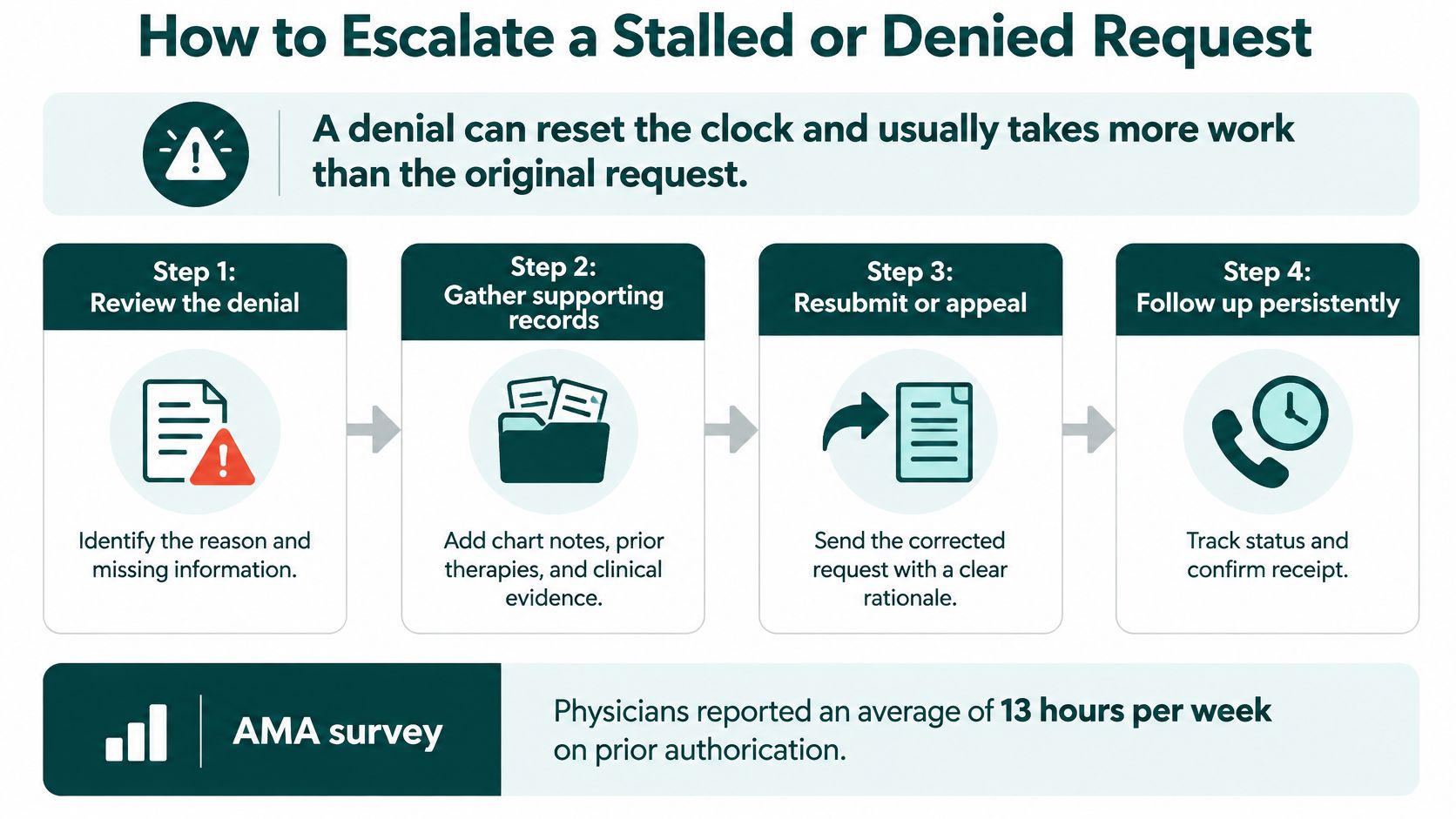
A denial resets the clock and usually demands more work than the original request. The payer's initial review window has already run once, and what follows is a different process: a new evidence packet, a clinician discussion, or a formal appeal rather than another routine status check. For the patient, the wait now extends past the first decision date, and the practice controls only part of that added time. Staff own the preparation, documentation, and follow-up cadence. The payer still owns its own review pace.
In an AMA survey on prior-authorization denials, physicians reported an average of 13 hours per week on prior-authorization work for a single physician; 67% cited doubts about an appeal's success, and 55% lacked sufficient resources to file an appeal. The staffing question extends beyond who submits requests to who owns the work after an unfavorable decision.
Match the response to the denial
Denial reasons and the first response to each
| Denial reason | What it usually means | First response | Owner |
|---|---|---|---|
| Missing documentation | Request lacked records or required fields | Send records with the reference number and resubmit | PA coordinator |
| Step therapy not met | Prior drug not tried or not documented as tried | Document prior trials and dates, or request an exception | Prescriber with PA coordinator |
| Excluded or non-formulary drug | Plan does not cover the drug under the benefit | Request a formulary exception or discuss a covered alternative with the prescriber | Prescriber |
| Clinical criteria not met | Reviewer disagrees with the indication or dosing | Schedule peer-to-peer review, then decide on appeal | Prescriber leads, staff prepare packet |
Read the denial notice before selecting a response. An exception request will not solve a benefit exclusion, and resending unchanged records will not answer a clinical disagreement. Use a consistent denied prior-authorization workflow while preserving the plan-specific instructions and deadlines.
The escalation path should remain visible to everyone handling the case.
Follow a documented escalation sequence
- Confirm receipt. Record the reference number and verify that the request reached the correct review team.
- Set active follow-up. Check status daily and assign a next action rather than leaving the case marked pending indefinitely.
- Assess urgency clinically. Request expedited review only when the prescriber supports the applicable urgency criteria, including serious jeopardy from the standard timeframe.
- Supply missing evidence. Attach the reference number and confirm that new records were associated with the existing case.
- Arrange peer-to-peer review. Where available, staff schedule the discussion and prepare records; the prescriber leads the clinical argument.
- File the appropriate appeal. Follow the denial notice's submission instructions and stated deadline.
- Evaluate further review. If internal review fails, assess applicable external-review rights or a state insurance department complaint with appropriate guidance.
These are not mandatory consecutive steps for every denial. Appeal deadlines, external-review rights, and complaint jurisdiction differ by plan and state, and a peer-to-peer discussion should not be assumed to pause an appeal deadline.
The longest stretch of a denied case usually sits between the denial date and the appeal decision, which is why the daily status check in step two matters more here than anywhere else in the process. A case marked pending with no next action assigned is where patient wait times double.
Route a patient facing a therapy gap to the prescriber promptly. Staff own tracking and paperwork; clinicians own treatment decisions and clinical arguments. Clear escalation ownership can matter more than a fast initial submission.
The Takeaway
How long does prior authorization take for medication? Usually several days in total, but a useful estimate must distinguish the payer's review from preparation, dispensing, and any denial-resolution work. A published average can't tell a patient whether their particular request is complete, which deadline applies, or whether the pharmacy can fill it after approval.
Start by reviewing a recent sample of requests, calculating medians by medication category and benefit, and assigning one owner to the queue. Require complete first submissions, documented follow-up, and a clear handoff to the prescriber when clinical evidence or urgency must be addressed. Measure success through fewer preventable delays and better visibility, not promises that every request will be approved faster.
Remote support is appropriate when administrative capacity is the bottleneck and the practice can provide supervision, secure access, and clear role boundaries. Confirm obligations with your compliance professional before changing workflows, and keep clinical judgment with the licensed care team.
MedicalVirtual offers pre-vetted remote healthcare staff for prior-authorization preparation, tracking, and payer follow-up. Visit MedicalVirtual to request a human-curated shortlist and discuss role scope, workflow fit, and a business associate agreement before granting access to patient information.