

A prior authorization denied isn't necessarily a final refusal: in 2023, 81.7% of appealed Medicare Advantage denials were fully or partially overturned. The practical job is to triage the denial, protect the patient's care plan, and choose the right correction or appeal pathway.
The notice lands in the shared inbox while the patient's appointment is still on the schedule. Your receptionist needs an answer, the provider is seeing patients, and the payer portal shows a denial without making the next step obvious. Leaving that notice in a general work queue means nobody has clearly accepted responsibility for what happens next.
Start with the patient-safety handoff, not an appeal template. Assign an administrative owner to preserve the notice and track deadlines, then route the case to a clinician who can assess the consequences of waiting. A missing attachment needs a different response from a disagreement about medical necessity, even when both appear under the same denied status.
For practice managers evaluating remote authorization support, this distinction also defines the staffing role. A capable coordinator can manage records, payer calls, submission evidence, and follow-up. The provider must retain responsibility for clinical reasoning, urgency, and treatment decisions. The operating model should make both responsibilities explicit.
What Happens When a Prior Authorization Is Denied
A denial notice means the payer hasn't approved the request as submitted. It doesn't, by itself, establish that the provider's recommendation was inappropriate or that no further review is available. Your first task is to determine what the payer decided, what evidence it considered, and what response the plan permits.
The scale makes a deliberate recovery process worthwhile. Medicare Advantage insurers received more than 50 million requests in 2023 and denied 3.2 million, while only 11.7% of denied requests were appealed, according to the Medicare Advantage authorization figures summarized by the AMA. That reporting also supports the appeal-overturn figure above, but outcomes among appealed cases shouldn't be treated as a prediction for every unchallenged denial.
Treat recovery as a handoff
Before someone starts calling the payer, identify the clinician responsible for reviewing the effect of delay. The administrative owner should know who will answer questions about urgency, whether the appointment should remain scheduled, and what to tell the patient while review is pending.
Practical rule: A denial isn't assigned until someone owns the payer response and someone owns the patient's interim care plan.
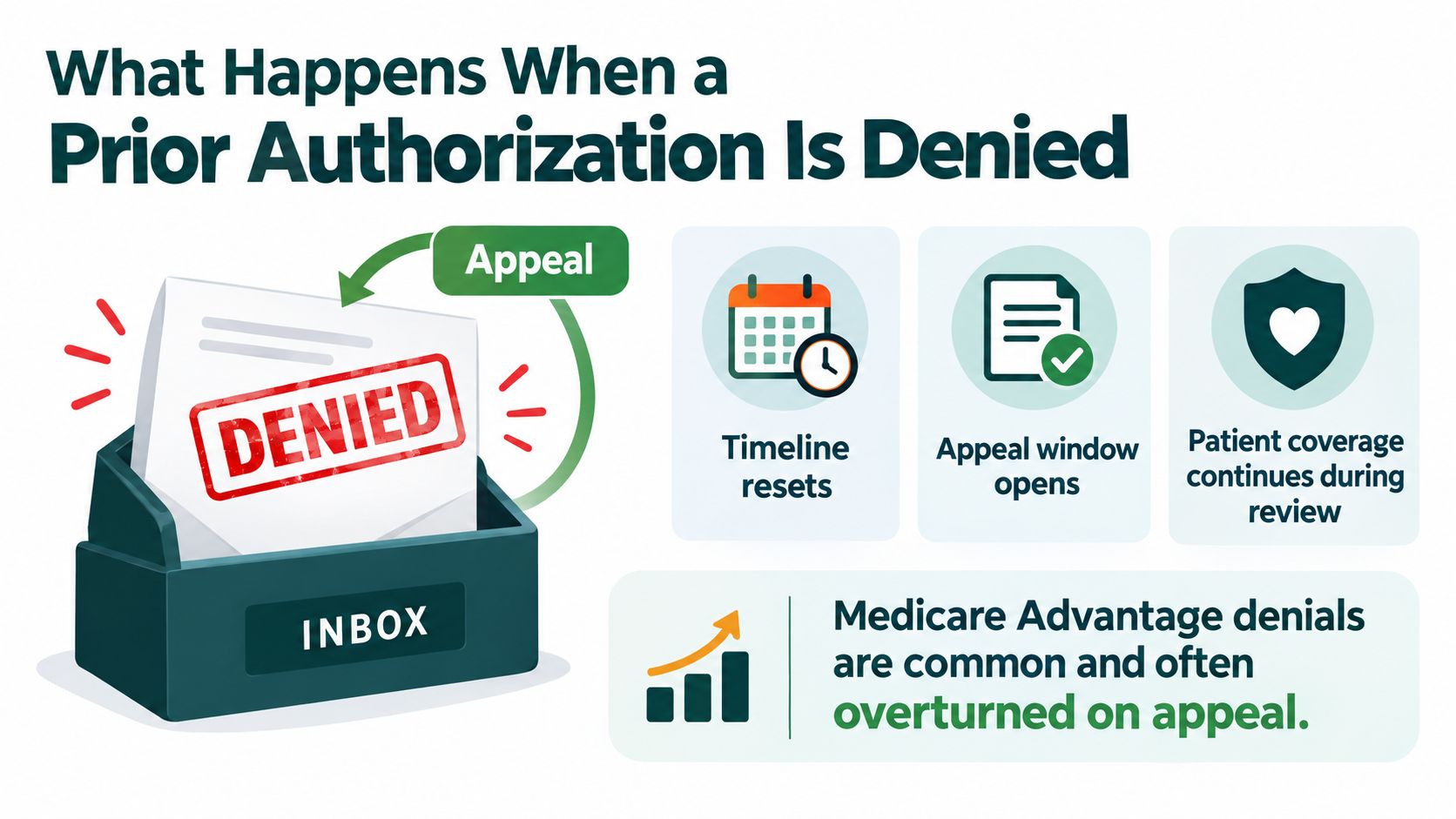
Don't interpret the graphic as a coverage guarantee. Filing an appeal doesn't automatically restart every deadline or establish continued payment for the requested service. Verify any continuation-of-benefits provisions and applicable review clocks for the patient's specific plan.
Then separate the work into administrative defects and medical-necessity disputes. The former calls for checking whether the original request can be corrected; the latter requires a clinician-supported response to the payer's stated criterion. Neither should disappear into an undifferentiated denial queue.
The First 24 Hours After the Denial Notice
Use the first working day as your practice's triage target, not as an assumed legal deadline. Download the complete notice rather than relying on a portal status or a message forwarded from the patient. Preserve attachments and submission history so the next staff member doesn't have to reconstruct the case.
Run a documented intake sequence
- Identify the coverage. Record the payer, patient's plan type, member information, and authorization ID.
- Match the request. Confirm the exact service or medication, ordering provider, requested location, and original submission.
- Capture the rationale. Save the denial reason code and full explanation, including any cited coverage criterion.
- Record the clocks. Enter the denial date, appeal due date, submission method, and any separate peer-to-peer window.
- Route the decision. Flag whether the original request was standard or expedited and send any urgency question to the provider.
- Assign follow-up. Name the owner, next action, and backup person responsible when the owner is unavailable.
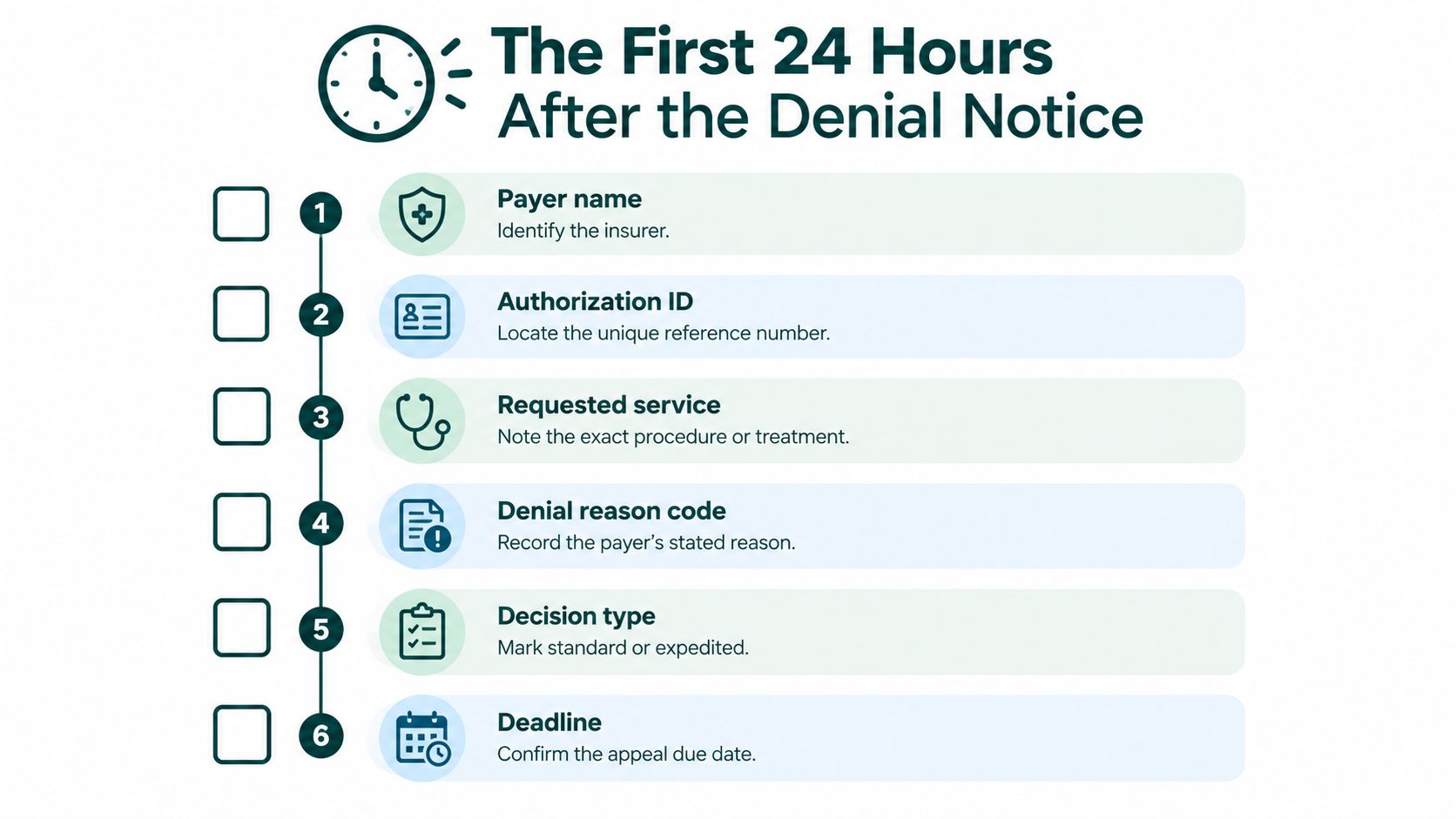
Separate request deadlines from appeal deadlines
Under the CMS Interoperability and Prior Authorization Final Rule, certain impacted payers must issue standard decisions within 7 calendar days and expedited decisions within 72 hours; the rule's standard-decision requirement excludes qualified health plans on federally facilitated exchanges. These are not universal deadlines for every payer, drug request, or appeal.
State law, plan type, service, submission completeness, and permitted extensions can affect the applicable timeline. Confirm the actual process rather than promising the patient a decision based on a federal maximum.
Ask the payer representative which review clock applies and whether additional information changes it. Record the representative's name, call reference, and answer, then check that answer against written plan instructions. A verbal explanation is useful operational evidence, but it shouldn't replace the denial notice in your deadline log.
Classifying the Denial Reason So You Know What to Fix
The payer's label is a starting point, not a complete diagnosis of the problem. A medical-necessity denial may reflect missing progress notes rather than a substantive disagreement with the provider. Conversely, sending another copy of the same chart won't resolve a clearly stated coverage-criterion dispute.
Distinguish missing evidence from disputed evidence
Consider an illustrative imaging request. If the payer says prior treatment wasn't documented, first check whether the relevant notes existed, were included, and were associated with the authorization. If the records weren't received, ask whether the plan permits supplemental documentation or reconsideration before preparing a formal appeal.
If the payer reviewed those records but concluded that the criterion wasn't met, the provider needs to address that conclusion. Don't ask an administrative employee to infer treatment failure, reinterpret findings, or add unsupported clinical language.
Denial categories and fastest remedies
| Denial category | Typical signal in the letter | Remedy path | Practice owner |
|---|---|---|---|
| Missing or incomplete documentation | Required notes or results not received | Confirm the missing item and permitted correction route; submit with receipt evidence | Authorization coordinator |
| Coding mismatch | Requested procedure and submitted diagnosis don't align | Obtain coding review and submit an accurate correction through the accepted channel | Coding or billing lead, with provider input |
| Wrong payer or plan | Request sent to an entity that doesn't manage the benefit | Recheck coverage and identify the responsible administrator | Insurance verification specialist |
| Medical-necessity disagreement | Records reviewed but criterion not satisfied | Prepare a criterion-specific clinical response and appropriate review request | Treating provider, supported by coordinator |
Choose the shortest permitted route
A callback and a targeted document upload may be more appropriate than a formal letter for an attachment problem. That's only useful if the payer confirms the route is available and the correction reaches the right case.
Don't let a representative's suggestion to resubmit replace a protected appeal deadline unless you've verified the consequences.
True benefit exclusions need separate attention. More clinical documentation may not resolve them, so confirm the actual benefit language and whether any exception pathway exists before spending provider time on a medical-necessity argument.
Documentation Checklist and Sample Appeal Language
A useful appeal packet answers the denial rather than merely describing the patient. Build it around the payer's stated criterion and make each supporting document easy to locate. A long chart export without an evidence summary can leave the reviewer searching for the very fact that should decide the case.

Assemble an indexed evidence packet
- Decision record. Include the complete denial notice, authorization reference, and relevant submission history.
- Clinical documentation. Select progress notes addressing the disputed criterion and relevant imaging or laboratory results.
- Treatment history. Gather documented prior therapies, outcomes, contraindications, or intolerance when relevant.
- Request details. Verify the requested CPT or other applicable procedure code, diagnosis code, service, and location.
- Provider explanation. Include a concise narrative connecting the evidence to medical necessity and explaining any clinically relevant risk of delay.
- Submission record. Preserve the final packet, transmission confirmation, and planned follow-up.
For Medicare health-plan appeals, beneficiaries generally have 65 days from the date on the initial denial notice to file, and the patient, authorized representative, or treating provider may submit the appeal, as explained in Medicare's health-plan appeal guidance. Confirm who may act in the specific case and don't treat the filing window as permission to defer patient care planning.
Use language that points to evidence
The following is adaptable sample language, not a source quotation or a completed clinical opinion:
Opening: We request reconsideration of the denial for [service], authorization reference [reference]. The denial identifies [specific criterion] as unmet.
Evidence summary: The enclosed [document and date] addresses that criterion through [documented finding or treatment history]. The treating provider's attached statement explains its relevance to this request.
Requested action: Please review the identified evidence and approve the requested service. If the denial is maintained, please provide the remaining unmet criterion and applicable next review pathway.
Administrative staff can organize the packet and draft the factual framework. The provider must verify the clinical narrative, including any assertion about failed treatment or harm from delay.
For broader revenue-cycle process planning, Clarity revenue cycle denial help is an additional resource to consider. Keep the individual appeal anchored to the patient's notice and plan instructions rather than a general denial-management template.
Escalation Pathways That Actually Move the Decision
Consider an illustrative specialty-practice case in which the payer maintains a denial after receiving the missing records. The coordinator has confirmation that the documents reached the case, but the reviewer still disputes whether the patient meets the clinical criterion. At that point, repeatedly uploading the same records isn't a meaningful escalation.
Move the unresolved issue to the right reviewer
- Internal reconsideration. When available, request review of new or overlooked information and identify exactly what changed.
- Peer-to-peer review. Schedule the treating provider's discussion with the payer's designated clinical reviewer. Prepare a focused summary of the unresolved criterion and supporting record.
- Further appeal or independent review. Follow the route identified for the plan and appeal level, including independent review when applicable.
- External review. Pursue it where permitted by the plan and governing process, with appropriate patient authorization and compliance support.
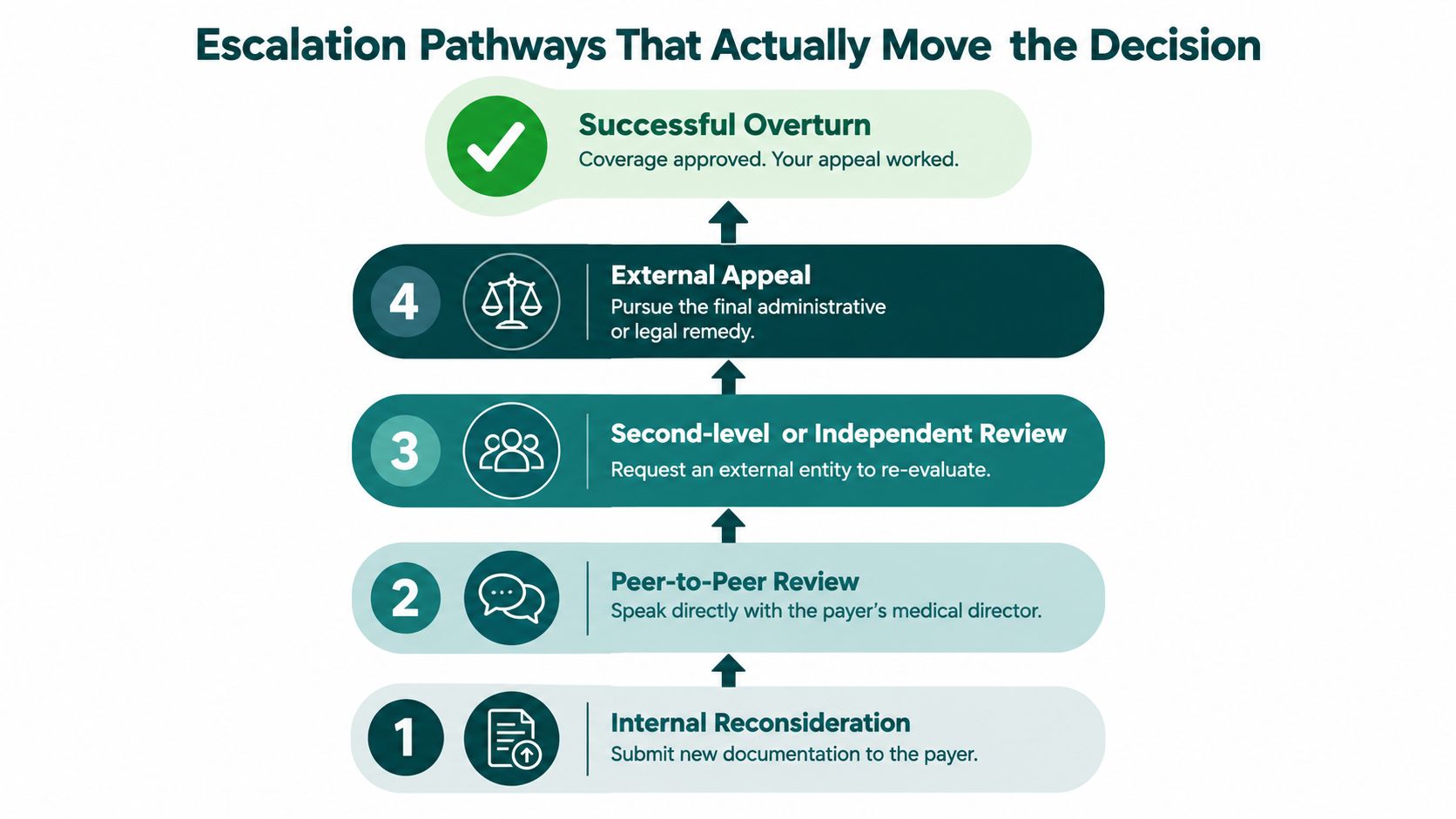
The diagram is a routing aid, not a universal sequence. A peer-to-peer discussion may not replace a formal appeal or suspend its filing deadline. Confirm its procedural role before deciding to wait for the call.
Build a case-specific timeline
Use a simple tracking sequence: submission confirmed → review scheduled → decision due → next action assigned. Enter the payer-confirmed dates for each stage rather than importing generic days-to-decision estimates. The Medicare prior authorization workflow overview can support practice-level process planning alongside the patient's actual notice.
In the illustrative case, the provider may decide that an acceptable alternative therapy is preferable to continued delay. For a medication request, an exception may be more relevant; for a service request, another site may warrant consideration. Those are clinical and coverage questions, not decisions for a coordinator to make independently.
Escalate because there is a specific unresolved argument and a useful available pathway, not because escalation is the next box on a checklist.
Patient Safety and Continuity of Care While the Denial Is Open
The appeal owner can complete every administrative task correctly while the patient still misses needed care. Keep an interim care plan visible in the chart and accessible to the people answering patient calls. It should identify who reviews symptom changes, who communicates updates, and what happens if the expected decision doesn't arrive.
The clinical stakes aren't theoretical. In an AMA report on physicians' prior authorization concerns, 82% of surveyed physicians said patients abandon treatment because of authorization struggles, and 29% reported a serious adverse event associated with prior authorization. These are physician-reported experiences, not a prediction of harm in an individual case.
Give patients a usable plan
Explain what the practice has done, what remains unresolved, and when the next update will occur. Distinguish the date your team will contact the patient from the date the payer might decide. A reliable update commitment is more useful than an unsupported approval promise.
- Clinical contingency. Ask the provider whether bridge therapy or another care setting is appropriate and document the decision.
- Financial clarity. Explain unresolved coverage and potential out-of-pocket exposure without promising later reimbursement.
- Accessible communication. Confirm the patient's language preference and whether phone contact is more workable than portal messages.
- Decision closure. Communicate the outcome and reconcile it with the treatment plan, appointment, and receiving facility.
Account for specialty and access differences
For behavioral-health practices, define how a patient reports deterioration while review is pending. For therapy clinics, ask the clinician to address the consequences of interrupted treatment. In oncology or other time-sensitive care, route urgency assessment directly to the treating team rather than letting administrative staff infer it from the appointment date.
The patient shouldn't have to discover that the payer, ordering practice, and treatment location each thought someone else was handling the next step.
These care coordination examples offer related workflow context. For patients with limited English proficiency, low digital access, or complex illness, choose a communication method they can actually use rather than making portal responsiveness the condition for continued follow-up.
How a Prior Authorization Specialist Virtual Assistant Fits In
A prior authorization specialist virtual assistant can own administrative execution without becoming the clinical decision-maker. That role differs from a receptionist who primarily manages calls and appointments, or a billing assistant working claim follow-up. Scope the position around the authorization queue, with designated clinical escalation contacts and protected time for payer work.
Staffing constraints deserve realistic treatment. The AMA prior authorization survey found that 49% of physicians lacked sufficient staff time or resources to appeal, while 67% doubted appeals would succeed based on prior experience. Adding a remote worker won't resolve those barriers unless the practice also supplies clear authority, training, and provider availability.
Define ownership before hiring
Use the prior authorization specialist role description as a starting point for assigning submission, tracking, appeal assembly, peer-to-peer scheduling, portal monitoring, and payer follow-up. Require the employee to route clinical questions back to the provider rather than fill documentation gaps by guessing.
Screen candidates with a de-identified denial exercise. Ask them to identify the missing information, locate the deadline, propose a next action, and explain what they can't decide themselves. For specialty practices, test relevant terminology and workflow judgment rather than assuming general front-desk experience transfers automatically.
- Access controls. Provide individual accounts, approved communication channels, and role-appropriate permissions.
- Coverage arrangements. Align working hours with payer calls and provider availability, and assign backup ownership.
- Privacy review. Confirm remote-access practices, contractual arrangements, and applicable obligations with your compliance professional.
Measure the work without distorting it
Track denial rate by payer and service, appeal submission rate, days to appeal, overturn rate, peer-to-peer completion, and authorization turnaround time. Review cases behind the measures, not just the dashboard.
An overturn rate alone can encourage selective handling of easier cases. Pair it with appeal participation and aging unresolved requests so difficult cases remain visible. A dedicated employee, an in-house coordinator, and a shared remote role are all options; choose based on workload complexity and available clinical support.
The Takeaway
A prior authorization denied should trigger a controlled recovery process, not an automatic cancellation or a generic letter. Separate correctable administrative defects from clinical disputes, preserve the applicable deadlines, and keep the patient's interim care needs visible throughout review.
Before expanding staffing, define who owns each queue action and who approves clinical decisions. Then test whether your workflow produces a documented next step, a usable patient update, and a closed handoff after the payer decides.
MedicalVirtual connects U.S. practices with pre-vetted Latin American healthcare staff, including prior authorization specialists who work clinic hours and support submission, tracking, and administrative escalation. Visit MedicalVirtual to discuss your denial queue, review role-specific screening standards, and define the support your providers need.