

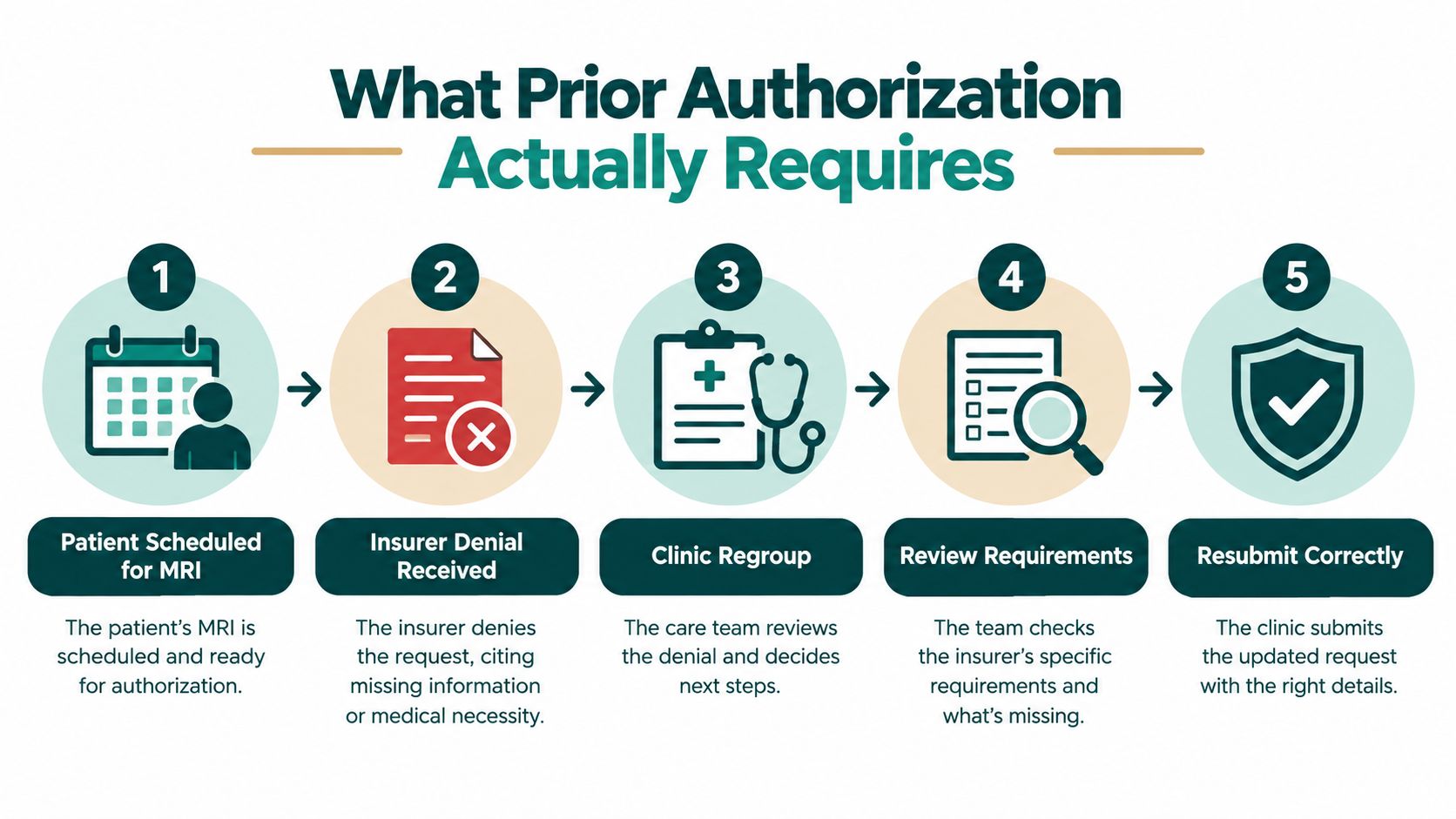
A patient is scheduled for an MRI, the appointment is approaching, and the insurer sends a denial that seems to arrive out of nowhere. The front desk forwards it to the clinical team, the ordering provider is asked to clarify the request, and someone starts calling the payer while trying to determine which records were submitted. That scramble is usually a workflow problem, not a single bad phone call.
How to get prior authorization reliably is to treat it as a documentation and tracking process. The practice must verify coverage, confirm the authorization requirement, identify the correct codes and payer channel, build evidence around the payer's medical-necessity criteria, submit a complete packet, track the case against the applicable deadline, and respond appropriately to missing information, non-affirmation, or denial. Medicare Advantage insurers made nearly 50 million prior-authorization determinations in 2023, which shows that authorization is routine administrative work rather than an occasional exception (American Hospital Association summary of KFF data).
The practical question is where your process breaks. The sections below focus on the evidence packet, submission controls, daily follow-up, and appeal paths that small practices often lack.
What Prior Authorization Actually Requires
Treat authorization as a workflow
The MRI denial exposes six connected stages:
- Eligibility: Confirm the patient's active coverage and exact product.
- Requirement check: Determine whether the service, drug, or procedure needs authorization.
- Evidence gathering: Collect codes, notes, results, treatment history, and other required records.
- Submission: Use the payer's designated portal, electronic transaction, fax, or form.
- Tracking: Record receipt, case identifiers, deadlines, status changes, and information requests.
- Decision handling: Validate approval details, correct a documentation issue, request review, or appeal.
A breakdown in one stage creates work in the next. An incorrect plan can send a complete packet to the wrong payer. A correct packet without a confirmation number leaves the practice unable to prove receipt. An approval that isn't checked against the scheduled site or service date can still result in a claim denial.
The operational burden is substantial. An American Medical Association survey of 1,000 physicians found that practices completed an average of 39 prior-authorization requests per physician each week, while physicians and staff spent about 13 hours weekly on them; 40% of physicians reported staff dedicated exclusively to prior authorization, and 89% said the process somewhat or significantly increased physician burnout (American Medical Association survey summary).
Assign ownership instead of spreading the work
A coordinator should own the request from intake through final decision. That person doesn't make a clinical determination, but they do make sure the clinical determination is documented, submitted, and followed through. The ordering provider should supply or approve clinical content, while administrative staff manage payer rules, records, timestamps, and status.
Leaving authorization with whoever happens to notice the task creates predictable gaps. A provider may complete the clinical note but miss the payer's separate form. A scheduler may see an approval but overlook that it covers a different facility. A billing employee may discover the mismatch only after the claim rejects.
Payer rules also vary by product. Medicare Advantage, commercial insurance, Medicaid managed care, and federally facilitated Marketplace plans can use different forms, portals, clinical policies, and response rules. Even within one insurer, an employer plan and a Medicare Advantage plan may apply different requirements to the same service.
A useful explanation of the process is available in this guide to how prior authorization works. The central operating principle is simple: authorization is not a phone-call task. It's a controlled record of what was requested, why it was needed, what was sent, and what the payer decided.
Pre-Submission Preparation That Prevents Most Denials
The strongest authorization work happens before submission. A coordinator should be able to complete the intake without repeatedly interrupting the provider or guessing which payer rule applies.
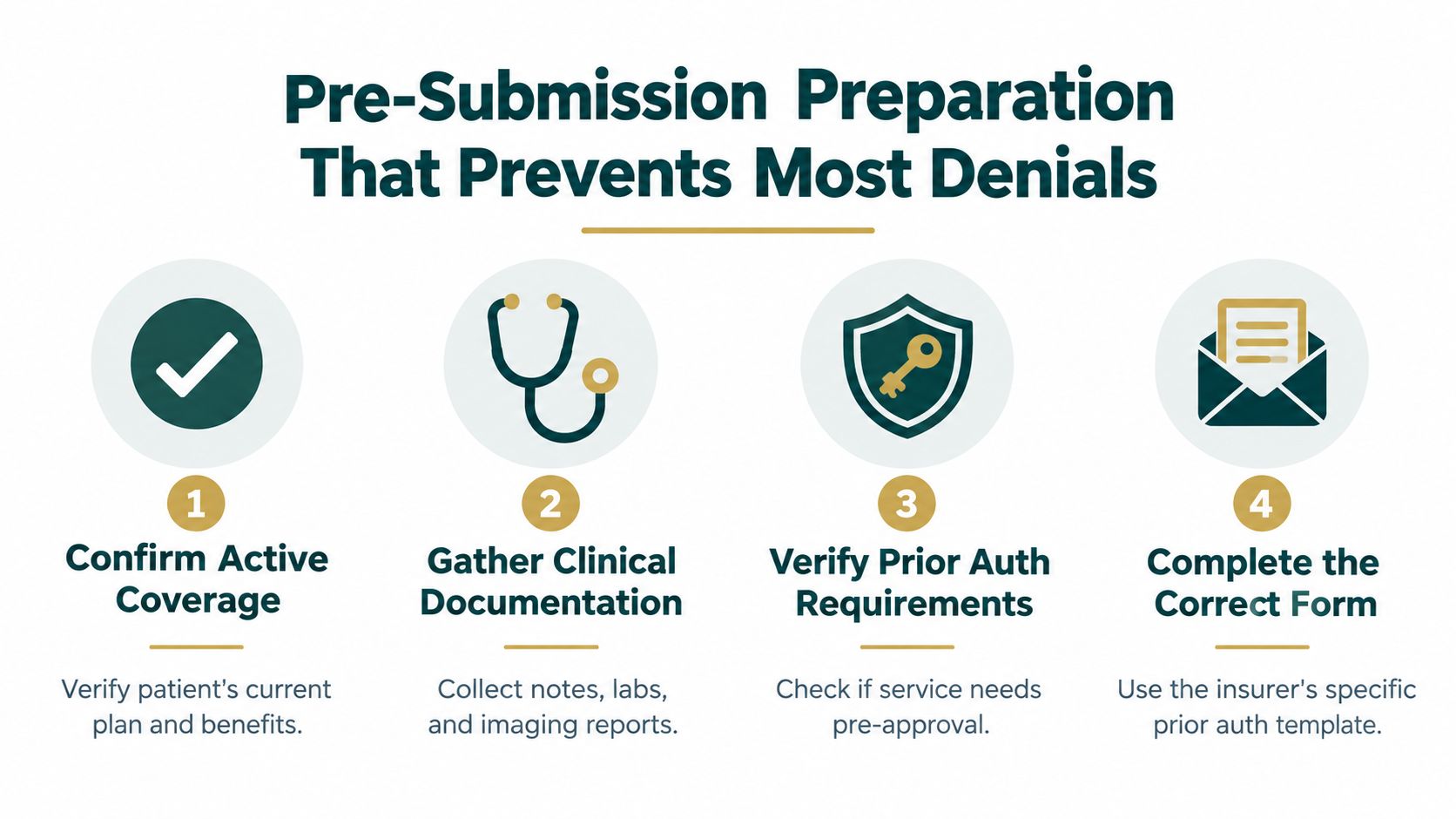
Start with four verification checks
Confirm active eligibility and the exact plan. Check the patient's current member ID, group or product information, effective status, and payer line of business. Don't rely only on an old insurance card or a prior visit. A patient may have changed plans while keeping the same insurer.
Check whether authorization is required. Use the payer's current portal, benefit tool, provider manual, or service-specific policy. A benefits document may describe coverage broadly, while a medical policy may impose authorization for a particular indication, setting, or code. When the sources disagree, document which source the coordinator used and escalate the discrepancy rather than assuming the service is clear.
Confirm the submission channel. Some payers accept portal submissions, some support electronic transactions, and others require a designated form with records attached. The submission route can differ for medical services, pharmacy benefits, and specialty drugs.
Assemble the identifiers. Capture the procedure or drug code, diagnosis code, ordering provider, rendering provider, provider identifiers, site of service, units when applicable, and planned service date. Missing one of these fields can make a clinically strong request difficult for the payer to match to the patient and scheduled service.
A structured insurance verification form can make these checks part of intake instead of an informal note in a message thread.
Match preparation to the service
The same code may require different evidence depending on the diagnosis, indication, or payer policy. Imaging requests often depend on symptoms, examination findings, prior treatment, and earlier test results. Advanced procedures may require conservative-treatment history and a clear description of functional impairment. Specialty medications may require medication history, prior therapies, laboratory results, and prescribing details.
A coordinator can use this intake checklist:
- Patient and plan: Verify identity, member number, plan type, effective coverage, and payer contact route.
- Requested service: Record the code, diagnosis, units, site, rendering provider, and planned date.
- Policy source: Save the relevant payer policy, portal requirement, or form name.
- Clinical records: Identify the note, results, treatment history, medication history, and severity information needed.
- Submission control: Assign an owner and a target submission date before the request enters the queue.
A portal check often gives more precise, service-specific information than a general call. It also creates a record of the fields and attachments the payer requested. Calls remain useful when the portal is unclear, but they shouldn't replace the practice's own evidence checklist.
Building a Payer-Specific Evidence Packet
A physician's opinion matters, but a persuasive narrative alone usually isn't enough. The packet should mirror the payer's medical policy and show how the patient meets each relevant criterion.
Translate policy criteria into chart evidence
Start by reading the payer's policy for the exact service and indication. Pull out each requirement and map it to a document or field in the chart. For example, if the policy asks for failed conservative treatment, identify the treatment, dates, response, and reason it was stopped. If it asks for objective findings, attach the relevant imaging, laboratory result, measurement, or specialist assessment.
A complete packet commonly includes:
- Relevant history: Symptoms, duration, progression, prior diagnoses, and functional impact.
- Conservative treatment history: Therapies attempted, medication trials, response, intolerance, contraindications, or documented failure.
- Objective findings: Imaging reports, laboratory results, examination findings, severity measures, and other records tied to the request.
- Medication history: Current medications, prior agents, response, adverse effects, and dosing information when required.
- Medical-necessity narrative: A concise explanation connecting the patient's findings to the requested service.
- Service details: Code, units, facility or site, ordering and rendering providers, and planned date.
The narrative should answer the reviewer's likely question: why this service, for this patient, at this point in the treatment sequence? Repeating the diagnosis without showing failed treatment, objective findings, or functional consequences leaves the reviewer to assemble the rationale independently.
Use a reusable documentation matrix
A matrix prevents the coordinator from rebuilding every request from memory. It should be maintained by service category and payer, then updated when a denial or additional-information request reveals a missing criterion.
| Service Category | Key Codes | Typical Clinical Evidence | Common Payer Question |
|---|---|---|---|
| Advanced imaging | CPT or HCPCS code, diagnosis code | Symptoms, examination findings, prior treatment, previous imaging, clinical progression | Why is this study needed now, and what prior findings support it? |
| GLP-1 or biologic medication | Drug code or pharmacy identifier, diagnosis code | Diagnosis, medication history, laboratory results, prior therapy, contraindications, prescriber documentation | Has the patient tried required alternatives, and does the indication match the policy? |
| Outpatient surgery | Procedure code, diagnosis code, facility and provider details | Specialist note, failed conservative care, objective findings, risk assessment, planned setting | Why is surgery medically necessary, and why is this site appropriate? |
| Durable medical equipment | Equipment code, diagnosis code, length of need | Functional limitation, measurements, physician order, treatment history, supporting test results | What condition requires the equipment, and how will it be used? |
Keep the matrix payer-specific where criteria differ. A generic packet may be faster to assemble, but a targeted packet is more likely to answer the questions that drive the payer's decision. That's why submission completeness is often a more effective intervention than submission speed alone.
Submission, Confirmation, and Daily Tracking
The submission channel matters less than the controls around it. A fast portal submission without proof of receipt is fragile. A fax submission with a detailed cover sheet, timestamp, and document inventory can be more defensible than an undocumented portal click.
Choose the channel deliberately
Payer portal: Usually practical when the payer exposes service-specific fields, attachment requirements, and status information. Save the confirmation page, case number, and uploaded-document list.
ASC X12N 278 transaction: CMS recognizes ASC X12N 278 Version 5010 as the adopted electronic standard for prior authorization and referrals (CMS adopted standards). Payer adoption and implementation still vary, so confirm whether the payer accepts this transaction for the specific service.
Fax or form-based submission: Still used by some payers and departments. Include a cover sheet with patient identifiers, ordering provider, request type, planned date, and page count. Retain the transmission confirmation and the exact files sent.

Make the request traceable
The authorization log should contain:
- Submission details: Date, time, channel, confirmation number, case ID, and document inventory.
- Ownership: Assigned coordinator, ordering provider, facility, and escalation owner.
- Status: Submitted, received, additional information requested, approved, non-affirmed, denied, appealed, or closed.
- Deadlines: Expected payer response date, information-response deadline, appeal deadline, and planned service date.
- Approval limits: Approved code, diagnosis, units, provider, location, and validity dates.
Run the queue every business day. New requests need an owner and due date. Open cases need a status check or a documented reason not to check. Requests for additional information should be routed to the clinical team immediately, with a clear deadline and list of missing items.
An authorization isn't a blanket approval. Before scheduling or billing, compare the approval with the actual appointment or order. A mismatch in CPT or HCPCS, diagnosis, units, location, provider, or validity window can still lead to a denial even when the payer issued an approval.
Responding to Delays and Additional-Information Requests
The period after submission is where many practices lose control. A portal may show “in review” while the payer is waiting for a record, a request may be routed to the wrong department, or the payer may have received the transmission without attaching it to the patient's case.
Apply the correct response window
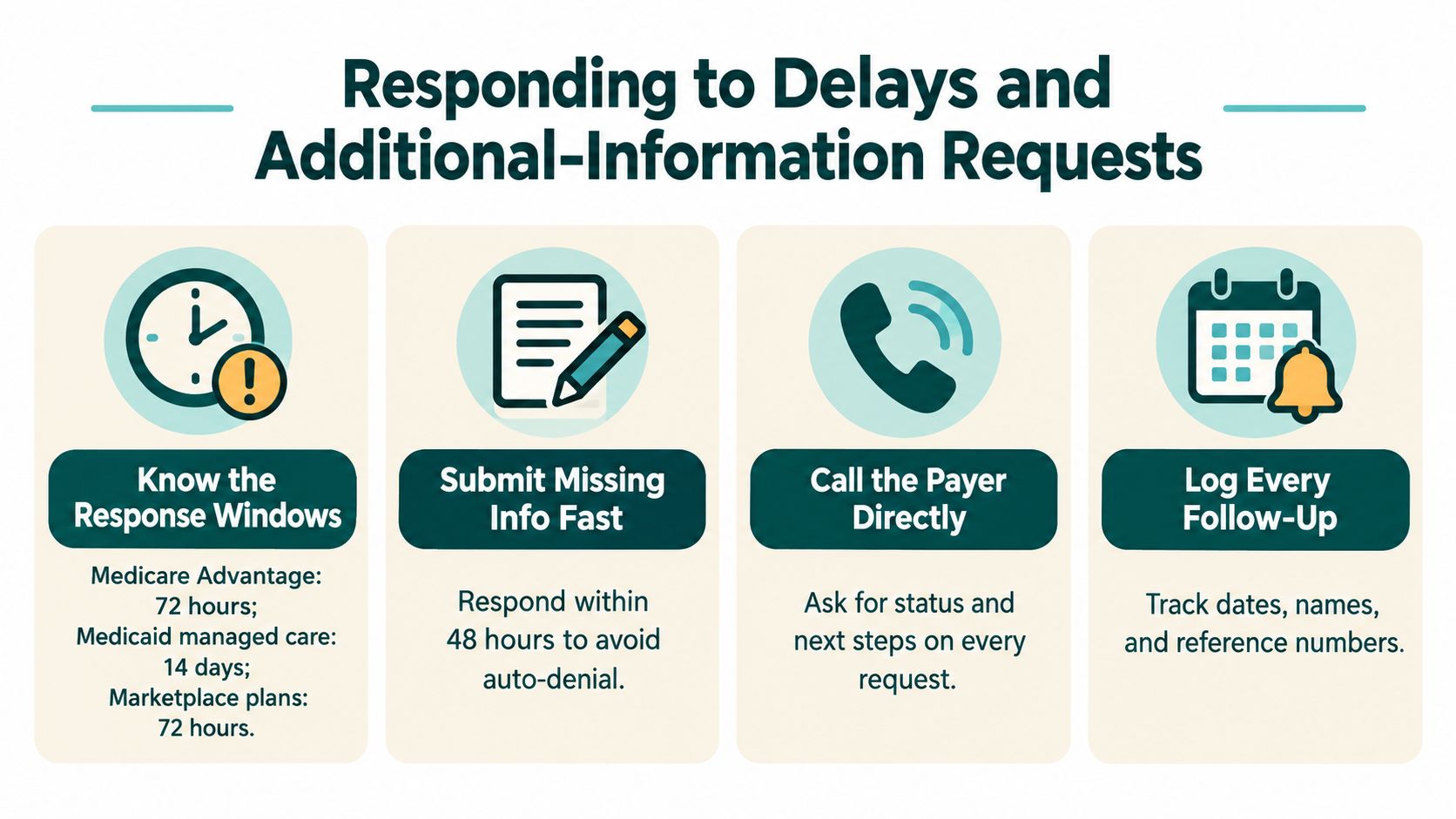
Under CMS's Interoperability and Prior Authorization final rule, impacted Medicare Advantage organizations, Medicaid and CHIP managed-care plans, and certain federally facilitated Marketplace plans must respond to requests for medical items and services within 72 hours for expedited requests and seven calendar days for standard requests, generally beginning January 1, 2026 (CMS prior-authorization FAQ). The rule excludes drugs from these particular timeframes and doesn't apply the same standard-decision requirement to qualified health plans on the federally facilitated Exchanges.
Classify urgency accurately. Use the clinical facts and payer rules, not convenience, to determine whether a request is expedited. Record when the payer received the request, because the response clock depends on receipt rather than the date the practice first opened the task.
Separate tracking failures from clinical questions
A status problem and a medical-necessity problem need different responses.
- Wrong routing: Ask the payer to transfer the request or identify the correct department, then record the new reference number.
- Missing attachment: Resend only the missing document if the payer confirms the case remains open, and retain proof of transmission.
- Portal error: Capture the status screen, call the payer, and ask whether the request exists in the clinical review queue.
- Clinical clarification: Send the exact requested evidence and tie it to the policy criterion instead of uploading the entire chart without explanation.
Use a consistent call structure: identify the patient and request, provide the submission confirmation, ask for current status, ask whether anything is missing, request the expected decision date, and record the representative's name, reference number, and next step. If the stated timeline has passed, request a supervisor or clinical-review escalation and document why the case is overdue.
The KFF prior-authorization polling summary found that 51% of insured adults had encountered prior authorization in the previous two years. Among those patients, 48% reported a delay and 43% reported a denial for requested care. Those figures reinforce why a practice needs an active tracking process rather than a passive “wait for the payer” approach.
Appeals, Peer-to-Peer Review, and External Review
A denial should trigger a controlled decision path, not another identical submission. Start by reading the determination and appeal-rights notice, then identify the gap that caused the adverse decision.
Classify the denial
Place the case into one of three categories:
- Missing information: The payer needs a note, test result, treatment history, signature, or another record. Send the specific item using the payer's stated method and retain transmission proof.
- Coding or administrative mismatch: The request contains the wrong code, provider, site, unit count, or date. Correct the error, then confirm whether the payer will amend the existing case or requires a new request.
- Medical-necessity decision: The payer reviewed the evidence and concluded that its criteria were not met. Compare the rationale with the clinical record and policy before selecting an appeal, peer-to-peer review, or both.
The response must address the stated reason for denial. Resending the original packet leaves the reviewer with the same information and usually creates another avoidable delay.
Prepare the clinical reviewer
Peer-to-peer review works best when the ordering clinician has a concise case summary. Include the relevant policy criteria, the patient's history, objective findings, treatment failures or contraindications, the requested service, and the precise reason the payer rejected it. Organize the evidence so the clinician can connect each fact to a criterion during the discussion.
Administrative staff can schedule the call, verify the deadline, assemble the records, and confirm the payer's process. They should not make the clinical argument or promise approval. The physician or another authorized clinician must explain the medical rationale within the applicable role and payer requirements.
Internal appeal and external review follow different paths. An internal appeal asks the plan to reconsider its decision under its own process. External review generally sends the dispute to an independent reviewer when the plan's rules and applicable requirements permit it. Check the adverse-determination notice for appeal rights, deadlines, submission instructions, and expedited-review eligibility.
Measure appeals separately
Medicare Advantage insurers fully or partially denied 3.2 million requests in 2023, equal to 6.4% of determinations, and only 11.7% of denied requests were appealed. Among appealed cases, 81.7% were fully or partially overturned (American Hospital Association summary of KFF data). These figures apply to Medicare Advantage, not every payer, but they show why an initial denial should not automatically close a case.
Track the denial reason, added evidence, review type, submission date, decision, and final outcome. Feed recurring gaps into the documentation matrix. If a payer repeatedly expects a particular test result or treatment history, add that requirement to intake so the next packet contains it before submission.
The Takeaway
Reliable prior authorization depends on three controls: a payer-specific evidence packet, a timestamped tracking log, and a documented appeal path. The packet connects the patient's records to the payer's criteria. The log proves what was submitted and keeps deadlines visible. The appeal path prevents a correctable denial from becoming a permanent care delay.
Small and mid-sized practices may not have enough internal capacity to run all three controls consistently. That's why authorization work is often assigned to a dedicated remote coordinator who works U.S. clinic hours inside the practice's EMR and payer portals. A prior-authorization specialist can handle submission, status follow-up, documentation requests, and escalation while the provider retains clinical responsibility.
This week, audit a sample of open requests, identify the most common missing document, create a service-specific matrix, and add confirmation and deadline fields to your queue. If you're evaluating outside help, MedicalVirtual connects U.S. practices with pre-vetted LATAM prior-authorization specialists aligned to U.S. clinic hours. Payer rules vary, so confirm specific operational, privacy, and compliance obligations with qualified counsel or a compliance professional.
MedicalVirtual can provide a pre-vetted prior-authorization specialist to prepare packets, work payer portals, track open requests, and coordinate denials or appeals during your clinic hours. Review the available staffing support at MedicalVirtual and decide whether a dedicated coordinator fits your authorization volume.