

A small practice can have a full schedule and still face a thin bank balance. Monday starts with rejected claims in the billing queue, authorization requests waiting for payer responses, patient statements that need clarification, and a front-desk employee answering calls while trying to verify benefits. The physician sees the operational cost later, when clinical staff stay after hours to resolve issues that should have been handled before submission.
Medical billing services for small practices can help, but only when they address the work behind the claim. Electronic submission alone isn't a revenue-cycle strategy. The useful question is whether a service prevents avoidable denials, follows unpaid claims, tracks prior authorizations, protects protected health information, and gives managers reliable performance data.
The right arrangement might be an internal biller, a full-service billing company, a virtual billing assistant, or a hybrid team. This guide compares those options through the economics of denial prevention, the capacity cost of authorizations, practical HIPAA safeguards, and a phased implementation plan.
Why Small Practices Rethink Medical Billing
A typical Monday exposes the weakness in a fragile billing process. The front desk discovers that a patient's coverage changed, a claim from the previous week was rejected for missing information, and a procedure scheduled later in the month still lacks authorization. The practice manager has to decide which problem deserves attention first, while the provider is waiting for charts to close and patients are calling about balances they don't understand.
That pressure isn't caused by claim submission alone. A complete revenue-cycle workflow includes accurate charge capture, eligibility and benefit verification, authorization documentation, payer-status monitoring, denial correction, payment posting, accounts-receivable follow-up, and patient communication. When one person handles several of those jobs, routine interruptions can push high-value follow-up into the next day, then the next week.

The bottleneck is usually exception work
CAQH's 2024 Index report estimated approximately $90 billion in annual spending across tracked medical and dental administrative processes. In medical administration, eligibility and benefit verification represented 51% of total spending, claim submission 23%, and claim-status inquiries 15%.
Those figures explain why outsourcing billing is rarely just about transmitting claims. A manual eligibility check costs providers approximately $8.57, compared with $4.46 through a payer portal and $2.00 through a fully electronic transaction, according to the same CAQH report. Moving from manual work to a fully electronic check creates a potential saving of $6.57 per verification, but only if someone still manages exceptions, documents the result, and acts when coverage or authorization requirements are unclear.
Practical rule: Choose billing support for the work it completes after the software raises a problem, not for the software access it advertises.
Protecting clinical capacity
Remote support can be useful when it gives repetitive administrative tasks a defined owner. A billing specialist may manage charge entry and claim status, while an insurance verification specialist confirms benefits before the appointment. A prior-authorization coordinator can track requests by payer, submission date, required records, decision deadline, and appeal stage.
That division reduces the number of revenue-cycle decisions competing with patient care. It also makes accountability visible. Instead of asking whether “billing is being handled,” a manager can ask which claims are approaching a deadline, which denials lack a root-cause code, and which authorizations have exceeded the practice's expected turnaround.
How Medical Billing Services Actually Work
Medical billing support works best as a sequence of controlled handoffs. The practice supplies accurate clinical and demographic information, the billing team checks the claim against payer requirements, and a designated owner follows the transaction until payment, correction, appeal, or patient responsibility is resolved.
CAQH reported that medical claim submission had reached approximately 98% fully electronic adoption in the 2023 measurement period, while eligibility and benefit verification reached 96% fully electronic adoption, according to national healthcare automation benchmarking. High electronic adoption hasn't removed labor. Staff still enter charges accurately, interpret payer responses, correct rejected claims, monitor unpaid accounts, and resolve documentation problems.
Five operational stages
Charge entry starts with visit details, procedures, diagnoses, modifiers, payer selection, and required documentation. Missing or inconsistent information at this point can create a downstream denial that takes longer to correct than the original entry would have taken.
Claim submission sends the completed claim through the practice-management system or clearinghouse. CAQH found that providers spend an average of 10 to 12 minutes submitting a claim manually, while electronic submission saves about six minutes, or approximately $3 per submission, as described in its provider specialty issue brief. Electronic transmission lowers transaction effort, but it doesn't repair inaccurate demographics, eligibility, coding, payer selection, or missing attachments.
Payer follow-up identifies claims that were received but haven't been paid, adjudicated, or clearly explained. For Medicare claims, CMS generally requires a clean claim to be paid or denied within 30 days of contractor receipt. CMS also identifies waiting periods of 13 days for electronic claims and 26 days for paper claims in its claims-processing guidance. These are processing ceilings, not payment guarantees, and non-clean claims may require correction and resubmission.
Denial management separates front-end errors, payer-processing issues, and patient balances. Each denial should have a root-cause code, owner, correction date, resubmission date, and appeal deadline. A queue that only shows “denied” doesn't tell a manager whether the practice needs better eligibility checks, documentation, coding review, or payer escalation.
Patient statements require accurate posting, understandable explanations, and a clear route for questions. Patient-facing billing support should know when to explain a balance, when to route a clinical question, and when not to speculate about coverage.
For practices that need to connect billing activity with broader financial operations, bookkeeping for healthcare providers can help separate revenue-cycle reporting from general bookkeeping. The distinction matters because a billing queue can show work completed while the practice's financial records still fail to explain timing, write-offs, or outstanding balances.
Metrics that reveal useful work
MGMA identifies claims denial rates, denial write-offs, days in accounts receivable, and aging buckets of 0–30, 31–60, 61–90, 91–120, and 120+ days as core practice KPIs in its practice-operations benchmarking guidance. A service should report these measures consistently, ideally by payer and denial category.
The operational scorecard should include:
- First-pass acceptance: How often claims clear initial processing without correction.
- Denial write-off dollars: The financial value of denials the practice doesn't recover.
- Corrected-claim turnaround: How quickly staff fix and resubmit preventable errors.
- A/R aging: Whether balances are concentrating in older buckets.
- Claim-status activity: Whether staff follow up before unresolved claims become harder to collect.
Service Models for Small Practices
The right model depends on who owns daily decisions. A practice can keep billing entirely internal, contract with a traditional revenue-cycle company, assign defined work to a virtual medical billing assistant, or combine internal coding with external claim and denial support.
Small-Practice Billing Support Models Compared
| Model | Who Manages Daily Work | Supervision Required | Best Fit When |
|---|---|---|---|
| Internal billing team | Practice manager or internal billing lead | Direct supervision, coverage planning, training, and reporting | The practice has stable staffing, clear workflows, and enough management capacity to maintain performance |
| Full-service outsourced billing company | Vendor account team, usually under a service agreement | Vendor oversight, reporting review, escalation meetings, and contract monitoring | The practice wants broader revenue-cycle coverage and doesn't want to recruit or maintain a complete billing function |
| Virtual medical billing assistant | Practice-designated manager with a remote specialist completing assigned tasks | Frequent workflow coordination, access controls, quality review, and documented escalation rules | The practice needs flexible daily support for charge entry, payer follow-up, denials, or statements |
| Hybrid arrangement | Internal staff retain selected functions, external support handles defined revenue-cycle queues | Clear handoff rules and shared KPI ownership | The practice has coding or clinical knowledge internally but needs more capacity for follow-up and exception work |
Internal billing
Internal control can be valuable when the practice has experienced staff and can provide backup coverage. The trade-off is concentration risk. If one employee understands the payer portals, denial history, authorization rules, and patient-balance process, the practice may lose continuity when that person is absent or leaves.
Internal staff also require ongoing training, performance management, and system administration. A low apparent payroll cost can obscure the manager's time spent reviewing queues, covering vacancies, and reconstructing undocumented processes.
Full-service outsourcing
A billing company may cover a wider scope, including charge entry, claims, payment posting, denials, appeals, and reporting. This reduces the need to build every capability internally, but it can create handoff risk if the vendor doesn't understand the practice's specialty, documentation habits, or patient communication standards.
Ask for a written scope. A vendor that submits claims but excludes authorization follow-up, appeals, patient balances, or credentialing isn't offering the same service as a partner that manages those functions.
Virtual and hybrid support
A virtual assistant can fit a practice that needs a defined person in the daily workflow rather than a distant queue. The practice retains closer control over priorities, but it must provide training, system access, quality review, and escalation instructions. Hybrid arrangements often work when clinicians or internal coders own charge accuracy while external staff manage eligibility, payer status, denials, and patient statements.
Before comparing monthly fees, review billing support pricing information against the actual scope, supervision burden, coverage expectations, and reporting included. A cheaper arrangement may shift work back to the practice instead of removing it.
The Hidden Economics of Denials and Authorizations
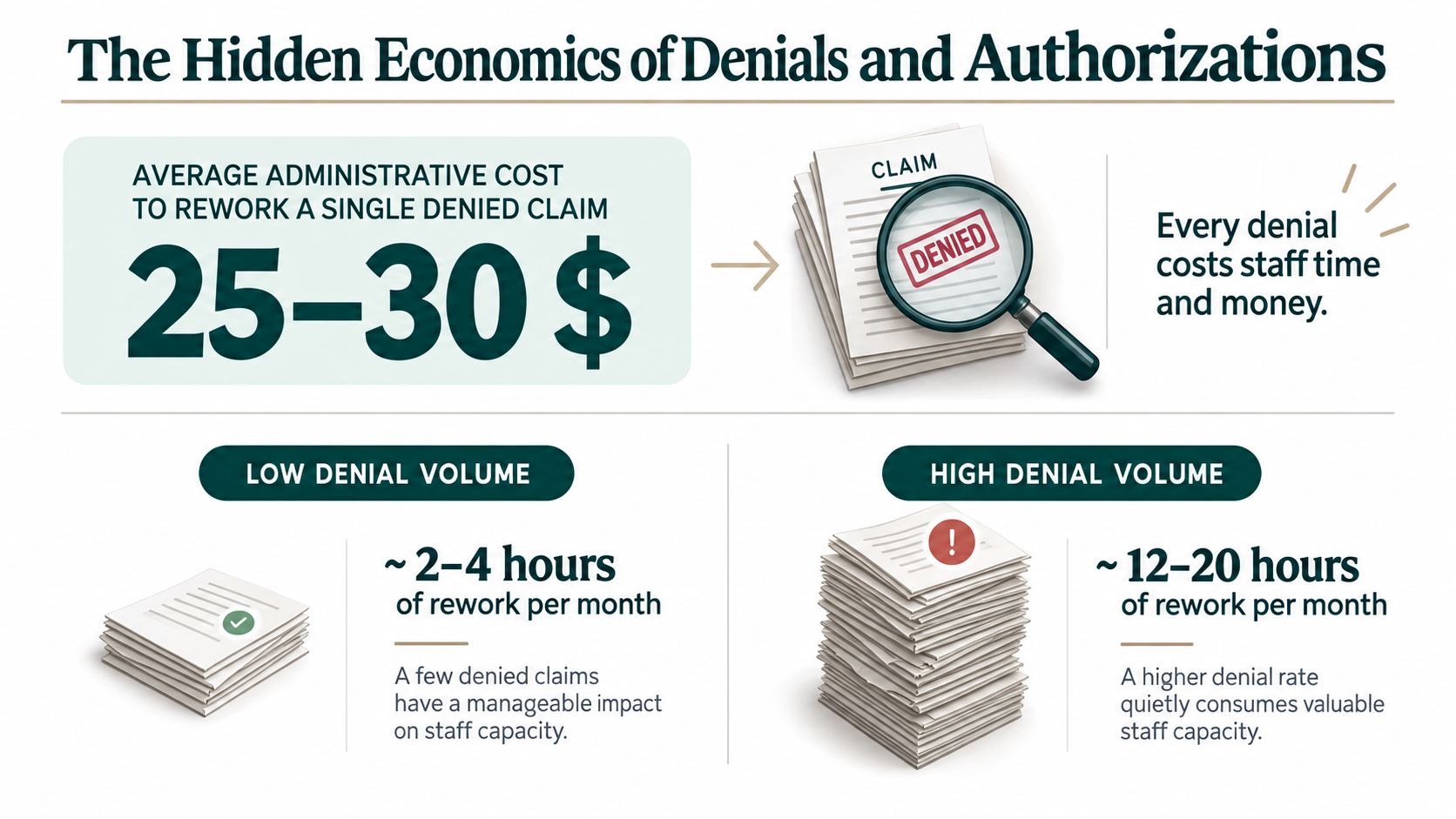
A practice can pay a monthly billing fee and still lose money if preventable denials continue, staff spend hours on rework, and authorizations delay treatment or charge capture. Evaluate a service by the losses it prevents, not only by the dollars it reports collecting.
A CMS payment delays and denials letter cites evidence that nearly 15% of private-payer claims are initially denied, while almost 70% of those denials are eventually overturned and paid. It also reports an average cost of $57.23 to fight a private-insurance denial and $80.16 for a Medicare Advantage denial. These figures will not match every practice, but they establish the financial trade-off: recoverable revenue requires labor, follow-up, and time.
Prevention versus recovery
A workflow focused on resubmitting rejected claims may produce visible activity while the original error keeps recurring. Prevention-oriented work checks eligibility, confirms demographic data, validates authorization details, reviews required documentation, and sends denial patterns back to the front desk and clinical team. Practices can also review insurance verification services when eligibility checks are consuming staff capacity before visits.
Prevention does not replace appeals. Some denials involve clinical interpretation or payer policy and require medical records, reconsideration, or formal appeal. Separate preventable denials, such as eligibility, missing data, authorization, or coding errors, from disputes that require specialized recovery.
A practical break-even model compares:
- Recoverable dollars by payer and denial category.
- Appeal success rate and average time to payment.
- Staff time per correction or appeal.
- Clearinghouse, portal, or mailing costs.
- The opportunity cost of delaying other revenue-cycle work.
- The monthly fee for prevention, recovery, or both.
The result may favor a higher-cost workflow if it prevents the same errors before submission. It may also show that low-value denials do not justify unlimited staff time. The decision depends on claim value, recovery likelihood, filing deadline, and the work required.
Prior authorization is a capacity problem
The American Medical Association's prior-authorization survey reported that physicians complete an average of 43 prior authorizations per week, while 27% said requests are often or always denied. An earlier AMA survey found that physicians and staff spent an average of 16.4 hours per week on prior-authorization work, equivalent to nearly 853 hours annually, and 26% reported waiting at least three business days for decisions.
That workload can delay treatment, reschedule visits, and postpone charge capture. A dedicated authorization workflow records the payer, request date, required clinical documentation, reference number, status, decision deadline, and appeal stage. It should separate routine renewals from complex imaging, procedures, specialty medications, and behavioral-health requests.
A monthly dashboard should track authorization volume per provider, first-pass approval rate, median turnaround time, requests exceeding payer timelines, and preventable denial reasons. The operational test is simple: can the practice identify stalled requests early enough to protect patient access and revenue?
HIPAA Basics for Remote Billing Support
A remote billing worker who handles protected health information on behalf of a medical practice generally falls within HIPAA's business-associate framework. HHS identifies claims processing, billing, practice management, data analysis, utilization review, and benefit management as business-associate functions in its business-associate guidance.
The practice should execute a written business-associate agreement before granting access to electronic protected health information. The agreement should define permitted uses, safeguards, incident reporting, assistance with applicable HIPAA obligations, and responsibilities for subcontractors. A marketing label isn't enough. HHS doesn't recognize an official “HIPAA certified” status for a person or service.
A practical access review
Before remote work begins, verify the following:
System boundaries: List the EHR, practice-management system, payer portals, phone platform, email environment, and document-storage tools the worker will use. Give access only to systems required for assigned duties.
Workforce controls: Confirm confidentiality commitments, HIPAA training, role-specific training, and a named supervisor who reviews work. Training should cover minimum-necessary access, screen privacy, password handling, suspicious messages, and escalation.
Incident response: Put reporting expectations in writing. The worker should know whom to contact, what information to preserve, and how quickly to report a suspected disclosure or compromised account.
Subcontractor visibility: Ask whether the vendor uses subcontractors, where they work, what access they receive, and how the vendor imposes equivalent safeguards.
Termination process: Define how accounts, tokens, devices, files, and credentials are disabled or returned when the engagement ends.
For additional operational context, a healthcare data protection guide can help managers organize broader security questions. Practices should confirm their specific obligations with qualified compliance counsel, especially when state privacy rules, sensitive services, or complex vendor arrangements apply.
Implementation Checklist for Small Practices
A billing transition shouldn't start with a system login. Start with a defined queue, measurable baseline, and documented handoff.
Scope the work before selecting a vendor
List every task currently performed by the biller, front desk, clinical staff, and practice manager. Mark whether each task is retained, delegated, reviewed, or escalated. Include charge entry, claim submission, eligibility verification, authorizations, payment posting, denial follow-up, appeals, patient statements, credentialing, and reporting.
Then identify the immediate constraint. A primary-care office may need eligibility and daily claim follow-up. A behavioral-health practice may need authorization tracking and payer-specific documentation control. A multi-provider specialty practice may need denial ownership and aging review more than basic submission.
Set the operating baseline
Pull current reports by payer and work queue. At minimum, record first-pass acceptance, denial rate, denial write-off dollars, corrected-claim turnaround, authorization volume, authorization delays, and A/R aging buckets. MGMA's guidance supports reviewing these reports monthly for administrative leaders and more frequently for billers.
Use a short transition period with parallel review where practical. The incoming team can audit recent claims, categorize open denials, identify aging balances, and document payer-specific rules before taking full ownership.
Use a go-live checklist
- Define ownership: Assign one practice lead and one vendor or assistant lead.
- Document escalation: State when staff should contact a payer, route a coding question, request clinical records, or notify the provider.
- Complete compliance paperwork: Execute the BAA, confidentiality terms, access list, and incident-reporting process.
- Test workflows: Run representative examples through charge entry, submission, status follow-up, denial correction, authorization tracking, and patient statements.
- Review early work: Inspect accuracy and queue completion frequently during the initial operating period.
- Hold monthly performance reviews: Discuss first-pass acceptance, denial causes, write-offs, A/R aging, authorization turnaround, and unresolved patient issues.
Don't bundle unrelated work into the first assignment. Stabilize one queue, such as denial follow-up or eligibility verification, before expanding responsibilities. If the practice also needs provider enrollment support, keep that project separately defined, using a resource such as medical credentialing services only when the scope and ownership are clear.
The Takeaway
Medical billing services for small practices should be judged by what they prevent and recover, not by claim volume or the lowest monthly fee. Compare denial write-offs, correction time, authorization delays, A/R aging, and staff capacity against the cost of the proposed model.
Small practices with stable internal expertise may retain billing successfully. Practices with fragile coverage, recurring denials, authorization backlogs, or aging balances may benefit from full-service, virtual, or hybrid support. Start with a scoped queue, a BAA, defined access, and a monthly scorecard, then expand only when the first workflow performs reliably.
MedicalVirtual connects U.S. practices with pre-vetted LATAM healthcare talent for billing support, insurance verification, prior authorization, and other revenue-cycle work aligned to U.S. clinic hours. Visit MedicalVirtual to discuss the role, workflow, and coverage your practice needs.