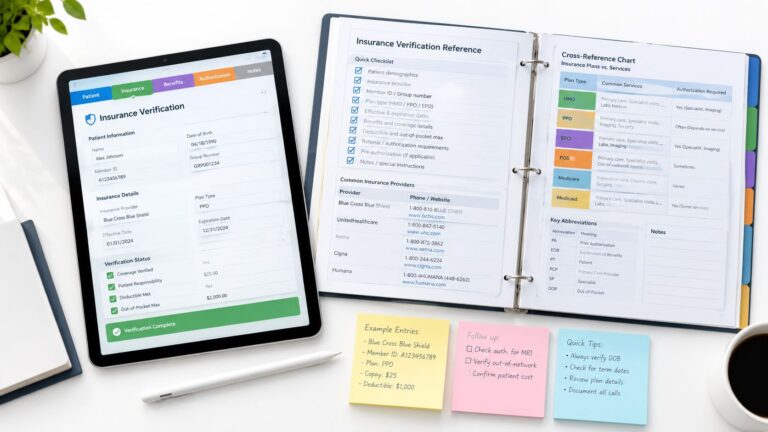

At the end of a busy clinic day, the last patient leaves, the phones quiet down, and the provider opens a second shift inside the EHR. Notes remain unsigned, the assessment and plan needs careful reconstruction, and billing staff can't work from encounters that aren't closed. Choosing providers choice scribe services isn't just a decision between hiring help and buying software. It's a decision about who controls the documentation workflow, how much clinical context is preserved, and where review responsibility sits.
A provider-driven scribe model lets the practice define the EHR process, the specialty requirements, the review cadence, and the level of human oversight. A remote human scribe can listen during the encounter, draft directly in the chart, and leave the provider with a note to review and sign. Ambient AI tools can be faster to deploy and less expensive at the software-license level, but they may still leave providers editing, transferring, and validating notes later.
The right choice depends on visit complexity, EHR integration, provider preferences, privacy obligations, and the work that remains after the draft is created. The following guide focuses on those operational details, including measurable outcomes, daily workflow design, human and AI trade-offs, HIPAA responsibilities, and the broader remote staffing roles that can support a practice beyond clinical notes.
Taking Control of Your Documentation Workflow
At 6:15 p.m., a family physician finishes the final appointment but still has several open charts. One note needs a medication history reconciled, another requires a clearer assessment, and a third is waiting for the provider to confirm the plan before a charge can move forward. The physician can finish the work tonight, arrive early tomorrow, or carry the backlog into the next clinic session. None of those options fixes the underlying process.
Providers choice scribe services refers to a documentation model in which the practice chooses how the scribe participates, which EHR fields they use, what the provider reviews, and how the service is supervised. The phrase matters because a scribe isn't interchangeable with a transcription app. A human virtual scribe can follow the visit's context, recognize when the provider changes direction, work through templates, and ask for clarification through an agreed workflow. The provider still owns the clinical record and signs the final note.
A wound-care practice, for example, may need consistent descriptions of wound location, measurements, tissue characteristics, drainage, treatment, and follow-up. A general-purpose note generator may produce a readable draft while missing the fields that support continuity and coding. An accurate wound care charting template can help the practice define the required structure before training a scribe or configuring software.
The decision is about workflow ownership
A passive AI tool usually listens, generates a draft, and waits for the provider to correct it. That can work well for straightforward, predictable visits. It becomes less attractive when the provider needs the scribe to handle a specialty template, carry information into discrete fields, or manage documentation while the visit continues.
A dedicated human scribe creates a different operating rhythm. The scribe joins through an approved secure connection, listens in real time, drafts in the EHR, and follows the practice's rules for incomplete information, pending results, and provider review. This doesn't remove clinical accountability. It moves repetitive documentation work away from the clinician while preserving a defined sign-off step.
Practical rule: Choose the model that removes the work you actually want removed, not merely the model that produces a note fastest.
The first audit should therefore map the current process. Record where notes originate, who enters them, how often providers edit them, which fields cause delays, and what happens when a visit includes multiple problems. That map gives you a practical basis for selecting a human, AI, or hybrid model instead of accepting a vendor's default workflow.
Measuring the Impact of Scribe-Assisted Drafting
Scribe programs should be evaluated as operating changes, not as vague promises about convenience. The useful question is whether the practice closes encounters faster, reduces unfinished chart work, and preserves note quality without extending provider hours.
A multicenter primary-care quality-improvement study found that clinicians spent 20.4% less time in notes per appointment, falling from 10.3 to 8.2 minutes, after ambient scribing was implemented. The same study reported that same-day appointment closure rose 9.3 percentage points, from 66.2% to 72.4%, while after-hours work time fell 30.0% per workday, from 50.6 to 35.4 minutes. These findings are reported in the JAMA Network Open study of ambient scribing.
The operational meaning is straightforward. Same-day closure is a leading indicator of a smaller chart accumulation, fewer unsigned notes, and less risk that coding and billing work will wait for documentation. A few minutes saved on each encounter can also compound across a high-volume clinic day, creating capacity to close more encounters without extending the provider's schedule.
The measures that belong on your dashboard
A practice manager shouldn't rely on a single productivity number. Track the point at which documentation becomes operationally useful, then compare the baseline with the pilot period.
- Note time per appointment: Measure provider time spent creating, editing, and finalizing the note.
- Same-day closure: Count encounters signed before the clinic day ends.
- Next-business-day completion: Identify charts that remain open after the provider's scheduled review window.
- After-hours documentation: Track charting completed outside scheduled clinical hours.
- Correction patterns: Review whether errors cluster in histories, objective findings, or assessment and plan fields.
- Downstream readiness: Check whether coding, charge entry, referrals, and follow-up tasks can proceed from the signed note.
A crossover study of 18 primary-care physicians found that documentation was more likely to be completed by the end of the next business day during scribed periods, with an adjusted odds ratio of 2.8 and a 95% confidence interval of 1.2 to 7.1. The physicians were also more likely to close at least 95% of office, telephone, and virtual encounters by the target time. The findings appear in the crossover study of scribe use and documentation productivity.
Measure quality, not just speed
Faster closeout doesn't justify a workflow that creates unsafe or unreliable notes. The same research link reports a simulation study in which individual scribe accuracy ranged from 50% to 76%, with section-level accuracy of 72% for subjective fields, 60% for objective fields, and 56% for assessment and plan fields. The assessment and plan deserves the most deliberate review because it influences clinical decisions, coding, referrals, and follow-up instructions.
During a pilot, sample notes from each provider should be reviewed against the encounter and the final signed chart. Pay particular attention to medication changes, diagnoses, laterality, dosage instructions, test orders, and follow-up intervals. If the scribe produces a polished note but changes the clinical meaning of the plan, the practice hasn't solved its documentation problem.
A useful baseline review can cover a representative mix of routine, complex, telehealth, and procedure-related encounters. Use the results to set training priorities and determine whether the provider should review every section or focus on high-risk fields. The strongest business case combines time saved with acceptable correction effort and reliable same-day completion.
How Remote Human Scribes Integrate into Daily Operations
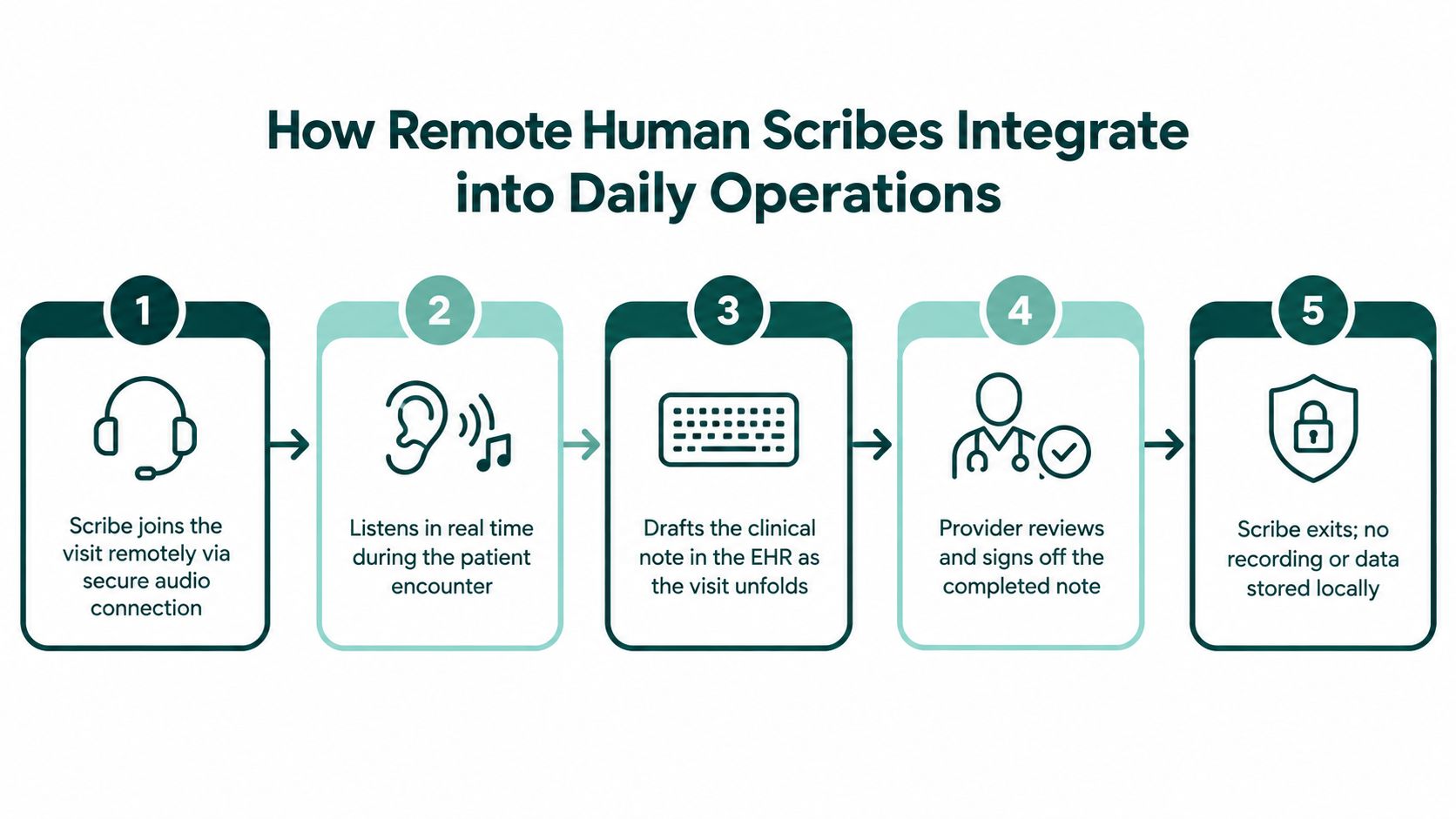
A remote human scribe works best when the practice treats the role as part of the clinical operating system rather than as an outside note-taking service. The scribe needs a defined login process, an approved communication channel, a schedule that matches the provider's clinic hours, and clear limits on what they can do in the EHR.
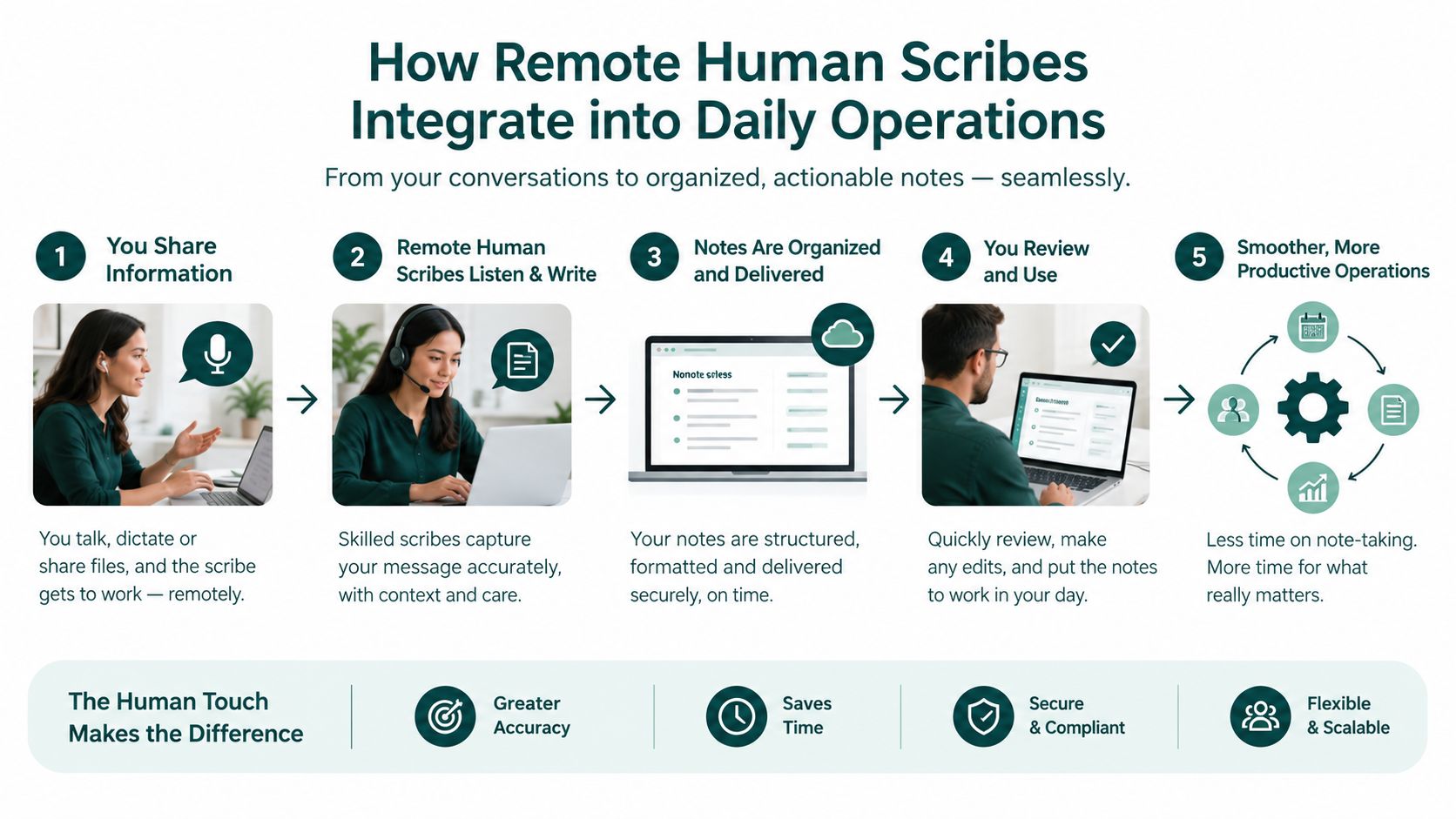
The daily workflow typically starts before the first appointment. The scribe confirms the provider's schedule, reviews the practice's note templates and instructions, and connects through the approved platform. During the visit, the scribe listens, identifies relevant clinical details, and drafts the note in the appropriate EHR location. The provider continues the encounter without dictating every sentence.
A workable visit-to-signature sequence
The scribe joins the encounter. The connection should use the practice's approved secure audio or telehealth workflow. The patient should understand that a scribe is participating when the practice's policy or applicable requirements call for disclosure or consent.
The scribe listens for clinical structure. They capture the history, symptoms, relevant negatives, examination findings, decisions, orders, and follow-up instructions. They shouldn't diagnose, select treatment, or independently interpret ambiguous information.
The note is built in the EHR. A trained scribe uses the provider's templates and enters information in the correct fields rather than leaving a large block of text for later sorting. This is where a human scribe can add value over a simple transcription workflow, particularly when the practice depends on structured documentation.
The provider reviews the high-risk content. The provider confirms that the history, objective findings, assessment, plan, medications, orders, and patient instructions accurately reflect the encounter. Any uncertainty should be corrected before signature.
The note is signed and the session ends. The scribe exits according to the practice's process. The service should define what happens to temporary notes, recordings, screenshots, and locally cached data, rather than leaving those questions to individual staff members.
The role also needs boundaries. A scribe may prepare a draft, organize information, and follow documentation instructions. They may not make clinical decisions, communicate a diagnosis as their own judgment, change orders without authorization, or sign on behalf of a licensed provider. Practices should document these boundaries in training materials and access policies.
Review cadence determines sustainability
Providers often resist scribe programs when the review step becomes unpredictable. A provider who reviews every note several hours later may still experience a delayed workload, even if the scribe created the draft in real time. A more sustainable cadence is usually a brief review immediately after the visit or during a defined block while the encounter is still fresh.
The difference between a medical assistant and a medical scribe is useful when assigning responsibilities. A medical assistant may support rooming, intake, orders, and administrative workflows, while a scribe's central responsibility is documentation under provider supervision. Combining the roles can work in a small practice, but only when the schedule leaves enough uninterrupted time for accurate charting.
Review the assessment and plan before you review the prose. A grammatically clean note can still contain a clinically wrong decision.
A monthly quality review can identify recurring problems without turning the program into a punitive audit. Look for missing details, inappropriate assumptions, template misuse, and corrections that should become part of the scribe's training. The practice should also maintain a fallback process for connection failures, unexpected volume, and visits that require the provider to document independently.
Comparing Human Virtual Scribes and Ambient AI Tools
Human and AI scribes solve different parts of the documentation problem. An ambient AI tool can capture a conversation and generate a draft without scheduling another person. A dedicated human virtual scribe can interpret the encounter's workflow context, manage the EHR while the visit unfolds, and apply practice-specific instructions. Neither option removes the provider's responsibility to review and sign the record.
A broader review found that scribe outcomes vary with workflow design. Physicians may still edit charts later, and the reduction in EHR time depends on choices such as when and how the provider reviews the note. The review also found that scribes can improve efficiency and job satisfaction, while the provider and scribe relationship can affect burnout and note length may increase even when documentation time falls. These considerations are discussed in the review of medical scribes and clinician workflow.
| Feature | Human Virtual Scribe | Ambient AI Scribe |
|---|---|---|
| Primary function | Listens, drafts, navigates the EHR, and follows practice-specific instructions | Captures conversation and generates a note draft |
| Context handling | Can recognize workflow cues and request clarification through an agreed process | May misinterpret speakers, chronology, abbreviations, or ambiguous statements |
| EHR work | Can enter information into designated fields when access and training permit | May require copy and paste, an extension, or a supported integration |
| Provider effort | Review remains necessary, but routine drafting and navigation can be delegated | Provider reviews and may need to correct or reorganize the generated note |
| Specialty fit | Training can focus on the practice's templates, terminology, and visit types | Performance may vary by specialty, visit length, audio quality, and complexity |
| Availability | Depends on staffing coverage, schedule management, and backup capacity | Available when the service and connection are functioning |
| Data handling | Requires controls for human access, temporary files, and communications | Requires review of recording, transcript, retention, training, and vendor access terms |
| Scaling | Adds a labor and management component | Adds software seats, usage, integration, and implementation requirements |
When human oversight earns its place
A human scribe is often a stronger fit when visits contain several active problems, when the provider relies on structured EHR fields, or when the practice has specialty-specific documentation requirements. Wound care, behavioral health, orthopedics, cardiology, and complex primary care can all require more than a fluent summary. The note must preserve distinctions that affect treatment, coding, and follow-up.
The human model also makes sense when the clinic has a predictable provider schedule and can maintain a dedicated working relationship. That continuity allows the scribe to learn the provider's templates and preferences. It doesn't eliminate training or quality review, but it can reduce the repeated explanation that occurs when a different tool or person handles each encounter.
Where ambient AI can be appropriate
AI may suit a solo provider who wants a low-friction trial, sees relatively consistent visits, and is comfortable reviewing the complete draft. It can also be useful when staffing coverage is difficult or when the provider wants documentation assistance without adding a scheduled participant to every visit.
The lower apparent cost of software isn't the same as lower total operating cost. The practice should include implementation, integration, provider learning time, correction work, and the consequences of notes that remain outside the EHR until someone transfers them. A tool that produces a draft quickly but leaves the provider with substantial editing may shift the burden rather than remove it.
A hybrid model can be sensible. AI can create an initial draft, while a human reviewer or dedicated scribe checks structure, enters information into the correct fields, or supports providers whose notes require more contextual judgment. That model adds coordination, so it should be tested against the actual workflow rather than adopted because it sounds like a one-size-fits-all fix.
Navigating HIPAA and Business Associate Agreements
When an outside scribe service handles protected health information for a medical practice, the compliance work starts before the first patient encounter. The practice needs to identify the vendor's role, the data the vendor can access, the systems involved, and the safeguards that govern that access.
Under HIPAA, an outside service handling PHI for a covered entity must have a written Business Associate Agreement. The agreement should define permitted uses and disclosures, require safeguards against unauthorized access, and require the vendor to report breaches or improper disclosures. The HHS sample business associate agreement provisions provide a useful reference for the subjects a BAA should address.
HHS also explains that business associates are directly liable for certain HIPAA requirements. The covered entity isn't required to monitor every safeguard used by the business associate, but it must obtain satisfactory written assurances through the BAA. That distinction matters. A practice still needs a due-diligence process, but it shouldn't treat a vendor's marketing statement as a substitute for a signed agreement and documented controls.
What to verify before access is granted
- Confirm the BAA: Obtain the final agreement, identify the parties, and confirm that the services and data flows are covered.
- Define permitted access: Limit the scribe's EHR permissions to the tasks they perform. Don't grant broad administrative access for convenience.
- Ask about recordings: Determine whether audio or video is created, where it is processed, how long it remains available, and how deletion is handled.
- Review breach duties: Confirm notification procedures, escalation contacts, cooperation obligations, and documentation requirements.
- Check workforce controls: Verify confidentiality agreements, HIPAA training, access termination, and supervision for every person who may handle PHI.
- Document the review: Keep vendor questionnaires, access decisions, training records, and periodic reassessments with the practice's compliance documentation.
HHS describes common business associate functions as including claims processing, billing, practice management, and related administrative services. That regulatory category aligns with remote staff handling front-desk, documentation, and care-coordination work, but the precise obligations can depend on the arrangement and the data involved. Practices should confirm their circumstances with qualified compliance counsel.
Don't confuse compliance with certification
There is no official HHS designation that makes a scribe service “HIPAA certified.” A vendor may hold security attestations or certifications under other frameworks, but those don't replace the BAA or prove that the practice's implementation is compliant. The practice remains responsible for configuring access, training its workforce, and following its own policies.
For organizations comparing phone, messaging, and patient communication systems alongside scribe services, a platform that documents BAAs and safeguards in one platform may be useful during vendor review. It still shouldn't replace an assessment of the specific scribe workflow.
The practical guide to HIPAA-compliant virtual assistants can help practice managers turn these requirements into a staffing checklist. The final decision should account for state privacy rules, specialty-specific confidentiality concerns, patient notices, and the practice's own security policies.
Expanding Remote Support Beyond the Clinical Note
A scribe can remove a documentation bottleneck, but a practice may still lose capacity through unanswered calls, incomplete insurance work, stalled authorizations, and inconsistent follow-up. Those problems often appear in the same daily workflow. The provider finishes the note, yet the appointment remains operationally incomplete because a referral wasn't sent or a payer request wasn't tracked.
Remote roles should therefore be designed around handoffs. A virtual medical receptionist can manage calls, scheduling, confirmations, and recall lists. An insurance verification specialist can check eligibility and benefits before the visit. A prior-authorization specialist can submit, track, and escalate requests. Billing support can work charge entry, claim submission, denial follow-up, and patient statements.
HHS identifies claims processing, billing, practice management, and related administrative services as common business associate functions in its overview of business associates. That doesn't make every remote staffing arrangement identical, but it shows why these administrative functions require the same deliberate privacy and contracting review as documentation work.
Match roles to the point of failure
A practice with a full voicemail queue doesn't need another billing specialist first. It needs coverage during clinic hours, a scheduling script, escalation rules, and access to the appointment system. A specialty group with clean front-desk operations but delayed imaging approvals needs prior-authorization support, not a broader generalist role.
- Front desk: A virtual receptionist or patient coordinator handles calls, appointment changes, reminders, intake forms, and records requests.
- Revenue cycle: A billing assistant enters charges, follows payer responses, works denials, and identifies missing documentation for escalation.
- Clinical administration: A medical records specialist coordinates referrals, outside records, and document routing.
- Provider support: A virtual scribe maintains the note workflow while the provider retains review and signature authority.
The roles can be separate or combined for a smaller practice, but combining them creates trade-offs. A person who is expected to scribe during visits may not be available to answer calls at the same time. A billing assistant who handles prior authorizations may need protected work blocks to avoid constant interruption.
Build one remote operating rhythm
Remote staff work best when the practice defines who owns each queue, which tasks require provider approval, and how unresolved items are escalated. Use the EHR task system, shared work queues, or another approved channel instead of relying on informal personal messaging. The manager should review open items, turnaround expectations, and error patterns at a regular operational meeting.
MedicalVirtual places pre-vetted LATAM healthcare talent for U.S. practices, including virtual scribes, receptionists, patient coordinators, billing assistants, insurance verification specialists, and prior-authorization support. Its overview of medical virtual assistant roles and hiring is relevant when a practice is considering a coordinated remote team rather than a standalone scribe.
Bilingual English and Spanish support, U.S.-hours alignment, prior healthcare experience, role-specific testing, confidentiality agreements, HIPAA training, and a BAA are useful criteria to verify during placement. The practice should still interview candidates, define permissions, test the workflow, and measure results after launch.
The Takeaway
Providers choice scribe services work best when the practice selects a documentation model around its real workflow rather than around a feature list. A human virtual scribe can provide structured EHR navigation, specialty-aware context, and a consistent same-day review process. Ambient AI can offer rapid adoption and flexible availability, but the practice must account for editing, integration, data governance, and the work that remains after the draft is generated.
Start with a short operational audit. Measure note time, same-day closure, next-business-day completion, after-hours charting, correction patterns, and the point at which billing or follow-up work is delayed. Then test the preferred model with representative visits, review assessment and plan accuracy closely, and define who owns every correction and escalation.
Before granting access, complete the BAA review, limit EHR permissions, document recording and retention practices, and train the remote workforce. If documentation is only one of several bottlenecks, scope a broader team with distinct responsibilities for reception, insurance, authorizations, billing, records, and care coordination. A deliberate provider-driven design is more likely to produce sustainable relief than adding another tool to the end of the workflow.
MedicalVirtual connects U.S. medical practices with pre-vetted LATAM healthcare professionals for virtual scribing, reception, billing, insurance verification, prior authorization, and care coordination during U.S. clinic hours. If you're evaluating a dedicated human scribe or a broader remote support team, visit MedicalVirtual to review role options and begin a specialty-specific conversation.